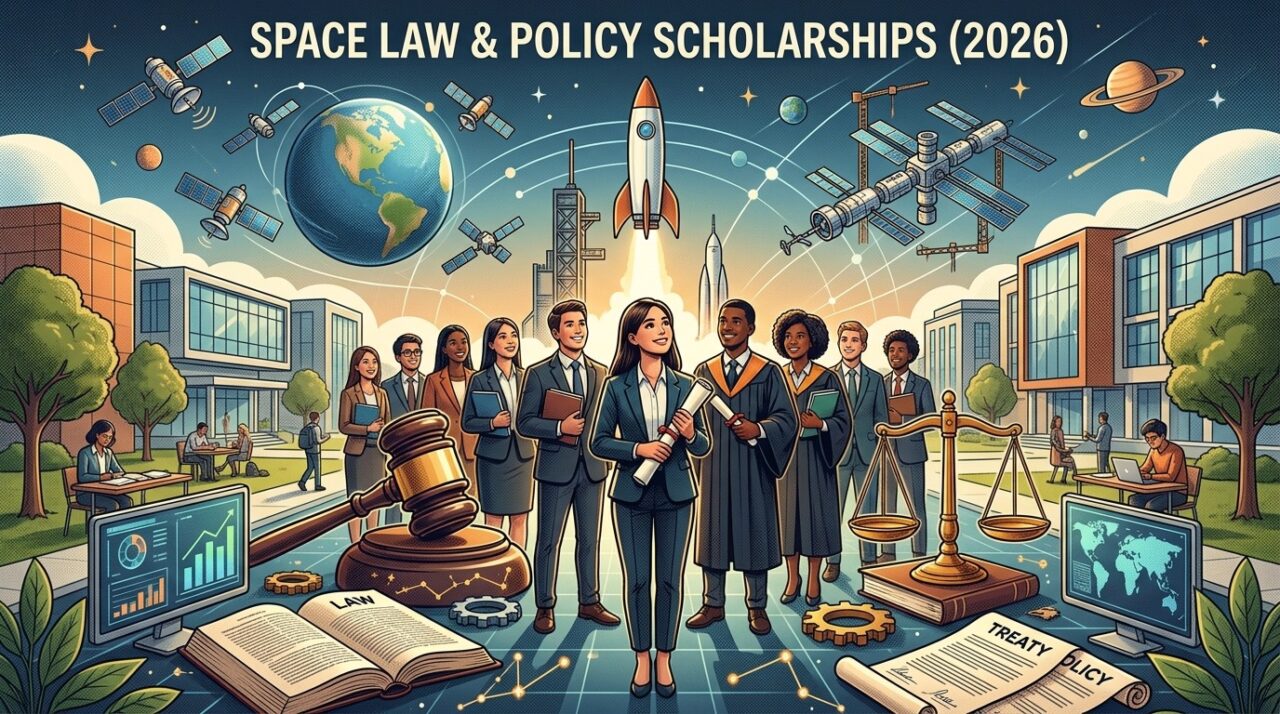
Space Law & Policy Scholarships (2026): 16 Verified Scholarships, Fellowships & Awards
January
1) Admiral James O. Ellis Jr. New Generation National Security Scholarship
Why It Slaps: This is not a generic tuition award. It is a sharp fit for military-affiliated applicants who want to move into national security space leadership, doctrine, strategy, or policy influence. Getting full access to Space Symposium plus the New Generation Space Leaders and Space Classified programming can be more valuable than a small cash award if your real goal is to get in the room with senior decision-makers. For readers pursuing space deterrence, military space operations, or policy-adjacent careers in the defense space ecosystem, this is one of the cleanest prestige opportunities on the board.
Amount: Full complimentary access to Space Symposium, New Generation Space Leaders programming, and the Space Classified session.
Deadline: January 30, 2026.
Apply/info: Space Foundation Ellis Scholarship.
2) AIAA Foundation Undergraduate Scholarships
Why It Slaps: This is broader than pure space law, but it is still one of the strongest official aerospace scholarship pools available. For students building a hybrid path that blends aerospace, regulation, public affairs, technology policy, or commercial-space strategy, AIAA can still be a smart funding target. The named awards on the page include strong space and aerospace categories, and the dollar range is meaningful enough that it can cover real academic costs instead of just resume fluff. It works especially well for students who want to build subject-matter credibility first and then pivot into law school, public policy, or industry policy work later.
Amount: Varies. Current listed undergraduate awards on the page range from $500 to $10,000.
Deadline: January 31, 2026.
Apply/info: AIAA Undergraduate Scholarships & Graduate Awards.
3) American Astronautical Society Scholarship via International Space University
Why It Slaps: This is one of the best direct policy-adjacent opportunities in the guide because ISU is explicitly interdisciplinary. It attracts future lawyers, diplomats, analysts, strategy people, commercial-space professionals, and governance-focused students alongside technical applicants. That makes it unusually good for someone who wants to work on the rules of space, not only the hardware. If your long-term plan involves international space governance, commercialization, treaty questions, sustainability, or cross-border policy work, this is the kind of credential that can travel well.
Amount: $10,000.
Deadline: January 31 to be considered through ISU, plus the page says applicants should also apply in parallel directly to AAS.
Apply/info: ISU Funding and Scholarships.
February
4) International Space University SSP Need-Based Financial Aid
Why It Slaps: This is not branded as a single named scholarship, but it is a serious funding path for students who want an international, cross-disciplinary space education environment. That matters in space law and policy because many of the most important issues are international by nature: spectrum, sustainability, traffic management, remote sensing norms, launch and licensing, and treaty interpretation. If you want a global network instead of a purely domestic pipeline, ISU is one of the best places to build it. The earlier financial-aid deadline is the key date to watch.
Amount: Partial scholarships and financial aid; amount varies.
Deadline: February 28, 2026, for applicants in need of financial aid.
Apply/info: ISU Space Studies Program.
March
5) NSSA Moorman Scholarship
Why It Slaps: This one is unusually good for policy-minded students because it does not just reward technical ability. The official description emphasizes leadership, verbal and written excellence, and commitment to service, which are exactly the traits that matter in policy, strategy, advocacy, and public-facing space work. If your interest is national security space, military space policy, congressional affairs, or strategic communications in the space sector, this is a much stronger fit than many generic STEM awards. The cash amount is also large enough to matter.
Amount: $10,000.
Deadline: March 27, 2026.
Apply/info: NSSA Scholarships 2026.
April
6) AFA Scholarships
Why It Slaps: This is a broader Air and Space Forces community scholarship hub, not a pure space-law award, but it deserves a place in the guide because policy and leadership readers often come through military, spouse, service-family, or public-administration pathways. Several listed scholarships are not limited to technical majors, and some explicitly support graduate-level leadership or non-technical study. For users targeting policy roles connected to the Space Force, air and space strategy, administration, or service-community advancement, this can be a very practical funding source. It is also a recurring program with a clear annual application window.
Amount: Varies. AFA says it contributed more than $110,000 across 11 scholarships in 2025, with individual listed awards including $1,000, $3,000, and $5,000 scholarships.
Deadline: April 30 each year.
Apply/info: AFA Scholarships.
May
7) Florida Space Grant Consortium Masters Fellowship Program
Why It Slaps: This is one of the rare official space-funding programs that explicitly names space policy and law as eligible fields. That alone makes it a standout. If you are doing a thesis-based master’s degree with a NASA-aligned topic and your work sits in governance, regulation, policy analysis, or law, this is one of the best “true fit” opportunities in the guide. It also has a real stipend, not just networking language.
Amount: $10,000 stipend for one academic year.
Deadline: Latest posted official cycle listed Notice of Intent by April 14, 2025, and proposals due May 30, 2025. Watch the page for the next cycle.
Apply/info: Florida Space Grant Masters Fellowship Program.
June
8) Secure World Foundation Dr. Michael Simpson Scholarship Fund
Why It Slaps: This is one of the most direct space-law-and-policy fits in the entire article because the official focus areas explicitly include Space Law and Policy. It is not tuition money. It is travel support for young professionals presenting at the International Astronautical Congress, which can be a huge career lever if you are publishing or presenting research on governance, sustainability, norms, or international regulation. For many early-career space law and policy people, conference visibility and access can be more catalytic than a small tuition award.
Amount: $500 increments up to a maximum of $1,500.
Deadline: Latest posted official cycle was June 16, 2025, at 8:00 AM EDT.
Apply/info: SWF Dr. Michael Simpson Scholarship Fund.
September
9) ABA Aviation and Space Law Committee Writing Competition
Why It Slaps: This is the purest law-school fit on the list. If you are a JD or LLM student, this gives you a direct way to build a serious writing sample in space law, get publication exposure, and potentially speak at a professional conference in Washington, D.C. That combination matters because space law is still a networked niche where strong writing and visible scholarship can open doors. For readers who want to show they are already doing actual space-law work, not just talking about it, this is a smart target.
Amount: $500 cash prize, up to $1,500 travel reimbursement, and publication in the committee newsletter.
Deadline: September 8, 2025, for the current posted cycle.
Apply/info: ABA Aviation and Space Law Committee Writing Competition.
October
10) Brooke Owens Fellowship
Why It Slaps: This is not a classic scholarship check, but it is absolutely relevant for policy-track undergraduates. The fellowship is built around mentorship, community, career development, and access to opportunities across aerospace, and Brooke Owens’ own legacy is deeply tied to space policy. The program’s mission and mentorship structure make it especially useful for students who want guidance, industry access, and long-term network value rather than only a one-time award. Women and gender-minority students interested in space policy, government affairs, communications, strategy, or industry leadership should not overlook it.
Amount: Mentorship, career-launching opportunities, and community support; no single flat cash scholarship amount is posted on the official page.
Deadline: The official site says Class of 2026 applications are closed, and the current FAQ snippet shows the Class of 2026 deadline was October 13, 2025.
Apply/info: Brooke Owens Fellowship Apply.
11) Patti Grace Smith Fellowship
Why It Slaps: This is one of the best “career first, funding second” programs in aerospace. It is especially useful for students who want their first serious aerospace opportunity and plan to grow into policy, law, regulation, or government-facing work later. The fellowship is designed for students entering aerospace rather than those already established in the workforce, which makes it strong for readers who have potential, curiosity, and drive even if they do not yet have a stacked industry résumé. In a narrow field like space policy, early access can compound faster than people expect.
Amount: Paid internship/fellowship experience; no single flat cash scholarship amount is posted on the application page.
Deadline: Applications were due October 17, 2025. The page says the next window is likely to open in August or September 2026.
Apply/info: Patti Grace Smith Fellowship Apply.
November
12) Matthew Isakowitz Commercial Space Scholarship
Why It Slaps: This is one of the strongest direct matches in the article because it specifically targets students who want to shape the commercial space industry through space policies. That is exactly the lane many readers are trying to enter. The program also has unusually strong policy-facing placement credibility, with official host-company examples including NASA Headquarters, the FCC Space Bureau, the Commercial Space Federation, and strategy-heavy organizations. For anyone interested in launch policy, spectrum, licensing, commercialization, or the political economy of space, this is a top-tier target.
Amount: $1,000 scholarship award plus consideration for a summer internship in the D.C. area and networking with industry leaders and policymakers.
Deadline: Summer 2026 applications were due November 7, 2025.
Apply/info: Matthew Isakowitz Foundation Scholarship.
13) Sally Ride Fellowship
Why It Slaps: This is not a law-specific award, but it is a strong policy-adjacent fellowship for LGBTQ+ undergraduates who want aerospace experience and long-term credibility in the field. Programs like this can strengthen later applications for law school, MPP programs, fellowships, Hill internships, or industry policy jobs because they signal real aerospace commitment. The official timeline is clear, and the fellowship is built around internship placement plus community support. For the right applicant, that is a very smart trade.
Amount: Fellowship/internship pathway; no single flat cash scholarship amount is posted on the official application page.
Deadline: November 19 on the current official timeline page.
Apply/info: Sally Ride Fellowship Apply.
Deadline Not Separately Posted or Varies
14) NSSA RGi Scholarship
Why It Slaps: If your version of space policy leans toward national security space, geospatial intelligence, defense applications, or the operational side of space power, this one is a real fit. It is not framed as a law scholarship, but it is directly tied to national security space and comes with a substantial cash award. That makes it more relevant for many defense-space policy readers than a lot of generic STEM lists. It is one to monitor closely even though the scholarship description does not separately post a fresh deadline line beyond the active 2026 page.
Amount: $10,000.
Deadline: The 2026 scholarship page is live, but a separate deadline line for the RGi entry was not clearly posted on the description at the time of checking.
Apply/info: NSSA Scholarships 2026.
15) Florida Space Grant Consortium Undergraduate Scholarships
Why It Slaps: This page deserves attention because it explicitly says eligible fields include space policy and law. That is rare on an official scholarship page. If you are at an eligible Florida institution and your academic work touches space governance, legal frameworks, or policy analysis, this is one of the cleanest undergraduate fits you will find. Even though the page does not currently show a clean standalone deadline line, it is absolutely worth bookmarking.
Amount: Amount not posted on the scholarship page at the time of check.
Deadline: Not separately posted on the scholarship page at the time of check.
Apply/info: Florida Space Grant Undergraduate Scholarships.
16) George Washington University Space Policy Institute Fellowships
Why It Slaps: If the goal is actual space policy training rather than generic aerospace branding, GW’s Space Policy Institute is one of the most directly aligned academic ecosystems in the country. The fellowship page says SPI has additional funding backed by AWS, Axiom Space, and the GPS Innovation Alliance, and recipients are expected to intern or work in the Washington, D.C. space community while studying. That is a serious advantage for students who want exposure to policy, regulation, lobbying, think tanks, federal agencies, nonprofits, or commercial-space government affairs. For pure policy-network density, this is one of the smartest pages to watch.
Amount: Varies; the SPI fellowship page does not post a single flat dollar amount.
Deadline: Varies by funding cycle and program.
Apply/info: GW Space Policy Institute Fellowships.
FAQs
Are there many scholarships specifically for space law and policy?
Not really. True direct-fit opportunities are limited, which is why a smart search strategy mixes pure law/policy fits with adjacent fellowships, conference support, and national security or commercial-space awards. The strongest direct-fit examples in this guide are the ABA writing competition, the Matthew Isakowitz Commercial Space Scholarship, the SWF Simpson Scholarship Fund, GW SPI fellowships, and Florida Space Grant programs that explicitly name space policy or law.
Are fellowships worth applying to even if they are not flat cash scholarships?
Yes. In this niche, access often matters almost as much as money. Programs like Brooke Owens, Patti Grace Smith, Sally Ride, GW SPI, and the Ellis Scholarship are valuable because they create mentorship, internships, D.C.-area access, conference exposure, and real space-community relationships that can compound into jobs, law-school opportunities, and policy credibility.
Do I need to be in law school to win something relevant in this field?
No. Some opportunities are for law students, like the ABA writing competition, but many of the strongest pathways are open to undergraduates, graduate students, early-career professionals, or policy-track applicants outside law school. That includes Brooke Owens, Patti Grace Smith, Sally Ride, ISU, NSSA, Florida Space Grant, and the Matthew Isakowitz Commercial Space Scholarship.
What should a strong essay focus on for a space policy application?
The strongest angle is usually a clear problem plus a clear role. Good themes include commercial-space regulation, spectrum and licensing, orbital sustainability, remote sensing governance, national security space, launch policy, international cooperation, and the public-interest stakes of space activity. That is an inference from the official focus areas and program language across the opportunities above, so applicants should tailor that framing to each program’s mission.
Are older posted deadlines still worth listing?
Yes, as long as they are labeled honestly. In a niche like this, many official pages keep the most recent cycle live before the next one opens. Those pages are still useful for research and bookmarking, but applicants should never assume the exact date will repeat until the new cycle is posted.