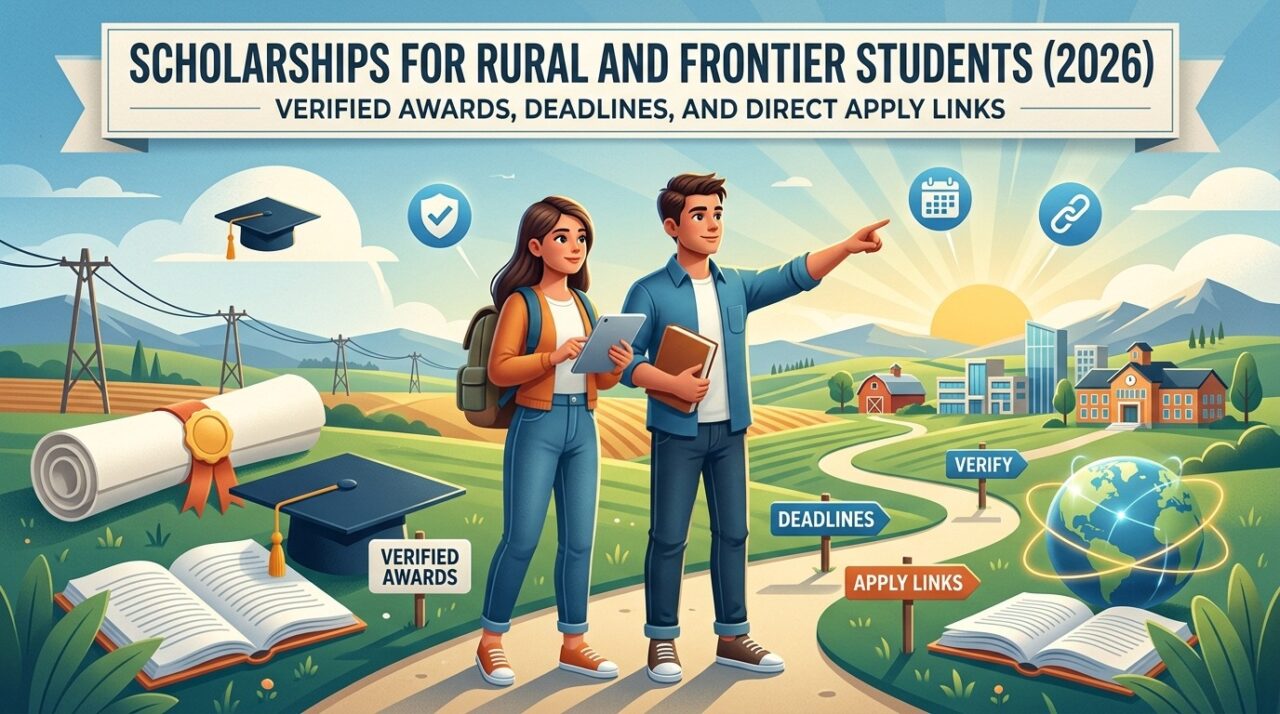
Scholarships for Rural and Frontier Students (2026): Verified Awards, Deadlines, and Direct Apply Links
January
1) Oklahoma Rural Water Enrichment Foundation (ORWEF) Scholarship Program
Why It Slaps: This is a strong exact-match rural scholarship because it is literally built to support students connected to Oklahoma’s rural water systems. That makes it especially useful for students from small towns where the local water system is a major community institution and where national scholarship visibility is usually lower. It also works well for students who want a regional scholarship that is not locked to one major, since the award can be used at an accredited college and is not limited to a single field. For applicants with real roots in rural Oklahoma, this is the kind of scholarship that can be much more realistic than a crowded national contest.
Amount: $2,000
Deadline: January 9, 2026
Apply/info: ORWEF Scholarship Program — for ORWA member-system employees, directors, or their dependent children/grandchildren in Oklahoma.
February
2) New York Rural Water Association (NYRWA) Scholarship
Why It Slaps: This is not a huge-dollar award, but it is exactly the kind of targeted regional scholarship rural students should not ignore. It is built for New York students who live on a water system that belongs to NYRWA, and the official rules even say priority is given, though not limited, to water-related studies. That means it can fit students headed into environmental science, public service, utilities, engineering, or other community-serving paths. Because the eligibility is tied to a rural system network instead of a giant national applicant pool, the odds can be much more human-scale.
Amount: $500 one-time grant
Deadline: February 2, 2026
Apply/info: NYRWA 2026 Scholarship Application.
3) Tricounty Rural Electric Cooperative Children of Members Scholarship
Why It Slaps: This is a classic rural co-op scholarship, and those are often some of the best underused awards in the country. Tricounty’s program is meant for graduating seniors tied to the co-op’s membership base, and the award structure gives multiple students a shot rather than only one grand-prize winner. If your household gets service from a rural electric cooperative, always check these local or regional programs first. They tend to reward the exact combination many rural students already have: community involvement, solid academics, and a real local connection.
Amount: One $1,000 scholarship, two $750 scholarships, and one $500 scholarship
Deadline: February 2, 2026
Apply/info: Tricounty Rural Electric scholarships page.
4) Butler Rural Electric Cooperative Community Achievement Scholarship
Why It Slaps: This one is a very clean fit for rural students because the scholarship is restricted to children or legal wards of Butler Rural Electric Cooperative residential members. That kind of membership-tied award sharply narrows the field and rewards students whose families are part of rural infrastructure networks. It is especially attractive for students who have done the normal things strong rural applicants do well: school involvement, community activity, and steady academics. These are not the flashiest scholarships online, but they are often some of the smartest to pursue.
Amount: $2,000
Deadline: February 13, 2026
Apply/info: 2026 Butler Rural Electric Community Achievement Scholarship rules.
5) Foundation for Rural Service (FRS) Scholarship Program
Why It Slaps: This is one of the strongest true rural exact-match programs in the whole list. FRS is built specifically for students from rural communities served by NTCA member broadband and telephone providers, and one application can place students into several different scholarship categories. That matters because rural students often have strong local commitment but fewer nearby scholarship resources. FRS explicitly values students who want to bring their skills back to rural America, which makes it a great fit for students who see college not as a way to escape their community, but as a way to come back stronger.
Amount: General scholarship is $2,500; named awards go up to $9,000
Deadline: February 14, 2026
Apply/info: Foundation for Rural Service scholarships.
6) Foundation for Appalachian Ohio Scholarship Opportunities
Why It Slaps: Appalachian Ohio is one of the clearest rural-regional scholarship ecosystems in the country, and this portal gives students access to a big cluster of place-based funds without needing to hunt them all down one by one. That is powerful for students from smaller communities across the 32-county region because it turns local geography into an advantage instead of a limitation. When a foundation has deep ties to a region, it often understands local school realities, transportation barriers, workforce needs, and community identity better than national sponsors do. That usually creates better-fit awards and less random competition.
Amount: Varies by fund
Deadline: February 15, 2026 for the 2026 general cycle
Apply/info: FAO scholarship opportunities.
March
7) GreenStone Farm Credit Services Scholarships
Why It Slaps: This is a very practical pick for students from agricultural and natural-resource communities in Michigan and northeast Wisconsin. It is especially strong because it is not just one scholarship. GreenStone offers an incoming-freshman track and a separate Dave Armstrong Scholarship for current college students already majoring in agriculture or natural resources. That makes it useful both for seniors entering college and for students already on the path. For rural students whose college plans are tied to ag, land, timber, conservation, or resource-based careers, this is one of the cleaner direct-match awards out there.
Amount: $1,000 for 2-year students, $2,000 for 4-year freshmen, and $5,000 each for Dave Armstrong Scholarship recipients
Deadline: March 1, 2026
Apply/info: GreenStone scholarships.
8) Blandin Foundation Scholarship Program
Why It Slaps: This is one of the better examples of a rural workforce scholarship system that meets students where they actually are. Blandin is not boxed into one narrow major or one prestige-heavy model. It supports Itasca-area students across certificate programs, trade schools, and 2- or 4-year colleges, which is exactly the kind of flexibility rural students often need. That matters because many rural students are balancing cost, family ties, and realistic employment pathways, not just chasing a brand-name campus. If your audience includes northern Minnesota students, this is absolutely worth featuring.
Amount: $1,000 to $6,000 or more per student
Deadline: March 1, 2026
Apply/info: Blandin Foundation scholarships.
9) Ernestine Keiser Memorial Scholarship
Why It Slaps: This scholarship is a good fit for students from rural Grange communities because it rewards the exact kind of long-term community participation that often grows in small-town life. It is open to graduating seniors, current college students, trade students, continuing education students, and even graduate students, as long as they are active Grange members in good standing. That flexibility is valuable. It is not one of those scholarships that only likes a narrow “traditional freshman” profile. For students raised in Grange networks, it is a real identity-match award, not a generic essay contest.
Amount: $1,000
Deadline: March 1
Apply/info: Ernestine Keiser Memorial Scholarship.
10) CARH Scholarship Foundation
Why It Slaps: This is one of the best exact-match scholarships for students from affordable rural housing communities. CARH is not vague about its mission: these awards are for students residing in CARH-member properties, and the foundation now supports traditional, non-traditional, technical/trade, and graduate applicants. That breadth is a big deal because rural students are not one-size-fits-all. Some are recent high school grads, some are adults returning to school, and some are pursuing workforce credentials. If your readers live in qualifying rural housing, this is one of the highest-value opportunities on the page.
Amount: $2,000 per semester, for up to four years
Deadline: Extended to March 13, 2026
Apply/info: CARH scholarship applications.
11) Hagan Scholarship
Why It Slaps: This is not branded as “rural only,” but it is a very strong practical fit for high-achieving students from small towns and lower-density areas who need serious money. The value is far above the usual local scholarship, and the program is built around helping students graduate debt-free. It also rewards work history, academic performance, and financial need, which can line up well with rural students who have been balancing school and jobs for years. This is one of the few scholarships on the page with the power to materially change a college decision instead of just trimming book costs.
Amount: $2,000 start-up support plus up to $7,500 per semester for up to 8 semesters
Deadline: March 15, 2026
Apply/info: Hagan Scholarship application.
12) Frontier Foundation Scholarship Program
Why It Slaps: This is a strong community-based scholarship for students tied to Frontier Credit Union, which serves communities that include many rural and small-town families. What makes it useful is the simple, understandable award structure and the fact that it is targeted to graduating seniors heading into college, university, or technical school. This is the kind of scholarship rural students often miss because they do not think to check the institutions already embedded in their town or region. Credit union and cooperative scholarships can be much better bets than massive national sweepstakes-style awards.
Amount: One $3,000 grand prize, five $2,000 scholarships, and one $2,000 Arlene Walker Scholarship
Deadline: March 16, 2026
Apply/info: Frontier Foundation scholarship page.
April
13) New York State Grange Scholarship Programs
Why It Slaps: This is less of a single scholarship and more of a mini-ecosystem for students connected to agriculture, Grange membership, nursing, and rural New York education pathways. That is a good thing. Instead of one narrow award, students can find several different tracks on the same official page, including agriculture-focused, nursing-focused, Junior Grange-connected, and SUNY/CUNY-related options. For rural students in New York, especially those with farm experience or Grange involvement, this is exactly the kind of page worth checking early every year because it offers several doors instead of one.
Amount: Usually $1,000 on the named awards; Cornell fund amount varies
Deadline: Most programs are due April 15; the Cornell fund uses June 1
Apply/info: New York State Grange education opportunities.
14) Choptank Electric “Luck of the Draw” Scholarship
Why It Slaps: This one stands out because it removes a lot of the usual overthinking. Choptank is awarding ten scholarships and selecting winners by random draw from eligible applicants who submit the required packet and attend the annual meeting. That means students do not need to out-polish the entire internet with a perfect scholarship persona. If they qualify as a member or dependent, follow directions, and show up, they have a real shot. For busy rural students juggling school, work, and commuting, that simplicity is a real advantage.
Amount: Ten $1,000 scholarships
Deadline: April 16, 2026, at 4:30 p.m.
Apply/info: Choptank Electric 2026 scholarship application.
15) LaVern and Nola McEntire Memorial Lineworker’s Scholarship
Why It Slaps: This is an excellent exact-match career scholarship for students in rural electric cooperative circles who want a direct workforce path instead of a generic academic route. It supports lineworker training, which is one of the clearest examples of a high-demand, community-critical rural career. For students who like hands-on work, want to earn strong wages, and want a career that matters in small communities, this is a standout. It is also great editorially because it broadens the article beyond four-year college thinking and shows that rural scholarship strategy should include technical pathways too.
Amount: $3,000
Deadline: April 30, 2026
Apply/info: LaVern and Nola McEntire Memorial Lineworker’s Scholarship.
May
16) Glenn English National Cooperative Leadership Foundation Youth Tour Alumni Scholarship
Why It Slaps: This is a great next-step scholarship for students who already came through the rural electric co-op youth pipeline. Too many students do a great leadership program, then never check whether that network also funds later college support. This scholarship rewards exactly that longer arc. It is for former Electric Cooperative Youth Tour participants who are already progressing through college, which means it is a strong option for rural students who have proven leadership, civic engagement, and follow-through. If someone on your site has Youth Tour on their resume, this should be on their shortlist.
Amount: $14,000 awarded annually across multiple alumni awards
Deadline: May 10, 2026
Apply/info: Glenn English Youth Tour Alumni Scholarship.
December
17) Thomas H. Moore Illinois Electric Cooperatives Memorial Scholarship
Why It Slaps: This is a strong “bookmark it early” scholarship for Illinois rural families. It is aimed at sons and daughters of Illinois electric cooperative members, employees, or directors, and it offers a large number of awards instead of just one headline winner. That is exactly what makes it useful. Big local-network scholarship programs with many awards are often more strategic than flashy national lists. It also covers both 2-year and 4-year pathways, including vocational and technical options, which matches how many rural students actually plan college.
Amount: Seventeen $3,000 scholarships
Deadline: December 31, 2025 for the 2026 award cycle; watch the same page for the next cycle
Apply/info: IEC Memorial Scholarship official rules.
FAQs
What counts as a rural or frontier student for scholarship purposes?
Usually it is not one universal federal definition on the application itself. In practice, the scholarships that actually help rural and frontier students most often define eligibility through service area, member system, county, region, housing property, or community institution. That is why co-op, rural water, broadband, housing, and Appalachian foundation scholarships are so valuable: they operationalize “rural” through place and community ties.
Do rural students need to stick only to agriculture majors?
No. Some of the best rural scholarships do favor agriculture, natural resources, or community-serving fields, but others support technical training, nursing, healthcare, business, STEM, trades, and general college study. Rural scholarship strategy should be broader than “farm kid equals ag major.”
Should students still apply if the 2026 deadline already passed?
Yes, for two reasons. First, many of these programs are annual. Second, students from rural areas usually do best when they build a calendar early and treat passed deadlines as next-cycle targets rather than lost causes. This article is strongest as a verified watchlist as much as a same-day application list.
Do these smaller local or regional scholarships really matter?
Absolutely. Rural students often piece together college funding from multiple smaller awards, and local-network scholarships can have much smaller applicant pools than national awards. A $500, $1,000, or $2,000 award with realistic odds can be more useful than a giant national scholarship with almost no chance of landing.
Should students file FAFSA even when applying for outside scholarships?
Yes. Many scholarship systems either require FAFSA outright or use financial need information in some form, and FAFSA also opens the door to Pell, state aid, and school-based grants. For 2026–27, students should be using the FAFSA that covers July 1, 2026 through June 30, 2027.
Suggested internal related links
Add a short “Related guides” block near the middle or end of the article with direct internal links like these:
- FAFSA 2026–27: Complete Guide for High School Seniors
- Pell Grant Changes for 2026–27: New Rules, Max Award, and What Students Should Do
- Compare Financial Aid Offers: Complete 2026 Guide
- Agricultural Technology Scholarships (Precision Ag, Ag Engineering, Irrigation Tech)
- First-Generation Scholarships for High School Seniors
Closing note for the post
Rural and frontier students should think like niche hunters, not lottery players. The strongest opportunities are often hidden inside the exact systems that shape rural life: co-ops, water systems, regional foundations, housing groups, broadband providers, Grange networks, and workforce programs. The smartest move is to build a deadline calendar, apply to the exact-match awards first, and then layer in broader scholarships after that.