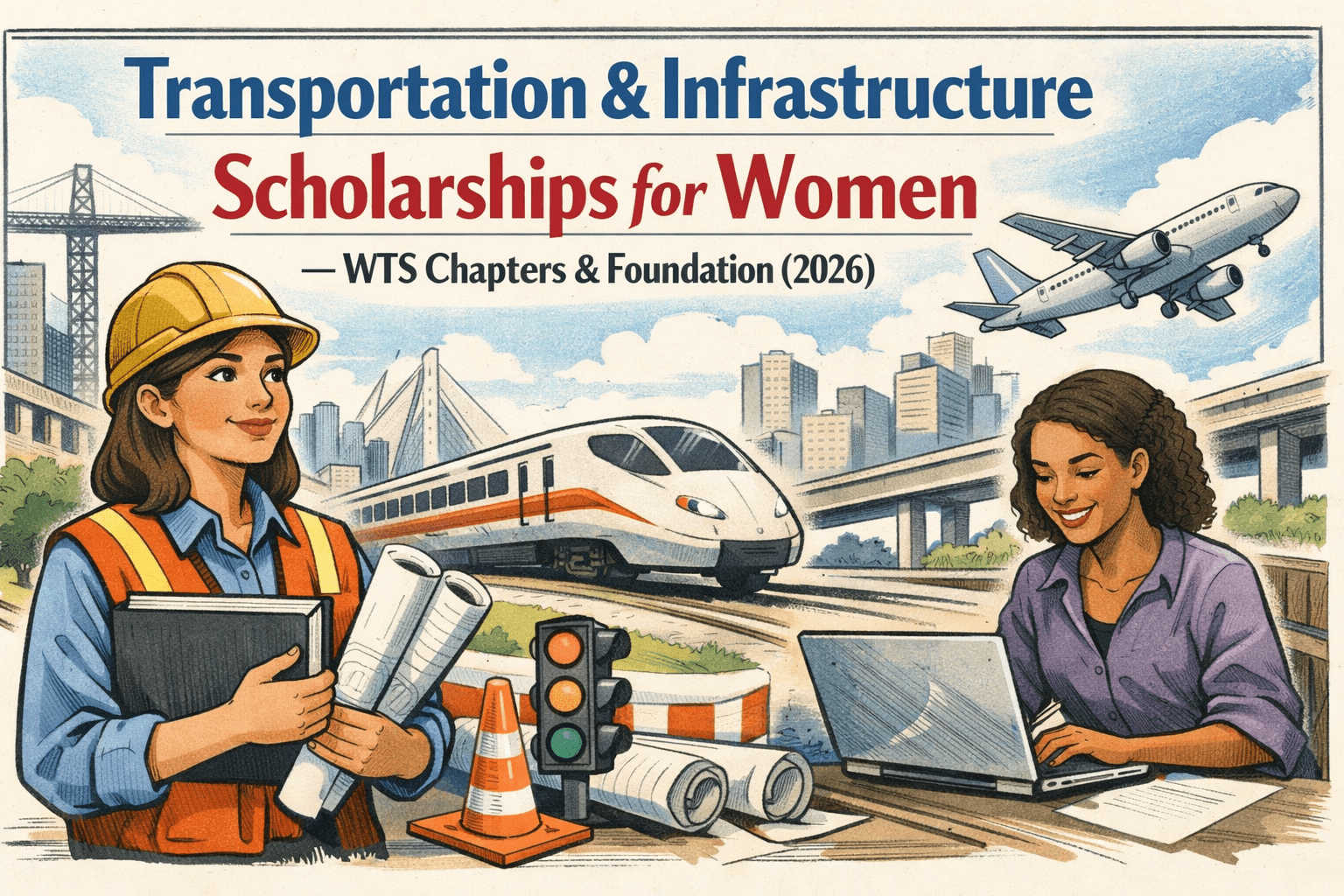
Transportation & Infrastructure Scholarships for Women — WTS Chapters & Foundation (2026)
Below are active, verified links to WTS International Foundation scholarships plus 30+ local WTS Chapter scholarship pages. Use the chapter nearest you to see this cycle’s exact deadlines and local award amounts; many winners also advance to larger WTS Foundation awards.
Pro tip: Apply at your local chapter and note that local winners are often forwarded to the national/Foundation round. 🏁
WTS International (Foundation) Scholarships
Helene M. Overly Memorial Graduate Scholarship (National)
💥 Why It Slaps: Flagship $10,000 grad award; many chapter winners advance to this national pick.
💰 Amount: $10,000.
⏰ Deadline: Varies by local chapter → national.
🔗 Apply/info: https://www.wtsinternational.org/wts-foundation/scholarships
Sharon D. Banks Memorial Undergraduate Scholarship (National)
💥 Why It Slaps: Celebrates visionary transit leader Sharon D. Banks; big undergrad boost.
💰 Amount: $5,000.
⏰ Deadline: Through your local chapter.
🔗 Apply/info: https://www.wtsinternational.org/wts-foundation/scholarships
Molitoris Leadership Scholarship for Undergraduates (National)
💥 Why It Slaps: Rewards leadership potential in transportation.
💰 Amount: $5,000.
⏰ Deadline: Via local chapter.
🔗 Apply/info: https://www.wtsinternational.org/wts-foundation/scholarships
Bridgette Beato Leadership Legacy Scholarship (Graduate) (National)
💥 Why It Slaps: Focus on innovation and leadership at the grad level.
💰 Amount: $5,000. WTS International
⏰ Deadline: Via local chapter.
🔗 Apply/info: https://www.wtsinternational.org/wts-foundation/scholarships
Junior College / Trade School Scholarship (National)
💥 Why It Slaps: Opens the door for community college & skilled trades students.
💰 Amount: $2,500.
⏰ Deadline: Through your local chapter.
🔗 Apply/info: https://www.wtsinternational.org/wts-foundation/scholarships
Transportation YOU High School Scholarship (National)
💥 Why It Slaps: Launchpad for STEM-minded high school seniors heading into transportation.
💰 Amount: $2,500.
⏰ Deadline: Through your local chapter.
🔗 Apply/info: https://www.wtsinternational.org/wts-foundation/scholarships
WTS Chapter Scholarships (Find Your Local Deadlines)
WTS Greater New York (NY)
💥 Why It Slaps: Multiple scholarships across HS, undergrad, grad.
💰 Amount: Varies by level.
⏰ Deadline: Opens each spring.
🔗 Apply/info: https://www.wtsinternational.org/chapters/greater-new-york/scholarships
WTS Boston (MA)
💥 Why It Slaps: Strong New England network + multiple awards.
💰 Amount: Varies.
⏰ Deadline: Annual.
🔗 Apply/info: https://www.wtsinternational.org/chapters/boston/scholarships
WTS Philadelphia (PA)
💥 Why It Slaps: Undergrad/grad/HS pathways with local industry ties.
💰 Amount: Varies; local + national forwarding.
⏰ Deadline: Annual.
🔗 Apply/info: https://www.wtsinternational.org/chapters/philadelphia
WTS Pittsburgh (PA)
💥 Why It Slaps: Steel City chapter backing future planners & engineers.
💰 Amount: Varies.
⏰ Deadline: Annual.
🔗 Apply/info: https://www.wtsinternational.org/chapters/pittsburgh/scholarships
WTS New Jersey (NJ)
💥 Why It Slaps: Supports students statewide across levels.
💰 Amount: Varies.
⏰ Deadline: Annual.
🔗 Apply/info: https://www.wtsinternational.org/chapters/new-jersey/scholarships
WTS Baltimore (MD)
💥 Why It Slaps: Known for a $5,000 undergraduate scholarship.
💰 Amount: Up to $5,000 (local). WTS International
⏰ Deadline: Opens each fall.
🔗 Apply/info: https://www.wtsinternational.org/chapters/baltimore/awards-scholarships/scholarships
WTS Washington, DC (DC/MD/VA)
💥 Why It Slaps: Typically awards $1,000–$5,000 locally; winners may advance.
💰 Amount: $1,000–$5,000 (local).
⏰ Deadline: Annual (fall).
🔗 Apply/info: https://www.wtsinternational.org/chapters/washington-dc/scholarships-0
WTS Connecticut (CT)
💥 Why It Slaps: Chapter highlights scholarships for undergrad & grad.
💰 Amount: Varies.
⏰ Deadline: Annual.
🔗 Apply/info: https://www.wtsinternational.org/chapters/connecticut/partner-program
WTS Greater Chicago (IL)
💥 Why It Slaps: Big Midwest footprint + multiple local awards.
💰 Amount: Varies.
⏰ Deadline: Annual.
🔗 Apply/info: https://www.wtsinternational.org/chapters/greater-chicago/scholarships
WTS Minnesota (MN)
💥 Why It Slaps: Multiple categories; strong public/private partners.
💰 Amount: Varies.
⏰ Deadline: Annual.
🔗 Apply/info: https://www.wtsinternational.org/chapters/minnesota/scholarships
WTS Northeast Ohio (OH)
💥 Why It Slaps: Cleveland/Akron region; local awards feed national round.
💰 Amount: Varies.
⏰ Deadline: Annual.
🔗 Apply/info: https://www.wtsinternational.org/chapters/northeast-ohio/scholarships
WTS Central Ohio (Columbus, OH)
💥 Why It Slaps: Columbus growth = strong industry network.
💰 Amount: Varies.
⏰ Deadline: Annual.
🔗 Apply/info: https://www.wtsinternational.org/chapters/central-ohio/wts-central-ohio-scholarship
WTS St. Louis (MO)
💥 Why It Slaps: Clear early-January deadlines; local Helene Overly listed.
💰 Amount: Local awards (e.g., $1,500 Helene Overly).
⏰ Deadline: Jan 3, 2025 (past cycle example; watch for 2026 dates).
🔗 Apply/info: https://www.wtsinternational.org/chapters/st-louis/scholarships
WTS Indianapolis (IN)
💥 Why It Slaps: Consistent collegiate support; simple apply flow.
💰 Amount: Varies.
⏰ Deadline: Annual.
🔗 Apply/info: https://www.wtsinternational.org/chapters/indianapolis/scholarships
WTS Michigan (MI)
💥 Why It Slaps: Statewide footprint; multiple categories.
💰 Amount: Varies.
⏰ Deadline: Annual.
🔗 Apply/info: https://www.wtsinternational.org/chapters/michigan/scholarships
WTS Houston (TX)
💥 Why It Slaps: Energy/port hub = internships + mentoring.
💰 Amount: Varies.
⏰ Deadline: Annual.
🔗 Apply/info: https://www.wtsinternational.org/chapters/houston/scholarships
WTS Dallas–Fort Worth (TX)
💥 Why It Slaps: DFW megaregion opportunities across modes.
💰 Amount: Varies.
⏰ Deadline: Annual.
🔗 Apply/info: https://www.wtsinternational.org/chapters/greater-dallasfort-worth/scholarships
WTS San Antonio (TX)
💥 Why It Slaps: Strong municipal & military-adjacent projects.
💰 Amount: Varies.
⏰ Deadline: Annual.
🔗 Apply/info: https://www.wtsinternational.org/chapters/san-antonio/scholarships
WTS Los Angeles (CA)
💥 Why It Slaps: Massive local pot — $137,000 awarded in 2024 alone.
💰 Amount: Multiple awards across HS → grad; apps closed for 2025.
⏰ Deadline: Opens annually (check back early year).
🔗 Apply/info: https://www.wtsinternational.org/chapters/los-angeles/scholarships
WTS Orange County (CA)
💥 Why It Slaps: 12 scholarships totaling $51,000 awarded in 2024.
💰 Amount: Varies by level.
⏰ Deadline: Posted each cycle on chapter page.
🔗 Apply/info: https://www.wtsinternational.org/chapters/orange-county/scholarships
WTS Inland Empire (CA)
💥 Why It Slaps: Typically ≥ $50,000 in local scholarships each year.
💰 Amount: Multiple awards; IE sets a high bar locally.
⏰ Deadline: Annual; see page.
🔗 Apply/info: https://www.wtsinternational.org/chapters/inland-empire/scholarships
WTS San Diego (CA)
💥 Why It Slaps: Chapter lists hard deadlines (e.g., June 13, 2025 last cycle) + named awards.
💰 Amount: Varies.
⏰ Deadline: Annually (spring/early summer).
🔗 Apply/info: https://www.wtsinternational.org/chapters/san-diego/scholarships
WTS San Francisco Bay Area (CA)
💥 Why It Slaps: Multiple awards; Bay Area industry ecosystem.
💰 Amount: Varies by category.
⏰ Deadline: Annual.
🔗 Apply/info: https://www.wtsinternational.org/chapters/san-francisco/wts-scholarship-opportunities
WTS Sacramento (CA)
💥 Why It Slaps: Long-running program; applications open for 2025.
💰 Amount: Varies; multiple awards.
⏰ Deadline: Nov 3, 2025 noted on chapter socials; check page for current window.
🔗 Apply/info: https://www.wtssacramento.org/scholarships
WTS Central California (San Joaquin Valley, CA)
💥 Why It Slaps: Clearly posted 2025 window + amounts.
💰 Amount: $2,500 UG Leadership; $2,500 CC/Trade (Dorothy Fuller).
⏰ Deadline: Sep 4 – Oct 4, 2025 (2025 cycle).
🔗 Apply/info: https://www.wtsinternational.org/chapters/central-california/scholarships —
WTS Puget Sound / Seattle (WA)
💥 Why It Slaps: Historically 10 scholarships, $50k+ total.
💰 Amount: Varies; multiple categories.
⏰ Deadline: Late fall (e.g., early Dec last cycle).
🔗 Apply/info: https://www.wtsinternational.org/chapters/puget-sound-seattle/scholarships
WTS Portland (OR)
💥 Why It Slaps: Eight chapter scholarships across levels; consistent annual gala.
💰 Amount: Varies (multiple awards).
⏰ Deadline: Spring (varies by year).
🔗 Apply/info: https://www.wtsinternational.org/chapters/portland/scholarships-0
WTS Colorado (CO)
💥 Why It Slaps: Multiple awards; strong DOT & private partners.
💰 Amount: Varies.
⏰ Deadline: Annual.
🔗 Apply/info: https://www.wtsinternational.org/chapters/colorado/scholarship-program-application
WTS Northern Utah (UT)
💥 Why It Slaps: Robust set of local awards across levels.
💰 Amount: Varies.
⏰ Deadline: Annual.
🔗 Apply/info: https://www.wtsinternational.org/chapters/utah/scholarships
WTS Metropolitan Phoenix (AZ)
💥 Why It Slaps: Fast-growing metro with major transit & highway projects.
💰 Amount: Varies.
⏰ Deadline: Annual.
🔗 Apply/info: https://www.wtsinternational.org/chapters/metro-phoenix/scholarships
WTS Tucson (AZ)
💥 Why It Slaps: Active student outreach + scholarship fundraising (golf tourney).
💰 Amount: Varies.
⏰ Deadline: Annual.
🔗 Apply/info: https://www.wtsinternational.org/chapters/tucson/scholarships
WTS Charlotte Metro (NC/SC)
💥 Why It Slaps: Adds $2,000 Mary N. Clayton local scholarship + $750 HS on top of national set.
💰 Amount: $2,000 (local) + $750 HS.
⏰ Deadline: Annual.
🔗 Apply/info: https://www.wtsinternational.org/chapters/charlotte-metro/scholarships
WTS Central Florida (Orlando, FL)
💥 Why It Slaps: Firm spring deadlines (e.g., May 4, 2025 last cycle) and multiple categories.
💰 Amount: Varies.
⏰ Deadline: Spring (see flyer).
🔗 Apply/info: https://www.wtsinternational.org/chapters/central-florida/scholarship-info
WTS Northeast Florida (Jacksonville, FL)
💥 Why It Slaps: Local up to $1,000 awards + forwarding to national.
💰 Amount: Up to $1,000 local (select categories).
⏰ Deadline: Annual (late fall typical).
🔗 Apply/info: https://www.wtsinternational.org/chapters/northeast-florida/scholarship
WTS South Carolina (SC)
💥 Why It Slaps: Announces total local pot ($11,500 for 2025).
💰 Amount: $11,500 total divided among recipients.
⏰ Deadline: (2025) Apr 25; watch page for next cycle.
🔗 Apply/info: https://www.wtsinternational.org/chapters/south-carolina/scholarships
WTS Toronto Area (Canada)
💥 Why It Slaps: Dedicated chapter + Canadian Education Foundation support; Indigenous scholarships too.
💰 Amount: Varies; prior cycles included multiple $2,500 awards.
⏰ Deadline: Annual.
🔗 Apply/info: https://www.wtsinternational.org/chapters/toronto/scholarship
WTS Southwest Ontario (Canada)
💥 Why It Slaps: Chapter posts a clear $3,000 CAD award (2025).
💰 Amount: $3,000 CAD (1 award, 2025).
⏰ Deadline: Annual (early summer).
🔗 Apply/info: https://www.wtsinternational.org/chapters/sw-ontario/scholarship
Quick data snapshot 📊
(How big are some local chapter pots?)
Chart shown above.
Notable standouts this past cycle: WTS-LA (~$137k in scholarships), WTS Inland Empire (typically ≥$50k), and WTS Puget Sound (historically $50k+ total). WTS International
Tips to maximize your odds 💡
- Apply at your nearest chapter first; most national/Foundation awards require chapter nomination.
- Many chapters post deadlines Aug–Dec (West/South) or Jan–Apr (some Mid-Atlantic). Set reminders and grab unofficial transcripts early.
- Don’t overlook community college / trade and high school categories—these are less crowded and still advance to national.
Transportation & Infrastructure Scholarships for Women
A data-driven workforce, earnings, and scholarship-ecosystem analysis (U.S. focus)
Transportation and infrastructure are in a once-in-a-generation investment cycle—yet women remain underrepresented across the occupations that design, build, operate, and manage these systems. This paper synthesizes U.S. labor-force and earnings data with a mapping of major women-centered scholarship pipelines (notably WTS, SWE, and women-focused modal organizations) to explain why scholarships matter, where they are most catalytic, and how scholarship design can measurably improve persistence into infrastructure careers. Using Bureau of Labor Statistics (BLS) occupation-by-sex data, BLS earnings tables, and occupational outlook information, we quantify representation gaps (e.g., ~17% female share in civil engineering, ~4% in construction and extraction, ~8% among driver/sales and truck drivers) and connect these gaps to costs of entry, earnings trajectories, and the “transition points” where women are most likely to exit the pipeline. We conclude with evidence-aligned recommendations for applicants, scholarship sponsors, and ecosystem builders to maximize impact through stackable aid, mentorship, paid work experiences, and supports targeted to field-based barriers.
1. Why transportation & infrastructure scholarships for women matter right now
Two forces are colliding:
-
Demand for infrastructure talent is rising. The Infrastructure Investment and Jobs Act (IIJA), often called the Bipartisan Infrastructure Law, provided $1.2 trillion for transportation and infrastructure, including $550 billion in new federal investments. . In parallel, the Federal Highway Administration highlights IIJA’s scale in highways—$350 billion in highway programs over five years. .
-
The U.S. infrastructure backlog remains large enough to require sustained labor and leadership. ASCE’s 2025 Report Card assigns U.S. infrastructure an overall “C” and projects a $3.7 trillion gap between planned investment and what’s needed for good working order. .
If the workforce is constrained—and if women remain a minority in core roles—then the “capacity” of the infrastructure economy (project delivery, safety, resilience, innovation, and community responsiveness) is constrained too. Scholarships are a targeted lever because they can (a) reduce cost barriers, (b) signal belonging, and (c) connect recipients to networks, internships, and leadership pathways—often more valuable than the dollar amount alone.
2. Data and method
This paper integrates five data streams:
-
Workforce representation by detailed occupation and sex (BLS Current Population Survey tables).
-
Earnings and gender earnings ratios (BLS The Economics Daily; annual averages).
-
Career outlook and pay for key transportation/infrastructure occupations (BLS Occupational Outlook Handbook).
-
Education cost context using College Board published tuition/fees and typical budgets (used as a benchmark for “coverage” analysis).
-
Scholarship ecosystem mapping from major scholarship providers serving women in transportation/infrastructure (WTS Foundation, SWE, WAI, WIT Foundation, FHWA fellowship).
3. The representation gap: where women are missing in the infrastructure pipeline
Transportation & infrastructure is not one occupation; it’s a system of roles spanning planning + engineering + construction + operations + logistics + policy + safety + technology. Women’s representation varies dramatically by role, and scholarship strategies should match that variance.
Table 1. Women’s share in selected transportation & infrastructure occupations (U.S.)
(BLS CPS occupation-by-sex data)
| Occupation group / role (examples) | Women’s share |
|---|---|
| Architecture & engineering occupations (overall) | 17.2% |
| Civil engineers | 17.2% |
| Construction & extraction occupations (overall) | 4.3% |
| Highway maintenance workers | 1.3% |
| Transportation & material moving occupations (overall) | 21.7% |
| Driver/sales workers and truck drivers | 7.9% |
| Aircraft pilots & flight engineers | 9.6% |
Interpretation:
-
The “design” side (engineering) is underrepresented but not vanishingly small (~17%); the “field build” side (construction, maintenance) is extremely underrepresented (~4% overall; ~1% in highway maintenance).
-
The “operations” side (driving, piloting, freight movement) is also sharply male-dominated in many sub-roles (e.g., ~8% among truck drivers).
Why that matters for scholarship design: scholarships that only target traditional 4-year engineering pathways will not fully address the deepest gender gaps—because some of the largest gaps are in trade/technical and operations roles that often use different training pipelines (community colleges, apprenticeships, licensure programs, academies).
4. Earnings, mobility, and the ROI logic of scholarships
Scholarships are frequently discussed as “help paying tuition,” but their labor-market value is better framed as risk reduction at a high-stakes transition: students take on time, debt, and opportunity costs to enter a field. Where the earnings trajectory is strong, even modest scholarships can shift decisions—especially for first-generation students and career changers.
4.1 What the wage data says about opportunity—and inequality
Across the overall labor market, women’s median weekly earnings were 83.6% of men’s among full-time wage and salary workers (2023). . In infrastructure-adjacent groups, BLS reports occupational-group earnings showing meaningful gender differences; for example, in transportation and material moving, median weekly earnings were $694 for women vs. $897 for men (2023 annual averages).
This reinforces a key point: scholarships that help women enter higher-wage segments (engineering, planning, logistics analytics, construction management, ITS/data, and leadership tracks) can compound over time—but only if women are supported to persist and advance.
4.2 Pay and outlook in high-leverage occupations
Three anchor roles illustrate the earnings-and-growth landscape:
-
Civil engineers: median pay $99,590 (May 2024) with projected growth around 6% (2023–2033).
-
Urban and regional planners: median pay $83,720 (May 2024).
-
Logisticians: median pay $80,880 (May 2024) with projected growth around 19% (2023–2033).
These figures matter because transportation/infrastructure scholarships are often only a few thousand dollars. If that amount prevents a stop-out semester, covers certification fees, or enables an internship in a capital-intensive metro where unpaid work is otherwise impossible, the lifetime ROI can be substantial.
4.3 Cost-of-entry reality check: why “stacking” is rational
College Board benchmarks show that published tuition/fees and total budgets (tuition + housing + meals + other costs) can be large relative to typical scholarship amounts. . Therefore, effective pathways usually involve stacking: multiple scholarships + paid internships/co-ops + employer tuition support + targeted fellowships.
5. The scholarship ecosystem for women in transportation & infrastructure
The women-centered scholarship market in transportation/infrastructure is best understood as a network of pipelines rather than a single list. Below is an ecosystem view—especially relevant for building a high-converting resource hub page.
5.1 The WTS Foundation: the backbone pipeline for women in transportation
WTS scholarships are explicitly structured to drive women into transportation careers and leadership. Key features include (a) multiple education levels, (b) chapter-level screening, and (c) scholarships named for transportation leaders, which reinforces identity and belonging.
Strategic Partner Scholarships (corporate-sponsored): In 2025, six $5,000 scholarships were available through corporate partners (including major infrastructure/engineering firms).
Flagship WTS Foundation scholarships (women-focused):
-
Sharon D. Banks Memorial Undergraduate Scholarship: $5,000
-
Helene M. Overly Memorial Graduate Scholarship: $10,000
-
Molitoris Leadership Scholarship (undergraduate): $5,000
-
Bridgette Beato Leadership Legacy Scholarship (graduate): $5,000
-
Junior College/Trade School Scholarship: $2,500
-
Transportation YOU High School Scholarship (girls in STEM): $2,500
Pipeline mechanism worth copying for other scholarship sponsors: WTS awards many scholarships first at the chapter level; chapter winners then advance for Foundation consideration, which adds mentorship and local network effects.
5.2 Society of Women Engineers (SWE): scale and cross-discipline reach
Many transportation and infrastructure careers sit inside engineering majors; SWE is a major national engine for scholarships that can support civil, environmental, electrical, industrial, and systems pathways relevant to transportation systems. SWE reports distributing ~$1.6 million across 330 scholarships and runs a centralized application window (e.g., Dec 1, 2025–Feb 2, 2026 for one cycle).
5.3 Modal organizations: aviation and trucking examples (and why they matter)
Transportation is multimodal; women-centered scholarships often cluster around modes with strong professional associations:
-
Women in Aviation International (WAI): since 1995, WAI reports awarding more than $15 million in scholarships, with annual cycles and multiple award categories.
-
Women In Trucking (WIT) Foundation: offers scholarships (e.g., $1,000 awards in at least one program) tied to trucking/transportation and often linked to membership and industry connection.
These modal ecosystems matter because they often provide the “wraparound” benefits students actually need: mentorship, job boards, conference access, and identity-based belonging—especially in subfields where women are single digits.
5.4 Government and quasi-government fellowships: the “capacity-building” layer
The Dwight David Eisenhower Transportation Fellowship Program (FHWA) is not women-only, but it is directly aligned with national workforce capacity and can support transportation study across degree levels. FHWA notes the program has awarded over $50 million since 1983, with roughly 150–200 grants annually.
For women applicants, these fellowships can be strategically paired with women-centered scholarships to reduce total cost and strengthen the resume signal (public-sector credibility + women-in-industry network).
6. What a “high-impact” scholarship looks like in a male-dominated sector
A doctoral-level lens treats scholarships as a program intervention. The empirical question is not “How many dollars?” but “Which constraints are binding?”
6.1 The binding constraints differ by subfield
-
Engineering & planning: often constrained by tuition, math gatekeeping, lack of role models, and internship access.
-
Construction & maintenance: often constrained by jobsite culture, safety equipment fit, harassment risk, schedule rigidity, and pathways that don’t start in universities.
-
Operations (trucking, aviation, maritime): often constrained by licensing costs, training program fees, safety, and access to hours/experience accumulation.
Because women’s representation is lowest in construction/maintenance and some operations roles, scholarships that cover certification fees, tools/PPE, licensing tests, travel to training sites, and childcare can be disproportionately powerful.
6.2 Scholarship + network is the multiplier
WTS’s chapter-first model is a blueprint: selecting locally and connecting winners to a chapter network converts financial aid into social capital (references, internships, mentors, job leads).
In infrastructure careers—where hiring is relationship-driven and project experience is king—this network effect can be as important as the dollar award.
7. Recommendations
7.1 For applicants (women pursuing transportation & infrastructure)
-
Apply across “levels” simultaneously. Mix women-centered (WTS, SWE, modal orgs) with general transportation fellowships (e.g., FHWA Eisenhower) to maximize stacking potential.
-
Target the transition you’re in. High school → community college/trade → 4-year → grad are different risk points; choose scholarships that match your cost structure (tuition vs. licensing vs. relocation).
-
Write “project-based” essays. Transportation funders respond well to specific problems (safety, transit equity, freight efficiency, climate resilience, asset management) and clear career intent.
-
Treat chapters/associations as career accelerators, not just scholarship portals. If a scholarship comes with a chapter network, that’s compounding value.
7.2 For scholarship sponsors and ecosystem builders (what increases women’s persistence)
-
Design for the largest gaps. If women are ~4% of construction/extraction and ~1% in highway maintenance, interventions that reach trades and field pathways can shift the gender distribution where it’s most extreme.
-
Bundle supports: scholarship + paid internship placement + mentorship + harassment/safety reporting pathways.
-
Make awards stackable and predictable. Even a $2,500–$5,000 award is more powerful when paired with a guaranteed interview, conference travel stipend, or co-op placement.
-
Measure outcomes: retention in major, internship attainment, first job placement, and 2–5 year advancement—not just number of awards.
7.3 For policy-aligned strategy (why this is infrastructure capacity, not charity)
ASCE’s projection of a multi-trillion-dollar investment gap implies the country needs sustained human capital in civil, transit, roads, water, rail, and ports. . Scholarships that bring women into these roles are a capacity-building response to a national delivery problem.
Conclusion
Women-centered scholarships in transportation and infrastructure are best understood as targeted capacity investments in a sector facing long-run demand and persistent underrepresentation. The data shows women remain ~17% of civil engineers and ~4% of construction/extraction occupations, with even lower shares in some field roles and operations subfields. . At the same time, infrastructure investment levels and workforce needs are elevated, and the opportunity set includes strong earnings trajectories in roles like civil engineering, planning, and logistics. .
The most effective scholarship ecosystems (exemplified by WTS’s chapter-to-foundation pipeline and SWE’s large-scale funding) do more than pay bills: they connect women to networks, internships, and leadership identities that counteract isolation in male-dominated environments. . For a resource hub like “Transportation & Infrastructure Scholarships for Women,” the highest-value contribution is therefore not only listing awards—but also helping applicants understand which scholarships fit which pathway, how to stack strategically, and how to choose programs that deliver the mentorship and project experience that ultimately determine persistence and advancement.
Selected sources (for further reading)
BLS occupation-by-sex tables; BLS earnings tables; BLS Occupational Outlook Handbook; U.S. DOT IIJA funding overview; FHWA IIJA implementation hub; ASCE 2025 Infrastructure Report Card release; WTS Foundation scholarships; SWE scholarships; WAI scholarships; WIT Foundation scholarships; FHWA Eisenhower Transportation Fellowship Program.