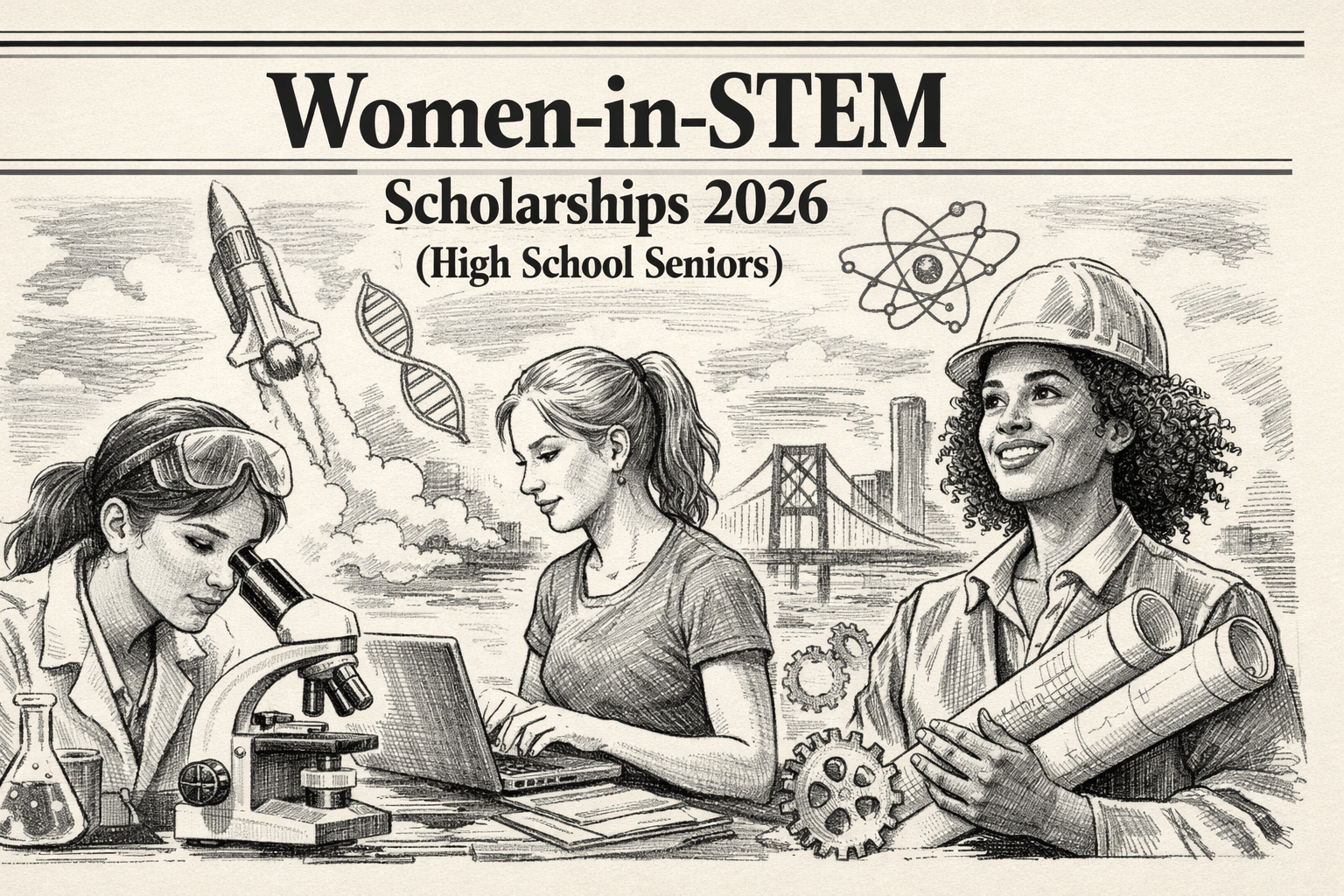
Women-in-STEM Scholarships 2026 (High School Seniors) — Verified Monthly
Find women-only STEM awards for the Class of 2026. Filter by state, major, GPA, renewable, and no-essay.
1) Society of Women Engineers — Emerging First-Year Scholars (SWE National)
💥 Full ecosystem + one application considers you for many SWE freshman awards.
💰 ~$1,000–$20,000 (many awards; some renewable)
⏰ Opens late fall/early winter; decisions summer (2026 cycle dates TBA)
🏷️ National • Major: Engineering/CS/Eng-Tech • GPA: varies • Renewable: varies • Essay: Yes
🔗 Apply/info: https://swe.org/apply-for-a-swe-scholarship/
2) Science Ambassador Scholarship (full tuition)
💥 Full-tuition for women in STEM via a 3-minute video lecture — no essay ✅
💰 Full tuition (up to 4 years)
⏰ Opens fall 2025 for the 2026 academic year
🏷️ National • Major: All STEM • GPA: n/a • Renewable: Yes (program) • No-essay: ✅ (video)
🔗 Apply/info: https://www.scienceambassadorscholarship.org/
3) BHW Scholarship for Women in STEM
💥 Straightforward app; strong fit if you’re headed into CS/engineering/math.
💰 $3,000
⏰ Typically due April (2026 dates TBA)
🏷️ National • Major: STEM • GPA: n/a • Renewable: No • Essay: Yes
🔗 Apply/info: https://thebhwgroup.com/scholarship
4) NCWIT Aspirations in Computing (AiC) — High School Award
💥 National + local affiliate recognition, cash prizes, swag, internships; comp-focused.
💰 Varies (cash awards + perks)
⏰ Opens fall; timelines vary by affiliate
🏷️ National + Local affiliates • Major: Computing/IT • GPA: — • Renewable: — • Essay: Short answers
🔗 Apply/info: https://www.aspirations.org/award-programs/aic-high-school-award
5) Women at Microsoft Scholarship
💥 Women-only HS senior scholarship for tech/STEM; includes community & mentorship.
💰 Varies
⏰ Cycles generally run winter–spring (watch page)
🏷️ National • Major: STEM/CS • GPA: — • Renewable: — • Essay: Yes
🔗 Apply/info: https://www.microsoft.com/en-us/diversity/programs/women-at-microsoft-scholarship
6) WTS International — “Transportation YOU” High School Scholarship
💥 Women in transportation-related STEM; national foundation + strong chapter network.
💰 Typically ~$2,500 (national); chapter awards vary
⏰ Usually late winter–spring (chapter specific)
🏷️ National/Chapters • Major: Transportation/Eng • GPA: — • Renewable: — • Essay: Yes
🔗 Apply/info: https://www.wtsinternational.org/wts-foundation/scholarships
7) WTS Boston — High School Scholarship
💥 Strong regional chapter; good odds if you’re in MA/New England.
💰 Varies
⏰ Spring window; watch chapter page
🏷️ State/Local • Major: Transportation/Eng • GPA: — • Renewable: — • Essay: Yes
🔗 Apply/info: https://www.wtsinternational.org/chapters/boston/scholarships
8) WTS Greater Chicago — High School Scholarship
💥 Chicago-area women aiming at civil/transport/infra fields.
💰 Varies
⏰ Spring (chapter timeline)
🏷️ State/Local • Major: Transportation/Eng • GPA: — • Renewable: — • Essay: Yes
🔗 Apply/info: https://www.wtsinternational.org/chapters/greater-chicago/student-info/scholarships
9) WTS Metropolitan Phoenix — High School Scholarship
💥 AZ-based; transportation & infrastructure pathways.
💰 Varies
⏰ Spring
🏷️ State/Local • Major: Transportation/Eng • GPA: — • Renewable: — • Essay: Yes
🔗 Apply/info: https://www.wtsinternational.org/chapters/metro-phoenix/scholarships
10) Michigan Council of Women in Technology (MCWT) — College Scholarships
💥 Michigan women in tech; HS seniors entering CS/IT/IS; powerful alum network.
💰 Multiple awards (varies)
⏰ Winter–spring cycle
🏷️ State • Major: Tech/CS/IT • GPA: see page • Renewable: Some • Essay: Yes
🔗 Apply/info: — https://mcwt.org/programs/university-initiatives/scholarship-program/
11) ITWomen (South Florida) Scholarship
💥 South Florida counties; HS seniors entering CS/IT/Eng; real local support.
💰 Varies
⏰ Typically Jan–Mar
🏷️ State/Local • Major: Tech/CS/Eng • GPA: see page • Renewable: — • Essay: Yes
🔗 Apply/info: https://itwomen.org/scholarships/
12) Women in Technology of Tennessee (WiTT) Scholarship
💥 TN-based, women pursuing tech/CS fields; community mentoring.
💰 Varies
⏰ Spring
🏷️ State • Major: Tech/CS • GPA: — • Renewable: — • Essay: Yes
🔗 Apply/info: https://www.wittn.org/Scholarships
13) Women in Technology (WIT) — Girls Scholarship (Georgia)
💥 For GA high-school women pursuing STEAM majors.
💰 Varies
⏰ Spring
🏷️ State • Major: STEAM (incl. CS/Eng) • GPA: — • Renewable: — • Essay: Yes
🔗 Apply/info: https://www.womenintechnology.org/git-scholarships-and-awards
14) SWE — Golden Gate Section (San Francisco Bay Area)
💥 Bay Area SWE section scholarship for HS grads entering Eng/CS.
💰 Varies
⏰ Annual; watch page for 2026 cycle
🏷️ Local/Chapter • Major: Eng/CS • GPA: — • Renewable: — • Essay: Yes
🔗 Apply/info: https://ggs.swe.org/
15) SWE — Chicago Regional Section
💥 Long-running local SWE; solid Chicago-area pipeline to Eng programs.
💰 Varies
⏰ Annual; watch chapter announcements
🏷️ Local/Chapter • Major: Eng/CS • GPA: — • Renewable: — • Essay: Yes
🔗 Apply/info: https://chicago.swe.org/scholarships/
16) SWE — San Diego Section (Freshman Scholarship)
💥 HS seniors in San Diego County/Temecula Valley going into Eng/CS; clear freshman track.
💰 Varies
⏰ Last cycle due Apr 1, 2025 (watch for 2026)
🏷️ Local/Chapter • Major: Eng/CS • GPA: — • Renewable: — • Essay: Yes
🔗 Apply/info: https://www.swesandiego.org/scholarships
17) SWE — Lehigh Valley Section (PA/NJ)
💥 Regional SWE awards; good odds for local applicants.
💰 Varies
⏰ Annual
🏷️ Local/Chapter • Major: Eng/CS • GPA: — • Renewable: — • Essay: Yes
🔗 Apply/info: https://sites.swe.org/lehighvalley/
18) ESET Women in Cybersecurity Scholarship (U.S.)
💥 Women in cybersecurity; expanding tiers; media + mentorship visibility.
💰 Historically $10,000 (tiered); amounts change by year
⏰ Opens around March; 2025 press notes expansion to $45,000 total
🏷️ National • Major: STEM (Cyber focus) • GPA: none stated (recent cycles) • Renewable: — • Essay: Yes
🔗 Apply/info: https://www.eset.com/us/women-in-cybersecurity-scholarship/
19) Kris Paper Legacy Scholarship for Women in Technology (Kansas City area)
💥 Kansas City-area HS senior women headed into tech; great local boost.
💰 $1,500 (typical; confirm yearly)
⏰ Spring cycle (watch foundation page)
🏷️ Local/Regional • Major: Tech/CS/IT • GPA: — • Renewable: — • Essay: Yes
🔗 Apply/info: https://krispaperlegacy.com/
20) EngineerGirl Writing Contest (HS girls)
💥 STEM communication counts too — national visibility + cash awards.
💰 Cash prizes
⏰ Annual theme; opens fall/winter
🏷️ National • Major: All STEM (communication focus) • GPA: — • Renewable: — • No-essay: ❌ (short essay)
🔗 Apply/info: https://www.engineergirl.org/
21) Southern Automotive Women’s Forum (SAWF) Scholarships (multi-state South)
💥 Women-only, HS seniors eligible, auto/engineering/STEM pathways; mentoring included.
💰 ~$2,500–$5,000 typical (varies)
⏰ Deadline has been mid–late March (e.g., Mar 24, 2025)
🏷️ Regional (AL, AR, FL, GA, KY, LA, MS, NC, SC, TN, VA, TX, WV) • Major: Auto/Engineering/STEM (not medical) • GPA: 2.5+ overall (see page) • Renewable: — • Essay: Yes
🔗 Apply/info: https://southernautomotivewomen.org/scholarship_program
Women-in-STEM Scholarships as a Workforce and Equity Intervention
Women-in-STEM scholarships sit at the intersection of labor-market demand, educational finance, and persistent gender stratification in science and engineering pathways. U.S. STEM occupations are projected to grow faster than non-STEM occupations and pay more than twice the median wage, making access to STEM credentials a high-leverage mobility channel. Yet women remain underrepresented across key STEM occupations and in several “gateway” majors (especially engineering and computing), and they shoulder a disproportionate share of U.S. student debt—conditions that compound financial risk and reduce persistence. This paper synthesizes current evidence on (1) where the gender gap is largest across the STEM pipeline, (2) how scholarships can shift enrollment, persistence, and professional identity formation, and (3) what design features most plausibly generate durable returns—particularly when financial support is paired with mentoring, community, and career signaling. Drawing on causal financial-aid research, NSF S-STEM program evidence, and workforce statistics, we propose an evaluation framework and a set of data-driven curation principles for Women-in-STEM scholarship ecosystems aimed at high-school seniors through graduate learners.
1. Why Women-in-STEM scholarships matter now: demand-side pressure meets unequal access
Two macro trends define the urgency. First, the economic premium for STEM work remains large. The Bureau of Labor Statistics’ projections for 2024–2034 show STEM occupations growing faster than non-STEM occupations, with a 2024 median annual wage above $100k and more than double the non-STEM median. Second, gender representation in STEM remains uneven despite long-run improvements. The National Science Board (NSB) reports that women accounted for about 35% of STEM workers in 2021, a figure that masks sharper underrepresentation in engineering and computing-intensive roles.
At a more granular level, representation depends heavily on definitions. One lens asks: “What share of women workers are employed in STEM occupations?” NSB’s Indicators show that in 2021, 18% of female workers held a STEM occupation (vs. 30% of male workers). A different lens asks: “What share of the STEM workforce is female?”—a statistic that rises if STEM includes health-related STEM jobs and other categories. For scholarship design, both measures matter: the first reflects the probability that a woman’s labor-market trajectory enters STEM; the second reflects the gender composition of the roles that society labels “STEM.”
Scholarships intervene where private incentives (individual ability and ambition) collide with market frictions (costs, uncertainty, bias, and lack of network access). Because STEM degrees often require sequenced coursework with limited scheduling flexibility (labs, capstones, internships), financial strain can trigger part-time enrollment or increased paid work—both risk factors for attrition. Scholarships reduce that strain directly and can also act as “credence signals,” improving internship odds and mentorship access when awards are well-known in industry or professional societies.
2. Where the pipeline leaks: enrollment, major choice, and occupational sorting
2.1 Degree production: broad parity, but not in the bottleneck fields
Across science and engineering overall, women earn substantial shares of degrees, but the pattern shifts sharply by field. NSB Indicators report that in computer and information sciences and in engineering, women earned no more than about a third of awards at any level (associate through doctorate), highlighting persistent bottlenecks in the majors most tightly linked to high-growth technical occupations.
Longer-run trends show improvement but from a low base. For example, NSB reporting indicates women’s share of engineering bachelor’s degrees increased from about 19% to 23% from 2011 to 2019—progress, but far from parity in a decade when demand for technical talent accelerated. Professional-society reporting aligns with this picture: the Society of Women Engineers (SWE) “fast facts” summary places women’s engineering bachelor’s degree share around the mid-20% range (e.g., 24.2% in 2020), emphasizing both momentum and the remaining gap.
2.2 Workforce entry and persistence: representation differs by occupation and credential level
On the labor-market side, NSB Indicators show women’s participation in STEM occupations remains lower than men’s, even as overall STEM employment expands. A complementary NCSES release using 2022 workforce data similarly reports that 17% of female workers were employed in STEM occupations (with differences by credential level). These statistics suggest scholarships that only address “entry” (first-year enrollment) may be necessary but insufficient: the system also needs interventions that support persistence through demanding sophomore/junior sequences and transitions into internships and first jobs.
2.3 Intersectionality: gender gaps are not uniform across race/ethnicity and disability
Evidence consistently shows that aggregate “women in STEM” numbers can conceal deeper stratification among women by race/ethnicity and other identities. Recent diversity-in-STEM reporting highlights wide variation across S&E occupations (e.g., women representing much lower shares among engineers than among social scientists) and emphasizes differences in credential profiles. For scholarship ecosystems, this implies that eligibility rules, outreach channels, and supports should be designed for heterogeneous constraints—including first-generation status, caregiving, rural location, disability accommodations, and transfer pathways.
3. The scholarship landscape: a typology that explains “what works”
Women-in-STEM scholarships vary widely in goals, size, eligibility, and the “bundle” of supports attached to funding. A useful typology is organized by the problem each scholarship is trying to solve:
3.1 Access scholarships (entry into STEM majors)
These awards focus on high-school seniors and incoming first-years, aiming to shift major choice or reduce the initial cost hurdle. They often require proof of admission, a declared major, or a STEM intent statement. Their primary mechanism is reducing perceived risk at the moment of college entry—when switching into STEM later may be harder because of prerequisite sequencing.
3.2 Persistence scholarships (keeping students in the pipeline)
Persistence awards are frequently renewable and tied to continued enrollment in STEM, GPA thresholds, or co-curricular participation. They are especially relevant because attrition often spikes after gateway courses (calculus, intro programming, physics) and during unpaid or underpaid internship periods.
3.3 Identity-and-network scholarships (belonging, mentorship, and signaling)
Some programs explicitly target women to counter isolation and stereotype threat and to expand professional networks. SWE’s scholarship infrastructure is a flagship example of a professional-society model that combines funding with a broader community and career identity. SWE reports awarding 330+ scholarships totaling ~$1.5 million for the 2025–2026 cycle, illustrating scale and repeated annual throughput.
3.4 Programmatic scholarships bundled with structured supports (S-STEM model)
NSF’s Scholarships in STEM (S-STEM) program is conceptually important because it treats scholarships not as standalone checks but as part of an integrated student-success design (mentoring, advising, co-curricular supports). A recent outcomes and impact report describes S-STEM’s explicit focus on retention, academic success, and career readiness for low-income STEM students, using mixed methods and synthesis across projects to identify which components are most effective. A focused review of S-STEM interventions also emphasizes the role of financial support combined with academic and social structures in improving STEM persistence.
3.5 Micro-awards and “application friction reducers”
Smaller awards (often $500–$3,000) can be powerful when paired with low time-to-apply and predictable deadlines, because they reduce friction for students who have limited time, high work hours, or caregiving duties. Although individually smaller, their marginal value can be high if they prevent course load reductions or replace paid work hours during academically intensive terms.
4. What the evidence says: scholarships do increase persistence—especially as grant aid
A large body of higher-education research finds that grant aid increases persistence and completion, although effect sizes vary with context, targeting, and baseline affordability.
4.1 Meta-analytic evidence: grant aid raises persistence and completion
A meta-analysis of dozens of studies on grant aid finds positive average impacts on student persistence and degree completion (with magnitudes depending on program design and population). For Women-in-STEM scholarships, this is foundational: even when scholarships are not STEM-specific, reducing net price tends to increase “staying enrolled” behaviors that are prerequisite for STEM degree attainment.
4.2 Causal studies: need-based grants measurably change outcomes
Causal identification studies reinforce this result. For example, research exploiting eligibility thresholds for need-based grants finds positive effects on college persistence and completion-related outcomes. Randomized experiments on grant offers similarly find increases in persistence (e.g., measurable percentage-point gains in two-year persistence among four-year students).
4.3 STEM-specific scholarship programs: effects strengthen when aid is bundled with support
STEM is a “high-structure” degree pathway: course sequences and time demands increase the cost of disruption. Program-level evaluations of S-STEM-like interventions commonly report higher retention and GPA for scholarship recipients compared with matched or eligible non-participants—suggesting that financial aid plus structured academic/social supports can outperform funding alone. Importantly, these bundled models align with what qualitative research often finds women cite as persistence factors: supportive environments, mentorship, and reduced isolation—mechanisms that scholarships can fund indirectly by enabling participation in cohorts, conferences, and professional societies.
5. Mechanisms: how scholarships translate dollars into degrees and careers
A doctorate-level account should specify mechanisms—because design should map to causality, not just good intentions.
-
Financial slack and time reallocation: Scholarships reduce hours worked, increase time available for high-cognitive-load courses, and lower the probability of “stop-out” after a bad semester. This mechanism is supported broadly by grant-aid evidence on persistence.
-
Risk reduction in major choice: STEM majors often carry higher perceived risk of failure due to grading severity or stereotype pressures. Scholarships lower the cost of trying and staying.
-
Belonging and identity formation: Women in male-dominated majors can face isolation; scholarships tied to cohorts, mentoring, or professional societies create repeated social reinforcement.
-
Career signaling: Recognized scholarships can function like credentials, increasing access to selective internships and early talent programs.
-
Capital conversion: Scholarships can convert financial capital into social and cultural capital when they fund conference travel, research experiences, or community-based projects—activities that are disproportionately important for STEM career entry.
6. Constraints and controversy: DEI restrictions, legal risk, and scholarship eligibility design
Women-in-STEM scholarships operate in a shifting policy environment. Since 2023, multiple states have enacted restrictions on DEI initiatives in public higher education—often targeting DEI offices, training, and certain programmatic activities. Separately, litigation has increasingly challenged scholarships that use race- or identity-limited eligibility criteria, creating uncertainty for some long-running programs and prompting redesign toward criteria such as “commitment to diversity” or disadvantage measures rather than strict identity thresholds.
Implication for Women-in-STEM scholarship ecosystems:
-
Scholarships that are explicitly “women-only” are often still lawful in many contexts, but programs housed at public institutions may be more exposed to state-level constraints.
-
A robust design strategy is dual-track targeting: (a) awards that support women as an underrepresented group in specific majors/occupations, and (b) awards that use functionally related criteria (financial need, first-gen status, rural background, caregiving, transfer pathway, low-income, disability, demonstrated barriers) that also reach many women in STEM without relying on narrow identity gating.
-
Transparency matters: scholarship pages should clearly state eligibility, sponsoring entity, and whether the award is administered by a private organization, a public institution, or a professional society—because compliance constraints differ.
7. The finance backdrop: why scholarships may matter more for women’s long-run balance sheets
Women hold almost two-thirds of U.S. student debt, and women bachelor’s graduates tend to owe more than men on average—making scholarship substitution for loans particularly high value. In STEM, where wages are higher on average, reducing debt at entry can accelerate wealth-building—especially if scholarship design supports timely graduation (a major determinant of ROI). Coupled with the STEM wage premium, a $2,000–$10,000 scholarship can have outsized long-run value if it prevents a delayed graduation, a major switch out of STEM, or a forced reduction in course load.
8. A data-driven framework for curating Women-in-STEM scholarships (application to a 2026 scholarship hub)
A scholarship hub intended for high-school seniors through early college should treat information architecture as part of the intervention. “Access” depends on discoverability, eligibility clarity, and deadline timing.
8.1 Minimum viable scholarship data model (for filtering and analytics)
To make a Women-in-STEM scholarship list genuinely decision-supportive, each record should ideally include:
-
Award: amount (min/max), renewable vs one-time, number of recipients (if disclosed)
-
Eligibility: grade level (HS senior, undergrad year, grad), major taxonomy (engineering, CS, math, physical sciences, life sciences, data/AI), citizenship/residency, GPA, institution type (2-year/4-year), transfer eligibility
-
Barrier proxies: need-based flag, first-gen flag, caregiving/nontraditional flag, rural/urban flag, disability-friendly accommodations (if stated)
-
Process friction: essay length, letters required, portfolio/project required, interview required, time-to-apply estimate
-
Career capital: internship connection, mentoring/cohort, conference travel support, professional society membership link
-
Temporal: deadline date, award cycle, notification date (if known)
This data model is not “just UX.” It enables monitoring whether the curated ecosystem overweights high-friction awards (which advantaged students disproportionately capture) or whether deadlines cluster in months that create overload for seniors already managing admissions.
8.2 Key performance indicators (KPIs) for scholarship ecosystems
A scholarship hub can track outcome-adjacent indicators even without access to applicant outcomes:
-
Coverage: share of awards available to HS seniors vs current undergrads; share available to community-college transfers
-
Equity by design: proportion that are need-based or barrier-proxy eligible; proportion with low-friction applications
-
Pipeline alignment: proportion targeting computing/engineering vs broader STEM; proportion offering renewable support through gateway years
-
Calendar risk: deadline concentration index (e.g., how many deadlines fall within a 6–8 week window)
These KPIs map directly to what the research suggests matters: persistence support, reduced friction, and timing.
8.3 A practical “portfolio strategy” for students (evidence-consistent)
Based on grant-aid evidence and STEM retention dynamics, a high-probability application portfolio typically mixes:
-
1–2 larger, higher-friction awards (big upside; longer essays)
-
4–8 moderate awards (major-aligned, predictable cycles)
-
10–20 micro-awards (fast applications; reduces variance and deadline risk)
This strategy operationalizes the idea that scholarships function partly as a risk-management portfolio under uncertainty.
9. Design principles for scholarship makers and sponsors (what to fund, not just whom to fund)
-
Prioritize renewability through gateway years: A $2,000 renewable scholarship can outperform a one-time $5,000 award if it reduces stop-out risk during sophomore/junior STEM sequences.
-
Bundle funding with belonging: Mentoring, cohort meetings, research placements, and conference travel make the financial award “convert” into persistence mechanisms.
-
Lower application friction where possible: Short-form applications and clear eligibility reduce inequities driven by time scarcity.
-
Support transfer pathways: Community colleges are major STEM on-ramps, and transfer students often face new costs at the point of transition (housing, fees, commuting).
-
Measure outcomes that matter: track retention in major, gateway course completion, internship attainment, time-to-degree, and early-career placement—not only GPA.
Conclusion
Women-in-STEM scholarships should be analyzed as more than philanthropic gestures: they are labor-market infrastructure and educational-finance policy tools. STEM work is growing and highly paid relative to non-STEM work, but women remain underrepresented in key technical majors and occupations, and they face higher student-debt exposure—conditions that amplify the marginal value of well-designed grant aid. The best-supported scholarship models do three things simultaneously: (1) reduce net price, (2) reduce persistence risk through renewability and timing, and (3) create social and professional capital via mentoring, cohorts, and recognized networks. As DEI policy constraints evolve, scholarship ecosystems can remain effective by combining women-focused initiatives with barrier-based criteria and transparent administration structures. The practical implication for a Women-in-STEM scholarship hub is clear: treat the page itself as an intervention—powered by structured data, friction-aware filters, and a portfolio strategy that turns scholarship search into measurable progress toward STEM degree completion.
References (selected, APA-style)
-
Angrist, J., et al. Evaluations of scholarship impacts on enrollment and persistence.
-
Carlson, D. E., et al. Randomized evidence on need-based grant offers and persistence.
-
Castleman, B. L., & Long, B. T. Causal effects of need-based grants on persistence and completion.
-
National Science Board / NCSES. STEM workforce size and demographic representation; women in STEM occupations and STEM workforce share.
-
NCSES. Field-level gender patterns in S&E degrees (engineering and computer/information sciences).
-
Nguyen, T. D., et al. Meta-analysis of grant aid effects on persistence/completion.
-
SWE. Scholarship scale and disbursement; women’s representation in engineering degree attainment (context).
-
U.S. Bureau of Labor Statistics. STEM employment projections and wage comparisons.
-
AAUW. Women and student debt burden.
-
Policy context on DEI restrictions and scholarship litigation.
FAQ (for Class of 2026)
Are these truly women-only?
Yes — every entry here is limited to women (many also include non-binary applicants; always check eligibility notes). For example, SWE scholarships are for students who identify as women, including Emerging First-Year Scholars for HS seniors entering college. Society of Women Engineers
Where are the “no-essay” options?
-
Science Ambassador uses a 3-minute teaching video (counts as no traditional essay). Science Ambassador Scholarship
-
Some awards emphasize forms/short responses (e.g., NCWIT AiC). Exact prompts vary by year. Sallie
What’s a smart application mix?
-
Apply to SWE National + your local SWE/WTS chapter + 1–2 niche fits (e.g., Cyber, Auto, or state-based like MCWT/ITWomen). That combo usually balances odds and award size.
Why so many chapters?
Local/section scholarships often have higher hit rates and excellent mentoring pipelines (e.g., SWE San Diego freshman award, WTS chapters). swesandiego.org