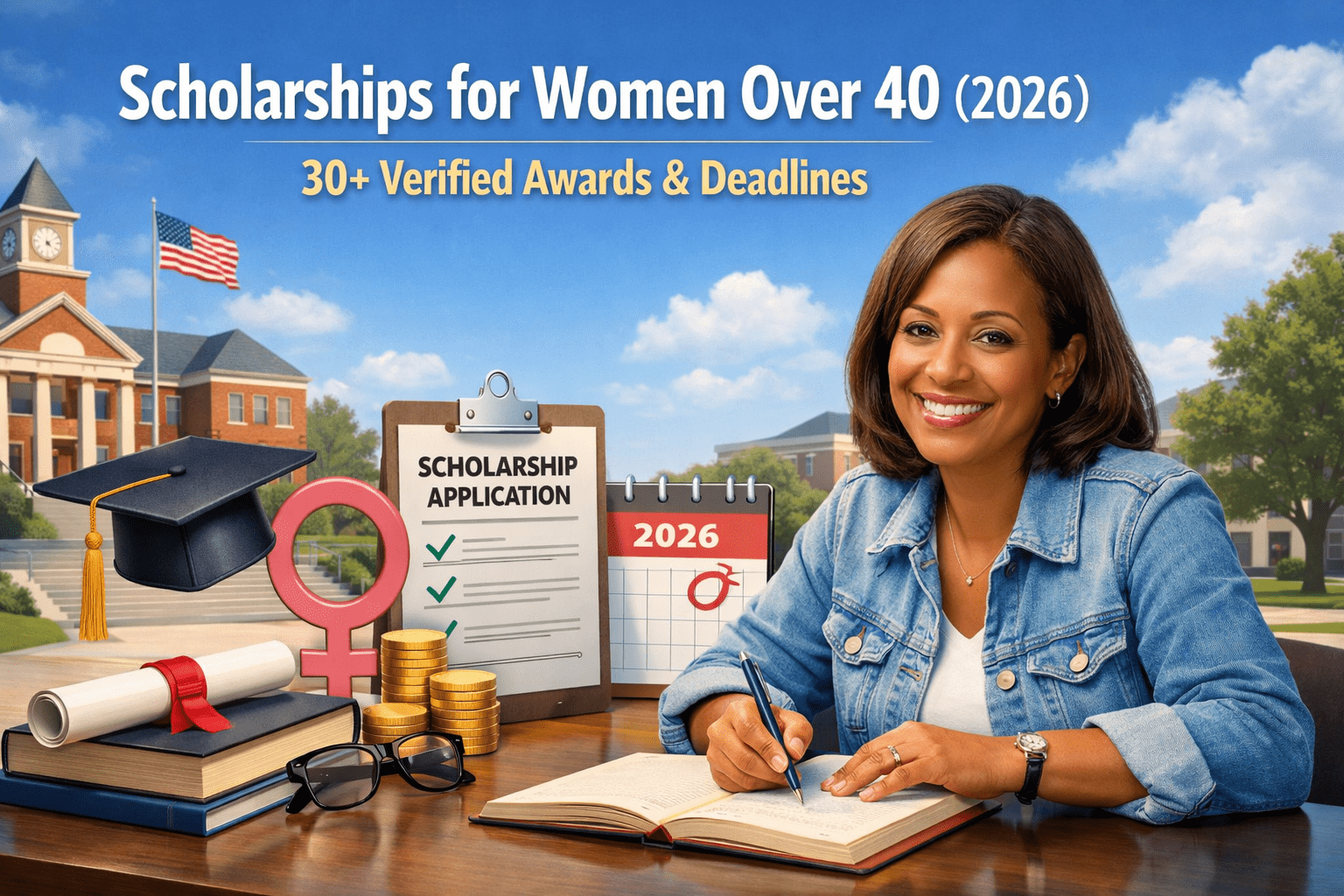
Scholarships for Women Over 40 in 2026: 30 Top Grants & Awards
Women returning to school or training after age 40 face unique challenges – and there are many scholarships built just for them. The list below covers 30 top scholarships and grants (updated for 2026) aimed at women over 40. Each entry shows “Why it slaps” (the main appeal), award amount, deadlines, and a link to apply. These programs target career development, degree completion, reentry aid, and support for non-traditional students.
1. AAUW Career Development Grants – Awards up to $2,000–$8,000 per year. (Multiple cycles each year; next deadline May 28, 2026.) Why It Slaps: Designed for women with a bachelor’s degree who are re-training or pursuing graduate coursework in underrepresented fields (STEM, business, health, etc.). These grants do not go through the school – winners get cash with minimal restrictions. In other words, a woman returning for a certificate, master’s, or career program can use the funds for tuition, books, or living expenses. This award is large (up to $8K) and prioritizes women of color, making it a perfect fit for older students changing careers.
– Amount: Up to $8,000 (depending on program).
– Deadline: Cycle 3 closes May 28, 2026 (applications opened April 1, 2026).
– Apply/Info: AAUW Career Development Grants.
2. Alpha Sigma Lambda (ASL) Adult Learner Scholarships – Awards ranging from $1,500 to $3,000 for part-time students age 23 and up at member colleges. (2026 deadline: April 24, 2026.) Why It Slaps: ASL is a national honor society for adult learners, so its scholarships specifically reward students juggling work, family, and school. There are dozens of awards (for example, six awards of $3,000 and many more of $2,500 or $2,000), making it highly accessible. Applicants must have strong grades and be enrolled part-time, but the payoff is big recognition for older students (many winners work full-time or raise kids while studying).
– Amount: $1,500–$3,000 (2026: six awards at $3,000; others at $2,500, $2,000, etc.).
– Deadline: April 24, 2026 (for academic year 2026–27).
– Apply/Info: Alpha Sigma Lambda Scholarships.
3. P.E.O. Program for Continuing Education (PCE) – Need-based grants up to $4,000 for women whose education was interrupted for at least 24 months. (Deadline: Varies by local chapter.) Why It Slaps: One of the oldest “non-traditional student” awards, P.E.O. helps women (usually age 35+) resume school after caregiving, illness, or job gaps. It’s explicitly aimed at women returning after a break. The grant is paid directly to the student and can cover tuition, books, child care or even living expenses. Because applicants apply through local chapters, deadlines differ by region – but nearly every state has P.E.O. support. This grant is popular because it fully acknowledges real-life setbacks in education.
– Amount: Up to $4,000 (maximum grant).
– Deadline: No national deadline – apply through your local P.E.O. chapter (varying dates).
– Apply/Info: P.E.O. PCE Information.
4. Osher Reentry Scholarships – Varied scholarships (awards up to roughly $50,000/year), granted by many colleges nationwide. (Deadlines: see participating colleges.) Why It Slaps: Funded by the Bernard Osher Foundation, these are among the richest scholarships for adult learners. Each participating college administers its own program – many target students who had a 5+ year educational gap and are finishing a bachelor’s degree. The awards (sometimes up to $50K per year) often cover full tuition and fees. In short, if you paused your degree and are now returning (typically age 25–50), this scholarship can completely fund your final years. The application is done through each college’s financial aid office.
– Amount: Varies by school (some provide up to $50,000/year).
– Deadline: Varies – check individual college deadlines (often spring or fall for next year).
– Apply/Info: Osher Reentry Scholarship Participating Institutions.
5. Charlotte W. Newcombe Scholarships (Mature Students) – Grants for women age 25+ nearing completion of their first bachelor’s degree. (Award amounts vary by institution; e.g. Morgan State Univ. endowed a $50K program for mature students.) Why It Slaps: The Newcombe Foundation has a special program to help “mature women” – those 25 or older who are close to finishing college. This is perfect for women over 40 because eligibility usually requires age 25+, first BA in progress, and halfway completed. Although the funding goes through select colleges (each with its own award), the intent is nationwide support. Morgan State’s example shows a $50K fund just to back these scholarships. In short, if you’re an older student winding down a degree, the Newcombe Scholarship can give you the final boost through those last semesters.
– Amount: Varies by college (e.g. Morgan State awarded a $50,000 fund for these scholarships).
– Deadline: Varies by college (funding renewed by participating schools; watch campus announcements).
– Apply/Info: Contact financial aid at schools participating in the Newcombe Mature Students program (see Newcombe Foundation for list of schools).
6. Jeannette Rankin Foundation National Scholar Grants – Annual awards of $2,500 per year (up to 5 years) for U.S. women (and nonbinary people) age 35+ pursuing an associate/technical program or first bachelor’s. (2025–26 deadline: Feb 13, 2026.) Why It Slaps: This is one of the few true national scholarships explicitly for older adult learners. By law it requires applicants to be at least 35 years old and have financial need. It doesn’t care about your past GPA or college seniority – only that you are returning or starting college later in life. Winners receive $2,500/year (paid directly to them) to use for tuition or living expenses. This award is famous in the older-student community because it only goes to age-35+ women pursuing their first degree, making it a clean fit for over-40 applicants.
– Amount: $2,500 per year (renewable up to 5 years).
– Deadline: February 13, 2026 (annual – applications open Nov 2025).
– Apply/Info: Jeannette Rankin National Scholar.
7. Soroptimist Live Your Dream Awards – Global program for low-income women (often single mothers) returning to school. Awards range up to $16,000 at the international level (with local/regional awards too). Applications open Aug 1 – Nov 15 yearly. Why It Slaps: Soroptimist’s “Live Your Dream” is one of the largest community-driven awards for women. It recognizes those who are the primary earners for their families and provides large grants. The top international awards are $10,000–$16,000, and even local awards are substantial. Importantly, funds can cover any educational need – tuition, childcare, transportation, etc.. For women over 40 supporting dependents and returning to school, this award’s flexibility and size is ideal.
– Amount: Up to $16,000 (grand prizes; regional awards ~$3K–$5K).
– Deadline: Nov 15, 2025 (for 2026 awards); opens annually Aug 1.
– Apply/Info: Soroptimist Live Your Dream Awards.
8. Women’s Independence Scholarship Program (Doris Buffett Independence Scholar Grant) – Scholarships for survivors of domestic violence returning to school. Awards about $500–$2,000 per semester (often ~$1,000 average). Two cycles per year (Spring: apply Jan 1–Mar 1, decisions by May; Fall: Aug 1–Oct 1). Why It Slaps: A national program dedicated to victims of abuse rebuilding their lives, WISP provides not just funding but support. The grants can be used for tuition, books, childcare or other needs. For women over 40 who left school due to abuse or are now rebuilding stability, WISP’s recurring grants are a lifeline. The program explicitly prioritizes returning students, single parents, and first-degree students.
– Amount: $500–$2,000 per semester (up to ~$4,000/year).
– Deadline: March 1 and October 1 each year (annual cycles: Jan 1–Mar 1 and Aug 1–Oct 1).
– Apply/Info: WISP – Doris Buffett Independence Scholarship.
9. Patsy Takemoto Mink Education Support Awards – In 2025–26 offered five awards of up to $5,000 each to low-income mothers (any age) pursuing their first post-secondary degree. (2025–26 cycle closed; check May 2026 for next posting.) Why It Slaps: A highly targeted national award, Mink Scholarships support women (often single moms) who paused their education to raise children. Although not age-specific, many women over 40 qualify as low-income mothers restarting college. The award is sizeable ($5K, paid in installments) and recognizes the financial strain of parenting and school. Keep this on your radar – it will reopen (criteria are announced May 2026) and directly addresses the needs of returning mothers.
– Amount: Up to $5,000 per award (paid in increments).
– Deadline: Next cycle announced May 2026; past cycle closed Aug 1, 2025.
– Apply/Info: Patsy T. Mink Education Support.
10. Women’s Forum of New York Education Fund Award – One $10,000 award (split into $5K now, $5K next year) for NYC women 25+ pursuing an associate or bachelor’s degree. (2026 cycle deadline: March 1, 2026.) Why It Slaps: This is a very generous local prize for older NYC women. The age minimum (25) makes it friendly to women over 40 who are finishing college. The award is fully discretionary (no tuition bills attached), so it can cover anything from school costs to rent or childcare. Winning $10K in stages is a major boost for a returning student balancing expenses.
– Amount: $10,000 (paid as $5K now + $5K next year).
– Deadline: March 1, 2026 (annual).
– Apply/Info: Women’s Forum NY Scholarship.
11. American Legion Auxiliary (ALA) Non-Traditional Student Scholarship – Five scholarships of $2,000 each (2026 awards) for students returning to education after an interruption. Deadline: March 1 each year. Why It Slaps: Open to veterans, active-duty military, and their family members, this award targets “non-traditional” students re-entering school. It can be used for technical, trade, two-year or four-year programs – any education path. For women 40+ with Legion ties (or vets themselves), it’s an ideal fit: fairly large award with no strict degree requirement, just a demonstrated break in education.
– Amount: $2,000 each (five awards in 2025–26).
– Deadline: March 1, 2026 (annual).
– Apply/Info: ALA Non-Traditional Scholarship.
12. ANSWER Scholarship (Charlotte, NC) – Varies ($2,750–$5,500/year) for single mothers age 25+ with children (Charlotte–area). Annual deadline February 28 (2027 cycle: Feb 28, 2027). Why It Slaps: One of the best regional scholarships for moms returning to school. Beyond money, ANSWER provides mentoring and career development tailored to non-traditional students. It targets exactly women balancing school and childcare, awarding substantial, renewable grants (up to $5,500 per year). If you live in Mecklenburg County, SC, or surrounding areas and have a child in school, this is a must-apply.
– Amount: $2,750–$5,500 per year (renewable up to 4 years).
– Deadline: Feb 28, 2027 (for 2027–28 awards).
– Apply/Info: ANSWER Scholarship.
13. Jeannette Rankin Emerge Grant (GA & MT) – Up to $2,500/year (renewable 5 years) for women 25+ in Georgia or Montana pursuing a technical/associate/first bachelor’s. 2026 deadline: Feb 13, 2026. Why It Slaps: A state-specific sibling to the national Rankin grants. It has the same age and need focus but is open only to GA and MT residents. Like the national grant, it directly assists adult learners returning to school. For women over 40 in those states, this means a targeted award with no degree requirement. (Amount and renewability match the national program.)
– Amount: $2,500 per year (renewable).
– Deadline: Feb 13, 2026 (annual).
– Apply/Info: Rankin Emerge Grant (GA/MT).
14. EWI ASIST Scholarships (Executive Women International) – Chapter-based awards of $2,000–$5,000 (for 2026, Omaha chapter had ~$22K total). Deadlines vary by chapter (e.g. March 31, 2026 for Omaha). Why It Slaps: ASIST (Adult Students in Scholastic Transition) is tailor-made for older students facing life challenges. Each local EWI chapter funds its own scholarships; many target women age 25+ who are returning to education after setbacks. The awards are substantial (some chapters give up to $5K each) and the selection process appreciates life experience. If your city has an EWI chapter, apply – this program was created for “transitioning” adult learners like women over 40 with career or family breaks.
– Amount: Varies by chapter ($2,000–$5,000 typical).
– Deadline: Varies (often March); e.g. Omaha’s is Mar 31, 2026.
– Apply/Info: EWI ASIST Scholarship.
15. Women in Aviation (WAI) Scholarships – Dozens of scholarships (in 2026, 50+ awards totaling >$200,000) for women in aviation/aerospace careers. 2026 applications were open July 15–Oct 15, 2025. Why It Slaps: WAI funds everything from flying lessons to engineering degrees. The key is it’s age-inclusive – whether you’re 22 or 62, if you’re a woman pursuing an aviation career, you can apply. The scholarship portfolio covers pilots, mechanics, technicians, dispatchers, aerospace engineers, and more. For women over 40 changing to an aviation career, WAI is one of the few programs that explicitly supports later-life entry into this field.
– Amount: Over $200,000 total awarded each cycle (50+ scholarships in 2026).
– Deadline: Applications typically open mid-summer and close mid-Oct (e.g. Oct 15, 2025 for 2026 awards).
– Apply/Info: WAI Scholarships.
16. WTS Foundation Scholarships (Women’s Transportation Seminar) – Multiple scholarships (various amounts, often $5,000) for women pursuing degrees or training in transportation industries (engineering, logistics, urban planning, etc.). For example, in 2025 WTS awarded six $5,000 scholarships through corporate sponsors. (Applications often open fall; 2026 winners announced May.) Why It Slaps: Backed by major industry sponsors, WTS scholarships are geared to women building careers in infrastructure and transit. The awards are generous and come with networking in a traditionally male field. If your studies align with transportation, logistics, engineering, or construction, WTS’s field-specific scholarships can greatly ease tuition.
– Amount: Varies (for 2025, six awards of $5,000 each).
– Deadline: Usually fall (2026 national cycle closed Jan 9, 2026; watch WTS websites for next opening).
– Apply/Info: [WTS International Scholarships](https://www.wtsinternational.org/ scholarships).
17. AAUW Selected Professions Fellowships – $20,000 stipends for women pursuing first master’s or professional degrees in high-need STEM fields (architecture, CS, engineering, math, statistics). (Applications open August 2026.) Why It Slaps: These fellowships specifically support adult women entering careers where they are underrepresented. A late-40s woman returning to school for a master’s in engineering or an MBA in finance could get a $20K boost. These are competitive but huge – $20K each – and acknowledge that returning adult learners in STEM need extra support.
– Amount: $20,000 each (award stipend).
– Deadline: Applications open August 2026.
– Apply/Info: AAUW Selected Professions Fellowships.
18. Educational Foundation for Women in Accounting (EFWA) Scholarships – Awards ranging from a few thousand up to $7,500 for women accounting/finance majors (undergrad and grad). 2026 applications open late Jan and close Mar 30. Why It Slaps: If you’re switching careers into accounting or finance, EFWA offers large scholarships for female students (many are non-traditional age). They have dozens of awards each year (some for bachelor’s level, some for MBA/accounting grad students). In 2026, they had at least one $7,500 award and many around $3,000–$5,000. For women over 40 changing careers to accounting, this is a dedicated funding source.
– Amount: Several thousand (e.g. up to $7,500 for bachelor’s students in 2025–26).
– Deadline: March 30, 2026 (application opens Jan 23, 2026).
– Apply/Info: EFWA Scholarship.
19. Society of Women Engineers (SWE) Scholarships – Hundreds of awards (range ~$1,000–$20,000) for women in engineering and computer science. 2026 deadline: March 31, 2026. Why It Slaps: SWE’s program is one of the largest for women in STEM. It includes scholarships for current students and for those returning to finish degrees. With awards up to $20K, it can significantly defray costs. Even if you started your engineering degree late or took a break, SWE encourages women of all ages to apply. (For example, one 2025 SWE award was $5,000; multiple awards up to $20K were available.)
– Amount: ~$1,000 to $20,000 (varies by award).
– Deadline: March 31, 2026.
– Apply/Info: SWE Scholarship Program.
20. Boomer Benefits Scholarship – Up to $4,000 scholarships for adult learners age 50+ (for 2026). (Deadline usually mid-late summer; check site for exact 2026 date.) Why It Slaps: Specifically for “baby boomers,” this scholarship acknowledges mature students continuing education. Award amounts have been $4,000 in past years. It’s a simple, dedicated award for older adults going back to school (often for career changes or finishing degrees), making it a perfect hit for women 50+.
– Amount: Up to $4,000 (2025 awards were $4,000).
– Deadline: TBA (typically August each year).
– Apply/Info: Boomer Benefits Scholarship.
21. Imagine America (ASEP) Adult Learner Scholarships – $1,000 scholarships for adult students in career programs (Apprenticeship Training, Career Colleges). Applications open year-round (Fall and Spring deadlines). Why It Slaps: If you’re in a vocational or career training program (CNA, automotive tech, skilled trades, etc.), Imagine America offers scholarships just for returning adults. Each semester a random drawing of registrants is held, awarding $1,000 scholarships. It’s not gender-specific, but women over 40 in career schools can benefit greatly. Simply register as an “adult learner” on their site to enter.
– Amount: $1,000 each (awarded via drawing each term).
– Deadline: Rolling (separate Fall and Spring deadlines each year).
– Apply/Info: Imagine America Scholarships.
22. Working Parent College Scholarship (Job-Applications.com) – $1,000 scholarship for students with children (any student, including adult/part-time). (Deadline: October 15, 2026.) Why It Slaps: Geared to parents juggling work/school and childcare, this scholarship has no age limit. If you’re a woman over 40 returning to college and you have school-age kids, this straightforward award can help. The application is just an essay, and every student with children is eligible – making it an easy win if your story resonates.
– Amount: $1,000.
– Deadline: October 15, 2026 (annual).
– Apply/Info: Working Parent Scholarship.
23. College JumpStart “Love of Learning” Scholarship – $1,000 (one-time) awarded monthly to a student of any age. (Deadline: December 31, 2025 for the next winner.) Why It Slaps: This is an open scholarship (no essays) that’s easy to apply for each month. You just submit a short “love of learning” statement. It’s not age-restricted at all, so women over 40 have just as good a shot as anyone. The monthly cycle means multiple chances per year, and it’s open to any student, including those returning to school.
– Amount: $1,000 (monthly).
– Deadline: December 31 (2025) for the first $1,000 in 2026 (then last day of each month).
– Apply/Info: College JumpStart Scholarship.
24. Return2College Scholarship – $1,000 awarded quarterly to a returning student (any major, any country). Application windows Jul–Sep 2025, Oct–Dec 2025, etc. Why It Slaps: Geared for older students, Return2College specifically asks applicants to explain why college matters to them later in life. Any adult student can enter each quarter. It’s another simple contest (no grade requirement), offering $1,000 to help with tuition or bills. Since it repeats quarterly, there are four chances a year – a great opportunity for women over 40 to try regularly.
– Amount: $1,000 (one-time).
– Deadline: Quarterly cycles (next: Oct 2025 – Dec 2025, etc.).
– Apply/Info: Return2College Scholarship.
25. Courage to Grow Scholarship – $1,000 monthly scholarship (renewable 2 years). (Monthly deadlines; winner announced each month.) Why It Slaps: One of the longest-running adult scholarships, Courage to Grow has been funding non-traditional students since 2004. Applicants just answer an essay prompt about their goals. Winners (women or men) can get up to $1,000 per month. For a woman over 40, this is an easy, open competition – with the bonus of a second-year award – to help defray costs. The frequent deadlines mean you can apply several times if needed.
– Amount: $1,000 each month (can renew for 2nd year).
– Deadline: Last day of each month (open to apply any time).
– Apply/Info: Courage to Grow Scholarship.
26. MyCAA (Military Spouse Career Advancement Account) – Up to $4,000 for career training for eligible military spouses (active duty E-5 and below). Rolling deadline (apply anytime). Why It Slaps: If you’re a military spouse, MyCAA is huge. It provides tuition funding for training certificates or associate degrees in in-demand fields. For women over 40 in military families, this can cover most of a program’s cost. There’s no essay – just an online application and military ID. (Note: must be military spouse and in the MyCAA career list.)
– Amount: Up to $4,000.
– Deadline: Rolling (apply any time).
– Apply/Info: MyCAA Program.
27. Stephen Bufton Memorial (SBMEF) Scholarships – Several awards (for bookkeepers, executive development, etc.) totaling $2,000–$10,000, run by the American Business Women’s Association. Deadline: May 15, 2026. Why It Slaps: The ABWA offers multiple scholarships (the Bufton Fund) for women at different education levels and careers. These include awards up to $5,000–$10,000 in past years. They’re open to women with financial need, often adults (no upper age limit). If you’re pursuing a degree or certification in business, finance, or related fields, this is a great national source. Applications are straightforward (essay-based) and winners announced in early fall.
– Amount: Varies (e.g. several awards from $2,000 up to $5,000 or more).
– Deadline: May 15, 2026 (annual).
– Apply/Info: SBMEF Scholarships (ABWA).
28. Washington State BPW Mature Woman Scholarship – $3,000 award (2026) for Washington residents age 30+ pursuing retraining or continuing education. Deadline: May 1, 2026. Why It Slaps: A perfect local hit if you live in Washington State. This award explicitly targets women 30+, meaning it’s tailor-made for older learners. The amount is substantial ($3K) and the eligibility and deadline are clearly stated on the foundation’s site. If you qualify by age and residency, this award is essentially a guaranteed fit – it’s made for mature women going back to school.
– Amount: $3,000.
– Deadline: May 1, 2026.
– Apply/Info: WSBPW Mature Woman Scholarship.
29. Naomi Scholarship – Annual award (amount varies, often ~$1,000+) for women over 40 returning to college (often focusing on survivors of domestic violence). Deadline: June (each year). Why It Slaps: Run by The RED Perspective, this scholarship is specifically for women over 40. It asks applicants to share a story of overcoming challenges later in life. There’s no GPA requirement – the focus is on resilience. While the amount is modest, being age 40+ is the very criterion, so it’s a direct hit for our audience.
– Amount: Varies (around $1,000).
– Deadline: June 2026 (annual).
– Apply/Info: Naomi Scholarship.
30. Debra S. Jackson New Horizons Scholarship – Two awards of $3,000 each (total $6,000) for students age 40 and over (undergraduate or graduate). 2026 deadline: July 15, 2026. Why It Slaps: Also known as the “New Horizons” scholarship, this prize is explicitly for adult learners 40+. It was set up by Tamara Jackson to celebrate mature students. The award is large ($3K each) and renewable for a second recipient. If you’re 40+ and enrolled in any program, your age alone makes you eligible – a rare offer of significant funding just for returning adults.
– Amount: $3,000 (two awards of $3K).
– Deadline: July 15, 2026 (annual).
– Apply/Info: Debra S. Jackson Scholarship.
FAQs
-
What is a “non-traditional” or over-40 student? This usually means someone who didn’t follow the straight path of graduating high school at 18 and immediately attending college. Typically it’s an adult (often age 25 or above) returning to education after a gap. Many of the above scholarships define “non-traditional” by age (25+, 30+, 35+, etc.) or by life circumstances (working full-time, parenting, veterans, etc.). If you are over 40 and juggling school with work or family, you fit these scholarships’ profile.
-
Do these scholarships require essays or paperwork? Yes, most do. Common requirements are short essays and financial need statements. For example, the Naomi and Courage scholarships ask for essays about your goals. The working parent or JumpStart scholarships require simple essays. A key tip is to tell your story: explain why returning to school at 40+ matters, and how it will change your life. Collect transcripts, tax info or letters (if required) early. The deadlines are fixed, so apply well in advance and follow each application’s instructions carefully.
-
Are these only for U.S. citizens? Most listed here require U.S. citizenship or residency (AAUW, Soroptimist, Rankin, WISP, etc., are U.S.-based). A few are more open (Return2College, Courage). International students should check eligibility on each page. For example, Women in Aviation and SWE scholarships are U.S./Canadian, while Imagine America is U.S.-only. If you’re not a U.S. resident, focus on scholarships without citizenship requirements (like Courage to Grow or JumpStart).
-
How can I find more scholarships? Beyond the top 30 above, local sources can help. Look at state and city organizations (e.g. state business/teachers/etc. associations), company or union scholarships, and college-specific funds. Also, “back-to-school” and adult education sites (like non-profit or military spouse scholarships) often list opportunities. Joining affinity groups (e.g. professional women’s clubs, AAUW local branches, veteran organizations) can provide additional leads. Finally, use scholarship databases and set alerts for new adult learner scholarships.
-
What if I’ve already earned another degree? Some scholarships (like Rankin or Mink) require a first bachelor’s degree, while others (AAUW Selected Prof, EFWA, etc.) allow graduate study. Carefully read eligibility. If you already have a degree, focus on those that either don’t care (AAUW Career, JumpStart, Courage, EFWA, etc.) or explicitly fund graduate education (AAUW SP, WTS, WAI). Many assume you’re finishing your first degree, so if you already have one, check alternative adult learner awards (e.g. licensing/certification scholarships or local grants).