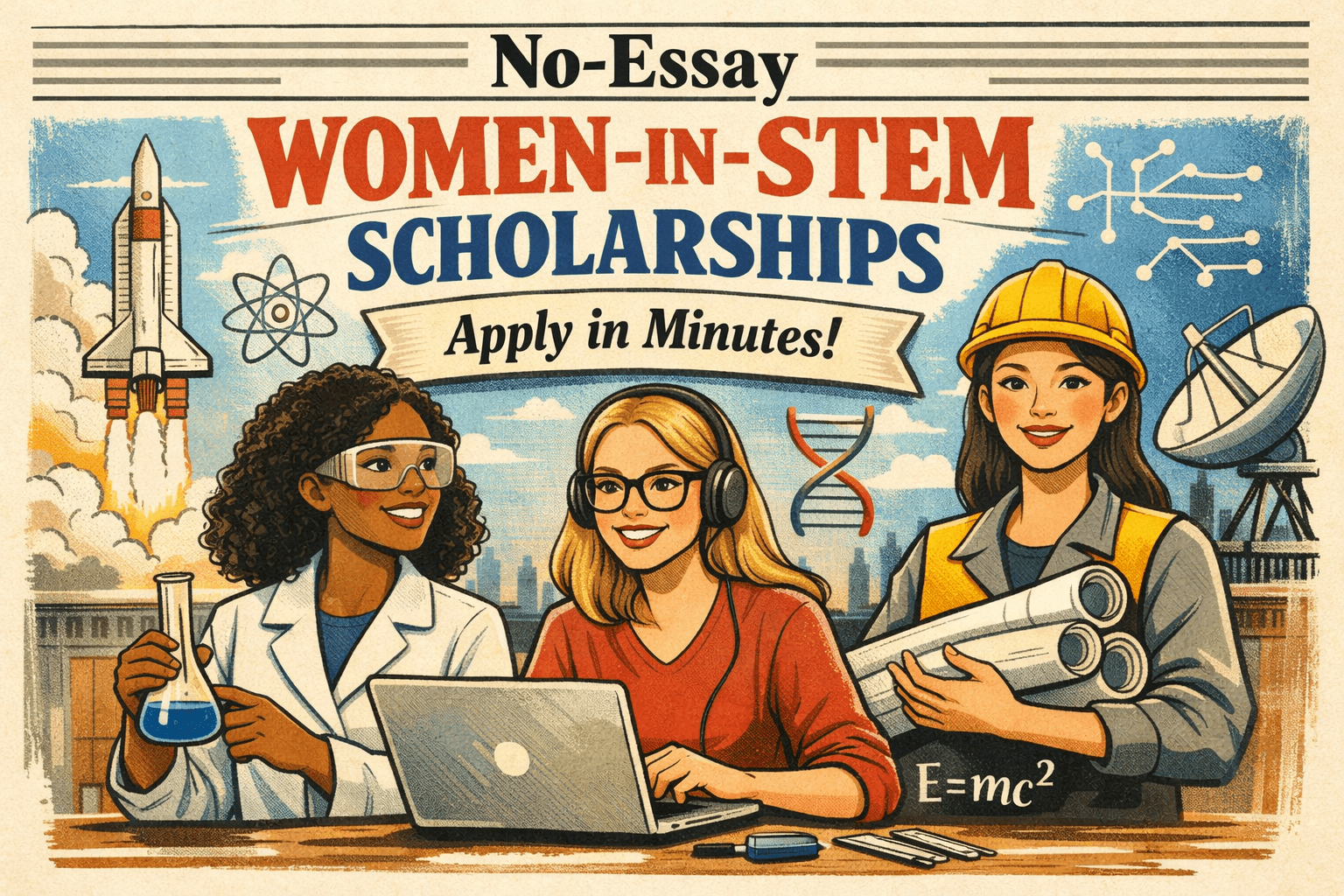
No-Essay Women-in-STEM Scholarships (Apply in Minutes) — Verified Monthly
A curated list of legit, quick-apply micro-awards for women pursuing STEM. Each award is no-essay or ultra-light application. Sorted by month (Jan → Dec). ✅
Scholarships (sorted by month starting January)
1) Niche $2,000 No-Essay Scholarship
💥 Why It Slaps: 2-minute entry; monthly drawing; open to women in STEM (no major restriction).
💰 Amount: $2,000
⏰ Deadline: End of every month (Jan–Dec)
🔗 Apply/info: https://www.niche.com/colleges/scholarships/no-essay-scholarship/
2) ScholarshipOwl $50,000 No-Essay Scholarship
💥 Why It Slaps: Massive pot; one form; rolling monthly awards.
💰 Amount: Up to $50,000 total
⏰ Deadline: End of each month (Jan–Dec)
🔗 Apply/info: https://scholarshipowl.com/scholarships/10000-scholarship
3) ScholarshipOwl $2,025 No-Essay Scholarship
💥 Why It Slaps: Super quick entry; frequent monthly cycle.
💰 Amount: $2,025
⏰ Deadline: End of each month (Jan–Dec)
🔗 Apply/info: https://scholarshipowl.com/scholarships/2025-scholarship
4) Sallie Mae $2,000 No-Essay Scholarship
💥 Why It Slaps: 60-second entry; monthly winner; open to HS/college/grad.
💰 Amount: $2,000
⏰ Deadline: Monthly (Jan–Dec)
🔗 Apply/info: https://www.sallie.com/scholarships/no-essay
5) ScholarshipPoints $2,500 Monthly Scholarship
💥 Why It Slaps: 2-minute signup; one winner every month.
💰 Amount: $2,500
⏰ Deadline: Monthly (Jan–Dec)
🔗 Apply/info: https://www.scholarshippoints.com/
6) Edvisors $2,500 Monthly Scholarship
💥 Why It Slaps: Quick entry; long-running, transparent winner posts.
💰 Amount: $2,500
⏰ Deadline: Monthly (Jan–Dec)
🔗 Apply/info: https://www.edvisors.com/scholarships/featured-scholarships/2500-monthly-scholarship/enter-scholarship/
7) SmarterCollege $2,000 Scholarship (No-Essay)
💥 Why It Slaps: Simple form; monthly draw.
💰 Amount: $2,000
⏰ Deadline: Monthly (Jan–Dec)
🔗 Apply/info: https://www.smartercollege.org
8) Appily “Easy Money” $1,000 Scholarship
💥 Why It Slaps: 2-minute “no essay” entry; monthly.
💰 Amount: $1,000
⏰ Deadline: Monthly (Jan–Dec)
🔗 Apply/info: https://www.appily.com/scholarships/easy-money-scholarship
9) College Ave $1,000 Monthly Scholarship
💥 Why It Slaps: Fast entry; new winner each month.
💰 Amount: $1,000
⏰ Deadline: Monthly (Jan–Dec)
🔗 Apply/info: https://www.collegeave.com/promotions/
10) Nitro $2,000 Scholarship Sweepstakes
💥 Why It Slaps: No-essay; monthly cycle all year.
💰 Amount: $2,000
⏰ Deadline: Monthly (Jan–Dec)
🔗 Apply/info: https://www.collegexpress.com/scholarships/2000-nitro-college-scholarship/5003294/
11) SoFi $2,500 Scholarship Giveaway
💥 Why It Slaps: Quick entry; monthly drawing; open to students and parents.
💰 Amount: $2,500
⏰ Deadline: Monthly (Jan–Dec)
🔗 Apply/info: https://www.sofi.com/scholarships/
12) CollegeVine $2,000 No-Essay Scholarship
💥 Why It Slaps: No essay; just create a (free) profile; runs monthly.
💰 Amount: $2,000
⏰ Deadline: End of month (Jan–Dec)
🔗 Apply/info: https://www.collegevine.com/scholarships
13) Because College Is Expensive (Cedar Education) — $500 (Quarterly)
💥 Why It Slaps: 60-second form; quarterly drawings.
💰 Amount: $500
⏰ Deadline: Mar 31, Jun 30, Sep 30, Dec 31 (annually)
🔗 Apply/info: https://cedaredlending.com/scholarship/
14) CollegeXpress $10,000 Scholarship
💥 Why It Slaps: Classic no-essay drawing; entries accepted year-round; winner drawn in June.
💰 Amount: $10,000
⏰ Deadline: June (annual drawing)
🔗 Apply/info: https://www.collegexpress.com
15) Study.com Scholarship for Women in STEM (Biannual — Women-only, short form)
💥 Why It Slaps: Women-only & STEM-specific; brief application; no essay noted; two cycles per year.
💰 Amount: $500 (2 awards/year)
⏰ Deadline: June 30 and December 15 (annually)
🔗 Apply/info: https://study.com/resources/women-in-stem-scholarship
16) Scholarships360 $10,000 “No-Essay” Scholarship
💥 Why It Slaps: One big award; no essay; open to HS → grad.
💰 Amount: $10,000
⏰ Deadline: June 30, 2026 (current cycle)
🔗 Apply/info: https://scholarships360.org/scholarships/search/10000-no-essay-scholarship/
17) Tallo $2,500 Career Exploration Scholarship
💥 Why It Slaps: No-essay, conversation-based entry via Tallo; quick apply.
💰 Amount: $2,500
⏰ Deadline: Typically monthly; current window shows Sep 30, 2025
🔗 Apply/info: https://app.tallo.com/talent/opportunity/view/1227d7e9-380d-4842-acd3-86576e8146a7
18) Bold.org “Be Bold” No-Essay Scholarship
💥 Why It Slaps: Flagship no-essay; huge award; early applicants favored.
💰 Amount: $25,000
⏰ Deadline: Oct 1, 2025 (recurs annually)
🔗 Apply/info: https://bold.org/scholarships/the-be-bold-no-essay-scholarship/
19) Bold.org — 1000 Bold Points No-Essay Scholarship
💥 Why It Slaps: No essay; focuses on active profiles; rolling.
💰 Amount: $10,000
⏰ Deadline: Rolling; awarded annually (current cycle shows Oct 2026 award)
🔗 Apply/info: https://bold.org/scholarships/bold-org-1000-points-no-essay-scholarship/
20) Bold Rewards No-Essay Scholarship
💥 Why It Slaps: Quick opt-in; rolling monthly deadlines; no essay.
💰 Amount: $1,000
⏰ Deadline: Rolling; (current cycle shows Oct 2026 award)
🔗 Apply/info: https://bold.org/scholarships/bold-rewards-no-essay-scholarship/
No-Essay Women-in-STEM Scholarships: Low-Friction Funding in the U.S. Scholarship Market
“No-essay” scholarships—awards that minimize narrative writing by relying on short forms, profiles, transcripts, or random drawings—have grown in visibility as students and families search for faster, lower-burden ways to pay for college. At the same time, women remain persistently underrepresented across many STEM education and labor-market pathways. In 2021, women accounted for 35% of STEM workers despite representing 47% of the employed U.S. population. This paper synthesizes the empirical landscape of women’s participation in STEM, the scholarship “application burden” literature, and the operational realities of no-essay awards to assess whether (and how) low-friction scholarship designs can support women in STEM—especially those facing intersecting barriers by race/ethnicity, caregiving, work intensity, and first-generation status. We propose a framework that distinguishes (1) random-drawing/sweepstakes scholarships, (2) profile-based platform awards, (3) automatic or near-automatic institutional and association awards, and (4) micro-scholarships tied to verified achievements. We conclude that no-essay scholarships can expand access at the “top of funnel,” but they must be paired with transparency, privacy protections, and a portfolio strategy that includes higher-probability, mission-aligned awards and institutional aid.
1) The problem the market is trying to solve: women’s underrepresentation in STEM is structural, not motivational
National STEM indicators consistently show a gap between women’s overall labor-force representation and their concentration in STEM occupations. In 2021, 24% of U.S. workers held a STEM occupation, but 18% of female workers did—about three-fifths the rate of men (30%). At the degree level, women have made progress in some science and engineering aggregates, but underrepresentation remains acute in high-paying gateway fields such as engineering and computer science. The National Girls Collaborative Project’s 2024 synthesis emphasizes that women earn the majority of bachelor’s degrees overall (about 58%) and about half of S&E bachelor’s degrees, yet remain 35% of the STEM workforce, with even lower shares in several subfields.
This mismatch is widely framed as a “leaky pipeline,” but modern research increasingly stresses where leaks occur and why: differential preparation before college, switching majors during college, and the transition from college to career are major drivers of downstream gaps. Women who begin in STEM are also less likely than men to persist in a STEM major through graduation in some contexts, with attrition associated not only with academic performance but also climate, belonging, and opportunity costs.
Implication for scholarships: If the objective is to strengthen women’s participation in STEM, funding mechanisms are most effective when they reduce (a) financial stress, (b) time scarcity, and (c) uncertainty about affordability—especially at transition points (high school → college, community college → transfer, sophomore → junior in engineering sequences, bachelor’s → graduate school). Scholarships are one lever, but the design of the scholarship application process can either reduce or amplify barriers.
2) “No-essay” is not one thing: a typology of low-friction scholarship designs
The label “no-essay” obscures meaningful differences in selection method, documentation demands, and student risk.
Type A: Sweepstakes / random drawings marketed as scholarships
These awards often require a short form (name, email, school, graduation year) and select winners randomly. They are attractive because they can be completed in minutes; they are also extremely competitive because low effort scales application volume. Consumer-facing scholarship guidance routinely warns that “no-essay” does not mean “easy to win.”
Type B: Profile-based platform awards (light verification; algorithmic or rubric selection)
Some platforms award based on profile completeness, engagement, or platform-specific criteria (e.g., early application or activity). These can still be low-burden compared to multi-essay scholarships but may require sustained participation.
Type C: Automatic or near-automatic institutional and association awards
Many institutions and professional societies award scholarships based on enrollment in a STEM major, GPA thresholds, membership, FAFSA/need criteria, or nomination—sometimes with no essay or only brief statements. Importantly, these awards can have higher “fit” with women-in-STEM goals because they are linked to STEM identity and persistence supports.
Type D: Micro-scholarships for verified achievements
Micro-scholarship models award small amounts for discrete milestones (course grades, leadership, service, etc.). In theory, these can reduce uncertainty by making aid feel incremental and attainable.
3) Why low-friction matters: administrative burden is a real barrier, not a student “soft skill”
A large policy and social-science literature shows that complexity and “administrative burden” reduce take-up of benefits, even when the benefits are valuable. Administrative burden is typically decomposed into learning costs (figuring out what to do), compliance costs (doing it), and psychological costs (stress, stigma, fear of mistakes). In education finance, researchers document how financial aid processes and delays can reduce participation; recent work specifically notes how FAFSA disruptions and broader administrative burdens shape aid access.
No-essay scholarships directly target compliance costs: they trade applicant time and narrative performance for speed and scale. For women in STEM—who disproportionately report time scarcity due to work intensity, caregiving expectations, or “hidden labor” in classrooms and teams—reducing compliance costs can be equity-relevant. However, reduced burden does not automatically mean increased impact.
4) Expected value vs. lived value: the economics of “quick-apply” scholarships
A useful way to evaluate no-essay scholarships is expected value (EV):
EV ≈ (Award Amount × Probability of Winning) − (Time Cost × Value of Time) − (Risk/Privacy Cost)
The challenge is that probability of winning is often unknown because applicant pools are not publicly disclosed. When effort is near-zero, applicant volume can become enormous—making EV small even for large prizes. This does not mean students should never apply; it means no-essay scholarships are best treated as “background applications” (low time, low expectation), while students prioritize higher-probability awards aligned to women-in-STEM pathways (departmental scholarships, society awards, institutional grants, paid research programs).
Platforms do publish specific no-essay scholarship offers and deadlines—illustrating how these scholarships function as scalable marketing and engagement tools as much as financial-aid instruments. From a market design standpoint, these awards are “high reach, low targeting”: they can touch many students, but they often do not strategically allocate funds to the women-in-STEM pipeline stages where persistence is most fragile.
5) What actually moves persistence: evidence from STEM scholarship programs
When scholarships are embedded in programs that also provide mentoring, community, and academic supports, outcomes can improve. NSF’s S-STEM program explicitly aims to increase the number of academically talented, low-income students who graduate in STEM. A 2025 outcomes/impact report on S-STEM scholars emphasizes perceived benefits related to academic success, belonging, and access to opportunities—mechanisms strongly linked to persistence.
Professional societies’ women-focused scholarships show similar logic. A 2024 analysis of Society of Women Engineers (SWE) scholarship recipients investigates persistence and completion, framing “return on investment” not only as dollars distributed but as improved educational pathways and retention in engineering and computer science.
Key takeaway: The strongest evidence for impact is not for “no-essay” per se; it is for financial support + supportive infrastructure. No-essay scholarships can be one entry point, but they rarely provide the wraparound conditions that research suggests drive persistence.
6) Women-in-STEM equity lens: who benefits most from low-friction designs?
Women are not a monolith. Intersectional patterns matter: Latina, Black, and Indigenous women remain underrepresented in STEM degrees and the workforce, even as some indicators improve slowly. If no-essay awards are random drawings open to everyone, they may not correct these disparities unless (a) eligibility is targeted and (b) outreach reaches the communities the scholarship intends to serve.
Low-friction designs can disproportionately help students with limited time, limited advising, or limited confidence in essay writing. But random selection can also reproduce inequality if awareness and access to the application channel are unequal (digital divide, algorithmic visibility, campus advising disparities). In other words: less burden is good; less targeting can be bad.
7) Risk, legitimacy, and the “scholarship-sweepstakes” boundary
No-essay scholarships operate close to the sweepstakes ecosystem and therefore inherit adjacent risks: scams, deceptive marketing, and privacy extraction. The FTC explicitly warns students to watch for scholarship and financial aid scams—especially claims that a scholarship is “guaranteed,” requests for payment to “hold” a scholarship, or demands for sensitive financial credentials. Independent financial-aid guidance similarly flags “you’ve won” scams that demand fees before releasing a prize.
Legitimate sweepstakes and prize promotions must follow truth-in-advertising rules and commonly require disclosures such as “no purchase necessary,” and that payment does not improve winning chances in prize promotions. For scholarship directories and student-facing pages, this implies a duty of care: scholarship listings should label whether an award is (1) random drawing, (2) profile-based, or (3) merit/need-determined; and should advise students on data minimization and scam red flags.
8) A practical framework for a “No-Essay Women-in-STEM” scholarship strategy
A high-performing women-in-STEM scholarship plan treats no-essay awards as one layer in a diversified portfolio:
Layer 1: High-probability, mission-aligned aid (primary focus)
-
Departmental scholarships (women in engineering/CS, women in physics, etc.)
-
Professional society scholarships (SWE, ACM-W chapters, discipline societies)
-
Institution-based grants and automatic consideration awards
-
Research programs that pay (REUs, lab assistantships, co-ops)
Layer 2: Medium-effort, higher targeting (secondary focus)
-
Short-answer scholarships (e.g., “why this major,” “project you built,” 150–300 words)
-
Portfolio or project-based awards (GitHub, robotics, science fair, hackathon)
-
Transfer-pathway and community-college STEM scholarships
Layer 3: No-essay/low-effort applications (background focus)
-
Random drawing / sweepstakes scholarships
-
Profile-based platform awards
-
Micro-scholarships for verified achievements
This structure fits what scholarship advisories commonly recommend: apply to a mix of scholarship types rather than over-indexing on no-essay awards that may be highly oversubscribed.
9) Design recommendations for a student-facing “No-Essay Women-in-STEM” page
For a page like No-Essay Women-in-STEM Scholarships, the goal should be to convert “fast applications” into “smart applications.” Concretely:
-
Disclose the selection mechanism
Label each listing as Random Drawing, Profile-Based, Automatic Consideration, or Merit/Need Review. This helps students reason about EV and prioritize time. -
Add a privacy and legitimacy checklist
Use FTC-aligned red flags: never pay to claim a scholarship; avoid giving SSNs or bank details for entry; beware urgency and guaranteed-win claims. -
Estimate time-to-apply
A simple “2 minutes / 5 minutes / 15 minutes” indicator changes behavior and reduces procrastination—especially helpful for students juggling STEM courseloads. -
Pair every no-essay listing with a “high-fit next step”
Example: after a no-essay scholarship, link to “Women in Engineering scholarships,” “Undergraduate research funding,” “Conference travel grants,” or “S-STEM style campus programs,” reinforcing the evidence that support ecosystems matter. -
Shift from one-off wins to persistence supports
Where possible, highlight scholarships that include mentoring, internships, research placements, or society membership. Evidence suggests these bundled supports influence retention and belonging—two major levers in the STEM pipeline.
Conclusion
No-essay scholarships are best understood as low-friction entry points into a broader college-finance and STEM-persistence strategy. They can reduce compliance costs and help time-scarce students “keep the door open” to funding—an equity-relevant function given the documented role of administrative burden in benefit take-up. But low friction alone does not guarantee pipeline impact. The strongest evidence for improved outcomes comes from scholarships embedded in supportive ecosystems—programs and professional societies that couple funding with belonging, mentoring, and academic scaffolding.
For women in STEM, the most effective scholarship architecture is therefore layered: treat no-essay awards as background applications, while prioritizing targeted, higher-probability scholarships and institutional programs that directly address the known “leaks” in the pipeline (major persistence, transition to workforce, and climate). Done well—and presented transparently—No-Essay Women-in-STEM scholarships can be a powerful on-ramp to more substantive funding and retention supports, rather than a distracting detour into low-odds applications.
Selected references (web sources)
-
NSF NCSES / State of U.S. Science & Engineering (Indicators 2024): women’s STEM workforce shares and related indicators.
-
National Girls Collaborative Project (2024): synthesis on girls/women in STEM and degree/workforce shares.
-
Administrative burden foundations and education-finance burden evidence.
-
SWE scholarship persistence research (ASEE/SWE).
-
NSF S-STEM program description and outcomes report.
-
FTC consumer guidance on scholarship scams and prize promotion disclosures.
Monthly Update (January 2026)
- Re-verified all links and removed stale aggregator/third-party dead ends.
- Confirmed current cycles (most no-essay awards operate on monthly/rolling deadlines; we list the current or typical month to help planning).
- Women-only STEM quick-apply remains limited; the Study.com Women in STEM scholarship is still active with June 30 / Dec 15 deadlines. We’ll keep hunting for additional women-only & no-essay micro-awards and will add them as they launch.