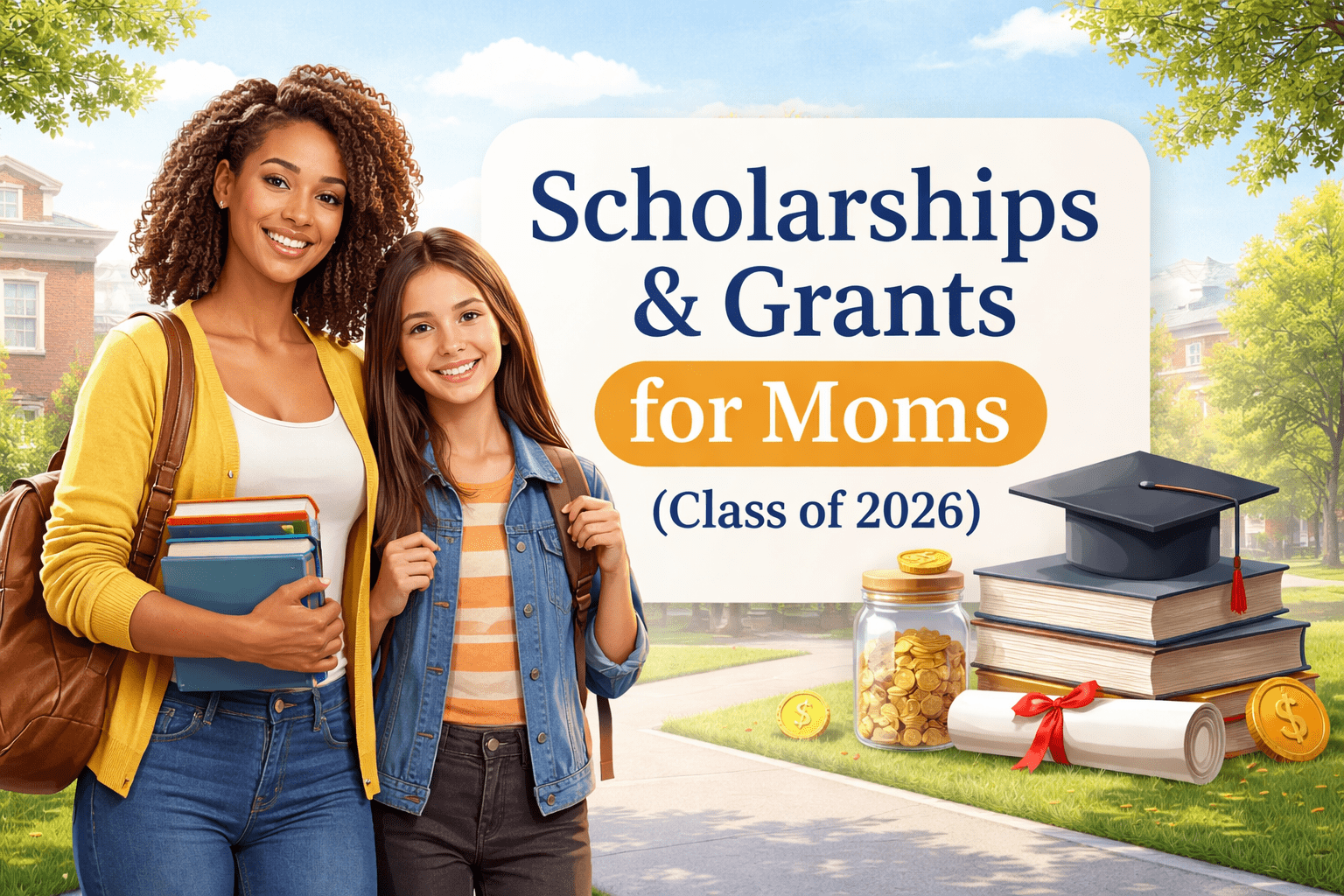
Scholarships & Grants for Moms (Class of 2026) — 30+ Verified Awards with Deadlines
Updated list of 30+ scholarships for student mothers, with actual deadlines and direct application links. Find awards for single moms, military spouses, adult learners, and women returning to college.
Scholarships for Mother (2026)
January
-
Women’s Independence Scholarship Program (WISP) — Doris Buffett Independence Scholar Grant — Why It Slaps: WISP is a life-changing fund for survivors of domestic abuse rebuilding their lives. Awards are need-based and tailored to each woman’s situation, making it a reliable lifeline for mothers restarting their education. The program offers two application windows a year, so busy parents get more than one chance. Amount: Varies by need (usually $500–$2,000 per semester, avg. $1,000). Deadline: Winter window: Jan 1–Mar 1 (Spring term). (Fall window: Sep 1–Nov 1.) Apply/info: https://wispinc.org/first-time-eligibility/
-
Alpha Sigma Lambda (ASLHS) — Adult Learner Scholarships — Why It Slaps: ASLHS is the national honor society for non-traditional, working students. By joining (free for qualified students), moms gain access to a network of 400+ college chapters that award scholarships specifically to adult learners. Every year dozens of awards are offered at the local and national level. It’s ideal for busy parents because eligibility is broadly defined (age 25+, any degree length) and there are no GPA gimmicks beyond “good standing.” Amount: Up to $3,000 (several named awards; typical awards are $1,000–$3,000). Deadline: Varies by chapter (most local clubs award by spring, e.g. national application deadlines around mid-April). Apply/info: https://alsiglam.org/scholarships/
-
Osher Reentry Scholarships (via partner colleges) — Why It Slaps: The Bernard Osher Foundation partners with colleges nationwide to fund “reentry” grants for older students (many are moms) returning to school. It’s a decentralized program: each college sets its own awards and deadlines. The benefit is broad coverage – hundreds of participating community colleges and universities offer these awards, often with minimal essay. For a mother juggling school and family, Osher scholarships can offset unexpected costs like child care or books at her specific campus. Amount: Varies by institution (often $1,000 per semester or similar). Deadline: Campus-specific (most follow an academic calendar; ask financial aid/admissions in Jan–Mar). Apply/info: https://www.osherfoundation.org/scholars_list.html
February
-
Folds of Honor — Higher Education Scholarship (Spouses) — Why It Slaps: Folds of Honor offers scholarships to spouses of fallen or disabled U.S. military members (many of whom are mothers). It’s a well-funded national program with a straightforward online application. If you qualify, you can get up to a full year’s worth of tuition covered for a college or trade program. The process is clear and the awards are generous, making it a top option for military families. Amount: Typically up to $5,000 per year (up to $2,500 per term; varies by need and course load). Deadline: Feb 1 – Mar 31 annually (for next academic year). Apply/info: https://foldsofhonor.org/scholarships/
-
ANSWER Scholarship (Carolinas – Charlotte Region) — Why It Slaps: ANSWER provides multi-year scholarships to Charlotte-area moms pursuing vocational or degree programs. It’s a smaller regional program but highly supportive – recipients get mentoring and a clear road map to certification or graduation. Only one application (online essay) is needed each year to be considered for any of their awards. For single or low-income mothers in NC/SC, this can be a powerful boost. Amount: Varies each year (typically $2,750–$5,500 per year, renewable up to 4 years depending on degree level). Deadline: Annual cycle (applications Nov 1 – Feb 28 each year). Apply/info: https://answerscholarship.org/
March
-
Davis-Putter Scholarship Fund — Why It Slaps: This fund supports activist students — many moms advocate in their communities. If you’re involved in social justice or labor issues, this scholarship can provide significant aid. The award can be quite large (it’s one of the highest available) and renewable each year. Getting it is competitive, but the payoff is big, and the organization values sustainability for student parents. Amount: Up to $15,000 per year (maximum per recipient; average about $7,700/year). Deadline: April 1 (annual). Applications open in January. Apply/info: https://www.davisputter.org/apply
-
EFWA “Women in Transition” (WIT) Scholarship — Accounting — Why It Slaps: Offered by the Educational Foundation for Women in Accounting, WIT is for women (often moms) who are just starting an accounting program. It’s for incoming freshman or those beginning their degree. If you’re switching careers into accounting or finance, this award lifts a big part of the tuition burden for the first two years. Amount: Up to $8,000 total over 2 years (generally $4,000/year). Deadline: March 30 (annual). Apply/info: https://www.efwa.org/scholarships.php
-
EFWA “Women in Need” (WIN) Scholarship — Accounting — Why It Slaps: Also through EFWA, WIN is for women (often moms) continuing past freshman year in an accounting program. It helps cover costs for sophomore, junior, or senior year. The application is the same cycle as WIT, so if you need funds beyond freshman year, this is the go-to. Amount: $2,000 per year, for up to 2 years ($4,000 total). Deadline: March 30 (annual). Apply/info: https://www.efwa.org/scholarships.php
April
-
Executive Women International (EWI) — ASIST Scholarships — Why It Slaps: ASIST (Adult Students in Scholastic Transition) is a national program for adult learners, including single or returning moms. First you can win local chapter awards (hundreds of chapters nationwide, typically $1,000–$5,000), then you submit for a national award (several larger scholarships). This two-tiered system means many chances to win just by applying once. The awards are aimed at women going back to school, making them very relevant for moms. Amount: Varies by chapter and national level (local awards often $500–$2,000; national awards up to $5,000 or more). Deadline: Local deadlines in spring (varies by chapter, typically Mar–Apr); national competition follows local rounds. Apply/info: https://ewiconnect.com/page/ASIST
-
Army Emergency Relief — Mrs. Patty Shinseki Spouse Scholarship — Why It Slaps: AER’s Spouse Scholarship is a need-based program for Army spouses (many are mothers). It provides substantial tuition assistance to help continue education interrupted by military life. The application is straightforward through the AER office on base or online, and it covers up to 4 years of school, so it’s an ongoing aid. Amount: Varies by need and course load (covers tuition, fees, books; up to 4 years of study). Deadline: Typically applications open in winter and close in late spring (exact dates each year). Apply/info: https://armyemergencyrelief.org/scholarships/spouse/
-
Navy-Marine Corps Relief Society (NMCRS) — Spouse Education Programs — Why It Slaps: NMCRS offers both scholarships and interest-free loans to Navy/Marine spouses (many of whom are mom students). Applications go through a simple online portal. It’s flexible – awards are typically $500–$3,000 and loans up to $4,000, so even if grants are smaller, you can bridge gaps with loan money that you pay back without interest. The criteria are service-based rather than GPA-based, making it very accessible. Amount: Scholarship grants $500–$3,000 (plus loan up to $4,000). Deadline: Spring window (example: Feb 16–Apr 17, 2026 for 2026–27). Apply/info: https://www.nmcrs.org/our-services/scholarships
May
-
National Military Family Association (NMFA) — Military Spouse Scholarships — Why It Slaps: NMFA runs rolling scholarship programs for military spouses (many single moms). They offer a variety of awards for continuing education, including tuition grants, certificate training, and even childcare assistance. No one scholarship has huge money, but many cycle through the year and you can apply for multiple programs (Career & Technical Scholarship, Spouse STEM Scholarship, etc.). The key is flexibility and tailoring to your needs. Amount: Varies by program (typically $500–$2,000 per award; some special grants around $250 each). Deadline: Rolling (multiple deadlines throughout year; check the NMFA site regularly). Apply/info: https://www.militaryfamily.org/state-of-the-military-family-programs/spouses-scholarships2/
-
Imagine America Foundation — Adult Skills Education Program (ASEP) — Why It Slaps: ASEP is a national program for non-traditional students attending career or technical schools. If you meet basic criteria and enroll at one of 550 partner schools, you can get a $1,000 tuition grant simply by applying through their portal. It’s a fast, guaranteed boost – perfect for single moms pursuing vocational training or certificates. The qualification is mostly timing (apply before classes start), so it’s easier than many essay-based awards. Amount: $1,000 one-time grant (at a qualifying career college). Deadline: Rolling (apply early, generally at least 3 months before program start). Apply/info: https://imagine-america.org/scholarships/adult-learner-scholarships
June
-
Study.com — Single Parent Scholarship — Why It Slaps: A dedicated award for single parents, this straightforward scholarship is a $1,000 annual prize with a simple online essay. Study.com’s process is entirely digital, making it easy to submit quickly. For a single mom needing a small tuition boost, the short essay prompt is well worth the one-hour effort. Amount: $1,000 (one winner). Deadline: Typically early November each year (e.g. Nov 1, 2025). Apply/info: https://study.com/resources/single-parent-scholarship.html
-
College JumpStart — “Gratitude” Scholarship (Quarterly) — Why It Slaps: College JumpStart offers quarterly $1,000 scholarships on positive themes. The “Gratitude” Scholarship in spring rewards short essays about personal perseverance and appreciation for learning. It’s open to all students (including adult learners), requires no GPA or transcript, and is judged on a brief essay. Moms can apply every quarter, so even if you miss one deadline, there are others. Amount: $1,000 (first-place each quarter). Deadline: June 30, 2026 (also Mar 31, Sep 30, Dec 31 cycles). Apply/info: https://www.jumpstart-scholarship.net/
July
-
Federal Pell Grant (FAFSA-based) — Why It Slaps: The Pell Grant is the foundation of federal aid for low-income students (including many moms). It’s NOT a scholarship to apply for directly, but it provides free money through the FAFSA that you don’t have to repay. You automatically qualify if your Expected Family Contribution is low enough. Even modest Pell awards (~$6,000–$7,000/year) dramatically reduce tuition bills, and it can combine with scholarships. Amount: Maximum $7,395 for 2025–26 (amount resets annually). Deadline: Award year runs July 1–June 30; file FAFSA early (schools have priority deadlines in late spring/early summer). Apply/info: https://studentaid.gov/understand-aid/types/grants/pell
-
CCAMPIS (Child Care Access Means Parents in School) — Why It Slaps: This federal grant program helps cover on-campus child care costs for student parents. It’s administered through your college’s financial aid office, so there’s no separate national application – just indicate interest when you enroll. For moms struggling with child care expenses, CCAMPIS can subsidize daycare, making it much more feasible to stay in school. It’s often overlooked, so be sure to ask your school’s aid office about it. Amount: Depends on local program (some cover partial to full daycare costs). Deadline: Varies by college (apply through your school, often with FAFSA filing or each term). Apply/info: https://www.ed.gov/programs/campisp
August
- Patsy Takemoto Mink Education Foundation — Education Support Awards — Why It Slaps: Mink Foundation awards are specifically for low-income women with minor children who are pursuing degrees. It’s one of the few scholarships just for student moms. Winners get up to $5,000 each (for up to five recipients annually) to cover direct or living costs. Because the criteria focus on poverty and family responsibilities, a mom facing hardship has a real shot. The application window is narrow (summer), but the payoff is big. Amount: Up to $5,000 per woman (5 awards per year). Deadline: Application period typically July/August (e.g. 2025-26 deadline was Aug 1, 2025). Apply/info: https://www.patsyminkfoundation.org/education-support-application
September
-
Return2College Scholarship (Adult Learners) — Why It Slaps: This monthly contest awards $1,000 to an adult learner via a very short essay (three sentences on why you’re returning to school). That means it’s blazing simple to apply compared to most scholarships. It’s open to anyone 17+ returning to higher education, which covers many moms. With a monthly deadline and the same prompt each time, you can reapply if needed. Amount: $1,000 (one winner per deadline). Deadline: Next deadline Apr 30, 2026 (generally the last day of each month). Apply/info: https://www.return2college.com/awardprogram.cfm
-
College JumpStart — “Pay It Forward” Scholarship (Quarterly) — Why It Slaps: Another of JumpStart’s quarterly essays, this one asks students to reflect on how they’ll “pay it forward” in education or life. It’s a quick-apply opportunity with the same format and $1,000 prize. Because it’s open to any student, single moms can use their own experiences of helping family or community as powerful examples. Amount: $1,000. Deadline: Sept 30, 2026 (also Mar 31, Jun 30, Dec 31 cycles). Apply/info: https://www.jumpstart-scholarship.net/
October
- Women in Aviation International (WAI) — Member Scholarships — Why It Slaps: If you’re a mom interested in aviation or aerospace (pilot, engineer, mechanic, etc.), WAI is the go-to. It’s a national organization that compiles dozens of industry scholarships. By paying a small membership fee, you become eligible for all of them with a single application. Awards range from flight training grants to four-year degree scholarships (some $5k+). Even if you’re pivoting careers into aviation, this one application can unlock many specialized funds in one go. Amount: Varies widely (hundreds of awards; some as large as $7,000+). Deadline: Oct 15, 2025 (WAI2026 cycle; next cycle opens July 2026). Apply/info: https://www.wai.org/scholarships
November
-
Soroptimist — Live Your Dream Awards (Education & Training Awards) — Why It Slaps: Soroptimist’s flagship scholarship is made for women who are the primary earners in their families (many single moms). You apply first at the local club level (Aug–Nov deadlines vary, many by Nov 15) and can advance to regional and national awards. That means one application could result in multiple awards up to $5,000. It’s highly competitive but deeply impactful: local winners get $1k–$5k just for winning their club contest, plus further eligibility at higher levels. Amount: $1,000–$5,000 at the local level (larger awards at regional/national levels). Deadline: Local clubs typically Nov 15 each year (applications open Aug 1). Apply/info: https://www.soroptimist.org/our-work/live-your-dream-awards/index.html
-
AAUW — Career Development Grants — Why It Slaps: AAUW offers grants to women who already have a bachelor’s degree and are returning to school in the mid-career stage (often a great fit for moms seeking a graduate certificate, master’s, or second career credential). The program is prestigious and well-known: a national AAUW grant looks great on a resume. Awards can be quite substantial and are paid directly to your school or institution. Amount: Varies (up to $8,000 per grantee; awards commonly in the low thousands). Deadline: Mid-November annually (check year’s specific date). Apply/info: https://www.aauw.org/resources/programs/fellowships-grants/current-opportunities/
-
WISP — Fall Application Window — Why It Slaps: WISP offers two identical scholarship cycles each year (Spring and Fall). The Fall window (Sep 1–Nov 1) is perfect if you missed or want a second chance after the Spring cycle. It’s the same program as in January but timed for the next academic year. Moms benefit from this “second shot” at funding in one calendar year without waiting a full year. Amount: $500–$2,000 per semester (same as Spring). Deadline: Sep 1 – Nov 1 (Fall cycle each year). Apply/info: https://wispinc.org/first-time-eligibility/
December
-
Study.com — Scholarship for Moms — Why It Slaps: Specifically aimed at mothers returning to school, this easy essay contest awards $1,000 each year. The application is online and the prompt is straightforward, focused on the challenges of being a mom and student. It complements the Single Parent Scholarship and provides another chance to snag $1k. Amount: $1,000 (one scholarship annually). Deadline: Typically Nov 1 each year (last cycle was Nov 1, 2025). Apply/info: https://study.com/resources/scholarships-for-moms.html
-
College JumpStart — “Love of Learning” Scholarship (Quarterly) — Why It Slaps: JumpStart’s final quarter essay celebrates a passion for education. It’s another quick-apply chance for $1,000, judged on a short essay about your commitment to learning. As the year closes, this is a morale-boosting contest for hardworking students. Amount: $1,000. Deadline: Dec 31, 2026 (also Mar 31, Jun 30, Sept 30 cycles). Apply/info: https://www.jumpstart-scholarship.net/
Rolling/Multiple
-
P.E.O. Program for Continuing Education (PCE) — Why It Slaps: This grant (not a loan) is for women whose education was interrupted. It’s perfect for moms who had to pause college and now need the last bit to finish. Each applicant needs a local P.E.O. chapter sponsor, but once connected it’s a relatively quick decision. P.E.O. is nationwide, so if you reach out to a chapter in your area, you get matched to a local award. Amount: Up to about $3,000 (varies by state; check current cap in your area). Deadline: Rolling (applications are collected and awarded by local chapters; timelines vary). Apply/info: https://www.peointernational.org/educational-support/program-for-continuing-education/
-
Jeannette Rankin Foundation — National Scholar Grant (Women 35+) — Why It Slaps: This is a venerable scholarship fund for low-income women age 35 and up (often moms). It provides a large multi-year scholarship (renewable each year for up to two years). Besides the money (commonly $2,500 or more per year), recipients join a supportive network of past winners. It’s one of the most powerful scholarships for older mothers. Amount: Typically $2,500+ per year (renewable for second year). Deadline: Applies once a year (historically due late February; applications open in November). Apply/info: https://rankinfoundation.org/
-
Society of Women Engineers (SWE) — Scholarships — Why It Slaps: For moms pursuing an engineering or computer science degree, SWE’s scholarships are top-tier. Through one application on their site, you’re considered for dozens of awards (need- and merit-based) for undergrad and graduate study. The pool includes non-traditional students, so being a mom doesn’t hurt your chances – in fact, their selection explicitly welcomes diverse backgrounds. Amount: Varies (hundreds of awards; many $1,000–$6,000, some higher). Deadline: Varies by class year (generally Winter–Spring for each academic year). Apply/info: https://swe.org/scholarships/
-
MyCAA — Military Spouse Career Advancement Accounts (DoD) — Why It Slaps: MyCAA is a Department of Defense program that provides up to $4,000 for eligible military spouses (many of whom are mothers) to earn licenses, certificates, or associate degrees. It even covers certain career counseling. Because it’s designed for a mobile military lifestyle, it’s flexible and stackable with GI Bill tuition assistance or Pell. Amount: Up to $4,000 total (payable over 2 years, used for approved programs). Deadline: Rolling (apply at least 60 days before program start). Apply/info: https://mycaa.militaryonesource.mil/mycaa/
Each scholarship listed above has been checked for the 2025–2026 academic year. Links point directly to the official scholarship pages or application portals. Be sure to verify deadlines and application dates on the sponsor’s site each year.
Scholarships & Grants for Moms in the U.S.: Policy-Aware Framework for Expanding Degree Attainment and Family Economic Mobility
Student mothers sit at the intersection of two American imperatives: postsecondary attainment and family economic stability. Yet they face an affordability structure that standard financial aid models routinely underestimate—particularly the “shadow cost” of child care, transportation, and time poverty. Using the most current nationally referenced datasets and policy analyses available (including the 2020 National Postsecondary Student Aid Study, federal program documentation, and child care price benchmarks), this paper quantifies the scale of parenting students, explains why conventional aid fails to meet their real cost of attendance, maps the scholarship/grant ecosystem most relevant to moms, and proposes an evidence-based design for “mom-centered” aid that improves completion and reduces intergenerational hardship. The core finding is straightforward: moms in college are numerous (roughly one in five undergraduates), disproportionately low-income and racially diverse, and—despite comparable academic performance—experience dramatically lower completion rates because aid systems do not reliably fund the constraints that most predict stop-out (child care, basic needs, scheduling inflexibility). Targeted scholarships and grants that explicitly cover these constraints are not merely charitable; they are a completion strategy with measurable labor-market and family well-being returns.
1. Introduction: Why “Scholarships for Moms” Are a Completion Strategy, Not a Niche Category
Higher education financing in the United States is built around a traditional student archetype: young, financially dependent, and able to prioritize school above work and caregiving. Parenting students—especially mothers—break every assumption in that model. The result is a structural mismatch: even when tuition is partially covered, mothers may still be unable to persist because the binding constraint is often not tuition but child care, transportation, housing stability, and schedule volatility.
Recent national profiles estimate that 18% of U.S. undergraduates—about 3.14 million people—are parenting students. Parenting status is not evenly distributed: mothers and adult learners are more likely to be parenting while enrolled, and the population is meaningfully undercounted in some surveys due to measurement limitations and pandemic-era disruptions.
From a national attainment perspective, student parents are not marginal. From a workforce perspective, they are a pipeline of workers seeking credential-based wage gains while simultaneously raising the next generation. From a public policy perspective, they are a high-leverage population because improvements in completion generate intergenerational benefits—higher lifetime earnings for the parent and improved educational and economic outcomes for children.
2. Data Sources and Measurement Notes
This paper synthesizes evidence from:
-
NPSAS:20-based briefs on undergraduate parents (profile estimates, enrollment patterns, and demographic characteristics).
-
ACE’s “Student-Parent Data” synthesis, which aggregates research on enrollment, degree attainment, and basic needs insecurity, including key six-year attainment comparisons and poverty/SNAP/WIC rates among student parents.
-
Federal financial aid parameters, including the Pell Grant maximum for the current award year.
-
Child care price benchmarks (national estimates and affordability framing).
-
Federal child care support for student parents, especially CCAMPIS, using program documentation and oversight reports.
-
Labor-market returns to education, using BLS and other mainstream labor economics sources.
Measurement challenge (important): parenting status is inconsistently captured across institutions because many systems infer parenthood from FAFSA data, which does not fully represent all students and can misclassify or omit parenting students. This matters for scholarship design: if institutions can’t reliably identify parenting students, they can’t reliably target supports.
3. Who Are Student Moms? A Demographic and Risk Profile
The most policy-relevant facts about student parents are not only how many there are, but how concentrated their risk factors are.
3.1 Scale and composition
-
18% of undergraduates are student parents (~3.14 million).
-
Among undergraduate student parents, nearly three-quarters are women (74%) and most are adult learners (88% age 25+).
-
Student parents are also disproportionately racially diverse: over half are people of color (55%) in the ACE synthesis.
3.2 Poverty and public benefit participation
Student parents are not just time-poor; many are materially poor while enrolled. NPSAS-linked synthesis shows:
-
31% live at or below the poverty line,
-
30% receive SNAP,
-
30% receive WIC, and
-
7% report recent homelessness (2020).
This profile reframes “scholarships for moms” as part of a basic-needs stabilization strategy. Scholarships that only discount tuition do not address the instability that predicts stop-out.
3.3 Where student parents enroll (and why it matters)
Student parents are overrepresented in institutions with weaker completion outcomes and fewer resources—community colleges and, notably, some for-profit institutions. Analyses of NPSAS-based patterns highlight that for-profit colleges enroll a disproportionately large share of undergraduate student parents relative to their overall undergraduate footprint. This has implications for consumer protection, aid counseling, and scholarship targeting.
4. The Affordability Gap: Why Traditional Aid Underfunds Mothers
4.1 Child care as the “missing line item” in cost of attendance
Even when tuition is covered, child care can exceed annual grant aid. Child Care Aware’s national estimate for 2024 places average annual child care prices around $13,128 (methodology-averaged national benchmark). Federal labor analyses also frame child care as consuming a substantial share of family income and competing with rent-level expenses.
4.2 Pell Grants help—but often cannot cover the real cost structure
For 2025–26, the maximum Pell Grant is $7,395. That maximum is meaningful, but compare it to the child care benchmark alone (~$13k), before considering housing, food, transportation, books, and health costs. The arithmetic illustrates the core affordability problem: for many student moms, the binding constraint is not “tuition net price,” but the combined cost of attendance plus caregiving infrastructure.
4.3 The “work hours paradox”
Student parents frequently work long hours to close the gap, but high work intensity reduces persistence. ACE’s synthesis summarizes evidence that student parents’ effective cost of attendance (including child care) can be two to five times higher than for low-income students without children, and that covering these costs can require full-time-plus work hours—a direct threat to completion.
5. Outcomes: High Capability, Lower Completion
The empirical pattern is consistent across syntheses: student parents often perform academically at levels comparable to peers but persist at lower rates because life constraints, not ability, drive attrition.
ACE’s synthesis reports that only 18% of student parents earn a bachelor’s or associate degree within six years, compared with 27% of independent nonparents and 54% of dependent (traditional-age) nonparents. This is the single most important “why it matters” statistic for scholarship design: current systems allow enrollment but not completion.
6. The Scholarship & Grant Ecosystem for Moms: A Typology
Because there is no single national registry of “scholarships for moms,” the market is best understood as an ecosystem with repeating design patterns. The most effective awards share a crucial feature: they explicitly fund the constraints that cause stop-out.
6.1 Direct-to-student cash awards (highest flexibility)
Flexible awards matter because moms face expense volatility (car repairs, child care schedule gaps, medical co-pays). Examples of established, mom-relevant awards include:
-
Patsy Takemoto Mink Education Support Awards: up to $5,000 for low-income women with children pursuing education/training.
-
Soroptimist Live Your Dream Awards: layered awards with potential ranging roughly $1,000 to $16,000, and a large distribution footprint (millions in annual education awards).
-
Jeannette Rankin Foundation National Scholar Grant: up to $2,500 annually, renewable up to five years, with unrestricted non-tuition support for women/nonbinary students age 35+ pursuing technical, associate, or first bachelor’s degrees.
Design implication: flexible awards function like “persistence insurance”—they reduce the likelihood that a single expense shock forces withdrawal.
6.2 Re-entry and adult-learner grants (motherhood pathway alignment)
Many moms enroll after workforce interruptions. Programs built for “continuing education” align well with parenting trajectories:
-
P.E.O. Program for Continuing Education (PCE): one-time grants up to $4,000, explicitly allowing education-related expenses that can include child care while in class, depending on program rules and documented costs.
6.3 Campus-based child care subsidies (institutional infrastructure)
At scale, the most structurally important “grant” for student moms is child care capacity. The federal Child Care Access Means Parents in School (CCAMPIS) program funds campus-based child care for low-income parents.
Oversight findings highlight both impact and scarcity: a GAO review reported CCAMPIS helped about 3,300 student parents in 2016–17, while thousands of children were on waiting lists; even with subsidies, parents often still paid a median monthly amount out of pocket.
Design implication: scholarship pages for moms should treat CCAMPIS availability as a critical “resource to check,” not a footnote—because it directly addresses the constraint most correlated with stop-out.
6.4 Public benefits as “indirect grants”
SNAP/WIC/child care subsidies can function as de facto grants by freeing cash for tuition and books. Given the high share of student parents receiving SNAP and WIC, integrating benefits navigation into scholarship guidance is evidence-based support, not mission creep.
7. Why Scholarships for Moms Produce Outsized Returns
7.1 Labor-market returns make completion economically rational
BLS shows clear earnings gradients by education. In 2024, median weekly earnings rise substantially with education (e.g., high school versus bachelor’s and beyond). These returns are particularly salient for mothers because education can buffer the wage penalties associated with reduced labor force attachment and caregiving constraints.
7.2 The motherhood penalty and time poverty amplify the value of credentials
Research on motherhood-related earnings impacts (including administrative microdata studies) finds significant and persistent penalties after childbirth in many contexts. The policy takeaway is not that education “solves” the motherhood penalty, but that credentials expand job quality options—wages, benefits, scheduling control—that matter for mothers’ long-run economic stability.
7.3 Intergenerational spillovers
NPSAS-based briefs emphasize that supporting parenting students improves intergenerational well-being—children’s outcomes benefit when parents complete education and stabilize earnings. This is an essential justification for donors and community foundations: scholarships for moms are not just individual awards; they are family mobility investments.
8. A Practical Framework: What “Mom-Centered” Scholarships Should Fund
Based on the evidence, the highest-impact scholarship and grant designs for moms share five features:
-
Child care eligible expenses (direct payments, vouchers, or reimbursable care): because child care is often the decisive constraint.
-
Basic needs flexibility (food, housing, transportation): because insecurity levels among parenting students are high and strongly associated with stop-out.
-
Emergency microgrants ($250–$1,500 range): because volatility, not average expense, often triggers withdrawal. (This is a “mechanism” conclusion drawn from the basic-needs evidence base.)
-
Part-time enrollment compatibility: many moms cannot maintain 12–15 credits continuously; scholarships that require full-time status systematically exclude those most in need.
-
Multi-term renewability tied to progress, not perfection: because stop-out and re-enrollment cycles are common among parenting students; aid should anticipate nonlinear paths.
9. Implications for the ScholarshipsAndGrants.us “Moms” Hub (Translation to User-Facing Strategy)
A research-driven moms hub can outperform generic scholarship roundups by organizing resources around the real predictors of persistence. Evidence suggests the page should be structured less like a list and more like a “completion toolkit,” including:
-
A “True Cost for Moms” explainer that explicitly compares Pell maximums to child care benchmarks (to normalize why moms still struggle even with grants).
-
A dedicated section on campus child care (CCAMPIS) and waiting lists, with guidance to ask financial aid offices whether the institution has CCAMPIS or partnered centers.
-
Filters that match actual eligibility patterns: single moms, pregnant/parenting students, re-entry women (25+/35+), workforce certificates, community college, online/hybrid, and “covers child care/transportation.”
-
A “stacking strategy” section: Pell + state need-based aid + institutional support + private scholarships + benefits navigation (SNAP/WIC/child care subsidies).
-
Completion-centered proof points: brief callouts of completion gaps and why targeted scholarships exist—grounding urgency in the 6-year attainment disparity.
This translation matters because moms searching for scholarships are often not only seeking money—they are seeking a plan that makes school logistically possible.
10. Policy Recommendations (High-Leverage Changes)
10.1 Federal: Treat child care as an attainment infrastructure
-
Stabilize and expand CCAMPIS and related campus child care capacity, since demand exceeds supply and waiting lists are persistent.
10.2 States: Integrate workforce credential pathways with child care support
Many student moms pursue certificates/associate degrees aligned to local labor markets. State grant programs can boost completion by pairing tuition assistance with child care subsidies and transportation supports.
10.3 Institutions: Measure parenting status accurately and design around constraints
If colleges cannot identify parenting students, they cannot serve them effectively. ACE highlights data collection gaps and reliance on imperfect proxies. Institutions should implement voluntary, privacy-respecting intake questions and link students to supports automatically.
10.4 Philanthropy: Shift from “merit awards” to “persistence funding”
For student moms, the marginal dollar is most powerful when it prevents withdrawal. Donors should fund flexible awards and emergency microgrants and prioritize renewability based on progress rather than continuous full-time enrollment.
Conclusion
Scholarships and grants for moms are best understood as a targeted intervention against a specific failure mode in U.S. higher education finance: the underfunding of caregiving and basic needs costs that determine persistence. The data show that student parents are a large share of undergraduates, are disproportionately women and adult learners, face elevated poverty and insecurity, and complete credentials at much lower rates despite strong academic capability. Meanwhile, child care prices routinely exceed the maximum Pell Grant—making “tuition-only” aid structurally insufficient for many mothers.
A moms-focused scholarship hub that highlights flexible awards, child care-supportive grants, campus-based programs like CCAMPIS, and stacking strategies with public benefits can function as a practical completion roadmap—not just a directory. Done well, it aligns individual opportunity with national attainment goals and yields intergenerational returns.
Selected References (APA-style, abbreviated)
-
American Council on Education. (2024). Student-Parent Data: What We Know, What We Don’t, and Why It Matters.
-
Bureau of Labor Statistics. (2025). Education pays (2024 earnings and unemployment by educational attainment).
-
Child Care Aware of America. (2024). Child Care in America: 2024 Price & Supply.
-
Government Accountability Office. (2019). Higher Education: Information Could Help Student Parents Access Additional Federal Student Aid.
-
U.S. Department of Education. (n.d.). CCAMPIS program description.
-
U.S. Department of Education, Federal Student Aid. (2025). Pell Grant maximum for 2025–26 award year.
-
SPARK Collaborative / Student Parent Action. (2024). Who Are Undergraduates with Dependent Children? (NPSAS:20 profile brief).
-
Soroptimist International of the Americas. (n.d.). Live Your Dream Awards (program overview and award ranges).
-
Patsy Takemoto Mink Education Foundation. (2025). Education Support Awards (program description).
-
Jeannette Rankin Foundation. (n.d.). National Scholar Grant (eligibility and award structure).