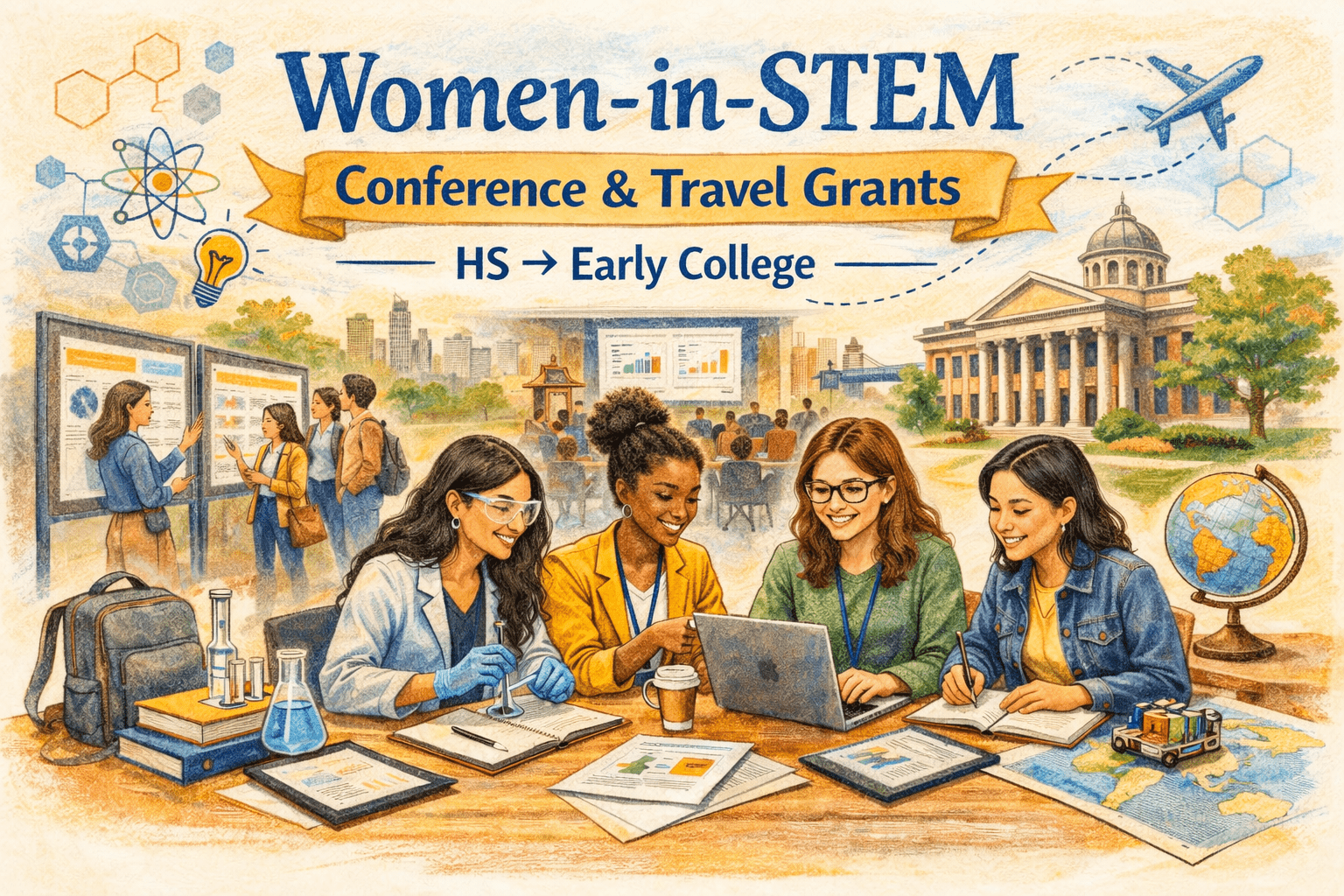
Women-in-STEM Conference & Travel Grants (HS → Early College) — Verified Deadlines & Official Links
Funding for STEM camps, conferences, and travel for high-school women and early-college students. 20+ legit programs with amounts, deadlines, and direct apply links.
Quick Picks & Tags to Help You Choose
- 🧪 Chem/Stats/Data: CWS • WSDS • ABRCMS
- 🤖 Computing/AI/Cyber: ACM-W • Google • WiCyS • Tapia • IEEE WIE/IEEE RAS • WISP/Hacker Summer Camp • DiviQ • OpenInfra • LF/CNCF
- 📐 Math/Physics: NCUWM • CUWiP
- 🚀 High School–Only: NASA HAS (TX) • MITES • NCWIT HS
- 🌍 Covers Travel + Hotel + Reg (package): Tapia • ABRCMS • SACNAS • WISP/HSC • IEEE RAS IDEA • Often OpenInfra/LF events
- 💸 Fixed Amounts: ACM-W ($600/$1,200) • IEEE WIE (up to $750) • IEEE RAS IDEA (up to $3,300) • DiviQ (up to $1,500) • Field Inclusive (up to $2,000) • WE25 finalists ($500)
ACM-W Computer Science Research Conference Scholarships
💥 Why It Slaps: Simple, global travel stipends just for attending a CS research conference (no paper required).
💰 Amount: Up to $600 (intra-continental) / up to $1,200 (intercontinental).
⏰ Deadline: Multiple cycles yearly (e.g., Feb/Apr/Jun/Aug/Oct/Dec).
🔗 Apply/info: https://women.acm.org/scholarships/
WECode (Harvard) Scholarships & Financial Aid
💥 Why It Slaps: Women-led CS conference with fee waivers and travel help for students.
💰 Amount: Registration aid + limited travel/housing support (varies).
⏰ Deadline: Typically early January.
🔗 Apply/info: https://www.wecodeconference.com/scholarships-housing
NASA SEES (High School) – Travel Scholarships for Summer Internship (UT Austin)
💥 Why It Slaps: HS interns get to do real NASA Earth/space projects; limited travel scholarships available.
💰 Amount: Travel scholarship (varies).
⏰ Deadline: Typically around Feb 1.
🔗 Apply/info: https://www.csr.utexas.edu/education-outreach/high-school-internships/sees/
ACM Richard Tapia Celebration Scholarships (CMD-IT)
💥 Why It Slaps: Full package (reg, travel, hotel) for underrepresented students in computing—women are strongly encouraged.
💰 Amount: Typically covers registration, airfare, and hotel (package).
⏰ Deadline: Usually spring; varies by conference year.
🔗 Apply/info: https://tapiaconference.cmd-it.org/
Google Conference Scholarships (North America)
💥 Why It Slaps: Stipends to attend selected tech conferences; women are priority.
💰 Amount: Stipend varies by region/event.
⏰ Deadline: Rolling; several windows per year.
🔗 Apply/info: https://www.google.com/about/careers/applications/buildyourfuture/scholarships
WiCyS Annual Conference Student Scholarships (Cybersecurity)
💥 Why It Slaps: Registration + 3 nights of lodging; need-based travel stipends often available.
💰 Amount: Registration + hotel; travel stipend may be provided (varies).
⏰ Deadline: Typically Jan–Feb.
🔗 Apply/info: https://www.wicys.org/events/wicys-2025/conference-scholarships/
MITES (MIT HS Programs) – Need-Based Travel Assistance
💥 Why It Slaps: Competitive, free STEM summer programs for HS students; need-based travel help available.
💰 Amount: Travel assistance (varies by need).
⏰ Deadline: Applications usually due mid-winter.
🔗 Apply/info: https://www.mit.edu/oeop/programs/mites
IEEE Women in Engineering (WIE) – Travel Grants
💥 Why It Slaps: Women IEEE student members can get travel funds to present at IEEE conferences/WIE events.
💰 Amount: Up to $750 (typical program cap; event-specific).
⏰ Deadline: Varies by event; rolling calls.
🔗 Apply/info: https://wie.ieee.org/grants-scholarships/travel-grants/
APS CUWiP (Conference for Undergraduate Women in Physics) – Travel Support
💥 Why It Slaps: Regional physics conferences for undergrad women; hosts cover meals/lodging; departments often fund travel.
💰 Amount: Housing/meals covered by host; travel funding via home department (varies).
⏰ Deadline: Registration window typically Aug–Oct.
🔗 Apply/info: https://sites.google.com/view/cuny-cuwip2024
ABRCMS Student Travel Awards (Biomedical/Behavioral Research)
💥 Why It Slaps: Full travel packages for student presenters (community college, undergrad, post-bacc, grad).
💰 Amount: Full awards cover registration, hotel, and travel; partial awards available.
⏰ Deadline: 2025 Student Travel Award deadline was Sept 5 (future cycles similar).
🔗 Apply/info: https://abrcms.org/present-at-abrcms/apply-for-a-travel-award/
SACNAS NDiSTEM Student Travel Scholarships
💥 Why It Slaps: Registration + travel + lodging packages to the nation’s largest DEI STEM meeting; women strongly encouraged.
💰 Amount: Package award (registration, travel, hotel; varies).
⏰ Deadline: Typically late spring/early summer.
🔗 Apply/info: https://www.sacnas.org/conference/travel-scholarships
Caucus for Women in Statistics (CWS) Student Travel Grants
💥 Why It Slaps: Multiple $500 student travel awards annually (includes WSDS).
💰 Amount: $500 (typical award).
⏰ Deadline: Common cycles include late May and late Aug (varies by award).
🔗 Apply/info: https://cwstat.org/cws-travel-awards-2/
ASA Women in Statistics & Data Science (WSDS) – Student & Early Career Travel Awards
💥 Why It Slaps: Travel help to the ASA WSDS conference; ideal for stats/data-science students.
💰 Amount: Travel/registration support (varies by year).
⏰ Deadline: Application window typically May–June.
🔗 Apply/info: https://ww2.amstat.org/meetings/wsds/2025/scholarships.cfm
IEEE Robotics & Automation Society WIE IDEA Travel Support
💥 Why It Slaps: One of the largest single-award caps; designed to help women attend top robotics conferences.
💰 Amount: Up to $3,300 (registration, travel, accommodation).
⏰ Deadline: Typically tied to ICRA/IROS/CASE cycles.
🔗 Apply/info: https://www.ieee-ras.org/women-in-engineering/idea-travel-support
Nebraska Conference for Undergraduate Women in Mathematics (NCUWM) – Travel Support
💥 Why It Slaps: Undergrad-focused math conf with built-in support to offset travel costs.
💰 Amount: Partial travel support; housing/registration assistance (varies).
⏰ Deadline: Registration opens in fall; travel funding requests during registration.
🔗 Apply/info: https://math.unl.edu/ncuwm-travel/
OpenInfra Summit – Travel Support Program (Open Source/Cloud)
💥 Why It Slaps: Travel/hotel/registration support to attend OpenInfra Summits; diversity strongly prioritized.
💰 Amount: Travel support package (varies by event).
⏰ Deadline: Typically 8–10 weeks before the event.
🔗 Apply/info: https://openinfra.org/summit/
Linux Foundation / CNCF – Scholarships & Dan Kohn Travel Fund
💥 Why It Slaps: Many LF/CNCF events (e.g., KubeCon) offer registration scholarships + dedicated travel funding windows.
💰 Amount: Travel funding often up to $1,000–$1,500 reimbursements (event-specific).
⏰ Deadline: Event-specific (often 1–3 months pre-event).
🔗 Apply/info: https://events.linuxfoundation.org/kubecon-cloudnativecon-north-america/attend/scholarships-travel-funding/
Women in Security & Privacy (WISP) – Hacker Summer Camp Scholarships (Las Vegas)
💥 Why It Slaps: Scholarships for The Diana Initiative, DEF CON, Black Hat, and SquadCon—includes passes and travel assistance/hotel nights.
💰 Amount: Full passes + 3–6 hotel nights; travel assistance (varies).
⏰ Deadline: Spring/early summer (varies by year).
🔗 Apply/info: https://www.wisporg.com/scholarships/hackersummercamp2025
The Diana Initiative (Cybersecurity) – Student Scholar Support
💥 Why It Slaps: Diversity-driven security conf with student scholar slots that include hotel and on-site support.
💰 Amount: Hotel nights + passes; some travel assistance (varies).
⏰ Deadline: Late spring/early summer.
🔗 Apply/info: https://www.dianainitiative.org/
DiviQ (SandboxAQ) – Student Travel Grants (Quantum)
💥 Why It Slaps: Clean, student-friendly travel grants for quantum conferences.
💰 Amount: Up to $1,500.
⏰ Deadline: Typically early summer; varies by call.
🔗 Apply/info: https://www.diviq.org/travel-grants
Field Inclusive – Student Travel Awards (Field Sciences/Bio/Geo/etc.)
💥 Why It Slaps: DEI-centered travel funding for students to attend/present at field-based STEM meetings.
💰 Amount: Up to $2,000.
⏰ Deadline: Cycles vary (often spring/summer).
🔗 Apply/info: https://www.fieldinclusive.org/student-travel-awards/
NCWIT Aspirations in Computing – National Award (HS + Collegiate)
💥 Why It Slaps: National HS winners receive a paid trip to the national celebration; collegiate awards also offer funds and visibility.
💰 Amount: Trip coverage for national HS winners; other prizes vary.
⏰ Deadline: HS award typically late Oct; Collegiate often mid-Nov (varies).
🔗 Apply/info: https://www.aspirations.org/award-programs/aic-collegiate-award
NASA High School Aerospace Scholars (HAS – Texas)
💥 Why It Slaps: Selected Texas juniors get a paid, residential NASA experience; program covers travel for the on-site experience.
💰 Amount: Travel/lodging/meals for on-site experience (value varies).
⏰ Deadline: Typically fall (applications open early in school year).
🔗 Apply/info: https://www.nasa.gov/education/high-school-aerospace-scholars/
IEEE WIE at Specific Conferences (Examples)
💥 Why It Slaps: Additional event-specific women’s travel grants appear across IEEE conferences (e.g., ISAF/ICC/GLOBECOM).
💰 Amount: Often up to $1,000 (varies by event).
⏰ Deadline: Event-specific (e.g., May 1 for ISAF 2025 call).
🔗 Apply/info: Example call: https://wie.ieee.org/industry/industry-experts-network/
WE25 (SWE) Collegiate Rapid-Fire/Poster – $500 Travel Stipend (Finalists)
💥 Why It Slaps: If your project is selected for finals at SWE’s annual WE conference, you’ll get a travel stipend plus conference exposure.
💰 Amount: $500 travel stipend for finalists (plus registration benefits).
⏰ Deadline: Mid-year (varies by WE cycle).
🔗 Apply/info: https://swe.org/awards/collegiate-competitions/
Women-in-STEM Conference & Travel Grants: A Data-Driven Research Synthesis, Program Landscape, and Design Framework (≈2,000 words)
Abstract
Women-in-STEM conference and travel grants are a targeted “mobility intervention” that reduces financial and structural barriers to professional visibility, mentoring access, and network formation—three inputs strongly associated with persistence and advancement in STEM career pathways. The need is measurable: women accounted for 35% of U.S. STEM workers in 2021, and women received only 24% of engineering and 22% of computer & information science bachelor’s degrees (2021), indicating persistent field-level underrepresentation even before graduate training and workforce entry. Globally, women remain less than one-third of researchers and hold about 22% of STEM jobs in G20 countries, with STEM graduation shares around 35%—a pipeline that narrows as careers progress. This paper synthesizes the empirical rationale for conference participation support, maps today’s travel-grant ecosystem (professional societies, federal pass-throughs, universities, and philanthropy), and proposes evidence-aligned program design and evaluation metrics—especially relevant to women, caregivers, disabled scientists, and those facing visa or institutional funding constraints. We conclude with a practical framework for both applicants and grantmakers to maximize equity, impact, and accountability.
1) Why conference travel grants matter in 2026: the macro problem behind a micro-grant
Underrepresentation is not just a headcount issue; it is also an opportunity structure issue. In the U.S., women’s participation in STEM occupations remains materially lower than men’s; women are underrepresented across many STEM subfields and are especially underrepresented in engineering and computing degree pipelines. At the global level, UNESCO continues to report stagnation in women’s representation among researchers and STEM jobs, underscoring that attrition and “glass ceiling” dynamics are not localized phenomena.
Conferences are one of the main labor-market and knowledge-market clearinghouses in STEM: they are where researchers signal competence (talks/posters), build collaborations, meet editors and program officers, and access hiring channels. The constraint is that conference participation is often pay-to-participate: registration, flights/ground transport, lodging, poster printing, and foregone caregiving or work time. Even a “modest” conference can exceed a student’s monthly discretionary budget—making attendance highly sensitive to short-run liquidity constraints, departmental norms, and advisor resources.
Travel grants therefore function as high-leverage, low-cost equity instruments: by subsidizing a specific professional action (conference participation), they can create durable downstream benefits (mentoring ties, collaborations, reference letters, internships/jobs, and greater field visibility). Their policy relevance has increased as conferences hybridize: virtual formats improve accessibility but do not fully substitute for in-person networking and recruitment benefits, and hybrid conference design raises new equity and sustainability tradeoffs.
2) Mechanisms of impact: how a travel grant becomes “career capital”
Conference travel support affects outcomes through five primary mechanisms:
(A) Visibility and signaling
Presenting a paper/poster is a high-information signal—especially for early-career participants with limited publication histories. Many travel-grant programs explicitly prioritize presenters, which tightens the link between funding and scholarly dissemination (e.g., IEEE and ACM-linked grants frequently require presenting-author status).
(B) Mentoring and developmental networks
National Academies’ synthesis work on mentorship in STEMM emphasizes that access to multiple mentors and developmental networks is consequential for career progress—conferences are one of the most scalable “network access points.” Travel grants can be seen as interventions that buy entry into these networks.
(C) Collaboration formation
Empirical work on inclusion and conference design consistently treats conferences as network engines; travel awards are a direct lever to broaden who can enter and benefit from that network.
(D) Belonging and identity safety
Women and underrepresented groups frequently report climate barriers in STEM contexts. Conference participation—especially at identity-supporting convenings—can improve belonging and persistence, particularly when paired with structured mentoring or cohort models.
(E) Access to recruiting markets
Many STEM conferences serve as recruiting hubs (career fairs, on-site interviews). Travel grants can therefore affect employment outcomes even when scholarly outputs are not immediate.
3) The cost structure: what applicants actually need to fund
Conference costs are predictable enough to model. Typical expense categories include: registration, transportation, lodging, meals/per diem, local transit, and incidentals. Even travel grants that look “small” can be decisive if they cover the most binding constraint (often registration or airfare).
Concrete policy signals from current programs illustrate real-world cost expectations:
-
Registration + travel combined caps around $1,200 appear in NSF-supported student travel grant structures for some conferences (e.g., “maximum $1,200”).
-
Conference organizers sometimes set lodging policy expectations such as hotel rate caps (e.g., $350/night), which shapes realistic budgets.
-
Larger caps exist in some computing conferences: travel grants typically capped around $2,500 in at least one major ACM venue.
-
IEEE conference travel grants can range (example: minimum around $700 with stated maximums depending on eligible candidates).
Implication: an effective portal page should teach applicants to budget and “stack” support: departmental funds, advisor grants, society travel awards, DEI offices, and conference-specific grants.
4) Landscape of Women-in-STEM travel funding: a typology
Travel-grant opportunities cluster into four main channels:
4.1 Professional societies (membership-based and field-based)
These programs are often stable, recurring, and aligned with field identity.
-
ACM-W: scholarships up to $600 (intra-continental) and $1,200 (intercontinental) for women in computing research conference travel, often encouraging departmental matching.
-
IEEE Women in Engineering (WIE): travel grants up to $750 for members to attend/present at IEEE-sponsored conferences or WIE events.
These amounts are meaningful because they frequently cover either registration or a major portion of airfare for domestic travel.
4.2 Computing-focused and pathway programs (cohort and research pipeline)
Some programs explicitly target structural barriers and include higher caps:
-
CRA-WP Travel Support for URMs in Research Labs: up to $2,000 per trip ($3,000 for international conferences) for eligible participants.
-
CRA/related funding examples show recurring “up to $2,000 reimbursements” models for approved awards.
-
Program-specific limits (e.g., conference co-author attendance support) can be around $750–$1,000 in some pipeline contexts.
These programs matter because they directly address unequal departmental funding landscapes across institutions.
4.3 Conference-linked NSF “student travel awards” (pass-through structures)
A common model is NSF-supported travel funding administered by conference organizers, sometimes first-come-first-served, often requiring U.S. affiliation and/or trainee status.
-
Example structure: NSF funding to cover registration + travel with a maximum $1,200 for eligible participants.
This channel is significant but can be administratively complex, especially for reimbursement-based systems.
4.4 Philanthropy and “constraints-specific” supports (childcare, caregiving, accessibility)
A critical frontier in equity is funding that targets why travel is difficult, not only the travel itself.
-
The Elsevier Foundation New Scholars work included Travel Childcare Awards enabling women STEM faculty to attend conferences while caring for young children—an explicit recognition that caregiving costs are a participation barrier.
Design insight: expanding “dependent care + accessibility” eligible costs can convert a travel grant from symbolic to truly enabling.
5) Evidence from society-based travel award practice: what works (and what’s missing)
A key evidence base comes from analyses of scientific society programs. Segarra and colleagues (ACCESS network) document how societies implement travel awards for underrepresented trainees and emphasize that travel awards are most effective when paired with intentional programming (mentoring, structured networking, professional development) and when outcomes are assessed beyond attendance counts.
The main lesson: funding attendance is necessary but not sufficient. The marginal impact rises when organizers deliberately convert attendance into relationship-building and career development.
6) Hybrid/virtual conferences: equity gains, equity gaps
Virtual and hybrid conferences can reduce cost barriers and expand access for those with caregiving responsibilities, disabilities, limited visas, or limited institutional support. The literature notes that virtual formats can increase accessibility and reduce inequities associated with in-person travel, while also changing the cost and carbon footprint calculus. Hybrid conferences can create more inclusive knowledge exchange spaces, but only if they avoid “second-class virtual participation” (e.g., limited networking access).
At the same time, recent work on conference travel behavior highlights persistent demand for in-person conferences even amid climate concerns and sustainability policies—suggesting that travel grants will remain relevant, but must be integrated into broader institutional strategies.
Practical implication for grant design: offer two tracks of support—(1) in-person travel awards and (2) virtual/hybrid participation awards (registration + technology + childcare coverage during key sessions).
7) The compliance layer grantmakers can’t ignore: “participant support costs” and reimbursement realities
For U.S.-funded programs, the administrative category matters. NSF defines participant support costs as direct costs such as stipends/subsistence, travel allowances, and registration fees for participants/trainees in connection with conferences or training projects. Federal definitions (eCFR) align: participant support costs include items like stipends, travel allowances, and registration fees paid to or on behalf of participants (not employees).
Why applicants care: reimbursement-only models can exclude the very people the awards target (students without credit cards, trainees without cash reserves). For equity, grantmakers should prefer:
-
direct payment of registration,
-
prepaid lodging blocks, or
-
advance disbursement options when allowed.
8) A data-driven design framework for high-impact Women-in-STEM travel grants
Below is an evidence-aligned framework that a grant program (or a curated portal page) can use to describe “what great looks like.”
8.1 Eligibility that matches the problem
-
Prioritize trainees (HS research programs, undergraduates, grad students, postdocs, early-career professionals) where marginal returns are high.
-
Explicitly include caregivers and disabled applicants by making eligible expenses broad (dependent care, accessibility services).
8.2 Award sizing and tiers
Use transparent tiers anchored in real cost bands visible in current programs:
-
$500–$750: common society-level support (e.g., IEEE WIE up to $750).
-
$600 / $1,200: intra/intercontinental computing model (ACM-W).
-
$1,200: typical NSF-linked student travel cap seen in conference-administered grants.
-
$2,000–$3,000: higher-cap supports for substantial barriers (e.g., CRA-WP travel support).
-
Up to ~$2,500: some conference travel-grant caps in computing.
8.3 Pair travel funding with “conversion programming”
Adopt the society best-practice lesson: pair awards with structured activities (mentor matching, cohort meetups, “how to network” prep, and post-conference debrief).
8.4 Equity-by-design features
-
Childcare/dependent care add-ons (modeled by travel childcare awards).
-
Accessibility and anti-harassment safeguards.
-
Visa/geo constraints: allow virtual participation awards when travel is impossible.
9) Evaluation: how to measure whether travel grants actually move the needle
Many programs stop at “# awards given.” That’s insufficient. A rigorous evaluation stack should include:
Short-term (0–3 months):
-
Attendance + presentation completion (talk/poster delivered).
-
New mentoring contacts (count + role diversity: peers, faculty, industry).
-
Skill gains (self-efficacy, clarity of next steps).
Medium-term (6–18 months):
-
Publications submitted/accepted stemming from conference feedback.
-
New collaborations (co-authorship, project start).
-
Internships/interviews/offers attributable to conference participation.
Long-term (2–5 years):
-
Retention in STEM training and occupation.
-
Promotion milestones (PhD progression, postdoc-to-faculty, industry leveling).
-
Leadership participation in societies (committee roles, session chairing).
The ACCESS society work argues for both short- and long-term assessment and for coupling travel awards with programmatic activities to improve outcomes.
10) Practical guidance for applicants (what a high-performing portal page should teach)
A Women-in-STEM conference/travel-grant page becomes dramatically more useful when it coaches applicants to behave like “funding optimizers.” Key guidance:
-
Build a defensible budget: registration + airfare/ground + lodging + meals + incidentals (use the conference’s hotel caps and policy constraints when available).
-
Stack funding: apply to (a) conference travel awards, (b) society grants (ACM-W, IEEE WIE), (c) departmental/professional development funds, (d) DEI or graduate school travel funds, (e) employer support.
-
Position the “why now”: emphasize presenter status, career stage, and concrete outcomes (mentor meetings planned, recruiting goals).
-
Demonstrate conversion readiness: include a 3–5 sentence “conference plan” (sessions, people to meet, deliverables).
-
Close the loop: after attendance, produce a brief report (what you learned, contacts made, next steps). This improves renewal likelihood and supports program evaluation.
Conclusion
Women-in-STEM conference and travel grants are not merely assistance; they are strategic access instruments that convert talent into opportunity by lowering the cost of entry into the professional networks and visibility channels that shape STEM careers. Persistent gender gaps in STEM degrees, workforce participation, and global research representation suggest that opportunity barriers remain structurally embedded, not fully solvable by individual effort alone. The most effective travel-grant ecosystem in 2026 will be the one that (1) aligns award sizing to real cost bands, (2) funds constraints like childcare and accessibility, (3) pairs travel with structured mentoring/cohort programming, and (4) evaluates outcomes across time horizons. By treating travel grants as a measurable intervention—rather than a goodwill gesture—grantmakers and applicants can jointly increase the return on each funded trip: more presentations delivered, more collaborations formed, more women retained and advanced, and ultimately a stronger and more equitable STEM system.