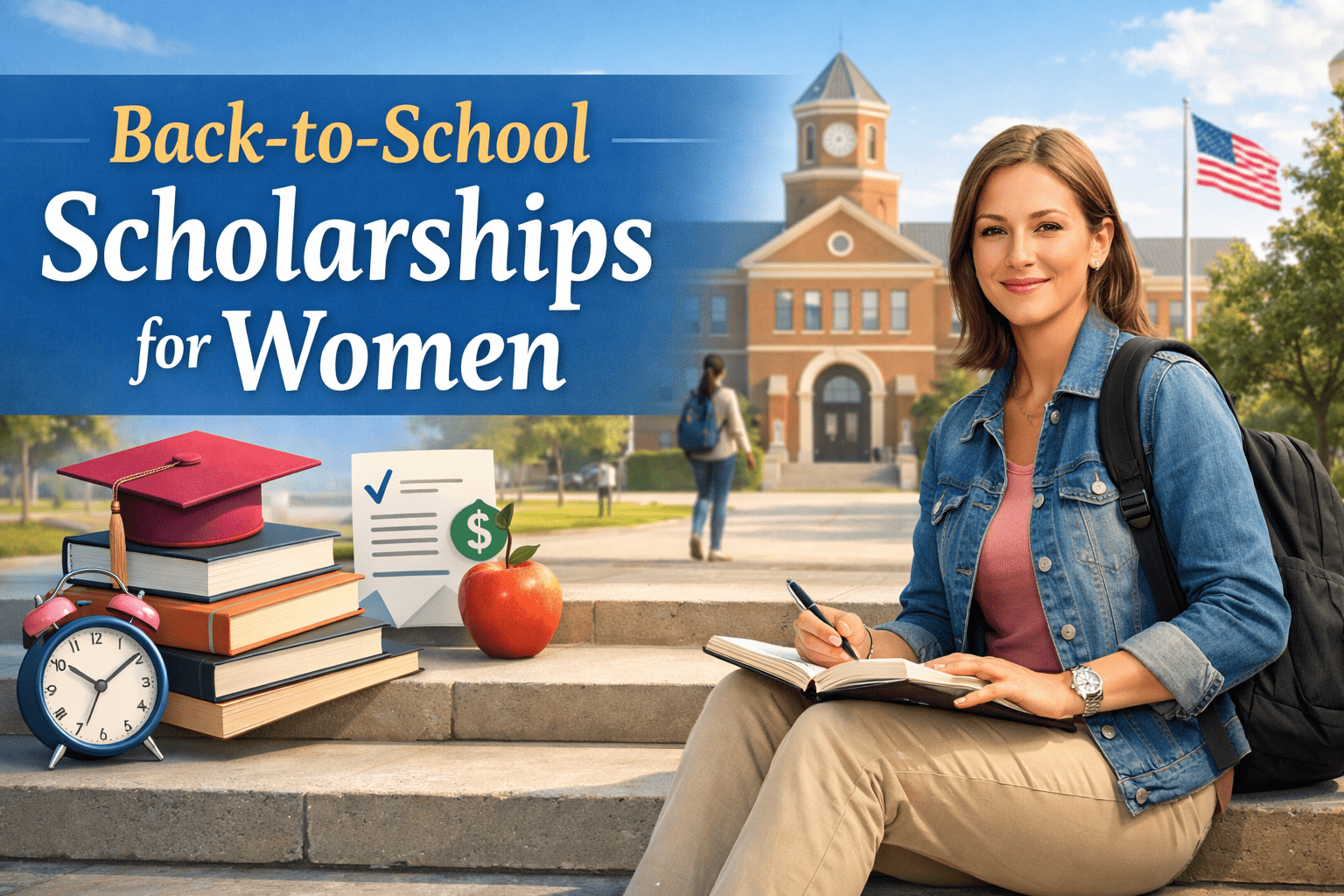
Back-to-School Scholarships for Women (Adult, Re-entry & Moms) — Deadlines & Verified Links
Top scholarships and grants for women returning to school in 2026. Detailed guide with amounts, deadlines, and links to applications for adult women, single moms, survivors, and career-changers.
Top 30 Scholarships:
-
WISP – Doris Buffett Independence Scholar Grant (Women’s Independence Scholarship Program)
Why It Slaps: Provides much-needed relief for survivors of intimate partner abuse returning to school. WISP awards semester grants ($500–$2,000) to help cover tuition and related costs as women rebuild their lives. The focus on survivors’ unique needs (financial aid, separation from abuser, etc.) means students get dedicated support while they pursue education.
Amount: $500–$2,000 per semester (up to ~$2,000).
Deadline: Typically early Spring (e.g. Mar 1, 2027 for upcoming cycle).
Apply/Info: WISP Independence Scholar Grant (official application portal). -
Jeannette Rankin Foundation Scholar Grants
Why It Slaps: A legendary program by the first woman in Congress (and namesake Jeannette Rankin). It awards unrestricted grants to low-income women (and nonbinary/Two-Spirit folks) aged 35+ who are completing their first college degrees or technical training. This “second chance” emphasis means older women without a degree can get support without restrictions on use (living expenses, books, etc.). Many recipients credit it with enabling them to finish college and change careers.
Amount: Three grant levels up to $2,000 (past awards have ranged up to ~$4,000).
Deadline: Application opens Nov and closes mid-Feb (e.g. Feb 13, 2026).
Apply/Info: Jeannette Rankin Foundation – National Scholar Grant (apply via Rankin portal). -
American Legion Auxiliary (ALA) Non-Traditional Student Scholarship
Why It Slaps: Exclusive to “non-traditional” students (often military spouses/widows and veterans returning to school). Offered by the largest women’s patriotic organization, it specifically aids adult learners who interrupted their education. Many recipients are moms or career-changers in technical or business fields. The broad eligibility and veterans’ support make it a standout for military families.
Amount: $3,000 one-time scholarship.
Deadline: Early Spring (e.g. mid-March 2026).
Apply/Info: ALA Non-Traditional Scholarship – Auxiliary.org (official ALA site). -
EFWA Undergraduate Awards (Educational Foundation for Women in Accounting)
Why It Slaps: A major pipeline for women in accounting. EFWA offers multiple scholarships for female accounting students at any level (associate through graduate). The pool of awards (including the Horizons and global scholarships) is large and renews annually. EFWA explicitly encourages non-traditional students and career-switchers pursuing accounting. Winning an EFWA scholarship also connects scholars to mentors and a vibrant women-in-accounting network.
Amount: Up to $10,000 or more (several awards each year).
Deadline: March 30, 2026 (annual, as EFWA applications open Jan 23 and close Mar 30).
Apply/Info: EFWA Scholarships (official EFWA site). -
AAUW Career Development Grants
Why It Slaps: Funds women (often returning to work or school) in career-related certification or master’s programs. AAUW’s Career Development Grants empower women re-training for new fields (STEM, business, law, etc.). Over 200 grants are awarded each year, so odds are better than many national awards. These grants explicitly support mid-career women building skills, making it ideal for career-changers.
Amount: $2,000–$12,000 (depending on full/part-time and degree level).
Deadline: Three cycles annually (typically Sept 30, Dec 31, and Mar 31).
Apply/Info: AAUW Career Development Grants (AAUW Fellowships & Grants portal). -
Soroptimist Live Your Dream Awards
Why It Slaps: One of the largest women-focused scholarships in the world. It assists low-income, education-focused women (single moms and heads of household) to “live their dreams.” Soroptimist’s award includes mentoring and community, as well as cash. Winners often highlight how this scholarship bridged gaps in childcare, transportation, and tuition as they return to school. It’s a lifeline for struggling moms who prioritize education despite hardships.
Amount: Up to $16,000 ($3,000–$5,000 per year for up to 2–3 years, as of 2025).
Deadline: November annually (e.g. Nov 15, 2025).
Apply/Info: Soroptimist Live Your Dream Award (Soroptimist Int’l). -
WISP – Fall (Doris Buffett Grant, Fall Cycle)
Why It Slaps: The second WISP cycle each year (for fall enrollments) also awards the Doris Buffett Independence Scholarship to domestic abuse survivors returning to college. This means two opportunities annually for eligible women. It’s ideal for anyone who missed the spring deadline or started school in fall. Like the spring award, it provides up to $2,000 per term, making autumn returns to school more affordable.
Amount: $500–$2,000 per semester (same scale as spring).
Deadline: Late summer (often August 1 each year, e.g. Aug 1, 2025).
Apply/Info: WISP Fall Cycle – Independence Scholar Grant (WISP portal). -
P.E.O. Program for Continuing Education (PCE)
Why It Slaps: P.E.O. is a historic women’s philanthropic group, and PCE is one of its flagship grants. It provides nonrenewable awards to women whose education has been interrupted and who need financial assistance to complete undergraduate degrees. Many PCE recipients are returning students paying for life’s “frictions” (e.g. daycare, expenses) while in school. The peer-based application process through local P.E.O. chapters adds a personal touch.
Amount: $3,000 one-time grant (some chapters may add state amounts).
Deadline: Rolling (each P.E.O. chapter has an annual local deadline; National deadlines typically early each year).
Apply/Info: P.E.O. PCE Guidelines (P.E.O. International). -
Society of Women Engineers (SWE) Scholarships
Why It Slaps: Major engineering support for women of all levels. SWE offers hundreds of scholarships for women in engineering, technology, computing, and related fields – including specific awards for re-entry or non-traditional students. The total funding is enormous ($million-plus annually). For women changing careers into tech/engineering, SWE’s scholarships can be transformative, often pairing applicants with professional mentors.
Amount: Varies widely (up to $20,000+ for top awards; many $1,000–$5,000 awards).
Deadline: March 2026 (application opens in fall, deadline Mar 31, 2026 for 26‑27 awards).
Apply/Info: SWE Scholarship Program (official SWE site). -
Zonta Women in Business Leadership Award
Why It Slaps: Newer Zonta global scholarship focusing on women building leadership skills. Up to 10 awards of $10,000 each are granted to women (ages 18–35) worldwide who are pursuing business or management programs. It’s a unique international opportunity for young professional women (especially those from non-Western countries) to get serious funding and global recognition for leadership potential.
Amount: 10 awards × $10,000 each.
Deadline: Annual cycle (2026 applications closed; next round opens Sept 2026).
Apply/Info: Zonta Women in Business Award (Zonta International). -
Zonta Women in STEM Award
Why It Slaps: Zonta’s STEM counterpart to the business award. It rewards up to 16 young women (18–35) from all over the world pursuing STEM fields (science, tech, engineering, math). The $10,000 award includes Zonta club membership, connecting winners to a global network. The prestige and support help offset the challenges of STEM careers and encourage diversity in innovation.
Amount: 16 awards × $10,000 each.
Deadline: Annual (2025 cycle closed; new round expected Fall 2026).
Apply/Info: Zonta Women in STEM Award (Zonta International). -
EWI – ASIST Scholarship (Executive Women International)
Why It Slaps: EWI’s Associates in Scholarship & Training (ASIST) is aimed squarely at non-traditional students. It provides up to $2,500 to women over 25 who are resuming their education after a break. Because EWI is composed of business and professional women, ASIST awardees often gain mentoring and networking along with the scholarship. Many winners say ASIST helped them finish college or vocational training they started decades earlier.
Amount: $2,500 (one-year award).
Deadline: Fall (applications typically due Oct/Nov each year).
Apply/Info: EWI ASIST Scholarship Program (Executive Women Int’l site). -
Patsy T. Mink Education Support Awards
Why It Slaps: This Maui-funded program honors a trailblazing Congresswoman by helping low-income single mothers (and surviving single-parent families) complete college. It’s one of the few multi-year awards explicitly for mothers returning to school. Recipients often praise how Mink support covered childcare and living costs that would otherwise force them to drop out. It makes a massive difference for women balancing parenthood and education.
Amount: Up to $5,000 per award (recently $5,000 each).
Deadline: Annually early summer (e.g. Aug 1, 2025 was the 2025 deadline; new cycle opens Spring).
Apply/Info: Patsy T. Mink Education Support Award (official Mink Foundation). -
Alpha Sigma Lambda Scholarships
Why It Slaps: The honor society for adult learners. ASL offers dozens of scholarships to students 23+ returning or continuing an undergraduate education. It’s one of the few programs that recognizes academic excellence specifically in re-entry learners. With multiple large awards (up to $3,000 each) and lower entry barriers (via membership through your college), many returning students have benefited. It “slaps” by celebrating the achievements of mature students often overlooked by traditional scholarships.
Amount: Multiple awards (e.g. 6×$3,000, 14×$2,500, etc. for 2026–27).
Deadline: April 24, 2026 (annual membership application deadline for scholarships).
Apply/Info: ASL Scholarships (Alpha Sigma Lambda site). -
Boomer Benefits Scholarship
Why It Slaps: Targeted at non-traditional students age 50+, this contest awards funds to older adults returning to college. It recognizes the career shifts and second careers many take later in life. Applicants write an essay on life goals and community service – an inspiring process for seniors rediscovering education. Recipients receive $1,000–$2,500 toward tuition. It’s a great fit for women 50+ who are re-entering college or grad school.
Amount: $2,500 (two scholarships of $2,500 each, per 2025 cycle).
Deadline: Annually late summer (e.g. Aug 27, 2025).
Apply/Info: Boomer Benefits Scholarship (official BoomerBenefits site). -
Imagine America (ASEP) Adult Learner Scholarships
Why It Slaps: These are $1,000 grants for adult learners at career colleges (trade, tech, vocational). Because the application is rolling, any qualifying adult can apply when enrolling. It’s a very inclusive program (550+ partner schools). Many women returning to vocational school (nursing, culinary, IT bootcamps, etc.) find this grant helps defray costs. It’s straightforward and available multiple times a year (as long as funds last).
Amount: $1,000 one-time grant.
Deadline: Rolling (apply any time through the academic year, subject to availability).
Apply/Info: Imagine America Scholarships (ImagineAmerica site). -
Osher Reentry Scholarships
Why It Slaps: Arguably the richest re-entry awards. Funded by the Bernard Osher Foundation, over 120 colleges nationwide award special scholarships to “adults 25–50+” resuming education. Amounts can be up to $50,000 per year (though many awards are smaller). The sheer scale (some flagship programs award $10K–$25K/year) and broad participation make it a game-changer for returning students. Winners report completing degrees they thought impossible to afford.
Amount: Up to $50,000/year (varies by institution; many awards in the $2,500–$10,000 range).
Deadline: Varies by college (check the Osher Foundation scholars list for each school’s deadlines).
Apply/Info: Osher Reentry Scholarships (Osher Foundation). -
Job-Applications.com Working Parent College Scholarship
Why It Slaps: Supports parents (mostly mothers) who balance work, school, and family. Applicants must be working at least part-time, caring for at least one minor, and enrolled in college. The award helps with the tight budgets of working families. Many recipients say it eased the strain of tuition and child care. It’s a useful option for single moms or any parent going to school.
Amount: $1,000.
Deadline: Fall (usually late summer; 2023 deadline was Sept/Oct). Check site for updates.
Apply/Info: Working Parent College Scholarship (Job-Applications.com). -
College JumpStart “Love of Learning” Scholarship
Why It Slaps: Open to any student – including non-traditional adults – who are passionate about learning. It’s simple (a short essay) and awards $1,000 to a randomly chosen winner. Its broad eligibility (10th grade through adult undergraduate) means a woman returning to school can apply on equal footing. The December 31 deadline makes it easy to remember each year.
Amount: $1,000.
Deadline: Dec 31, 2025 (annual).
Apply/Info: College JumpStart Scholarship (official site). -
Return2College Scholarship
Why It Slaps: A $1,000 monthly contest open to any American planning to start or return to college. Entrants answer “Why are you getting your degree?” in 3 sentences. Although not women-only, it’s popular among adult learners restarting education. It rewards commitment to goals, so many mothers and career-changers apply.
Amount: $1,000 first-place.
Deadline: Sept 30, 2025 (monthly or quarterly deadlines; previous was Sept 30).
Apply/Info: Return2College Scholarship (official site). -
Courage To Grow Scholarship
Why It Slaps: An easy $1,000 monthly scholarship (open to high school and college students) that requires a 250-word essay. Because it has no GPA requirement and deadlines on the last day of each month, a returning woman student can apply any month. Its small essay prompt (“take a position on a topic”) is broad. Though competitive, it’s a consistent opportunity for an extra $1,000.
Amount: $1,000 each month (one winner per month).
Deadline: Last day of each month (e.g. June 30, 2026).
Apply/Info: Courage to Grow Scholarship (official site via Sallie Mae). -
AAUW Selected Professions Fellowships
Why It Slaps: Big stipends ($20K each) for women pursuing graduate degrees in traditionally male fields (like medicine, engineering, law, business). It’s aimed at supporting women who may be returning to school for advanced education in these areas. The competitive fellowship helps defray living costs for women in STEM or professional programs, and winning it carries prestige. It recognizes and empowers women re-entering rigorous graduate studies.
Amount: $20,000 (stipend for one year).
Deadline: Fall (2026–27 cycle extended to Oct 7, 2025).
Apply/Info: AAUW Selected Professions Fellowship (AAUW site). -
MyCAA – Military Spouse Career Advancement Account
Why It Slaps: A nontraditional “scholarship” for spouses (many are women) of active-duty military, providing up to $4,000 for credentialing, licenses, or associate degrees. It’s effectively free tuition for spouses pursuing portable careers (teaching, tech, healthcare, etc.). The only catch is you must apply and complete coursework, but for a nontraditional female student in a military family, it’s huge support.
Amount: Up to $4,000 (toward eligible career programs).
Deadline: Rolling (enrollment-based; no single deadline).
Apply/Info: MyCAA (Military Spouse Scholarship) (official site). -
Stephen Bufton Memorial Educational Fund (ABWA Scholarships)
Why It Slaps: Administered by the American Business Women’s Assoc., SBMEF awards dozens of scholarships annually to women pursuing college or MBA degrees. Awards range from $2,000–$10,000 and are open to women of all fields. Because ABWA chapters nationwide contribute, SBMEF scholarships have a large reach. They specifically target women aiming to advance their education and leadership in business, providing both funds and community recognition.
Amount: Varies by scholarship ($2,000–$10,000).
Deadline: May 15, 2026 (annual SBMEF deadline).
Apply/Info: SBMEF Scholarship Opportunities (official SBMEF site). -
The Future Is Women Scholarships (Holistic)
Why It Slaps: A cohort of smaller programs and contests that support women returning to school (for example, local community or college-specific scholarships, nonprofit awards, and even creative essay contests). Many campuses and organizations now offer “returning woman” scholarships (especially for single mothers or career-switchers). Top winners often shout out college foundations or local charities. While amounts vary, combined these opportunities can add up. (Check state and college aid offices for region-specific ones.)
Amount: Varies (often $500–$5,000).
Deadline: Varies (many in spring).
Apply/Info: Check local organizations (AAUW branches, community foundations, workplace funds) and resources like [Scholarships360] or [GoingMerry] for region-specific awards.
Note: All links above go to official scholarship pages or major programs. Always verify eligibility and deadlines on the official site. Apply early and prepare essays/surveys carefully for the best chance to win.
Back-to-School Scholarships for Women: Re-Entry Finance, Barriers, and Program Design (2026)
“Back-to-school” scholarships for women occupy a distinct niche in U.S. postsecondary finance: they are designed less for first-time, “traditional-age” entrants and more for re-entry—women returning after work, caregiving, military service, health disruptions, financial shocks, or other life events. This paper synthesizes the most recent national enrollment indicators, student-parent research, and program rules from leading women-focused re-entry funds to explain (1) why demand is rising, (2) what scholarship designs best match women’s re-entry constraints, and (3) how applicants and platforms can optimize outcomes. We show that adult enrollment has re-accelerated since the pandemic-era dip, with recent national estimates indicating continued gains for learners aged 25+ and especially strong growth in certificates—credentials frequently sought by returning students. We also demonstrate that child care and “time poverty” are not peripheral barriers but central determinants of persistence, and that scholarships explicitly funding non-tuition costs (transportation, testing fees, tools, and child care) are better aligned with re-entry realities than tuition-only awards. Finally, we propose evidence-based design recommendations—renewability, direct-to-learner disbursement, and integrated support services—to improve completion and labor-market returns.
1. Introduction: Why “Back-to-School” Funding for Women is a Distinct Market
In U.S. higher education finance, women re-entering school face a paradox: women are the majority of undergraduates overall, yet re-entry students are more likely to be constrained by caregiving, irregular work schedules, and high “friction costs” that don’t look like tuition (child care, transportation, devices, licensing fees, uniforms, and emergency expenses). National data show women comprised 58% of undergraduate enrollment in fall 2021, underscoring that “women in college” is not a niche category. The niche is women’s re-entry—learners whose timeline and constraints differ fundamentally from the traditional financial-aid calendar built around full-time, dependent students.
Recent enrollment indicators support the argument that re-entry demand is not only persistent but growing again. Preliminary national estimates for fall 2025 show total postsecondary enrollment up 2%, with undergraduate enrollment up 2.4% and adult (25+) enrollment continuing to rise (including gains among ages 25–29 and 30+). In spring 2025, total enrollment was also up year-over-year, and the number of undergraduates in their late 20s rose notably—an early signal of adult enrollment recovery after pandemic-era declines. This matters because re-entry students disproportionately seek short-term credentials and applied pathways, and national estimates show undergraduate certificate enrollment is among the fastest-growing credential types.
Research question (practical): What scholarship structures most effectively convert “intent to re-enroll” into persistence and completion for women returning to school?
2. Data and Method: Triangulating Enrollment Signals, Student-Parent Evidence, and Program Rules
This paper uses a three-layer approach:
-
Macro demand signals from national enrollment reporting (National Student Clearinghouse Research Center) highlighting recent growth patterns by age and credential type.
-
Barrier and persistence evidence from research on stop-outs, student parents, and child care constraints—especially studies identifying why adult learners do not re-enroll.
-
Program design analysis from primary program pages of major women-focused re-entry scholarships and grants, coding for: eligibility gatekeeping (age, dependency, caregiving), allowable uses (tuition vs. total cost of attendance), timing (application windows), and disbursement method (direct-to-learner vs. institution).
While the U.S. scholarship ecosystem is fragmented, this triangulation reliably distinguishes scholarships optimized for re-entry realities from those that simply allow “nontraditional” applicants.
3. The Re-Entry Need: Adult Enrollment Is Rebounding—and Women’s Constraints Are Structural
3.1 Adult learners are a large, renewing population
A key “back-to-school” driver is the large pool of adults with some college but no credential. One recent synthesis cites ~36.8 million adults (18–64) in the “some college, no credential” category—an enormous re-entry pipeline for community colleges and workforce-aligned programs. The National Student Clearinghouse’s recent reporting also indicates adult enrollment growth continues into fall 2025.
3.2 Student parents are common—and time/child care barriers are decisive
A second driver is that many re-entry women are parents. Research summarized by Ascend at the Aspen Institute emphasizes that student parents are a substantial share of postsecondary enrollment—“one in five postsecondary students are parents,” translating into millions of learners balancing school and caregiving.
Crucially, this is not a “motivation” problem; it is a logistics and affordability problem. In a survey discussed by New America, nearly 60% of community college stop-outs who cared for young children cited child care responsibilities as a reason for not re-enrolling, and more than half said balancing coursework with child care prevented return. This finding implies that scholarship dollars limited to tuition can miss the primary barrier—meaning the scholarship may not change the enrollment decision at the margin.
3.3 The “friction cost” thesis: non-tuition expenses are the binding constraint
Women re-entering school often have constrained schedules and budgets; they may be “financially aid-eligible” yet still unable to absorb up-front costs. Programs that explicitly allow child care and transportation (or pay directly to learners for flexible use) match the friction-cost reality better than tuition-only awards. This design distinction becomes visible when we examine leading programs.
4. What “Back-to-School Scholarships for Women” Actually Look Like: A Program Typology
Across the U.S., women’s re-entry funding clusters into five functional types:
-
Unrestricted or semi-flexible micro-grants (often paid directly to recipients)
-
Need-based re-entry grants tied to local sponsorship networks
-
Cash awards explicitly designed for women who financially support families
-
Targeted scholarships for high-barrier groups (e.g., survivors of domestic violence)
-
Institutional “returning adult” awards (tuition discounts, completion grants, emergency aid)
The most effective “back-to-school” programs tend to (a) recognize an interrupted pathway, (b) allow non-tuition uses, and (c) align timelines with adult scheduling constraints.
5. Case Studies: High-Signal Programs and What Their Rules Reveal
5.1 Jeannette Rankin National Scholar Grant (Age 35+, renewable, direct-to-learner)
The Rankin Foundation’s National Scholar Grant is a canonical re-entry model: it targets women and nonbinary students age 35+ pursuing technical/vocational education, an associate degree, or a first bachelor’s degree, with grants up to $2,500 annually and renewable for up to five years—supporting persistence, not just entry. The 2025–2026 cycle shows a defined application window (opens Nov. 3, 2025; closes Feb. 13, 2026), which aligns with spring planning and adult “reset” moments.
Design takeaway: Renewability + direct support for nontraditional degree paths creates a higher probability of completion, particularly for part-time learners who need multi-year stacking.
5.2 P.E.O. Program for Continuing Education (PCE) (Interrupted education + non-tuition supports)
P.E.O.’s PCE is explicitly built for interruption and return. It provides one-time grants up to $4,000 to women in the U.S. or Canada whose education was interrupted and who must return to support themselves/families; it can cover tuition, books, testing fees, transportation (limited), and notably child care while in class or studying—a rare feature that directly targets the primary re-enrollment barrier.
Design takeaway: Allowable-use policy matters as much as award size. Even a moderate grant can be high-impact if it offsets child care and other friction costs.
5.3 Soroptimist Live Your Dream Awards (Cash awards tied to family financial responsibility)
Soroptimist’s Live Your Dream Awards are structured as cash awards with multi-level scaling: recipients can receive $1,000–$16,000, with local club awards feeding into higher levels. The application window (Aug 1–Nov 15) syncs with the “back-to-school” season itself and is explicit about helping women offset tuition, books, transportation, and child care.
Design takeaway: A tiered pathway creates both breadth (many local awards) and depth (larger regional/international awards). For applicants, it also multiplies “shots on goal.”
5.4 Patsy Takemoto Mink Education Foundation (Low-income mothers; limited awards; living expenses allowed)
Mink’s Education Support Awards highlight a different constraint: scarcity. In 2025, the Foundation offers five awards up to $5,000 for low-income women with children, and funds may be used for direct school expenses or living expenses while enrolled.
Design takeaway: Programs that allow living expenses acknowledge the real budget constraint for parents; however, very limited award counts create high selectivity, reinforcing the need for applicants to build a diversified application portfolio.
5.5 Women’s Independence Scholarship Program (WISP): High-barrier targeting with term-based support
WISP’s Doris Buffett Independence Scholar Grant targets survivors of intimate partner abuse with a defined separation window and financial need criteria, and awards range $500–$2,000 per semester/quarter (with master’s awards averaging ~$1,000). Preference is given to returning students and single parents with young children, and part-time enrollment is allowed (award scales with credits).
Design takeaway: Term-based awards that accommodate part-time enrollment align with survivor realities and re-entry pacing; credit-sensitive scaling is a pragmatic way to support persistence without imposing full-time requirements.
6. Why Some “Back-to-School” Lists Fail: Volatility, Verification, and the Cost of Outdated Info
The scholarship landscape changes: funds pause, sponsors change priorities, and legacy awards can be discontinued while still appearing on third-party lists. A clear example is the Talbots Women’s Scholarship Fund, which Talbots publicly stated was discontinued (despite continued mentions elsewhere).
Implication for a back-to-school hub page: Trust is created by link verification, current-cycle dates, and visible “last updated” practices—not by sheer volume. In re-entry contexts, misinformation is costly: adult applicants have less discretionary time and fewer “application retries.”
7. A Practical Model: The Re-Entry Scholarship Stack (RSS)
Evidence suggests that no single scholarship typically solves re-entry affordability. Instead, completion is most likely when women can stack:
-
Baseline aid (federal/state/institutional need-based aid)
-
Re-entry grants (Rankin, P.E.O. PCE, Soroptimist, Mink, etc.)
-
Friction-cost funding (child care, transportation, tools, licensing)
-
Emergency aid (to prevent stop-out during shocks)
-
Employer tuition benefits (when applicable)
The New America evidence on child care-driven stop-out suggests that (3) and (4) are not optional add-ons; they are often the binding constraint. Programs like P.E.O. PCE and Soroptimist explicitly funding child care show how scholarship policy can be tuned to the true barrier.
8. Recommendations (Program Design + Applicant Strategy + Platform Strategy)
8.1 For scholarship providers and funders
Design for persistence, not just entry. Renewable awards (Rankin) and term-based supports (WISP) better match part-time pathways and reduce re-stop-out risk.
Explicitly fund friction costs. Child care, transportation, and required equipment are disproportionately decisive for parenting students; policies that allow these expenses are evidence-aligned.
Shift disbursement toward learner flexibility where possible. Direct-to-learner models can better cover the costs that actually block attendance (e.g., child care deposits, commuting), though they require clear guardrails and reporting.
8.2 For applicants (women returning to school)
Apply in seasonal waves. Back-to-school windows are real: Soroptimist runs Aug–Nov, while Rankin’s current cycle runs Nov–Feb—together they create a natural annual cadence.
Target “fit” before volume. High-fit scholarships ask you to describe interruption, caregiving, and career re-entry. These narratives are not weaknesses; they are the eligibility logic.
Build a “non-tuition budget” paragraph. Many reviewers want a credible plan: specify child care hours, commuting costs, tools/testing fees, and time constraints. This aligns with what stop-out research identifies as decisive barriers.
8.3 For a scholarship hub page (like /women/back-to-school/)
To be maximally useful for re-entry women, the page architecture should reflect how returning students actually behave:
-
Deadline calendar by season (Aug–Nov, Nov–Feb, Spring/summer rolling) anchored to the two major national windows above.
-
“Covers child care?” and “Direct-to-learner?” filters because these are high-impact design signals.
-
Verification cues (cycle year, open/close dates, “checked on” stamps) to reduce wasted effort in a volatile landscape.
Conclusion
Back-to-school scholarships for women are not simply “scholarships for women” rebranded; they are a targeted intervention for re-entry constraints—especially caregiving, time poverty, and non-tuition friction costs. The newest national enrollment signals indicate adult learner participation is rising again alongside strong growth in certificate programs, reinforcing that re-entry pathways are a central (not peripheral) part of the postsecondary market. The strongest programs in this niche share identifiable design features: they recognize interrupted education, allow flexible spending on the true barriers (including child care), and support persistence through renewability or term-based funding. For applicants, the evidence supports a seasonal, stack-based approach rather than reliance on a single award. For platforms, the highest value comes from verified, cycle-specific information plus filters that map to real-world constraints—turning “I want to go back” into “I stayed enrolled and finished.”