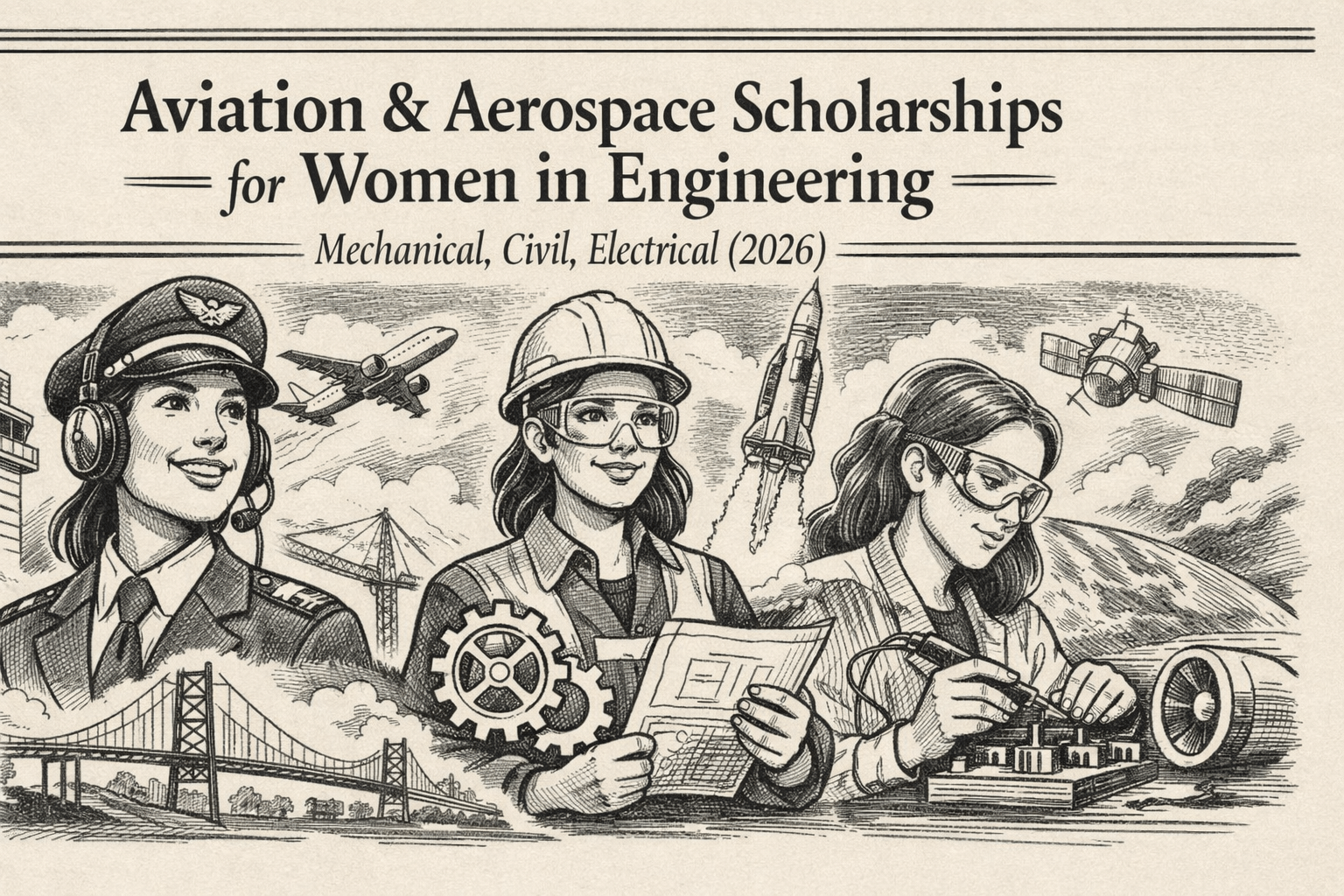
Aviation & Aerospace Scholarships for Women in Engineering — Mechanical, Civil, Electrical (2026)
Engineering awards for women with chapter-level picks and competition tie-ins (SAE, FIRST/REC). We quantify renewable status and membership notes.
🚀 Aerospace & Aviation (Women-only + strong aerospace fit)
Zonta International — Amelia Earhart Fellowship (PhD)
- Why it slaps: pure aerospace engineering/space sciences; global prestige 🌍
- Amount: $10,000 (one-year) · Deadline: typically Oct–Nov (check page)
- Renewable? No (re-application allowed in future cycles)
- Apply: https://www.zonta.org/Web/Web/Programs/Education/Amelia_Earhart_Fellowship.aspx
Women in Aerospace (WIA) Foundation Scholarships (Rising Juniors/Seniors)
- Why it slaps: aerospace-focused, women-only ✈️
- Amount: $5,000 each · Deadline: mid-June (rising Jr/Sr)
- Renewable? No
- Apply: https://www.womeninaerospacefoundation.org/
Women in Aviation International (WAI) Scholarships (multiple funds incl. engineering/maintenance/dispatch)
- Why it slaps: dozens of awards; one application; engineering & maintenance options 🛠️
- Amount: varies (many $2k–$10k) · Deadline: typically Oct 15
- Renewable? Mostly no (varies by fund) · Membership required
- Apply: https://www.wai.org/scholarships
Association for Women in Aviation Maintenance (AWAM) Scholarships
- Why it slaps: large package list; strong for A&P/maintenance; some cross over to engineering tools/training 🔧
- Amount: varies; multiple awards · Deadline: typically late fall
- Renewable? No (mostly) · Membership note: $15 student applicant donation
- Apply: https://www.awam.org/scholarships
AIAA — Lockheed Martin Marillyn Hewson Scholarship (Women in Aerospace)
- Why it slaps: aerospace degree + “must identify as female” requirement ✅
- Amount: $10,000 (one-year) · Deadline: see AIAA cycle
- Renewable? No
- Details/Eligibility: https://aiaa.org/get-involved/university-students/undergraduate-scholarships-graduate-awards/eligibility-requirements/
AIAA — Roger W. Kahn Scholarship (HS Seniors → Engineering)
- Why it slaps: early pipeline into aero; includes mentorship 👩🏽🔧
- Amount: up to $10,000 · Deadline: opens Sept 15; closes early Jan
- Renewable? No
- Apply: https://aiaa.org/get-involved/k-12-students/scholarships/aiaa-roger-w-kahn-scholarship/
AIAA — Rising Stars in Aerospace (Diversity travel scholarship)
- Why it slaps: funds undergrads from underrepresented groups to attend AIAA forums (networking = jobs) 🤝
- Amount: travel/registration support · Renewable? No
- Info: https://aiaa.org/get-involved/university-students/rising-stars-program/
AIAA & Club for the Future — Resilient Student Scholarship
- Why it slaps: supports students who have faced unique challenges; aero intent 🌌
- Amount: varies · Renewable? No
- Info: https://aiaa.org/get-involved/k-12-students/scholarships/club-for-the-future-scholarship/
Vertical Flight Society (VFS) Scholarships
- Why it slaps: rotorcraft/vertical-flight niche 🌀
- Amount/Deadline: varies · Renewable? No
- Apply: https://vtol.org/scholarships
🔧 Mechanical / Automotive / HVAC&R
ASHRAE — Lynn G. Bellenger Scholarship (Women-only)
- Why it slaps: named for ASHRAE’s first woman president; HVAC&R-aligned 🧊🔥
- Amount: $5,000 (one-year) · Deadlines: Dec 1 / May 1 (different sets)
- Renewable? No
- Apply: https://www.ashrae.org/communities/student-zone/scholarships-and-grants/engineering-technology-scholarships
Automotive Women’s Alliance Foundation (AWAF) Scholarships
- Why it slaps: auto/mobility focus; women-only 🚗
- Amount/Deadline: varies by cycle · Renewable? No
- Apply: https://awafoundation.org/Scholarships
SAE — Women-in-Automotive Scholarship
- Why it slaps: for women in electrical/software/mechatronics pathways; SAE ecosystem connects to Formula/Baja/AutoDrive ⚙️
- Amount: SAE targets multiple $5,000 awards annually · Renewable? No
- Apply: https://www.sae.org/participate/scholarships/sae-women-in-automotive-scholarship-grad
NFPA Fluid Power / Robotics Challenge Scholarships (REC partner)
- Why it slaps: fluid power = mechatronics; robotics tie-in 🤖
- Amount: typically $2,500 · Renewable? No
- Info/Apply: https://recf.org/scholarship/nfpa-robotics-challenge-scholarship/
⚡ Electrical / Photonics
Optica Women Scholars (Optica Foundation + partners)
- Why it slaps: power grant in optics/photonics; mentorship + network 🌈
- Amount: $10,000 (one-year) · Renewable? No
- Apply: https://optica.org/womenscholars
IEEE Women in Engineering — Scholarships & Grants hub
- Why it slaps: central page for chapter/technical society awards + travel grants 🔌
- Amount/Deadline: varies · Renewable? No (mostly)
- Explore: https://wie.ieee.org/grants-scholarships/
🛣️ Civil / Transportation (WTS = women-only + tons of chapter awards)
WTS Foundation — National Scholarships (women in transportation)
- Why it slaps: transportation/civil focus; undergrad/grad; huge chapter network 🛤️
- Amount: varies by level · Renewable? No
- Apply: https://www.wtsinternational.org/wts-foundation/scholarships
Chapter-level WTS picks (deadlines vary by chapter; typically late winter–spring):
17) Boston: https://www.wtsboston.org/scholarships ee-scholarship.org
18) Los Angeles: https://www.wtslosangeles.org/cpages/scholarships aoefoundation.org
19) Chicago: https://www.wtschicago.org/scholarships IEEE Women in Engineering
🧰 Multi-Discipline (Women-only; great for Mech/Civil/EE; stack with aero)
Society of Women Engineers (SWE) — National Scholarship Portal
- Why it slaps: one application → auto-match to 250+ awards; ABET-aligned majors ✅
- Amount: many $1k–$15k; mostly one-time · Membership: not required to apply
- Apply: https://swe.org/scholarships/ (eligibility: https://swe.org/apply-for-a-swe-scholarship/)
Chapter/Section SWE scholarships (chapter-level picks):
21) SWE Chicago: https://www.swe-chicago.org/scholarships SAE International
22) SWE Detroit: https://www.swe-detroit.org/index.php/scholarships/ fsaeonline.com
23) SWE San Diego: https://www.swesandiego.org/scholarships Society of Women Engineers
24) SWE Houston: https://www.swehouston.org/scholarships phisigmarhofoundation.org
25) SWE Boston: https://www.sweboston.org/scholarships askwits.org
26) SWE Phoenix: https://www.swephoenix.com/phoenix-section-scholarships phisigmarhofoundation.org
27) SWE New York: https://swenyc.org/student-outreach/ ask-wits.com
NSPE Education Foundation — Auxiliary Legacy Scholarship (Women-only, rising juniors)
- Why it slaps: national PE network; women entering junior year 👷♀️
- Amount: typically $5,000 (one disbursement) · Renewable? No
- Apply: https://www.nspe.org/membership/types-membership/student/auxiliary-legacy-scholarship
AAUW — Selected Professions Fellowships (Master’s; engineering included)
Why it slaps: large stipend; invests in fields with low female participation 🧪
- Amount: $20,000 (one year) · Renewable? No
- Apply: https://www.aauw.org/resources/programs/selected-professions-fellowship-program/
Alpha Omega Epsilon Foundation (engineering sorority) — Scholarships
- Why it slaps: for AΩE members; women in engineering 🟣
- Amount/Deadline: varies · Renewable? No
- Apply: https://www.aoefoundation.org/scholarships.php
Phi Sigma Rho Foundation (engineering sorority) — Scholarships
- Why it slaps: for PSR members; women in engineering 💠
- Amount/Deadline: varies · Renewable? No
- Apply: https://www.phisigmarhofoundation.org/memorial/
Alpha Sigma Kappa Foundation — Women in Technical Studies Scholarships
- Why it slaps: for ASK members/alumnae; engineering & technical majors 🧬
- Amount/Deadline: varies · Renewable? No
- Apply: https://ask-wits.com/foundation/
Hydropower Foundation — Julie A. Keil “Women in Hydro” Scholarship
- Why it slaps: energy/water/civil-mech cross-over 💧⚙️
- Amount: varies (often multiple awards) · Renewable? No
- Apply: https://nwhydro.org/Opportunities/Scholarships
🤖 Competition Tie-Ins (Robotics/SAE = extra chances + portfolio boost)
FIRST® Robotics Scholarship Program (many university partners)
- Why it slaps: hundreds of partner awards; many engineering majors supported
- Hub: https://www.firstinspires.org/alumni/scholarships
REC Foundation (VEX) — Scholarship Directory
- Why it slaps: 100+ partners; ~$18M value; includes niche partners (NFPA, WIA, etc.)
- Hub: https://recf.org/teams/for-participants/scholarships/
SAE Collegiate Design Series + SAE Scholarships
- Why it slaps: participation in Formula/Baja/AutoDrive often favored; Women-in-Automotive award now live
- Hub: https://www.sae.org/participate/scholarships
💡 Pro tips (renewable math, membership, stacking)
Quantify “renewable” at the award level. Example: “$2,500 renewable 4 years” = $10,000 total. If a fund says “one-year,” assume non-renewable unless the page says otherwise.
Membership matters (WAI/AWAM/SWE/IEEE/Sororities). If dues are modest (e.g., WAI/AWAM student tiers), the ROI can be huge with access to dozens of funds. wai.org+1
Stacking: It’s often allowed to stack a national award (e.g., SWE, NSPE, AAUW) with a chapter award (SWE section/WTS chapter) and a competition-partner award (FIRST/REC/SAE). Always check each fund’s stacking policy.
📅 Fast calendar cues (2025–26 cycle)
WAI apps typically July 15 → Oct 15; membership required. wai.org
WIA Foundation due mid-June (rising Jr/Sr). womeninaerospacefoundation.org
ASHRAE deadlines Dec 1 / May 1 (different sets). ASHRAE
NSPE Auxiliary Legacy occurs spring (varies; often Mar–Apr portal). nspe.org
🧭 Mini FAQ
Q: I’m MechE with Formula SAE—what should I target first?
A: Apply SWE national + your SWE section + SAE Women-in-Automotive + any FIRST/REC partner awards you qualify for (if you competed in HS). Add ASHRAE Lynn Bellenger if HVAC&R applies. Society of Women Engineers+2SAE International+2
Q: Civil/transportation?
A: Start with WTS national + chapter; layer SWE (national + local) and NSPE Auxiliary (if entering junior year). IEEE Women in Engineering
Q: Aerospace PhD?
A: Amelia Earhart Fellowship first, then look at WIA Foundation; add AIAA travel/diversity programs to build your network. zonta.org+1
Aviation & Aerospace Scholarships for Women in Engineering
Aviation and aerospace engineering sit at the intersection of national security, global mobility, climate innovation, and a fast-expanding commercial space economy. Yet women remain persistently underrepresented in the engineering talent pipelines that feed these sectors—especially in aerospace engineering itself. Recent U.S. labor-market data show aerospace engineers earn a median annual wage of $134,830 (May 2024), with employment projected to grow 6% from 2024–2034 and roughly 4,500 openings per year—a strong demand signal that makes participation gaps costly for both families and the economy. At the same time, women represent only ~10.5% of the aerospace engineering occupational workforce (a low point among engineering disciplines), while women earn about 17.4% of aerospace engineering bachelor’s degrees—evidence of a “leaky pipeline” between education and employment.
This paper argues that scholarships—especially when paired with mentorship, experiential learning, and professional networks—operate as targeted “risk-reducing capital” that can increase women’s persistence in aerospace pathways. We synthesize national datasets (BLS wage/projection data; discipline-level degree statistics; engineering workforce demographics) with program evidence from leading scholarship ecosystems (Society of Women Engineers, AIAA Foundation, Women in Aviation International, Women in Aerospace Foundation, and the Zonta Amelia Earhart Fellowship). We also quantify scholarship purchasing power against current college pricing: in 2025–26, average published in-state public four-year tuition and fees are ~$11,950, meaning a $5,000 award can cover ~42% of tuition (and ~16% of the typical in-state total budget). Finally, we present evidence-informed design principles for scholarship programs and practical strategies for applicants—tailored to women pursuing aviation/aerospace engineering degrees.
1. Why women’s aerospace scholarships are an economic and workforce imperative
Aviation and aerospace are unusually “talent-elastic” industries: small shifts in the engineering workforce can influence safety margins, product cycles, mission success, and the pace of innovation. These sectors also concentrate high-wage, high-skill jobs, making them powerful mobility engines for households and communities. The U.S. Bureau of Labor Statistics (BLS) reports aerospace engineers’ median pay at $134,830 (May 2024), with projected growth of 6% (2024–2034)—faster than the all-occupation average—and thousands of annual job openings. Even adjacent technical roles—such as aerospace engineering technologists/technicians—carry a median wage near $79,830 (May 2024), signaling broad demand across the aerospace production-to-R&D continuum.
In this context, underrepresentation is not only an equity problem; it is a capacity problem. When women are missing from aerospace engineering, the industry forfeits potential productivity, reduces its problem-solving diversity, and narrows its recruitment base during a period of sustained demand.
2. The participation gap: where the pipeline leaks
2.1 Degree production (supply)
Across engineering overall, women’s participation has risen but remains far from parity. The Society of Women Engineers (SWE) reports that women earned ~23.0% of engineering and engineering technology bachelor’s degrees in 2021 (up from ~17.2% in 2011), showing progress—but also persistent imbalance.
Aerospace engineering, specifically, remains below women’s overall engineering share. In ASEE’s Engineering & Engineering Technology by the Numbers (2023 edition), women account for ~17.4% of aerospace engineering bachelor’s degrees (with engineering overall near 24.6% women). This differential matters: the aerospace discipline is already drawing from a smaller set of specialized programs, so a lower women’s share translates into a compounded workforce shortfall.
2.2 Employment (conversion from degree to workforce)
Workforce representation is even more constrained. SWE’s workforce analysis indicates women represented ~15% of the engineering workforce in 2023, but only ~10.5% within aerospace engineering occupations—among the lowest proportions across engineering fields. The combined implication is stark: even when women earn aerospace degrees, a smaller fraction appear to convert into (or remain in) aerospace engineering jobs, consistent with a leaky pipeline narrative.
2.3 Policy recognition of the problem
The federal government has explicitly identified women’s underrepresentation in aviation as a strategic workforce issue. The FAA’s Women in Aviation Advisory Board (WIAAB) recommendations emphasize sustained coordination across agencies and stakeholders to attract and retain women in aviation careers. While aviation spans more than engineering (pilots, maintenance, operations), the same ecosystem constraints—cost, access, mentorship, and culture—shape women’s engineering participation.
3. Why scholarships work: scholarships as “risk-reducing capital”
3.1 The cost barrier is structural, not motivational
Engineering degrees—especially aerospace—often require heavy course loads, labs, team projects, and time-intensive design sequences that can limit paid work hours. For many students, the binding constraint is not interest; it is financial bandwidth and risk tolerance. Scholarships reduce that risk by lowering borrowing needs, enabling course-load intensity, and supporting unpaid/low-paid experiential learning (research, internships, conference participation).
3.2 The “purchasing power” of common aerospace scholarships
To evaluate real impact, scholarship amounts should be assessed against current college pricing. College Board reports that for 2025–26, average published tuition and fees for public four-year in-state students are about $11,950, with average in-state student budgets around $30,990 (tuition, fees, room/board, and other costs).
Using those benchmarks:
-
A $5,000 scholarship can cover ~42% of average in-state tuition/fees (5,000 ÷ 11,950 ≈ 0.418) and ~16% of the total in-state budget (5,000 ÷ 30,990 ≈ 0.161).
-
A $10,000 scholarship can cover ~84% of in-state tuition/fees and ~32% of the total in-state budget.
This matters because many flagship aerospace programs are at public universities; “tuition coverage” is a psychologically salient threshold that can shift enrollment and persistence decisions.
3.3 Scholarships also buy time, identity, and networks
In aerospace, networks often function as informal gatekeepers to high-quality internships, research labs, and early-career placements. Scholarship programs that bundle membership, conference attendance, mentorship, or industry introductions can increase “professional social capital” alongside financial support—often a decisive factor in retention.
4. The scholarship ecosystem for women in aviation/aerospace engineering
This section organizes major scholarships into a pragmatic typology aligned to women’s career stages.
4.1 Undergraduate “on-ramp” scholarships (entry + persistence)
Women in Aerospace Foundation Scholarship (WIA Foundation)
One of the most directly targeted programs, this scholarship supports women pursuing aerospace careers and is commonly structured as four awards of $5,000 for students (often rising juniors/seniors) in engineering/math/science tracks aligned to aerospace. The junior/senior targeting is strategically sound: it funds students at the point where major coursework intensifies and internship conversion begins to matter most.
Society of Women Engineers (SWE) scholarships (broad engineering; strong aerospace relevance)
SWE’s scholarship system is one of the largest and most scalable pipelines for women in engineering. SWE reports disbursing 330+ scholarships totaling nearly $1.6 million (2025), with many awards commonly ranging $1,000–$5,000. Because aerospace engineering pathways often overlap with mechanical, electrical, systems, software, and materials engineering, SWE awards serve as a major “stackable” funding layer for aerospace-bound students.
AIAA Foundation scholarships (discipline-specific pipeline builder)
The American Institute of Aeronautics and Astronautics (AIAA) Foundation reports awarding 1,300+ scholarships and graduate awards over the past 20 years, spanning undergraduates and graduate students across science and engineering programs. AIAA also offers high-visibility awards such as the Roger W. Kahn Scholarship (up to four $10,000 scholarships for high school seniors entering engineering) and the Mary W. Jackson Scholarship ($10,000 undergraduate scholarship honoring the NASA mathematician and aerospace engineer). These awards matter beyond dollars: they deliver prestige signaling and early professional identity formation inside the aerospace community.
4.2 Aviation-to-aerospace “ecosystem scholarships” (engineering included, plus industry adjacency)
Women in Aviation International (WAI) scholarship program
WAI’s scholarship ecosystem is unusually broad, covering flight training, maintenance, dispatch, career advancement—and importantly, engineering. For its 2026 cycle, WAI reports 50+ scholarships valued at $200,000+, and notes that since 1995, funders have provided $15+ million in scholarships. WAI’s model is especially relevant for women who bridge aviation operations and engineering (e.g., maintenance engineering, safety systems, avionics, human factors), and for students who benefit from an aviation community identity while pursuing engineering credentials.
4.3 Graduate and research-stage funding (deep specialization and PhD persistence)
Zonta International—Amelia Earhart Fellowship
For doctoral-level aerospace engineering and space sciences, the Amelia Earhart Fellowship is a flagship: $10,000, awarded annually to up to 30 women pursuing PhD/doctoral degrees in aerospace engineering and space sciences. Program statistics underscore the scale and longevity: since inception in 1938, Zonta reports 1,764 fellowships totaling $11.9+ million, serving 1,335 women from 79 countries. This fellowship targets a critical bottleneck: advanced research training that feeds R&D leadership, academia, and frontier innovation.
4.4 Corporate and industry-aligned scholarships (workforce-linked funding)
Aerospace/defense primes and suppliers increasingly use scholarships as part of workforce strategy—often pairing funding with internships, mentorship, or early-career recruitment pipelines.
Lockheed Martin STEM Scholarship
Lockheed Martin’s scholarship program offers $10,000 renewable scholarships, positioning the award as a multi-year persistence tool rather than a one-time grant. Although not always women-exclusive, such programs are frequently designed to expand participation among underrepresented or underserved groups and can be highly relevant for women pursuing aerospace engineering.
SWE partner scholarships (example: Northrop Grumman SWE Scholarship)
SWE’s partner-funded awards include corporate scholarships aligned with aerospace and defense employers. The Northrop Grumman SWE Scholarship is one example of employer-linked support administered through SWE pathways. These programs can function as “workforce-bridges,” supporting students whose majors map directly onto industry hiring needs (systems, electrical, software, avionics-adjacent fields).
5. What the data imply: designing scholarships to actually change outcomes
If the core policy goal is to close the aerospace gender gap, scholarship design should be evaluated against measurable “conversion points” rather than only counting award dollars.
5.1 Target the high-attrition semesters
Because aerospace engineering has lower women’s degree share than engineering overall (e.g., ~17.4% women in aerospace BS vs ~24.6% women across engineering BS), scholarship timing matters. Awards that land at the sophomore-to-junior transition (when students enter rigid prerequisite chains and team design sequences) are likely to produce higher persistence gains than awards that arrive after the student has already stabilized.
5.2 Bundle funding with retention mechanisms
Evidence from professional societies suggests scholarships can carry added value when they include:
-
Mentorship (career navigation, identity safety, and sponsorship)
-
Conference access (professional belonging + recruiting exposure)
-
Internship matchmaking (turning coursework into employability)
WAI and AIAA models are notable because they operate as professional communities as much as funding sources—reducing both financial and social barriers.
5.3 Measure “conversion,” not just “awards”
Given that women’s representation drops from degree to workforce (e.g., aerospace engineering occupation ~10.5% women), scholarship programs should track: internship attainment, major persistence, graduation, job placement, and early-career retention—particularly in aerospace roles.
6. Applicant strategy: how women can maximize scholarship yield in aviation/aerospace engineering
A practical, data-informed approach to winning and stacking scholarships:
-
Stack by ecosystem: Apply across society-based (SWE, AIAA), women-in-aviation community (WAI), and research-stage (Zonta) pipelines, because their eligibility rules and timelines often differ.
-
Align your narrative to sector demand: Use labor-market facts to show you understand the field’s needs (e.g., BLS pay and projected openings) and position your interests in safety, autonomy, sustainability, propulsion, materials, systems engineering, or space operations.
-
Demonstrate “engineering identity” with proof: Aerospace scholarships often favor evidence of persistence—design teams, research posters, flight-test clubs, robotics, coding projects, or internships.
-
Translate aviation experience into engineering relevance: If you come from aviation (pilot training, maintenance, dispatch), explicitly map that experience to engineering systems thinking—human factors, reliability engineering, avionics, safety management, or certification processes. WAI is a natural bridge here.
-
Apply at the right time: Many high-impact awards target rising juniors/seniors (WIA Foundation) or early college (some corporate programs). Plan around the semesters when your financial stress is highest.
Conclusion
Women’s underrepresentation in aerospace engineering is measurable across the entire pipeline—from degree share to workforce participation—despite strong labor-market rewards and growth projections. Scholarships for women in aviation/aerospace engineering function as more than tuition relief: they reduce financial risk at high-attrition points, enable time-intensive engineering training, and—when paired with professional society ecosystems—build identity, networks, and career conversion pathways. Programs such as SWE’s large-scale scholarship portfolio, AIAA’s discipline-centered awards, WAI’s aviation ecosystem funding, WIA Foundation’s targeted undergraduate support, and Zonta’s doctoral-level Amelia Earhart Fellowship collectively form a ladder from entry to leadership.
For ScholarshipsAndGrants.us, the strategic takeaway is clear: the highest-value content and curation will (1) help women identify the right scholarship rung for their current stage, (2) emphasize stacking strategies and deadlines, and (3) spotlight programs that combine money with mentorship and aerospace community access. Done well, scholarship guidance becomes a workforce intervention—one award, one internship, and one retained engineer at a time.
References (selected, APA-style)
American Institute of Aeronautics and Astronautics (AIAA). (n.d.). Undergraduate scholarships & graduate awards.
American Institute of Aeronautics and Astronautics (AIAA). (2024). AIAA announces new $10,000 Mary W. Jackson Scholarship.
American Society for Engineering Education (ASEE). (2024). Engineering & Engineering Technology by the Numbers, 2023.
College Board. (2025). Trends in College Pricing and Student Aid 2025 (selected figures).
Society of Women Engineers (SWE). (2025). U.S. degree attainment.
Society of Women Engineers (SWE). (2025). U.S. employment (engineering workforce representation).
Society of Women Engineers (SWE). (2025). SWE scholarships.
U.S. Bureau of Labor Statistics. (2024). Aerospace engineers: Occupational Outlook Handbook.
U.S. Federal Aviation Administration (FAA). (2022). Women in Aviation Advisory Board recommendations report.
Women in Aviation International (WAI). (2025). WAI 2026 scholarships open; program totals since 1995.
Women in Aerospace Foundation. (n.d.). WIA Foundation Scholarship.
Zonta International. (n.d.). Amelia Earhart Fellowship.
NSPE Auxiliary Legacy: women entering/continuing junior year in ABET engineering. nspe.org
Optica Women Scholars: $10,000 + mentorship (optics/photonics). Optica
SAE Women-in-Automotive: multiple $5,000 awards aimed at women in EE/software/mechatronics; SAE scholarship hub active. SAE International