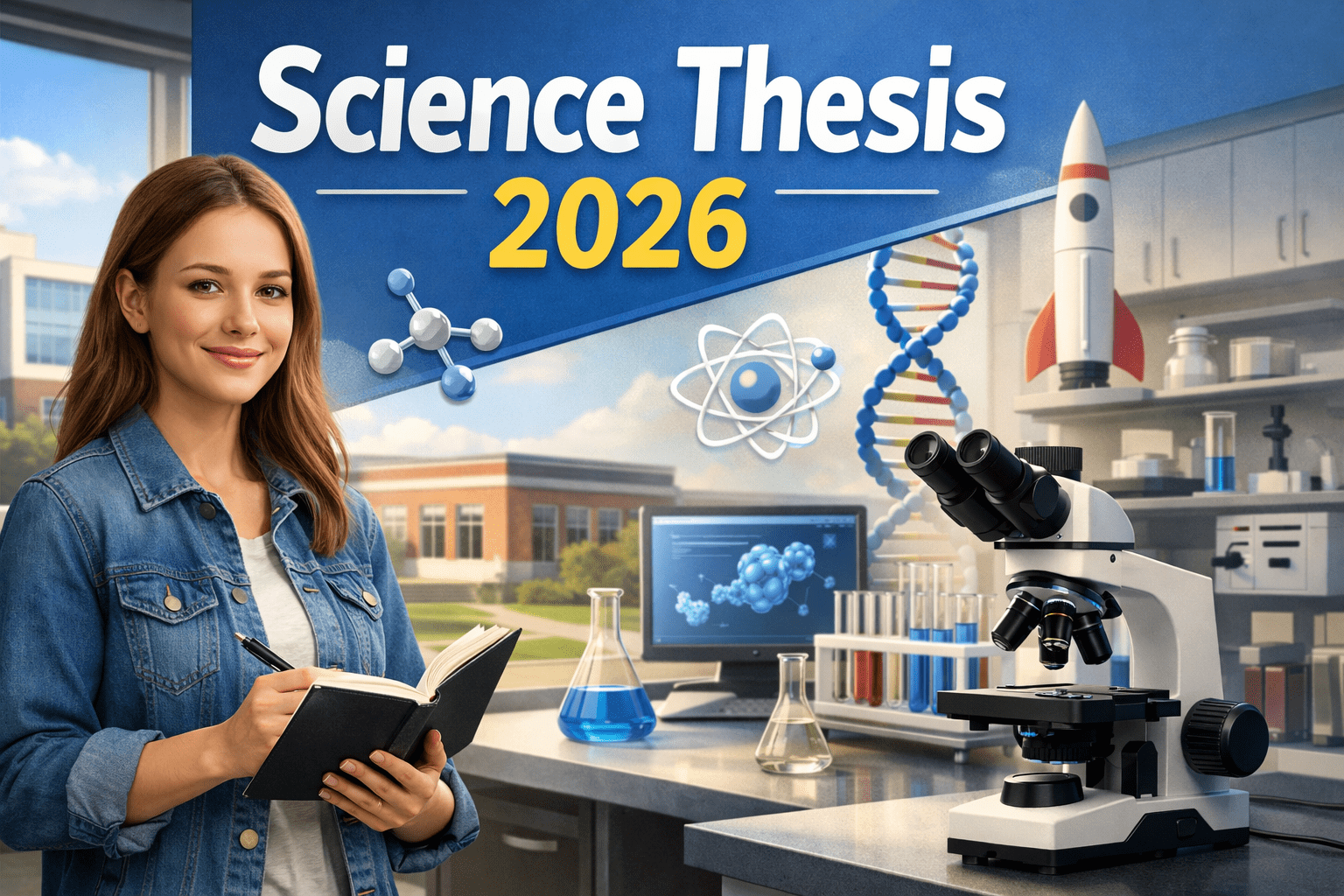
Science Thesis 2026: A Guide to Crushing Your Research
For high school students (Class of 2026) and early undergrads who want a fun, clear, actually-usable guide to a science thesis—plus the receipts (official links) to keep everything accurate.
(What this page gives you)
-
A plug-and-play thesis outline (IMRaD) with sentence starters 🧩 The Writing CenterPMCUniversity of Minnesota Libraries
-
What counts as ethical research (IRB/assent/parental permission) ✅ HHS.govSociety for ScienceSSPCDN
-
Formatting basics (APA student format + SI units) 📝 APA StyleNIST PublicationsNIST
-
Open, free tools for stats, writing, citations, and data storage 🛠️ about.zenodo.orgZenodohelp.osf.io
-
Real competitions and scholarships where a strong thesis shines 🏆 jasp-stats.orgJunior Science and Humanities Symposium
What is a “science thesis” (in plain English)?
It’s a long-form research report where you ask a question, test a method, analyze data, and explain what it means. In science, the standard structure is called IMRaD—Introduction, Methods, Results, Discussion. Journals use it because readers can find what they need fast. You can, too. The Writing CenterPMC
Before You Start: Safety & Ethics (non-negotiable) 🧪🧤
-
Human participants? Minors can’t give legal consent—schools must follow IRB rules: get child assent + parent/guardian permission when required, and keep risk minimal. Science fair rules and federal guidance agree. HHS.govSociety for ScienceSSPCDN
-
Lab work? Follow high-school safety guidelines (RAMP: Recognize, Assess, Minimize, Prepare), wear splash-resistant goggles, and use district Chemical Hygiene Plans. institute.acs.org+1slcschools.org
-
Biology cautions: Many K–12 labs shouldn’t culture bacteria outside approved courses. Ask your teacher before you even think petri dishes. NSTA
Pick a Project Type (choose your adventure)
-
Experimental (you manipulate variables)
-
Observational (you measure, don’t interfere)
-
Computational / Data science (you analyze datasets or models)
-
Engineering design (you build and iteratively test a solution; aligns with NGSS HS-ETS1). Next Generation Science Standards+1
Engineering path? Use a design loop (requirements → prototype → test → redesign). Science Buddies+1
The Thesis Blueprint (IMRaD with sentence starters)
1) Title & Abstract (write last, place first)
-
Title formula: Specific variable + context + method (avoid jargon overload). Nature’s editors recommend accurate, brief, clear. Nature+1
-
Abstract (150–250 words): one sentence each for background → question → methods → key results → meaning. Writing Center UNC Chapel Hill
Starters:
-
Background: “Climate-related heat waves are increasing, yet ___ is understudied.”
-
Question: “We asked whether ___ affects ___.”
-
Methods: “We measured/compiled/simulated ___ using ___.”
-
Results: “Compared with _, ___ increased by ___ (95% CI [, __]).”
-
Meaning: “Findings suggest ___ could help ___.”
2) Introduction (why your study matters)
-
Map the gap: what’s known → what’s missing → your hypothesis. (Keep it brief—save details for your lit table/appendix.) Nature
3) Methods (how someone could replicate you)
-
Participants/materials, variables, controls, data collection, analysis plan (pre-register if you can). For human studies, include consent/assent procedures. HHS.gov
-
If you’re doing a design project, state criteria/constraints up front (cost, safety, reliability). Next Generation Science Standards
4) Results (just the facts)
-
Use tables/figures with clear captions; report effect sizes and confidence intervals (not just p-values). APA JARS encourages transparent reporting. APA Style+1PMC
5) Discussion (so what?)
-
Interpret patterns, compare to prior work, note limitations, and suggest next steps. Nature’s writing guides emphasize clarity over flair here. Nature
6) References
-
Use your field’s style: APA (common in school science), ACS/CSE (chem/bio), or IEEE (engineering). Start with APA student format unless told otherwise. APA StyleACS Publications
Formatting that teachers (and judges) notice
-
APA student paper basics (title page, running head optional for student papers per instructor, double-spaced, 1-inch margins). Check official APA Style. APA Style
-
Use SI units correctly (e.g., 25 °C, 75 cm; symbols have no plural “s” and no period unless end of sentence). NIST PublicationsNIST
Stats & Rigor (keep your science tight)
-
Prefer estimation (effect sizes + CIs) over p-value worship; report what the size means. PMC
-
Consider pre-registration (short, free) to lock your analysis plan and avoid “HARKing.” OSF Registries makes it simple. Center for Open Science
Free Tools You’ll Actually Use 🛠️
-
Write & manage refs: Zotero (cite as you write), Overleaf (LaTeX when needed). GraphPadcolab.google
-
Analyze data: Google Colab (Python), JASP (menu-driven stats). ZoteroOverleaf
-
Plan/Share/Preregister: OSF projects + registrations; archive data on Zenodo (DOIs) or figshare. help.osf.io+1about.zenodo.orgFigshare
Gold-standard checklists (optional but impressive)
-
PRISMA 2020 for literature/systematic reviews. GraphPad
-
CONSORT for randomized trials (if you run classroom-scale experiments). Overleaf
-
APA JARS for reporting standards across many study types. APA Style
Where to find legit data (for computational projects) 💾
-
Data.gov (US open data hub), NASA open data/POWER viewer, UCI ML Repository (classic datasets). Data.govNASA Open Data PortalPOWERUCI Machine Learning Repository
Competitions & Scholarships that love a strong thesis 🏆
-
Regeneron ISEF (International Science & Engineering Fair) – 1,860 finalists from 67 countries/territories in 2025; projects follow strict ethics rules for humans/animals. Google ColabOARC Stats
-
JSHS (Junior Science & Humanities Symposium) – many regions require APA student format, papers typically 5–40 pages (double-spaced), and 12-minute talks + Q&A at nationals. Deadlines run Oct–Feb regionally. California State University Long Beachartscioutreach.tamu.eduJunior Science and Humanities Symposium
-
Regeneron Science Talent Search (STS) – premier US research competition for HS seniors. (Strong, ethical, original research papers score well.) jasp-stats.org
Always check current year rules (formats and page limits vary by region). Junior Science and Humanities Symposium
A 10-Week Game Plan (you can stretch to a semester)
Week 1–2: Pick a question; quick lit scan; draft hypothesis or design criteria; meet teacher/mentor about ethics & safety. HHS.gov
Week 3: Pre-register on OSF (optional but pro). Center for Open Science
Week 4–6: Collect data or build/test prototype; keep a lab/design notebook (dates, settings, raw data).
Week 7: Analyze (effect sizes + CIs, not just p); make plots. PMC
Week 8–9: Write IMRaD draft; format in APA student style; check SI units. APA StyleNIST
Week 10: Revise (read aloud, reverse outline), write abstract + title last, proof citations. Writing Center UNC Chapel Hill+1
Quick-reference Templates (copy + adapt)
Thesis Outline (IMRaD):
-
Title page (title, name, school, date)
-
Abstract (150–250 words)
-
Introduction (context → gap → hypothesis)
-
Methods (participants/materials; variables; procedures; analysis; ethics)
-
Results (tables/figures + text with effect sizes/CIs) APA Style
-
Discussion (meaning, limits, future work)
-
References (APA student) APA Style
-
Appendix (survey, code, extra tables)
Figure Caption Formula: Figure 1. Variable A vs. Variable B in ___ (n = __). Error bars = 95% CI. Measured using ___. APA Style
Common Pitfalls (and how to dodge them) 🚧
-
No consent for minors → Pause. Get assent + parent permission per rules. HHS.gov
-
Only p-values → Add effect sizes and CIs; say what the number means. PMC
-
Messy units → Follow SI checklist (no “cms,” space between number and unit). NIST
-
Unclear methods → If a peer can’t replicate, beef it up (materials, settings, code link). Nature
Resources to Bookmark (official & trusted)
-
APA Style—Student Paper & JARS, apastyle.apa.org. APA Style+1
-
NIST—SI Units & Style Checklist, nist.gov. NIST PublicationsNIST
-
Society for Science (ISEF)—Rules & Human Participants, societyforscience.org. SSPCDNSociety for Science
-
OHRP (HHS)—Children in Research FAQs, hhs.gov. HHS.gov
-
OSF—Create Projects & Preregister, cos.io/help. help.osf.ioCenter for Open Science
-
CONSORT / PRISMA Checklists, consort-statement.org; prisma-statement.org. OverleafGraphPad
-
Data.gov / NASA / UCI ML Repository (open datasets). Data.govNASA Open Data PortalUCI Machine Learning Repository