The Freshman Year Guide (Then vs. Now) for the Class of 2026
Discover how freshman year now differs from then—with tips for happiness, safety, and study success. Class of 2026 guide + trusted resources.
🎓 Campus Life 2.0: How Freshman Year Hits Different (Then vs. Now)
College today = community + wellness + smart tech. For parents and first-years, here’s the side-by-side of what’s changed—and how to make it amazing.
🕰️ Then vs. Now (quick compare)
| Area | Then | Now |
|---|---|---|
| Dorm life | Landline phones, cork boards | Wi-Fi everywhere, dorm apps, group chats |
| Social | Flyers & icebreakers | Insta/Discord clubs, micro-communities for every interest |
| Studying | Library stacks & highlighters | Digital libraries, tutoring centers + online help, AI study tools (used responsibly) |
| Safety | Blue phones, campus patrol | Real-time alerts, safety apps, escort programs, transparent crime stats & Title IX info. U.S. Department of EducationU.S. Department of Education |
| Wellbeing | Stigma around counseling | 24/7 hotlines, campus counselors, parent toolkits, proactive wellness weeks. 988 LifelineNational Institute of Mental HealthThe Jed Foundation |
💡 Make the most of freshman year (happy • safe • study-smart)
1) Find your people 🤝
-
Hit welcome week + the first club fairs (low-pressure way to meet friends fast).
-
Join two things: one “comfort” (e.g., gaming/anime) and one “stretch” (e.g., debate/outdoors).
-
Keep homesickness in check: plan a weekly family call + one new-friend plan each week.
2) Study smart, not nonstop 📚
-
Use your school’s writing center + tutoring (already covered by fees).
-
Try the 50/10 flow: 50 minutes focused, 10 minutes movement.
-
Build a “Sunday reset”: map deadlines, book study rooms, prep notes for the week.
-
Backup everything (cloud drive), and enable 2-factor login on school accounts.
3) Stay campus-safe 🌙
-
Save campus emergency and escort/shuttle numbers in your phone.
-
Walk with a buddy at night; share your location with someone you trust.
-
Know where to see official campus safety reports & alerts (and how to report issues). U.S. Department of Education
-
Learn your rights and reporting options under Title IX (discrimination/harassment/sexual misconduct). U.S. Department of Education
4) Protect your happiness 🧠💛
-
Normalize the help: counseling is part of tuition; hotlines are 24/7. 988 Lifeline
-
Sleep, sunlight, and movement beat all-nighters.
-
If a slump lasts or daily life feels hard, reach out—students and parents both have support guides. The Jed Foundation
✅ Freshman “Study-Safe” checklist (copy/paste for your phone)
-
⏰ Add class times, office hours, tutoring, and exam dates to your calendar
-
📝 Reserve quiet study spaces before midterms & finals
-
🔐 Turn on 2FA for email/LMS; auto-backup notes
-
🧭 Save: Campus Police, Health/Counseling, Title IX, Housing, RA
-
🚌 Download campus app(s) for alerts/escort/shuttles
-
🧑🤝🧑 Join 1 study group per core class
-
🌙 Night routine: buddy system, check shuttle routes, share location
🔗 Quick, trusted resources (parents + students)
Safety & rights
-
Campus crime & fire data (see your school’s official reports). U.S. Department of Education
-
Title IX—what it covers & how to report. U.S. Department of Education
Mental health & wellbeing
-
988 Suicide & Crisis Lifeline — call/text 988 or chat, 24/7. 988 Lifeline
-
NIMH — evidence-based info + student/educator resources. National Institute of Mental Health+1
-
JED Foundation (For Families & Students) — transition guides, practical tools. The Jed Foundation+2The Jed Foundation+2
Campus life & fit
-
Student-life snapshots & rankings to compare vibe/culture (use with a critical eye). Niche
If you or your student needs urgent help, call 911. For mental-health support any time, call/text 988. 988 Lifeline
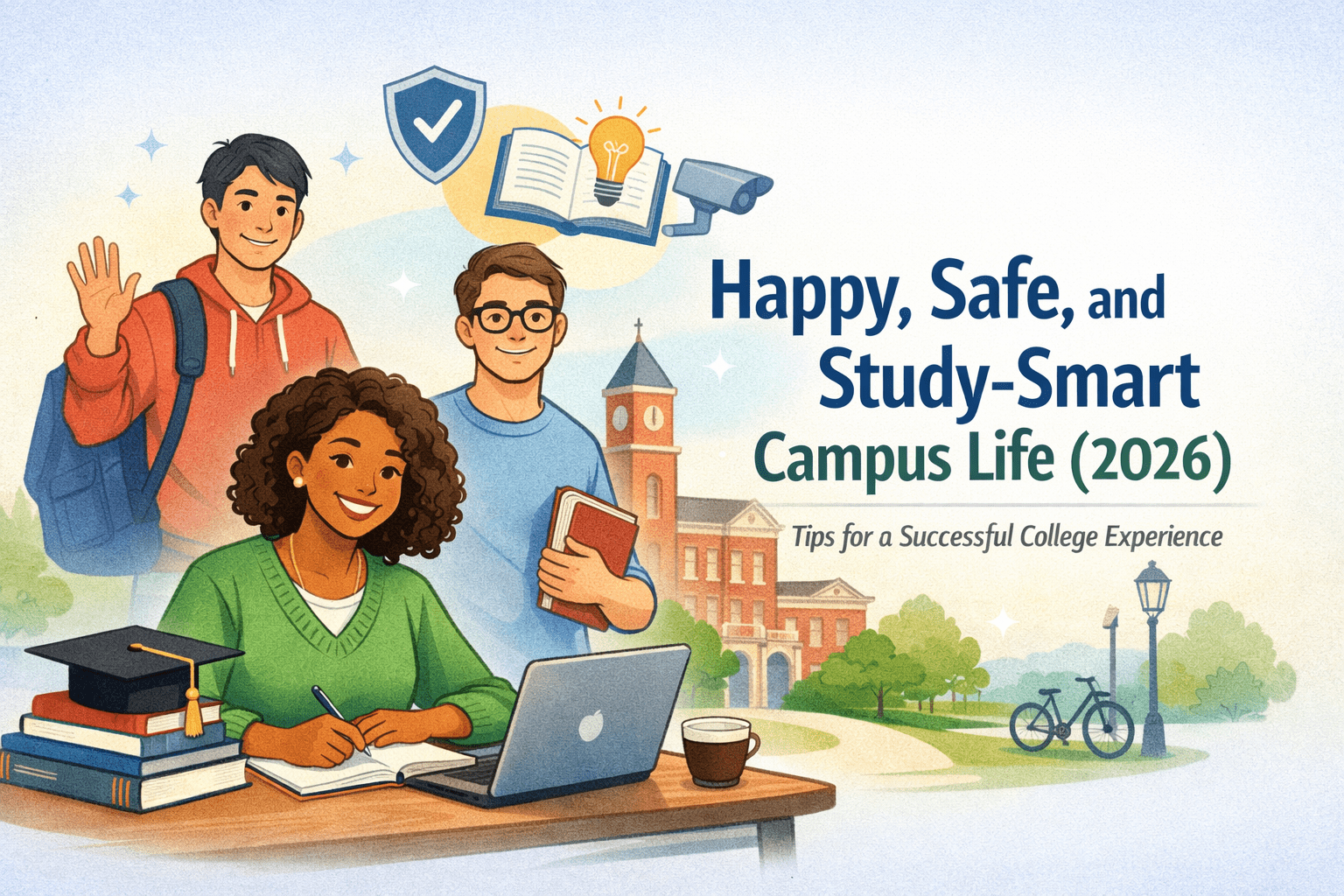
Freshman Year, Upgraded (2026): Happy, Safe, and Study-Smart Campus Life
Freshman year is a high-velocity transition: new autonomy, new academic demands, new relationships, and (often) new risks. In 2026, that transition is shaped by three converging realities: (1) student mental health strain remains widespread even as some indicators show modest improvement; (2) campus safety has expanded beyond “crime” to include hazing transparency, sexual misconduct processes, digital risk, and emergency readiness; and (3) learning itself is being re-engineered by evidence-based study science and near-ubiquitous generative AI tools. Drawing on large national datasets (Healthy Minds Study; American College Health Association’s NCHA), federal reporting systems (IPEDS retention; Clery/Jeanne Clery Campus Safety Act), and peer-reviewed learning research (distributed practice and retrieval practice meta-analyses), this paper proposes a unified “Freshman Operating System”: a practical, measurable approach that upgrades wellbeing (“happy”), harm reduction and informed consent (“safe”), and academic performance (“study-smart”) without romanticizing hustle culture. We translate the evidence into a 30–60–90 day plan, a weekly time architecture, and a set of student–parent–institution recommendations designed to reduce avoidable crises and increase persistence, learning depth, and belonging.
1) Why “Freshman Year” Is the Highest-Leverage Year
Freshman year is a structural inflection point: students shift from externally scaffolded routines (family/school) to self-directed life management, while simultaneously navigating high-stakes academic evaluation. Institutions feel this leverage too: first-year retention is a core success metric, and nationally the full-time retention rate in U.S. postsecondary institutions was about 77.5% in fall 2023—meaning roughly one in five full-time students does not return the following year.
That persistence gap is not primarily about intelligence. It is more often about systems: time, sleep, help-seeking, finances, belonging, and alignment between effort and effective learning strategies. In other words, students frequently “work hard” but underperform because they study in low-yield ways, delay care, or lack safety and support.
A modern freshman-year upgrade therefore requires three interlocking goals:
-
Happy: stable mental health and social connection; basic needs met; manageable stress.
-
Safe: informed risk reduction across hazing, alcohol, sexual misconduct, violence, and digital threats; clarity on rights and reporting.
-
Study-smart: evidence-based learning methods, sustainable routines, and ethically sound use of AI and campus resources.
2) Methods and Evidence Base
This paper uses a rapid evidence assessment approach: synthesizing high-quality, recent, and/or foundational sources across public health, higher education policy, and cognitive science. Key data inputs include:
-
Healthy Minds Study (HMS) 2024–2025: national sample (N ≈ 84,735 from 135 colleges/universities) with validated mental health screens and service utilization metrics.
-
ACHA National College Health Assessment (NCHA): large multi-institution surveys reporting academics-disrupting anxiety, sleep patterns, social media exposure, belonging, and safety concerns.
-
Hope Center Basic Needs Survey (2023–2024): large sample (tens of thousands) quantifying food insecurity, housing insecurity, and homelessness.
-
Federal policy/reporting: IPEDS retention trends; Title IX enforcement status; Clery/Jeanne Clery Campus Safety Act resources; Stop Campus Hazing Act requirements and timelines.
-
Learning science: meta-analyses and reviews identifying high-utility learning techniques (distributed practice, practice testing/retrieval), and research linking sleep to GPA.
-
Substance use: NSDUH-based prevalence for binge drinking among full-time college students ages 18–25.
-
Generative AI in college: student usage prevalence and policy clarity gaps (higher ed surveys and reporting).
Limitations: many datasets are cross-sectional; campus experiences vary by institution type and student demographics; and “safety” outcomes can be underreported (especially sexual violence). The goal is not to claim universal causality, but to identify the most defensible levers and translate them into action.
3) The “Happy” Layer: Mental Health, Stress, Belonging, and Basic Needs
3.1 Mental health burden is common—and increasingly “normal” to talk about
HMS 2024–2025 reports that 37% of students screened positive for moderate/severe depressive symptoms (PHQ-9 ≥10) and 33% for moderate/severe anxiety symptoms (GAD-7 ≥10). 11% reported suicidal ideation in the past year, and 27% reported non-suicidal self-injury in the past year.
These are not edge cases. They describe a sizable portion of a typical first-year cohort. The implication for families and institutions is straightforward: treat mental health as a standard “student success” variable, not a private flaw.
Just as important: service engagement is substantial but not complete. HMS indicates 38% of students received therapy/counseling in the past year, 29% used psychiatric medication, and among those screening positive for depression or anxiety, 61% received therapy and/or medication.
That also implies a meaningful share of symptomatic students are untreated or under-treated—often due to time, stigma, cost, or lack of confidence in services.
3.2 Belonging is a protective factor—and it’s measurable
Belonging predicts persistence and wellbeing through multiple mechanisms: help-seeking, peer learning, identity safety, and reduced loneliness. ACHA highlights that more than 65% of students agree or strongly agree they feel they belong at their college/university (and this is a campus-optimizable metric, not a personality trait).
However, loneliness remains a broader public-health issue, with the U.S. Surgeon General warning that roughly half of U.S. adults report loneliness, with some of the highest rates among young adults.
HMS also shows substantial loneliness frequency distributions (e.g., “often” and “some of the time” responses across companionship/left out/isolated items).
Freshman-year insight: belonging is not a vibe—it’s a behavior pattern. Students typically do not “find their people” by accident; they do it by repeated exposure, small risks, and consistency (showing up even when it’s awkward).
3.3 Stress and sleep are academic variables, not lifestyle add-ons
ACHA reports that 76.4% of surveyed students experienced moderate or high stress in the last 30 days.
It also notes that 30% said anxiety negatively impacted their academics, and more than 75% reported getting less than 8 hours of sleep on weeknights in the prior two weeks.
This is the hidden logic of freshman-year struggle: if sleep and stress degrade attention and memory consolidation, the student may study longer while learning less, creating a feedback loop (more stress → worse sleep → lower learning efficiency → panic studying).
Research supports the academic importance of sleep. For example, a PNAS study found nightly sleep duration predicts end-of-term GPA (even accounting for other variables), underscoring sleep as a performance driver.
3.4 Basic needs insecurity is widespread and under-discussed
The Hope Center’s 2023–2024 Student Basic Needs Survey reports that 59% of students experienced at least one form of basic needs insecurity; 41% experienced food insecurity, 48% housing insecurity, and 14% homelessness (in the measured time windows).
Basic needs insecurity is not just “hardship”—it is a direct academic risk factor: reduced concentration, missed classes, increased work hours, and higher dropout probability. A freshman-year upgrade must therefore include resource navigation as a core skill (food pantry, emergency grants, affordable dining plans, textbook access programs, housing support).
4) The “Safe” Layer: What Campus Safety Means in 2026
Safety is no longer synonymous with “don’t walk alone at night.” In 2026, it includes transparency about hazing, credible reporting systems, consent culture, alcohol harm reduction, and digital hygiene.
4.1 Clery/Jeanne Clery Campus Safety Act: “Know the reporting ecosystem”
Federal law requires institutions participating in federal student aid to disclose certain campus security policies and crime statistics (the Clery framework). The U.S. Department of Education provides a campus safety and security tool to access institutional reports and data.
Student-level application: early in the semester, students should (a) sign up for campus emergency alerts, (b) learn how timely warnings work, (c) identify late-night transport/escort options, and (d) understand how to report concerns.
4.2 Hazing is now federally “trackable”—and that changes the decision calculus
The Stop Campus Hazing Act became Public Law 118-173 on December 23, 2024, requiring institutions to report hazing incidents and expanding transparency obligations.
A Congressional Research Service overview explains that institutions must disclose additional hazing statistics, publish prevention programs, and develop a Campus Hazing Transparency Report (CHTR).
Clery Center guidance further explains how the law amends the Clery framework (and renames it as the Jeanne Clery Campus Safety Act).
Freshman-year implication: “join everything” is not always an upgrade. Students should treat organization membership like a safety decision: look for published violations, ask direct questions about initiation practices, and favor groups with transparent values and accountability.
4.3 Sexual violence risk: prevention is about timing, context, and reporting pathways
National statistics emphasize that sexual violence is underreported and that certain groups face elevated risk. RAINN summarizes DOJ-derived findings and notes differential risks for college-aged populations; it also highlights that reporting rates to law enforcement are low.
For freshmen, the highest-risk periods often cluster early in the academic year (the “red zone” concept is widely used in prevention education, though exact timing varies by campus). The evidence-based prevention angle is not fear—it’s preparation:
-
Know confidential vs. nonconfidential resources (counseling center, health services, advocacy office).
-
Clarify Title IX reporting options and what happens after a report.
-
Use buddy systems and clear communication in party environments.
-
Learn bystander intervention skills (many campuses require or provide training).
4.4 Title IX process clarity matters—especially given regulatory whiplash
As of January 9, 2025, the U.S. Department of Education states a federal court vacated the 2024 Title IX Final Rule and that the 2020 Title IX Rule is back in effect as the basis for OCR enforcement.
This is not a call to become a lawyer. It is a call to avoid misinformation. Students should rely on their institution’s Title IX office pages and published policies (and ask questions), because procedures and definitions can shift with regulatory changes.
4.5 Alcohol, cannabis, and harm reduction: use prevalence + brain science, not vibes
NIAAA/NSDUH-based reporting indicates that among full-time college students ages 18–25, about 29.3% reported past-month binge drinking (2023 NSDUH).
A “safe” freshman year does not require abstinence to be successful, but it does require risk literacy:
-
Know standard drink sizes and pacing.
-
Avoid mixing substances.
-
Eat before drinking, hydrate, and plan transportation.
-
Watch for signs of alcohol poisoning; intervene early.
5) The “Study-Smart” Layer: What the Science Says Actually Works
The most empowering message for freshmen is also the most rigorous: effective studying is a skillset, and the evidence is unusually clear about which strategies yield the highest returns.
5.1 Two heavyweight techniques: distributed practice + retrieval practice
A major review of learning techniques rates practice testing (retrieval practice) and distributed practice (spacing) as high-utility strategies across contexts.
The distributed practice effect is supported by large meta-analytic evidence across hundreds of experiments.
A later synthesis/meta-analysis of learning techniques similarly finds distributed practice and practice testing among the strongest approaches.
Translation to freshman life:
-
Don’t “re-read” notes for hours the night before.
-
Instead, study in short cycles across days (spacing) and force your brain to retrieve information (practice questions, flashcards, teaching it aloud).
5.2 Interleaving, elaboration, and “desirable difficulty”
Beyond spacing and retrieval, evidence supports strategies that feel harder but produce stronger learning: interleaving practice types, explaining “why,” self-explanation, and using feedback loops.
Freshmen often confuse fluency (“this looks familiar”) with mastery (“I can produce it under exam conditions”). Retrieval practice breaks that illusion—and protects grades.
5.3 Sleep is part of the learning algorithm
Sleep supports memory consolidation, attention, and emotion regulation. If a student studies until 3 a.m., they may increase time-on-task while decreasing learning efficiency and next-day function. Empirical work linking sleep duration to GPA reinforces that sleep is not an indulgence; it’s academic infrastructure.
ACHA’s finding that most students get under 8 hours on weeknights suggests this is a population-level opportunity for improvement.
5.4 First-year seminars and structured onboarding produce small—but meaningful—effects
A meta-analytic review of first-year seminars finds small average effects on first-year grades and one-year retention, but “small” at scale still matters because retention shifts compound institutionally and personally.
Practical implication: if your campus offers a first-year seminar, learning community, or structured advising program, treat it as a high-ROI asset. It is not “extra work”; it is engineered scaffolding.
6) Generative AI in 2026: The New Academic Environment (and How to Use It Without Self-Sabotage)
AI is now part of freshman reality. Surveys and reporting indicate widespread student use: one Inside Higher Ed report (June 2025) describes roughly two-thirds of students using a standalone generative AI tool weekly.
Tyton Partners reporting also indicates substantial “regular use” by students (monthly or more).
At the same time, policy clarity is inconsistent: Inside Higher Ed’s Student Voice reporting suggests many students are uncertain about when AI use is permitted.
EDUCAUSE notes many institutions still lack comprehensive acceptable-use policies, which increases risk and confusion.
6.1 The central risk: outsourcing thinking
The academic danger of AI is not simply “getting caught.” It’s skill atrophy: reduced practice in planning, argumentation, and error correction. Students who let AI do the hard cognitive work may earn short-term points while losing long-term capacity (and confidence). That trade is especially costly in freshman year when foundational skills are built.
6.2 The central opportunity: AI as a study amplifier
Used well, AI can increase learning efficiency while preserving integrity. The rule is simple:
AI should accelerate practice and feedback, not replace original reasoning.
High-integrity, high-yield uses include:
-
Generating practice questions from lecture topics, then answering without looking.
-
Explaining confusing concepts in multiple ways, then doing problems independently.
-
Creating study schedules and spacing plans.
-
Acting as a “Socratic tutor” that asks you questions rather than giving solutions.
Low-integrity, high-risk uses include:
-
Generating entire essays/solutions submitted as your work.
-
Paraphrasing sources without real comprehension (plagiarism risk + shallow learning).
-
Using AI when the syllabus explicitly prohibits it.
Freshman-year upgrade: students should ask each professor for explicit AI boundaries early, and keep a simple “AI use log” for major assignments (what tool, what prompts, what you changed). This supports transparency if questions arise.
7) The Freshman Operating System: A 30–60–90 Day Evidence-Based Plan
0–30 Days: Stabilize (reduce chaos, build the floor)
Goals: routine, belonging seeds, resource map, academic feedback loop.
-
Build a weekly template (non-negotiable anchors):
-
Sleep window (consistent bedtime/wake time).
-
3–5 study blocks with retrieval practice.
-
Exercise/walk blocks (stress regulation).
-
One “social exposure” commitment (club meeting, study group, residence event).
-
-
Resource mapping (do this before you “need it”):
-
Counseling/mental health access + after-hours options.
-
Academic support (tutoring, writing center, office hours).
-
Basic needs supports (food pantry, emergency grants).
-
Safety/reporting: campus police, escort, Title IX office.
-
-
Learning loop starts Week 2:
-
Convert each class into a question bank (practice testing).
-
Use spaced sessions (20–45 minutes) instead of marathon re-reading.
-
-
Belonging seed strategy:
-
Pick two consistent micro-communities (e.g., dorm floor + one club).
-
Aim for repeated exposure, not instant best friends.
-
31–60 Days: Optimize (turn effort into results)
Goals: upgrade study technique, deepen relationships, reduce risk peaks.
-
Office hours as a grade multiplier
-
Show up with 2–3 questions.
-
Ask: “What does an A answer look like?” (rubrics and exemplars).
-
Get feedback early, not after a disappointing grade.
-
-
Study-smart escalation
-
Shift from notes to retrieval: self-quizzes, practice problems, teaching out loud.
-
Use interleaving (mix problem types) once basics are learned.
-
-
Safety literacy
-
Review hazing transparency resources before joining high-risk orgs; ask direct questions about initiation.
-
Party plan: buddy system, drink limits, exit strategy.
-
61–90 Days: Sustain (make it a lifestyle, not a sprint)
Goals: prevent burnout, plan for finals, lock in support structures.
-
Sleep-first finals strategy
-
Start spaced review 2–3 weeks out; reduce all-nighters.
-
-
Mental health check-in
-
If symptoms persist (low mood, panic, self-harm urges), escalate care: counseling, health services, crisis lines.
-
Normalize support: stigma is lower than students assume (HMS personal stigma low).
-
-
Financial and basic needs stabilization
-
If food/housing insecurity is present, treat it as urgent—not shameful—and engage supports.
-
8) What Parents Can Do Without Being “Extra”
The best parent role in freshman year is scaffolding without controlling:
-
Ask process questions, not outcome questions
-
Better than “How are your grades?”: “What’s your plan for the next exam?”
-
-
Support help-seeking
-
Normalize tutoring and counseling as “maintenance.”
-
-
Provide predictable contact
-
A weekly check-in reduces loneliness without micromanagement.
-
-
Fund safety where possible
-
Basic needs insecurity is common; small predictable support (meal plan, emergency fund) can reduce academic derailment.
-
-
Encourage clarity about AI policies
-
Students need to ask instructors what’s allowed; many are unsure.
-
9) What Institutions Can Do: High-ROI, Evidence-Consistent Upgrades
If campuses want “happy, safe, study-smart” cohorts, the best interventions are structural, not motivational posters.
9.1 Expand stepped-care mental health models and reduce friction
Given high symptom prevalence and high (but incomplete) service use, institutions should:
-
Offer rapid access triage, group programs, workshops, and tele-mental health options.
-
Integrate mental health with academic advising and residence life.
-
Measure wait times and dropout from care.
9.2 Make belonging a design goal
Belonging can be increased through:
-
Small cohort programs, learning communities, peer mentoring.
-
Identity-safe spaces and inclusive pedagogy.
-
Early semester structured social exposure opportunities.
9.3 Treat basic needs as retention infrastructure
Given the scale of need, campuses should:
-
Normalize basic needs supports during orientation.
-
Provide proactive outreach and “single door” access points.
-
Expand emergency aid and housing navigation.
9.4 Implement the Stop Campus Hazing Act with real transparency
Compliance should become prevention:
-
Publish clear definitions, reporting channels, and organization accountability.
-
Use the Campus Hazing Transparency Report as a decision tool for students.
9.5 Clarify AI acceptable use and teach “AI literacy for learning”
Because student use is widespread and policy clarity is uneven:
-
Provide course-level AI policy templates.
-
Teach students how to use AI for retrieval practice, feedback, and planning—without outsourcing thinking.
10) A Practical “Freshman Dashboard”: Metrics Students Can Track Weekly
A freshman-year upgrade becomes real when it becomes measurable. A simple weekly dashboard (10 minutes every Sunday) can prevent slow-motion failure:
-
Sleep: average hours + consistency (bed/wake variability)
-
Study quality: number of retrieval sessions (not total hours)
-
Belonging: number of “repeat exposures” (same club/study group)
-
Help-seeking: office hours or tutoring touchpoints
-
Mood/anxiety: quick self-rating; if worsening, escalate supports
-
Risk: nights out with plan vs. without; substance use boundaries
-
Basic needs: food/housing stability; if unstable, seek resources
Conclusion
“Freshman Year, Upgraded” is not a personality type—it’s a system. In 2026, the highest-return approach blends public health realism (mental health prevalence and basic needs insecurity), policy literacy (Clery safety reporting, hazing transparency, and Title IX procedural clarity), and cognitive science (spaced practice + retrieval practice + sleep as learning infrastructure). The goal is not perfection. The goal is stability + smart effort + protective habits, built early enough to prevent predictable crises.
If ScholarshipsAndGrants.us readers take only three ideas from this paper, let them be these:
-
Belonging and wellbeing are performance variables (not separate from academics).
-
Safety is partly preparation (knowing systems, choosing communities wisely, and using harm reduction).
-
Study-smart beats study-hard (retrieval + spacing + sleep).
References (selected)
-
American College Health Association (ACHA). National College Health Assessment resources and highlights.
-
Cepeda, N. J., et al. Distributed practice meta-analysis.
-
Creswell, J. D., et al. Sleep duration predicting GPA (PNAS).
-
Dunlosky, J., et al. Learning techniques review.
-
Eisenberg, D., Lipson, S. K., et al. Healthy Minds Study 2024–2025 National Data Report.
-
Hope Center, Temple University. 2023–2024 Student Basic Needs Survey Report.
-
NIAAA / NSDUH. College/young adult alcohol use prevalence.
-
NCES IPEDS. Retention trend.
-
Stop Campus Hazing Act (Public Law 118–173) and CRS summary.
-
U.S. Department of Education, OCR. Title IX regulations enforcement status (2020 rule in effect after 2024 rule vacated).
-
U.S. Surgeon General. Advisory on social connection and loneliness.
-
Higher-ed AI use and policy reporting (Inside Higher Ed, EDUCAUSE, Tyton Partners).
🙋♀️ Parent + student mini-FAQ (SEO booster)
Q: How do we track safety on our campus?
A: Search your school in the U.S. Dept. of Education Campus Safety tool for crime/fire data and policies; also subscribe to your campus alert system. U.S. Department of Education
Q: Where do we learn about harassment/assault reporting?
A: Your school’s Title IX office publishes options, processes, and contact info; here’s what Title IX covers. U.S. Department of Education
Q: What if my student feels overwhelmed?
A: Start with campus counseling. If they want to talk now, 988 is free, confidential, 24/7; JED offers parent/student transition guides. 988 Lifeline, The Jed Foundation
Q: Is “AI for studying” ok?
A: Use only within course & academic integrity rules. Great for outline ideas or quizzes; not ok for graded work unless the instructor says so.