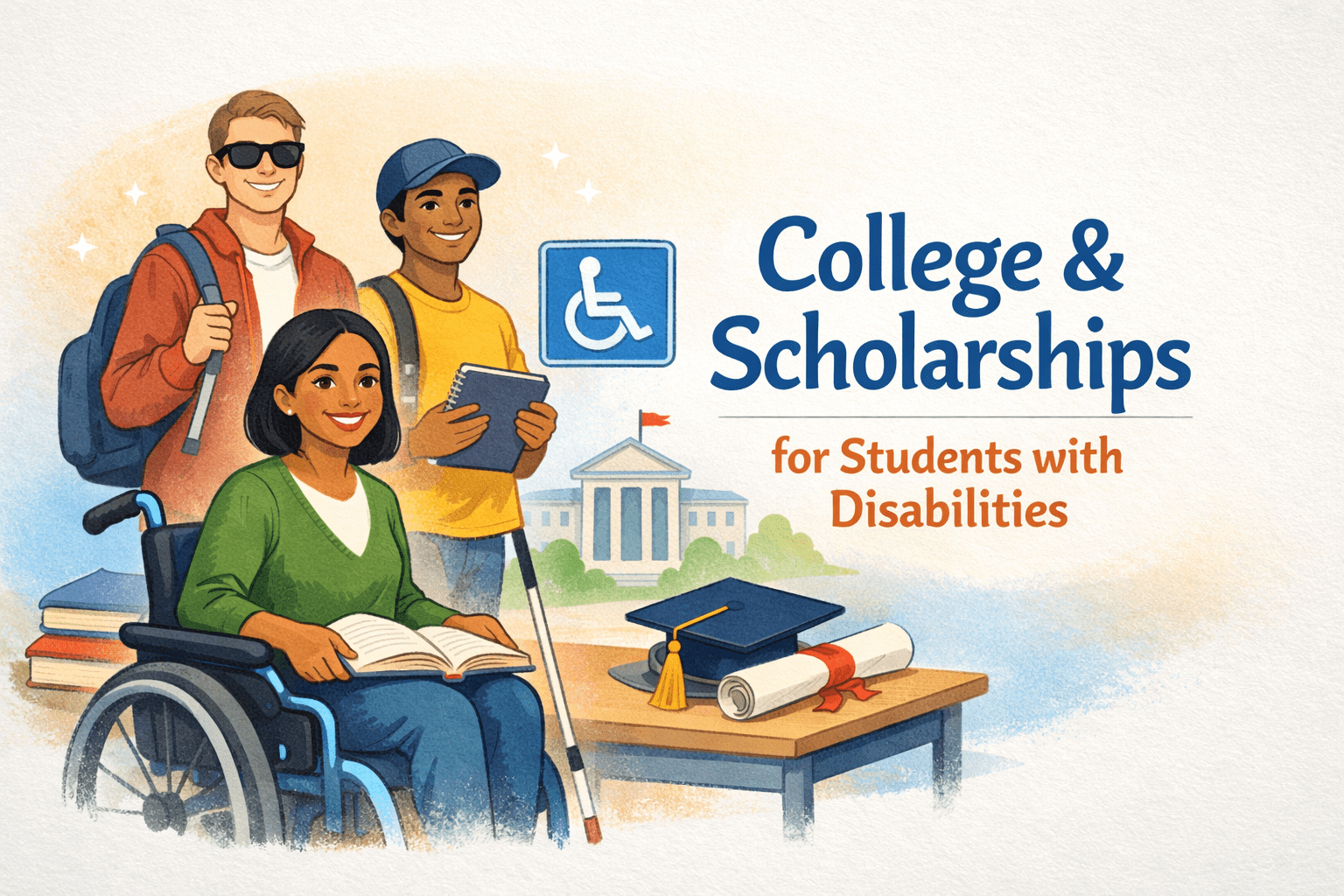
College & Scholarships for Students with Disabilities (Class of 2026)
Students with disabilities constitute a large—and growing—share of the U.S. postsecondary population, yet they face persistent disparities in degree completion, employment outcomes, and financial security. Using national datasets and federal oversight findings, this paper synthesizes (1) the scale and characteristics of disability in higher education, (2) where financial aid systems and scholarship markets do—and do not—meet disability-related need, and (3) evidence-informed design principles for colleges, scholarship providers, and student-facing scholarship platforms. In 2019–20, an estimated 3.48 million undergraduates (20.5%) and 385,000 postbaccalaureate students (10.7%) reported a disability, based on the National Postsecondary Student Aid Study (NPSAS). Federal analysis also documents widening participation over time, driven heavily by mental health and attention-related conditions—while simultaneously showing lower degree attainment and lower full-time employment after graduation for disabled students compared with non-disabled peers. These gaps are not simply academic: disability is associated with “extra costs” that can materially increase the effective price of attendance and persistence, and labor-market participation remains substantially lower for people with disabilities at the population level. Scholarships can reduce unmet need, but disability scholarship markets are fragmented, documentation-intensive, and unevenly aligned to the most common disability profiles in higher education. This paper proposes a “finance + access” framework: scholarships are most effective when designed as part of an integrated funding stack (Title IV aid, vocational rehabilitation supports, institutional aid, emergency grants, and private scholarships) and when coupled to accessible information systems, reduced administrative burden, and predictable renewability. The conclusion offers actionable recommendations—especially relevant for scholarship-listing ecosystems—on taxonomy, verification, accessibility, and equity-focused scholarship discovery.
1. Introduction: Disability, Higher Education, and the Real Price of Opportunity
Disability in higher education is best understood through a dual lens: the social model of disability (barriers arise from environments and systems) and the human-capital lens (education is a major driver of lifetime earnings and employment). The two converge on a core empirical claim: when postsecondary systems lower barriers—through accessible design, effective accommodations, and adequate financing—students with disabilities can persist and succeed; when systems shift costs and complexity onto the student, disparities widen.
This paper focuses on “College & Scholarships for Students with Disabilities” because scholarships sit at a critical junction between access and persistence. Scholarships can reduce borrowing, mitigate basic-needs stress, and fund disability-related supports that are not fully covered by institutional accommodations. Yet scholarships are also a market with frictions: information is dispersed; eligibility criteria are heterogeneous; and documentation requirements can impose a burden that is uniquely high for disabled students.
To ground the discussion, we treat “disability” as it is operationalized in key national data. In NPSAS-based Digest reporting, students with disabilities include those reporting deafness/serious difficulty hearing; blindness/serious difficulty seeing; serious difficulty concentrating/remembering/making decisions due to a condition; or serious difficulty walking/climbing stairs. This is not identical to the legal frameworks used for accommodations (ADA/Section 504), but it provides a consistent population estimate for financing and outcomes analysis.
2. Scale, Growth, and Composition of Disability in College
2.1 How many college students report a disability?
Nationally, during academic year 2019–20 (NPSAS:20), there were approximately:
-
16.936 million undergraduates, of whom 3.478 million (20.5%) reported a disability.
-
3.6 million postbaccalaureate students, of whom 385,000 (10.7%) reported a disability.
These figures align with broader NCES “Fast Facts” summaries that place disability prevalence at roughly one-fifth of undergraduates and around one-tenth of graduate/postbaccalaureate students in that period.
2.2 Growth over time—and what’s driving it
Federal oversight analysis indicates that the share of college students reporting disabilities has risen substantially since the mid-2000s, with growth largely attributed to increases in students reporting mental health conditions and attention-related disorders. GAO summarizes this dynamic in public-facing analysis, estimating ~3.5 million college students with disabilities and noting that behavioral/emotional conditions and attention deficit disorders comprised about 69% of disabilities reported in 2020 (the most recent year they analyzed in that context).
Implication: Scholarship and support ecosystems that still heavily privilege visible or mobility-related disability categories risk missing the modal reality of disability on contemporary campuses—particularly in documentation, outreach, and stigma-sensitive program design.
2.3 Disability is present across demographic groups and pathways
NPSAS:20 shows disability prevalence varies across race/ethnicity, attendance intensity, and dependency status. For example, disability prevalence among undergraduates is higher among students attending part-time/part-year than among full-time/full-year students, and higher among independent students without dependents and not married than among dependent students.
Disability also intersects with veteran status: undergraduate veterans show notably higher disability prevalence in NPSAS tabulations.
Pipeline context: In K–12, IDEA services cover ~7.5 million students ages 3–21 (15% of public school students) in 2022–23, indicating a large cohort transitioning toward adult systems where accommodations are self-advocated rather than guaranteed through IEP structures.
3. Outcomes: Persistence, Degree Attainment, and Employment
3.1 Degree attainment gaps are sizable
GAO analysis (using federal education data) finds that students with disabilities graduate at lower rates than peers without disabilities. In its detailed tabulations for the 2011–12 beginning postsecondary cohort (observed in 2016–17), GAO reports:
-
Students without disabilities: 30% had no degree/certificate and were not enrolled by 2016–17.
-
Students with disabilities: 47% had no degree/certificate and were not enrolled by 2016–17.
When broken down by disability type, bachelor’s attainment is also lower for each disability subgroup compared with no-disability peers in GAO’s table: “no disability” shows 38% bachelor’s attainment, while disability subgroups range substantially lower.
Interpretation: These are not marginal differences. From a policy-evaluation perspective, this is the kind of gap that typically signals structural barriers (information, administrative load, financial fragility, and access to effective accommodations), not merely individual variation.
3.2 Employment outcomes after graduation remain unequal
GAO also reports that among those who completed a bachelor’s degree, disabled graduates were less likely to be employed full-time compared with non-disabled graduates. In GAO’s tabulation of bachelor’s degree recipients observed ten years later (2015–16):
-
Full-time employment was 78% for those without disabilities versus 73% for those with disabilities.
This aligns with broader labor-market statistics showing persistent population-level gaps in employment. The Bureau of Labor Statistics reports that in 2024 the employment-population ratio for people with a disability was 22.7%, compared with 65.5% for those without a disability.
Why this matters for scholarships: Scholarships are often evaluated narrowly as “tuition offsets.” A more complete model treats scholarships as an investment in persistence and post-college outcomes—especially when scholarships support assistive technology, transportation, reduced work hours, or stability during episodic health fluctuations.
4. The Financial Reality: Unmet Need Meets “Extra Costs”
4.1 The disability “cost premium” changes affordability calculations
Even when tuition is stable, the effective cost of attendance can be higher for disabled students due to disability-related expenses (assistive technology, health costs, accessible transportation, personal assistance, specialized software, and time costs associated with care coordination and administrative tasks). The National Disability Institute estimates that working-age people with disabilities may require ~28% more income to achieve the same standard of living as those without disabilities, illustrating an “extra cost” burden that can compound during college years.
4.2 Enrollment scale and affordability pressure
Total undergraduate enrollment in U.S. degree-granting institutions was about 15.4 million in fall 2021. With disability prevalence near one-fifth among undergraduates in 2019–20, disabled students are not a niche subgroup; they are a central constituency of higher education financing.
5. Funding Architecture: Where Scholarships Fit in the “Stack”
A disability-informed financing approach treats scholarships as one layer in a broader stack:
-
Title IV aid (Pell, campus-based aid, work-study)
-
State vocational rehabilitation (VR) supports for training aligned to employment plans
-
Institutional aid (merit, need-based, departmental, retention grants)
-
Private scholarships (nonprofit, corporate, association, condition-specific)
-
Emergency aid/basic-needs funds
-
Disability-related savings tools (e.g., ABLE accounts) where relevant
5.1 Targeted federal supports are real—but limited in scale
GAO highlights TRIO Student Support Services (SSS) funding, including a small subset of grants dedicated exclusively to students with disabilities. In FY2022, SSS had:
-
52 grants “exclusively for students with disabilities,” totaling about $14.25 million and funded to serve 6,088 students;
-
plus 954 regular grants totaling about $312.4 million funded to serve 183,478 students (which can include disabled students).
This demonstrates both commitment and constraint: the dedicated disability-only TRIO footprint is meaningful, but tiny relative to the 3.48 million undergraduates with disabilities nationally.
5.2 ABLE accounts: a complementary tool for disability-related education expenses
ABLE accounts can be used for “qualified disability expenses,” explicitly including education among other categories. Importantly for 2026 planning, the Social Security Administration notes that effective January 1, 2026, eligibility expands to include individuals whose disability began before age 46 (previously before age 26).
Practical relevance: For some students—especially adult learners and those acquiring disabilities after age 26—ABLE expansion can widen access to tax-advantaged savings that can support education-related disability expenses.
6. The Disability Scholarship Landscape: A Typology (and Why It’s Fragmented)
Disability scholarships are best understood as a segmented market rather than a single category. The segmentation is partly ethical (targeting historically excluded groups), partly strategic (pipeline-building for fields like STEM), and partly administrative (documentation and verification differ across disability types).
6.1 Major scholarship “archetypes”
Below is a practical typology that scholarship platforms and researchers can use to structure discovery and evaluation:
| Archetype | Common sponsor | Typical eligibility logic | Typical award logic | Equity risks |
|---|---|---|---|---|
| Cross-disability general scholarships | National nonprofits | Any documented disability + enrollment | One-time, modest awards | May over-index on documentation burden |
| Condition- or impairment-specific | Foundations/advocacy orgs | Specific diagnosis/impairment | Often renewable or multi-award pools | Excludes undiagnosed/underdiagnosed students |
| Corporate/industry pipeline | Tech/engineering firms, partners | Disability + major/field alignment | Larger awards, prestige + internships | Skews toward STEM + high GPA norms |
| Professional association | Field associations | Disability + field interest | Mid-size awards | Field gatekeeping; may miss community colleges |
| Institution-based scholarships | Colleges/universities | Enrollment at institution + disability status | Mix of need/merit | Inconsistent visibility; varies by campus resources |
| VR-aligned supports | State VR agencies | Employment plan + training necessity | Tuition/books/support services | Administrative navigation complexity |
6.2 Representative programs and what they signal
A few widely cited programs illustrate award magnitude and selection structure:
-
AAHD Frederick J. Krause Scholarship on Health and Disability: award amount $1,000 (as listed in program information).
-
Microsoft Disability Scholarship (administered via Scholarship America): award amount $5,000, with an annually stated deadline (e.g., March 2026 in current posting).
-
Google Lime Scholarship (as listed by College Board’s BigFuture scholarship directory): awards up to $10,000 for eligible students in computer-related fields (with posted application windows that vary by year).
-
National Federation of the Blind (NFB) scholarships: a portfolio approach, often described as 30 scholarships totaling more than $300,000, with individual awards in the multi-thousand-dollar range (e.g., $3,000–$12,000 depending on the scholarship).
What the distribution tells us: Disability scholarships range from $1,000 “gap fillers” to $10,000+ field-specific awards, but higher-dollar programs are disproportionately concentrated in corporate/STEM pipelines. The modal disabled student—especially those in community colleges, part-time enrollment, or with episodic/mental health-related disabilities—may not align neatly with those pipelines.
7. Key Barriers: Why Scholarships Don’t Automatically Translate to Access
7.1 The “self-disclosure” and documentation barrier
In college, disability support usually requires self-disclosure and proactive requests. GAO underscores that some students face challenges because they don’t know they must request accommodations or how to self-advocate. Scholarship programs can unintentionally reproduce this barrier by requiring extensive medical documentation or narrowly defining qualifying conditions.
7.2 Information systems and accessibility are now a compliance issue—not just good practice
Digital accessibility is increasingly central to higher education operations and scholarship discovery. The Department of Justice’s ADA Title II web accessibility rule requires state and local governments (including public institutions) to meet technical accessibility requirements for websites and mobile apps, with compliance timelines that include April 24, 2026 for larger entities and April 26, 2027 for smaller ones (as summarized in DOJ guidance).
For scholarship ecosystems, this is a strategic point: a scholarship website that is not accessible is not merely suboptimal—it becomes a barrier that can erase the value of scholarships for the students who need them.
7.3 Community college reality: high service demand, uneven reporting
Community colleges enroll many students with disabilities and often serve as entry points for adult learners and part-time students. Yet reporting and registration patterns vary, suggesting unmet need and inconsistent service pathways. AACC reporting notes that a substantial share of community colleges indicate more than 3% of their students have reported a disability, with changes over time.
8. What Works: Evidence-Informed Design Principles for Scholarships and Campuses
This section translates empirical constraints into design principles.
8.1 Reduce administrative burden (the “time tax”)
Because disability already imposes administrative load (healthcare logistics, documentation, assistive tech troubleshooting), scholarships should avoid redundant paperwork. High-impact moves include:
-
accepting standardized documentation alternatives (where appropriate);
-
minimizing repeated uploads for renewals;
-
offering flexible essay formats (audio/video + transcript options);
-
and ensuring application portals meet accessibility requirements.
8.2 Predictability and renewability matter as much as dollar amount
One-time awards help, but persistence is multi-year. A $2,000 renewable scholarship can outperform a $5,000 one-time scholarship if it stabilizes enrollment and reduces work hours across semesters. Because disabled students have higher non-tuition cost exposure, scholarship design should explicitly consider total cost of attendance, not tuition alone.
8.3 Align scholarships with the real disability distribution
If behavioral/emotional and attention-related conditions represent the majority of reported disabilities in recent GAO analysis, scholarships that only “feel accessible” to visible disabilities will miss most of the population. Programs can be inclusive while still safeguarding legitimacy through clear but not punitive verification.
9. Recommendations for a Scholarship Platform: Building a Disability-Smart Taxonomy
For a scholarship website or directory, the biggest “impact multipliers” are structural:
-
Use a multi-tag taxonomy (not one category)
-
cross-disability; condition-specific; D/deaf & hard of hearing; blind/low vision; mobility; neurodiversity/ADHD; mental health; chronic illness; learning disabilities; autism; veterans w/ disabilities; graduate/professional; STEM; community college; part-time.
-
-
Expose “documentation burden” as a filter
-
e.g., “no medical letter required,” “IEP/504 accepted,” “self-attestation allowed,” “documentation required.” (Students can self-select based on capacity.)
-
-
Separate “accommodations/college supports” from “scholarships” but connect them
-
Students search scholarships; they also need an adjacent guide on disability services offices, VR supports, and ABLE usage where relevant.
-
-
Accessibility-by-default
-
WCAG-aligned design, keyboard navigation, alt-text, and accessible PDFs. This is consistent with DOJ guidance for public entities and increasingly expected across higher education systems.
-
-
Verification practices
-
“Link verified” dates, deadline validation, and “last updated” stamps are especially valuable when students have limited bandwidth for dead links and shifting requirements.
-
10. Conclusion: Scholarships as a Capability-Builder, Not a Side Fund
The core quantitative story is clear: students with disabilities are a major share of postsecondary enrollment (~3.48 million undergraduates in 2019–20), yet they face systematically worse degree and employment outcomes than non-disabled peers. At the same time, disability increases the effective cost of participation through extra expenses and reduced labor-market flexibility.
Scholarships can be decisive—but only if they are embedded in an ecosystem that recognizes disability realities: documentation and disclosure burdens; the prevalence of mental health and attention-related disabilities; the necessity of accessible digital systems; and the long horizon of persistence rather than a single tuition bill. Future-facing changes (like ABLE eligibility expansion in 2026) and evolving digital accessibility compliance timelines strengthen the case for scholarship platforms and institutions to treat accessibility and financing as joint levers.
A disability-smart scholarship ecosystem is therefore not merely larger; it is better designed: searchable by real constraints, accessible by default, and structured to reduce friction while improving persistence.
References (selected, for further reading)
-
National Center for Education Statistics (NCES): NPSAS/Digest tables on disability status in postsecondary enrollment.
-
U.S. Government Accountability Office (GAO): Higher Education: Education Could Improve Information on Accommodations for Students with Disabilities (GAO-24-105614).
-
Bureau of Labor Statistics (BLS): Persons with a Disability: Labor Force Characteristics—2024.
-
National Disability Institute (NDI): estimates on “extra costs” of disability and standard-of-living equivalence.
-
Social Security Administration (SSA): ABLE accounts overview and qualified disability expenses; ABLE age expansion effective Jan 1, 2026.
-
DOJ/ADA.gov: guidance on Title II web accessibility rule steps and compliance context.
-
You have rights in college under Section 504 & the ADA. You must self-advocate (college won’t track you down) and request accommodations with your campus disability office. U.S. Department of EducationCharter College
-
FAFSA still rules. The new Student Aid Index (SAI) replaced EFC and can be as low as –1500. Schools can also add disability-related costs to your cost of attendance—ask for it. Federal Student Aid+1FSA Partner Connect
-
Testing help exists. Need SAT/ACT/AP accommodations (extra time, readers, Braille, breaks, etc.)? Apply early with documentation. UCB USAScholarship America
-
Scholarships just for disabled students are real (and competitive!). We’ve listed trusted national options below with quick “who it’s for” notes. MicrosoftNCLDAmerican Council of the Blind
-
State Vocational Rehabilitation (VR) can help pay for school, training, and assistive tech if it’s tied to employment. Find your state’s office. nccsd.ici.umn.edu
-
Consider an ABLE account (if you qualify) to save for college & tech without hurting benefits; age limit rises to 46 starting 2026.
1) Know Your Rights (& What Changes After High School) ⚖️
-
In college, IDEA no longer applies. Your protections come from Section 504 and the ADA. You must register with Disability/Accessibility Services and request accommodations. U.S. Department of Education
-
Colleges must provide equal access (think: accessible housing, course materials, auxiliary aids like captioning/ASL, accessible transportation), but you start the process. Charter College
Power move: Email the disability office as soon as you commit, attach your documentation, and ask, “What’s the timeline to be fully set up before classes start?”
2) How to Get Accommodations in College 🧩
What to bring
-
Recent documentation that explains your functional limitations (e.g., psycho-educational eval, provider letter).
-
Your IEP/504 is great history but isn’t automatically accepted as college documentation—bring it anyway. U.S. Department of Education
Typical supports
-
Extended testing time, distraction-reduced rooms, note-taking access, captioning/ASL, accessible formats (EPUB/Braille), housing adjustments, priority registration, etc. (Varies by campus; ask!) Charter College
3) SAT/ACT Accommodations (apply early!) 🧠⏱️
-
SAT/AP (College Board): Request through your school or directly; guidelines explain docs + process. Start weeks to months ahead. UCB USA
-
ACT: Similar deal—submit documentation + history of accommodations; check deadlines. Scholarship America
4) Paying for College When You Have a Disability 💸
FAFSA & SAI (the new EFC)
-
The Student Aid Index (SAI) replaced EFC; it’s an index (not a bill), and can be –1500 to 999,999. Federal Student Aid
-
Schools use COA – SAI – other aid = need. Ask the aid office to include disability-related expenses (software, readers, personal care when school-related, transportation, etc.) in your cost of attendance adjustment. Federal Student AidFSA Partner Connect
ABLE Accounts (optional flex)
-
ABLE lets eligible disabled students save for school/tech without losing means-tested benefits. The ABLE Age Adjustment Act expands eligibility to disabilities onset before age 46 starting 2026.
5) Scholarships for Students with Disabilities 🎓🌟
Deadlines change—always check the current cycle on the official page.
Cross-Disability
-
Microsoft Disability Scholarship — HS seniors with disabilities headed to college (tech/business/law/related majors). 2025 cycle ran Jan–Mar. Microsoft
-
AAPD x NBCUniversal Tony Coelho Media Scholarship — For students with disabilities pursuing media/communications/entertainment (often 8 awards; ~$5,625 each). AAPD
-
AAHD Frederick J. Krause Scholarship — For students with disabilities in health/disability-related fields (typically opens in fall). AAHD+1
Blind/Low Vision
-
National Federation of the Blind (NFB) National Scholarships — One of the largest programs for legally blind students; multiple awards annually. National Federation of the Blind
-
American Council of the Blind (ACB) Scholarships — National awards (recent cycles: 20+ recipients; thousands each). American Council of the Blind
Autism
-
Organization for Autism Research (OAR) Scholarships — “Schwallie” & “Sunflower Dream” awards; 2025 cycle ran Dec–Apr.
Deaf/Hard of Hearing (listening & spoken language focus)
-
AG Bell scholarships (various; some programs college-level; separate law scholarship). Check the AG Bell financial aid hub. Alexander Graham Bell Association
Epilepsy
-
UCB Family Epilepsy Scholarship — Undergrad/grad awards for people with epilepsy and their caregivers.
STEM & Career-Focused (good for many disabilities)
-
Lime Connect (US & Canada): multiple corporate-partnered scholarships (e.g., Johnson & Johnson Access-Ability, BMO Capital Markets) + fellowships & internships. RSA
Learning Disabilities / ADHD + LD
-
NCLD Anne Ford Scholarship — $10,000 over 4 years (LD required). NCLD
-
NCLD Allegra Ford Thomas Scholarship — $5,000 over 2 years (LD required; for 2-year, vocational/technical, or specialized programs). NCLD
6) State Vocational Rehabilitation (VR) 🏛️
Your state’s VR agency may help with tuition, fees, books, job coaching, and assistive tech for education tied to your employment goal. Find your state VR and ask about an Individualized Plan for Employment (IPE) that includes college. nccsd.ici.umn.edu
7) Assistive Technology: Get What You Need 🖥️📚
-
Try, borrow, or finance devices through your State Assistive Technology Act Program (device lending libraries, demos, low-cost loans). Locate your state’s program. AT3 CenterACL Administration for Community Living
8) Copy-Paste Checklist ✅
Before senior year ends
-
Draft a 1-page “access needs” summary (what works for you).
-
Book testing evals if your documentation is old.
-
Request SAT/ACT/AP accommodations (if needed). UCB USAScholarship America
-
Start FAFSA (when it opens) and set up FSA IDs for contributors; learn your SAI. Ask about COA adjustments for disability costs. Federal Student Aid+1
-
Build a quick scholarships spreadsheet (name, deadline, award, status).
After you commit to a college
-
Email Disability/Accessibility Services with your docs and class start date to schedule your intake. U.S. Department of Education
-
Ask Financial Aid about COA adjustment for disability-related expenses. FSA Partner Connect
-
If eligible, contact State VR about support for your program. nccsd.ici.umn.edu
-
Connect with your state AT program for tech loans/demos. AT3 Center
9) FAQs (you’ll actually use) 💬
Do I have to disclose my disability to admissions?
No. Disclosure is your choice. To receive accommodations, you’ll disclose privately to the disability office after you enroll. U.S. Department of Education
Will my high-school IEP/504 automatically continue in college?
No. College uses 504/ADA standards and requires a new, interactive process. Your IEP/504 is helpful background, not a guarantee. U.S. Department of Education
Can financial aid cover assistive technology or disability-related costs?
Yes—ask the aid office for a COA increase for documented disability expenses. That can unlock more need-based aid eligibility. FSA Partner Connect
When should I apply for SAT/ACT accommodations?
As early as possible (weeks to months before your test date). Gather documentation and follow the platform’s directions. UCB USAScholarship America
10) Quick, Trusted Resources 🔗
-
Your college rights & transition: US Dept. of Ed OCR “Postsecondary” guides. U.S. Department of Education
-
What colleges must do: ADA National Network explainer. Charter College
-
FAFSA / SAI explained: StudentAid.gov. Federal Student Aid+1
-
Include disability costs in aid: FSA Handbook (COA allowances). FSA Partner Connect
-
Vocational Rehabilitation (find your state): US Dept. of Ed RSA. nccsd.ici.umn.edu
-
Assistive Technology (find your state program): AT3 Center directory (official TA center). AT3 Center
-
Scholarships hubs (official pages):
Microsoft (disability) Microsoft · AAPD/NBCU (media) AAPD · AAHD (health/disability) AAHD · NFB (blind) National Federation of the Blind · ACB (blind) American Council of the Blind · OAR (autism) · AG Bell (deaf/HH; LSL focus) Alexander Graham Bell Association · Lime Connect (multiple partners) RSA -
ABLE accounts: ABLE National Resource Center; Age 46 rule starts in 2026.
Pro tips to stand out 🌈
-
Tell your story (if you want) in one focused paragraph: challenge → strategy → result.
-
Ask recommenders to highlight self-advocacy & persistence.
-
Track every application in a single doc (due date, doc status, submitted, outcome).
-
Use campus TRIO Student Support Services if you qualify (first-gen/low-income/disability). Free coaching, tutoring, and sometimes grant aid. U.S. Department of Education+1