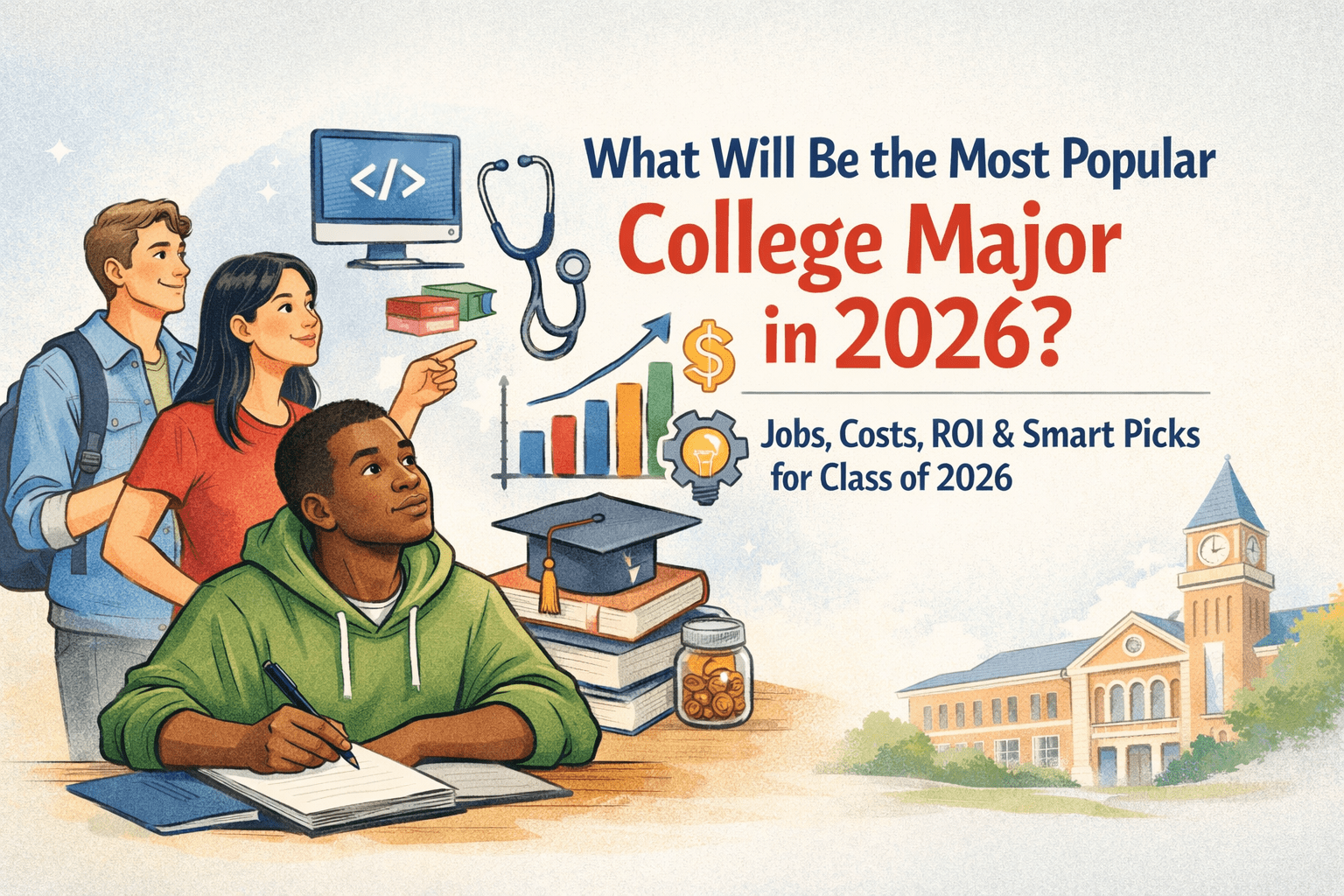
What Will Be the Most Popular College Major in 2026? Jobs, Costs, ROI & Smart Picks for Class of 2026
Business is still on track to be the most popular major by number of degrees in 2026, while Computer & Information Sciences (CIS) is the fastest-growing. Healthcare remains a powerhouse for jobs. College can still be worth it—but the ROI depends on what you study, how long you take, and how you pay.
Prediction: What’s the most popular major in 2026?
Short answer: Business stays #1 by volume; Computer & Information Sciences keeps surging and climbs the ranks fast.
Why we’re confident:
-
The latest federal completions data show Business already far ahead of other fields: 375,400 bachelor’s degrees (2021–22), compared with 263,800 in Health Professions, and 108,500 in Computer & Information Sciences (CIS). Those baselines make Business very likely to remain the largest in 2026.
-
At the same time, CIS has more than doubled over the last decade and is the fastest-rising major by degree earners and enrollment. The National Student Clearinghouse reports CIS posted the largest year-over-year increase among top fields and keeps logging big gains even when overall bachelor’s completions dip. National Student Clearinghouse+1
-
NSF confirms the long-run picture: computing degrees have surged in recent years, reflecting employer demand.
Bottom line: By 2026, Business likely remains the most popular major (by degrees), while CIS is the fastest-growing and may become top-three at many campuses. Health programs remain huge. National Student Clearinghouse
🧭 What’s driving those trends?
-
Every company is a tech company now. Software developers add the most new jobs among IT roles through 2034 (+267,700 jobs). Data scientist employment is projected to grow +33.5%. Meanwhile, some entry-level IT support roles shrink (e.g., computer user support −3.7%), which pushes students toward higher-skill CIS paths. Bureau of Labor Statistics
-
Healthcare demand is structural. An aging population boosts nurse practitioners (one of the fastest-growing jobs) and other health roles through 2034.
-
Business stays broad and flexible. Accounting, finance, marketing, analytics, and operations feed into nearly every industry—and many roles now blend business + data skills. BLS projects steady growth for accountants & auditors (+5%; ~124k openings/yr) and market research analysts (+7%). Bureau of Labor Statistics+1
💼 Job outlook snapshot (you’ll actually care about)
Computer & Information Technology (group):
-
Median pay: $105,990 (May 2024)
-
Projection: “Much faster than average” growth; about 317,700 openings/year across roles. Bureau of Labor Statistics
Software Developers:
-
Employment change 2024→34: +267,700; +15.8%. Bureau of Labor Statistics
Data Scientists:
-
Employment change 2024→34: +82,500; +33.5%. Bureau of Labor Statistics
Information Security Analysts:
-
Employment change 2024→34: +28.5%. Bureau of Labor Statistics
Nurse Practitioners:
-
One of the fastest-growing occupations through 2034 (healthcare is the top-growth sector overall). Bureau of Labor Statistics
Business & Financial Occupations (group):
-
Median pay: $80,920 (May 2024)
-
Projection: Faster than average; big annual replacement needs. Bureau of Labor Statistics
Science roles (still solid!):
-
Biochemists & Biophysicists: +6% (faster than average).
-
Materials Engineers: +6% (faster than average).
-
Environmental Scientists/Engineers: ~+4% (about average). Bureau of Labor Statistics+3Bureau of Labor Statistics+3Bureau of Labor Statistics+3
👉 Translation for you: If you love code/data, the market is strong—but skew toward software, data, security, cloud, or AI, not just “help desk.” If you prefer people/systems, Business is broad and employable—add data analytics to your toolkit. If you’re a science person, the work is meaningful and stable; growth is moderate overall, but biotech, materials, and environmental tech are bright spots. Bureau of Labor Statistics+2Bureau of Labor Statistics+2
💸 College cost (2024–25) & what that means for you
Sticker prices (published tuition & fees):
-
Public 4-year, in-state: $11,730
-
Public 4-year, out-of-state: $30,290
-
Private nonprofit 4-year: $42,100
-
Public 2-year (in-district): $4,100
(Books, housing, travel add more.)
Reality check: Many students do not pay sticker price thanks to aid, especially at in-state publics and some private colleges with generous need-based support. Always compare net price (after grants/scholarships).
📈 Is college “worth it” in 2025–26?
-
The New York Fed estimates the typical ROI on a bachelor’s degree at ~12.5%, which they classify as a “sound investment.” But not for everyone: major, time-to-degree, and costs matter a lot. Liberty Street Economics
-
Recent grads face a tougher entry market: unemployment ~5.3% and underemployment just over 41% in 2025 Q2. That makes internships and skills (projects, certifications) extra important. Federal Reserve Bank of New York
How to keep the ROI high (no fluff, just facts):
-
Finish on time. Taking 5–6 years raises total cost sharply and drags lifetime earnings. Liberty Street Economics
-
Pick in-demand paths (or add in-demand skills) within your interest area. NACE shows engineering & computer sciences majors lead starting-salary projections for the Class of 2025; business is also strong. Default
-
Reduce borrowing: compare net price, use community college transfer plans, and work-study. Community college can be powerful, but transfer execution matters (only ~20% of CA students who intended to transfer did so in 4 years—plan your pathway tightly). Axios
🤖 Should you “learn AI or programming”?
Both—but in the right order.
-
Programming (Python/JavaScript/Java + data structures) is the foundation.
-
AI/ML literacy (prompting, using APIs, understanding model limits) is the multiplier.
-
The job data back this up: software developers add the most new jobs; data scientists grow fastest; security surges; basic support shrinks. That’s a clear signal to build deeper technical skills, not only user-level AI. Bureau of Labor Statistics
A simple plan for any major:
-
Take Intro CS + Data Analysis (Python + spreadsheets + SQL).
-
Add domain-specific analytics (e.g., marketing analytics, bioinformatics, health informatics).
-
Do projects/internships that prove real-world impact.
🔬 Are science majors still “good”?
Yes—especially where science meets technology or health.
-
Biochemists/Biophysicists: growth +6%; strong in pharma/biotech.
-
Materials Engineers: growth +6%; critical for chips, batteries, and med-devices.
-
Environmental Scientists/Engineers: ~+4%; driven by climate, water, and compliance.
-
Bioengineers/Biomedical Engineers: six-figure median pay and solid growth. Bureau of Labor Statistics+4Bureau of Labor Statistics+4Bureau of Labor Statistics+4
Tip: Pair science with programming, statistics, and lab automation. Employers love scientists who can also code, run analyses, and communicate results.
🧮 Pathways other than the 4-year right away (and why they’re legit)
-
Community college → transfer: Lower cost, then finish at a 4-year. Success varies by state and planning; use advising + transfer pathways that map course-by-course. AxiosCommunity College Research Center
-
Registered Apprenticeships: “Earn while you learn.” ~680k–940k active apprentices in recent federal counts; youth participation is rising. Great for trades, advanced manufacturing, and emerging tech apprenticeships. Community College DailyDOLGovernment Accountability Office
🧩 So…what should a Class of 2026 student actually do?
If you like business:
-
Major in Business or Econ, add a data analytics minor/certificate. Target roles like financial analysis, marketing analytics, operations, or product. Bureau of Labor Statistics
If you like tech:
-
Major in CS / Data Science / Software Engineering. Build projects (GitHub), do internships, and learn cloud + security basics. The most new jobs and fastest growth sit here. Bureau of Labor Statistics
If you like health:
-
Consider Nursing, Health Informatics, Public Health, or pre-PA/NP pathways. The sector drives overall U.S. job growth. Bureau of Labor Statistics
If you like lab science:
-
Pair Biology/Chem/Materials/Environmental with programming + stats; look for co-ops in biotech, energy, or materials. Bureau of Labor Statistics+1
If you’re cost-sensitive:
-
Start in-state public or community college, ensure a locked-in transfer plan, and aim to finish on time. Use net-price calculators and keep loans low. Axios
💥 Fast facts you can quote
-
Most popular major in 2026 (by degrees): Business (momentum + huge base). Fastest-growing: Computer & Info Sciences. National Student Clearinghouse
-
Biggest job engines: Healthcare + Tech. Bureau of Labor Statistics+1
-
Typical degree ROI: ~12.5% (but not universal—major and time-to-degree matter). Liberty Street Economics+1
-
Recent-grad hurdles: ~5.3% unemployment; 41% underemployment (so internships/projects are key). Federal Reserve Bank of New York
-
2024–25 sticker prices: Public in-state $11,730; private nonprofit $42,100 (tuition/fees only). Always check net price.
🧠 FAQs (no fluff)
Q1) Will AI replace all entry-level jobs?
No. AI automates tasks, not entire occupations. Demand shifts toward roles using AI effectively. BLS still projects strong growth in software/data/security while lower-skill support roles decline. Upskill to where the growth is. Bureau of Labor Statistics
Q2) Is Business a “safe” major?
Yes—broad applicability and steady demand. Combine with data analytics or tech for maximum value. Accountants/Auditors: +5% growth; Market Research Analysts: +7%. Bureau of Labor Statistics+1
Q3) Are science majors worth it?
Yes—especially when paired with quant skills. Biochemists and Materials Engineers are growing faster than average; environmental roles are steady and mission-driven. Bureau of Labor Statistics+1
Q4) What if I can’t afford a 4-year right now?
Use community college → transfer with a mapped plan, or Registered Apprenticeships (earn while you learn). Both paths have expanded. AxiosGovernment Accountability Office
Q5) Do international students change my odds?
They enrich campuses and often cluster in STEM/Business. Focus on building differentiated skills (internships, projects, communication) and networking. India is now the #1 sending country; STEM dominates. IIE Open Doors
🧰 Resources you can trust
-
What majors are most popular? NCES IPEDS completions by field.
-
Which fields are rising now? National Student Clearinghouse enrollment/completions trends. National Student Clearinghouse+1
-
What’s the job outlook? BLS Occupational Outlook + 2024–34 Projections (IT, healthcare, business). Bureau of Labor Statistics+2Bureau of Labor Statistics+2
-
What will I earn as a new grad? NACE Salary projections & in-demand majors. Default
-
How much will college cost me? College Board Trends in College Pricing 2024.
-
Is college worth it? New York Fed on ROI and labor market for recent grads. Liberty Street EconomicsFederal Reserve Bank of New York
-
Pathways beyond 4-year: U.S. Registered Apprenticeship data. Apprenticeship.gov
-
Global campus reality: IIE Open Doors (international students). IIE Open Doors
✅ Final take
-
If you want the most common major in 2026, choose Business—and layer data/tech skills to stand out.
-
If you want maximum growth, choose Computer & Information Sciences (software/data/security/AI).
-
If you want mission + stability, Healthcare and Science are strong—especially when paired with coding/analytics.
-
Keep ROI high: finish on time, pay less than sticker, intern early/often, and show your work (projects, labs, portfolios). Liberty Street Economics