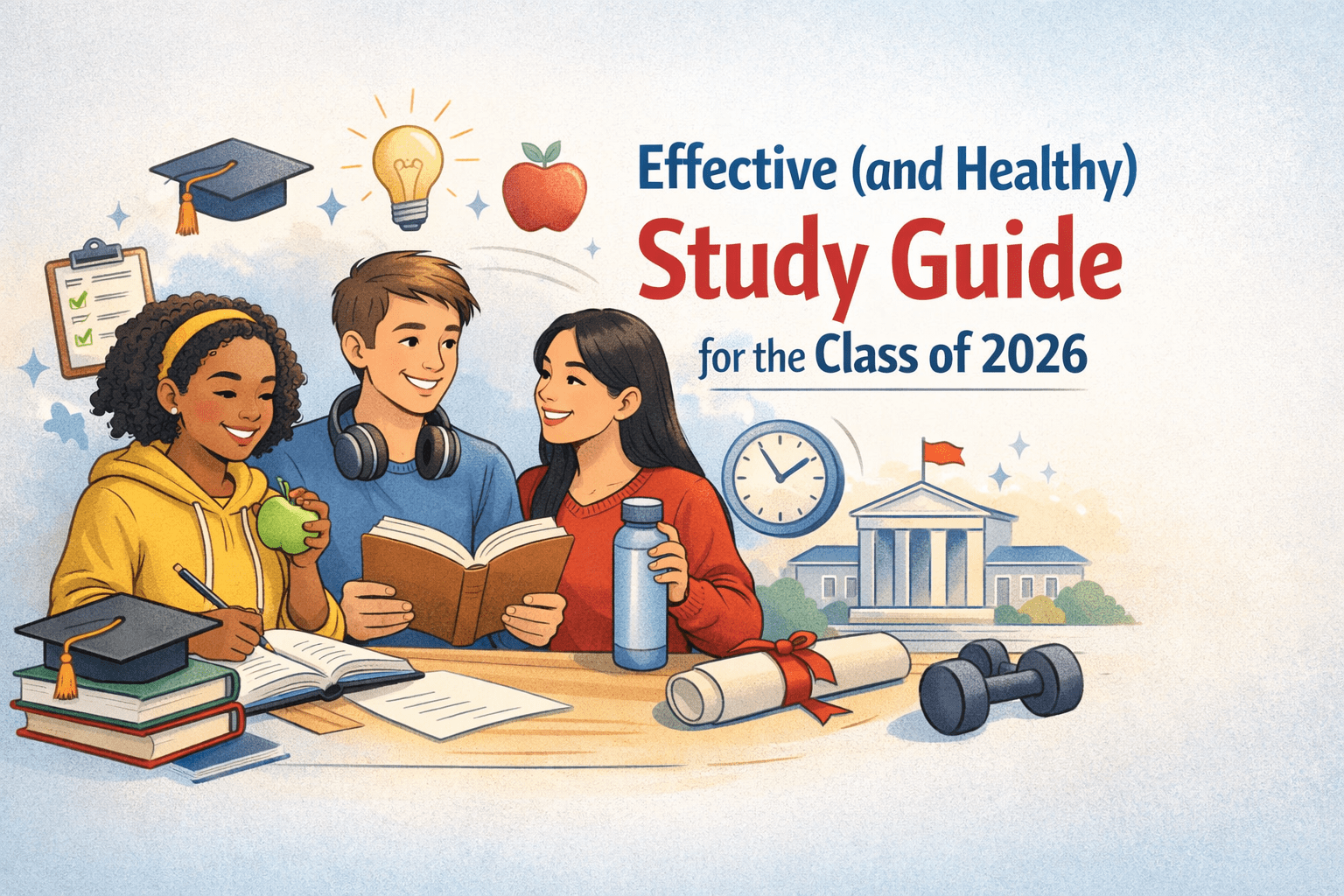
Effective (and Healthy) Study Guide for the Class of 2026
Tips for Effective Study
Studying doesn’t have to feel like a boss battle. With the right strategies (and some healthy routines), you can learn smarter, not just longer. Let’s go. 🚀
1) The Brain-Boosters You Should Actually Use
These study moves are proven by cognitive science—aka they really work:
-
Retrieval practice (aka “test yourself”)
Close your notes and try to recall key ideas from memory. Use flashcards or do a “blur-to-recall” (hide notes → brain dump → check). This strengthens memory way more than rereading. The Learning Scientists -
Spaced practice (no cramming)
Break study into short sessions across days/weeks. Example: 25–30 mins a day beats a 3-hour cram. Pair this with mini self-quizzes. The Learning ScientistsSAGE Journals -
Interleaving (mix it up)
Rotate topics (A→B→C→back to A) instead of doing one thing for hours. It builds flexible understanding and recall. The Learning Scientists -
Elaboration + examples
Ask “why/how does this work?” and create concrete examples from your life. The more connections, the better the learning. The Learning Scientists -
Dual coding
Turn text into visuals (simple diagrams, timelines, arrows). Don’t make it pretty—make it clear. The Learning Scientists
nerd note: A big 2013 review ranked practice testing and distributed (spaced) practice among the highest-utility techniques. SAGE JournalsPubMed
2) Your No-Stress Study Flow (repeat each week)
-
Plan → study → quiz → review → sleep
-
Map out your week (see “Healthy Planner” below)
-
Study in 25–30 min focus blocks with 5-min breaks
-
End every block with a quick self-quiz
-
Space your reviews across the week
-
Get the sleep (see below)
-
-
Tech tip: Set a timer, put your phone on Do Not Disturb, and keep only the tab/app you need open. Bonus: use website blockers during blocks.
3) Healthy = Higher Grades (yes, really)
Your brain is part of your body—treat both well.
-
Sleep (non-negotiable)
Teens need 8–10 hours a night. Sleep turbo-charges attention, memory, and mood. Build a wind-down routine and aim for a consistent schedule. CDCCDC Archive -
Move your body
Aim for 60+ minutes of moderate-to-vigorous activity daily (walks, hooping, dance, workouts). Even 10-minute “movement snacks” between study blocks help. CDC+1 -
Fuel smart
Use MyPlate as your easy template: fruits 🍎, veggies 🥦, grains 🌾, protein 🍗/🫘, and dairy/fortified soy 🥛 daily. Keep brain-fuel snacks handy (nuts, yogurt, fruit, hummus + pita). Hydrate! MyPlate+2MyPlate+2 -
Tame the scroll
If screens steal sleep or study time, build an AAP Family Media Plan with boundaries that fit your life (bedtime tech-off, study-time DND). HealthyChildren.org+1 -
Quick calm for test stress
Slow, guided breathing (e.g., inhale 4–hold 4–exhale 4–hold 4 for 2–5 min) can reduce anxiety and improve mood. Practice before the big day. PMCNature
if stress or sleep issues are heavy or persistent, loop in a school counselor or health professional.
4) Build Your Study Space 🧘♀️📚
-
Light + posture: Good lighting, comfy chair, screen at eye level.
-
Minimal clutter: Keep only what you need for the current block.
-
Sound: White noise/lo-fi/earplugs—whatever keeps you focused.
5) Smart Tech Toolkit (optional but clutch)
-
Flashcards & spacing: Anki, Quizlet (use retrieval + spaced review)
-
Focus blockers: built-in Focus/DND, website blockers
-
Notes → visuals: simple diagram tools or paper sketches (dual coding)
(We don’t endorse specific apps; pick what works for you.)
6) Get Help Faster
-
Teachers: Ask 1–2 targeted questions in office hours or email; bring your notes so they can see where you’re stuck.
-
Study groups: Keep them purposeful—set an agenda, quiz each other, and end with a 5-minute “what sticks/what’s fuzzy” recap.
7) 7-Day “Healthy Study” Challenge ✅
Day 1: Set a weekly plan—3 subjects × 2 short blocks each
Day 2: Make 20 flashcards for a tough unit (retrieval)
Day 3: Quick walk between blocks (movement snack)
Day 4: Interleave: rotate 3 topics (A→B→C→A)
Day 5: Make one simple diagram (dual coding)
Day 6: Practice 5 minutes of calm breathing
Day 7: Full sleep reset—lights out on time, no late scroll
(Want a printable? I can generate a 1-page PDF checklist.)
8) Accessibility & Your Rights ♿️
If you have a disability, you may qualify for classroom/testing accommodations (like extended time or assistive tech) under Section 504. Ask your counselor about starting or updating a 504 plan. U.S. Department of Education+1
Save-worthy Resources 📎
-
The Learning Scientists (free posters + how-to’s on the 6 strategies) → perfect for students & teachers. The Learning Scientists
-
Key research summary (Dunlosky et al., 2013) on which study techniques actually work. SAGE Journals
-
CDC: Teen sleep & physical activity guidelines. CDC+1
-
MyPlate for Teens: Simple, visual healthy-eating tips. MyPlate
-
AAP Family Media Plan: Customize screen-time boundaries. HealthyChildren.org
Effective (and Healthy) Study Guide for the Class of 2026
For the U.S. high-school Class of 2026, “studying harder” is rarely the binding constraint. The binding constraints are (1) study methods that feel productive but produce weak long-term learning, and (2) health tradeoffs—sleep loss, chronic stress, digital distraction—that quietly erode attention, memory, mood, and academic persistence. Recent national data show that adolescent distress remains widespread: in 2023, about 40% of high school students reported persistent sadness or hopelessness, and about 20% seriously considered attempting suicide. Against that backdrop, an “effective” study guide that ignores health is incomplete.
This paper synthesizes findings from cognitive/educational psychology on durable learning (retrieval practice, spacing, interleaving, elaboration, and feedback) and integrates them with evidence-based health behaviors that function as learning multipliers (sleep duration/regularity, movement, stress regulation, caffeine boundaries, and digital hygiene). High-utility learning techniques—especially practice testing (retrieval practice) and distributed practice (spacing)—consistently outperform passive review in building long-term retention. Meanwhile, sleep and attention are not “nice-to-haves”: objective and observational research links nightly sleep to academic performance, including evidence that reduced sleep predicts lower GPA. Digital distraction adds a measurable headwind; recent meta-analytic evidence finds a small but reliable negative association between smartphone use frequency and university students’ academic performance (e.g., r ≈ −0.12).
The result is an implementable study system for spring 2026 that prioritizes high-yield learning moves and health-protective routines. It includes session templates, a weekly scheduling architecture, exam-week protocols, and equity-minded adaptations for students juggling work, caregiving, neurodiversity, or mental health strain.
Keywords: retrieval practice, spaced repetition, interleaving, sleep, adolescent mental health, digital distraction, executive function, study systems
1. Context: Why “effective” now must also mean “healthy”
1.1 The Class of 2026 academic reality
By spring of senior year, Class of 2026 students often face a paradox: admissions outcomes may be partially decided, yet scholarship eligibility, final transcript review, AP/IB exams, dual-enrollment grades, and college readiness still depend on performance. The workload peak also collides with common senior-year stressors—financial aid paperwork, family expectations, shifting friendships, and future uncertainty.
1.2 Mental health and cognition are entangled constraints
U.S. surveillance data underscore the scale of distress: CDC reporting on 2023 Youth Risk Behavior Survey (YRBS) results indicates ~40% of students experienced persistent sadness or hopelessness and ~20% seriously considered attempting suicide. These are not abstract numbers; they describe classrooms where many students are studying under chronic cognitive load. Stress and anxiety can narrow attention, bias memory toward threat, and reduce the working-memory bandwidth needed for problem solving.
Implication: A modern study guide must be a learning + recovery plan, not only a tactics list.
2. Method: Evidence synthesis approach
This guide draws primarily from:
-
Foundational cognitive/educational psychology reviews ranking study techniques by utility and generalizability (e.g., Dunlosky et al.).
-
Meta-analyses quantifying effects of retrieval practice and related strategies in educational settings (e.g., practice testing).
-
Public-health and pediatric guidance on sleep, school start times, physical activity, and caffeine for adolescents.
-
Recent research syntheses on digital distraction/smartphone use and academic performance.
-
Peer-reviewed findings linking sleep patterns to GPA and performance.
Where evidence is mixed or context-dependent (common in health and education), recommendations are framed as principles + experiments, not absolutes.
3. The learning science: what reliably builds long-term memory
A useful way to think about studying is building retrieval strength (can you pull it out later?) rather than familiarity (does it look recognizable now?). Most students overinvest in familiarity because it feels smooth.
3.1 High-utility techniques (best “ROI” across subjects)
A major review of 10 learning techniques rated practice testing and distributed practice as the most broadly effective and scalable. These techniques work because they match how memory stabilizes: effortful retrieval and repeated reactivation across time.
Practice testing (retrieval practice)
Definition: Answering questions, recalling from memory, doing problems without looking—then checking.
Why it works: Retrieval strengthens the memory trace and improves future access (the “testing effect”).
Evidence: Educational meta-analytic work finds practice tests generally outperform restudy and many comparison conditions for retention and transfer.
Practical translation for seniors:
-
Turn every unit into a question bank (teacher-provided, self-made, or AI-assisted with verification).
-
Do closed-book retrieval first, then open notes for corrections.
-
Track misses; missed items become the next day’s warm-up.
Distributed practice (spacing)
Definition: Repeating study across days/weeks rather than cramming.
Why it works: Spacing forces partial forgetting, making retrieval harder—and that desirable difficulty improves durability.
Evidence: Rated high utility in broad reviews.
Practical translation:
-
“Short + frequent” beats “long + rare.”
-
Space review of older material even while learning new content (spiral).
3.2 Moderate-utility techniques that amplify understanding
These aren’t as universally strong as retrieval + spacing, but they matter—especially for writing-heavy or concept-heavy courses.
-
Elaborative interrogation: Ask “Why is this true?” and answer in your own words.
-
Self-explanation: Explain steps while solving; connect new info to what you already know.
-
Interleaving: Mix problem types/topics instead of blocking by one type. Reviews rate it as promising with conditions.
3.3 Low-ROI traps (feel productive, underperform long-term)
The same evidence base cautions that common habits like rereading and highlighting are often low-yield when used alone, especially if they replace retrieval.
Rule of thumb: If your study method never forces you to produce answers, it’s probably building familiarity more than memory.
4. The health science: the “learning multipliers” most students ignore
Effective studying is not only about tactics; it’s about the brain state you bring to tactics.
4.1 Sleep: the non-negotiable memory tool
The American Academy of Sleep Medicine recommends that teens ages 13–18 sleep 8–10 hours per 24 hours regularly. Sleep supports attention, mood regulation, and memory consolidation.
Recent research links sleep to academic outcomes. For example, a PNAS study on college students found that greater nightly sleep earlier in the term predicted higher end-of-term GPA. Reporting on related findings notes that students getting less than ~6 hours showed pronounced performance decline and that each hour of sleep lost corresponded to a measurable GPA decrease.
Senior-year implication: The common “I’ll sleep after exams” strategy is self-defeating for learning-intensive exams (AP/IB/finals) because it undercuts the consolidation you’re studying for.
Operational sleep targets (choose one):
-
Protect duration: Aim for the 8–10 hour adolescent recommendation when possible.
-
Protect regularity: Keep wake time consistent; avoid big weekend shifts if you can.
-
Protect pre-sleep: Reduce late-night cognitive arousal and screens.
4.2 School start times: structural friction matters
AAP guidance has urged middle/high schools to start no earlier than 8:30 a.m. to better align with adolescent sleep biology. Even if your school starts early, this reinforces a key point: if you’re fighting biology, you need stronger routines to compensate (evening wind-down, caffeine boundaries, morning light exposure).
4.3 Physical activity: cognition isn’t separate from movement
CDC and WHO recommend that youth ages 6–17 get 60 minutes/day of moderate-to-vigorous activity. Beyond long-term health, exercise supports executive function (planning, inhibition, working memory). Meta-analyses and pediatric publications report cognitive benefits from exercise interventions in children and adolescents.
Study translation: Think of movement as an attention primer. A 10–20 minute brisk walk before a hard subject can improve session quality even if it “costs time.”
4.4 Digital distraction: a measurable academic tax
A 2025 meta-analysis focused on university students found smartphone usage frequency had a small but statistically significant negative association with academic performance (e.g., r ≈ −0.12). Another 2025 meta-analysis across technology-related factors (smartphones/social media/video games) similarly reports a small negative association with academic performance (effect around d ≈ −0.085).
Interpretation: The effect is “small” at the population level, but for an individual student in a high-stakes semester, reducing distraction can be the difference between good intentions and actual throughput.
4.5 Caffeine: useful tool, easy to overdose
Pediatric guidance often advises limiting adolescents (12–18) to ~100 mg caffeine/day and avoiding energy drinks. Caffeine too late also disrupts sleep—creating a performance loop (tired → caffeine → worse sleep → more tired).
Practical boundary: If you use caffeine, treat it like a medication: dose, timing, and purpose—not a personality.
4.6 Stress regulation: modest tools that reduce test friction
Mindfulness-based interventions show small-to-moderate benefits in some school settings, with evidence suggesting improvements in stress even when broader outcomes vary. The value for seniors is often tactical: lowering test anxiety enough to access what you already know.
5. An integrated framework: the “Durable Learning × Sustainable Energy” model
You can model academic performance as:
Performance = (Durable Learning) × (Available Cognitive Energy)
-
Durable learning comes from retrieval + spacing + feedback.
-
Cognitive energy comes from sleep + movement + stress regulation + distraction control.
Most students try to solve performance by pushing only the first lever (“more hours”). High performers increasingly solve it by engineering the second lever (“better brain state”), so each hour counts more.
6. The Effective & Healthy Study System (EHSS) for Spring 2026
Below is a concrete system designed for seniors who are balancing classes, scholarships, jobs, and life.
6.1 The three-layer plan
Layer A: Semester map (1 hour, once)
-
List every major assessment: unit tests, essays, labs, performances, AP/IB exams, finals.
-
Mark “high-impact” weeks (two+ major items).
-
Choose two non-negotiables:
-
Sleep floor (e.g., “7.5+ hours school nights” or “lights-out by 11:30”).
-
Distraction rule (e.g., “phone outside room for study blocks”).
-
Layer B: Weekly plan (20 minutes, Sunday)
-
Allocate 4–6 retrieval blocks (30–45 minutes) across the week.
-
Allocate 1–2 longer production blocks (writing set, lab report, project build).
-
Schedule movement (even 3×20 minutes) and protect 1 recovery window.
Layer C: Daily plan (5 minutes, morning or after school)
-
Pick one “hard thing” (most cognitively demanding).
-
Pick one “maintenance thing” (quick review/admin).
-
Define a stopping time to defend sleep.
6.2 The 45-minute “high-yield” study session template
This is the EHSS core unit.
0–3 min: Setup
-
Phone away (physically).
-
Open a single task list.
-
Decide success metric: “Complete 20 retrieval Qs” or “Draft 300 words.”
3–23 min: Retrieval first (closed-book)
-
Do questions, problems, flashcards, or free recall.
-
Mark confidence (✔ / ? / ✘).
23–33 min: Feedback + error correction (open-book)
-
Check answers.
-
Write corrections in a “mistake log” (what I missed + why + the right reasoning).
33–43 min: Spaced reinforce
-
Re-do missed items without looking.
-
Create 3–5 new questions from today’s lesson.
43–45 min: Schedule the next touch
-
Put the weakest items on tomorrow’s warm-up list.
Why this works: It forces the two highest-utility learning mechanisms—retrieval and spacing—into every session.
7. Technique-by-technique: what to use, when, and how (with evidence)
| Technique | Best for | How to do it in real life | Evidence signal |
|---|---|---|---|
| Retrieval practice (practice testing) | Exams, math/science, vocab, concepts | Closed-book questions → check → correct → re-test misses | High utility in major review; meta-analysis supports learning gains. |
| Spaced practice | Anything cumulative | Revisit material across days/weeks; “tomorrow + next week + pre-exam” | High utility across contexts. |
| Interleaving | Mixed problem sets, STEM, grammar | Mix problem types; shuffle practice sets | Promising/moderate utility; depends on task structure. |
| Self-explanation | Problem solving, labs, proofs | Narrate steps: “I did X because…” | Moderate utility in reviews. |
| Elaborative interrogation | Reading/history/biology | Ask “why/how” and answer from memory | Moderate utility in reviews. |
| Highlighting/rereading | Only as prep for retrieval | Skim once to map; then switch to questions | Often low yield when used alone. |
8. The “Healthy Study” operating rules (simple, strict, high payoff)
Rule 1: Sleep is scheduled first
AASM guidance for teens is 8–10 hours. If you can’t hit that consistently, prioritize:
-
consistent wake time,
-
earlier screens-off,
-
a shorter but non-negotiable wind-down.
Rule 2: Make movement a study tool, not an optional hobby
Aim toward youth guidelines (60 minutes/day). If that’s unrealistic in senior spring, use the minimum effective dose:
-
10 minutes brisk walk before a hard subject
-
5 minutes mobility between blocks
-
2–3 strength mini-sets/week
Cognitive benefits of exercise interventions have meta-analytic support.
Rule 3: Phone friction beats phone willpower
Because smartphone use correlates with academic performance at the population level, treat phone control as academic hygiene.
Implement friction:
-
phone outside room
-
app limits during study blocks
-
grayscale mode
-
“single-device rule” (if you need laptop, phone is off)
Rule 4: Caffeine has a ceiling and a curfew
Guidance commonly suggests teens cap caffeine around 100 mg/day and avoid energy drinks.
-
Ceiling: ~100 mg/day
-
Curfew: avoid within ~8 hours of bedtime (often recommended in pediatric guidance).
Rule 5: Stress tools should be small, frequent, and measurable
Mindfulness interventions show evidence of stress reduction in adolescent school settings, though effects vary by comparator and program type.
A practical senior protocol:
-
60–90 seconds of slow breathing before tests
-
3-minute reset after a missed question set
-
brief body scan before sleep
9. A ready-to-use weekly schedule for a typical senior
Goal: 5 study blocks/week + health protections (sleep, movement, phone boundaries)
Mon–Thu (school nights):
-
45 min EHSS session (retrieval + corrections)
-
10–20 min movement (walk, stairs, short workout)
-
screens-off wind-down
Fri:
-
30–45 min “maintenance” (missed items + organizing)
-
social/recovery
Sat:
-
90 min deep work (essay draft, lab report, project)
-
30 min mixed retrieval for two subjects
Sun (planning day):
-
20 min weekly plan
-
45 min retrieval session
-
prep environment (print Qs, pack materials)
Built-in spacing: Material touched multiple times across the week rather than once.
10. Exam-week protocol (how to peak without burning out)
10.1 The 5-day ramp
-
Day −5 to −3: heavy retrieval, build mistake log
-
Day −2: mixed interleaving + targeted weak areas
-
Day −1: short retrieval + early stop + sleep defense
-
Test day: warm-up retrieval (10–15 min), not full cramming
10.2 The “two-lists” method
-
List A: “I can do this under time pressure”
-
List B: “I miss this when stressed”
Exam week is mostly List B work—retrieval with feedback until stress no longer breaks it.
11. Equity-minded adaptations (because not everyone has the same time or conditions)
If you work a job / have caregiving duties
-
Use micro-sessions: 2×20 minutes beats 0×60.
-
Make commute time “audio retrieval” (explain concepts aloud).
-
Prioritize the two high-utility moves: retrieval + spacing.
If you have ADHD, anxiety, or chronic overwhelm
This is not medical advice, but evidence-informed scaffolding can reduce friction:
-
Shorter blocks (25–35 minutes)
-
Externalize next action (“open doc, write 3 bullets”)
-
“Start ritual” that’s always the same
-
Reduce phone access during blocks (environmental control tends to beat willpower)
If mental health feels dangerous or unmanageable
Given the prevalence of distress in national data, it’s worth stating plainly: if you’re experiencing suicidal thoughts or feel unsafe, seek immediate help (trusted adult, local emergency services, or 988 in the U.S.). The priority is safety.
12. What schools and families can do (system-level supports)
Individual strategy matters, but structural conditions matter too. Pediatric guidance has long argued that school schedules should better align with adolescent sleep needs (e.g., 8:30 a.m. or later). Schools can also:
-
build retrieval practice into class (low-stakes quizzes)
-
teach students how to study (not assume they know)
-
implement phone norms that reduce in-class distraction while also addressing out-of-school use patterns
-
expand access to counseling and stress-management programming
Conclusion: The senior-year study goal is not “maximum hours”—it’s maximum durability per hour
For the Class of 2026, the most competitive advantage is rarely raw effort. It is a system that:
-
makes learning durable (retrieval + spacing + feedback), and
-
keeps the learning machine healthy (sleep + movement + stress regulation + digital boundaries).
If you adopt only two changes this week, make them these:
-
Replace half of rereading with closed-book retrieval, and
-
Protect sleep as the foundation (teens: 8–10 hours recommended).
That combination is simple, evidence-aligned, and—most importantly—sustainable through graduation.