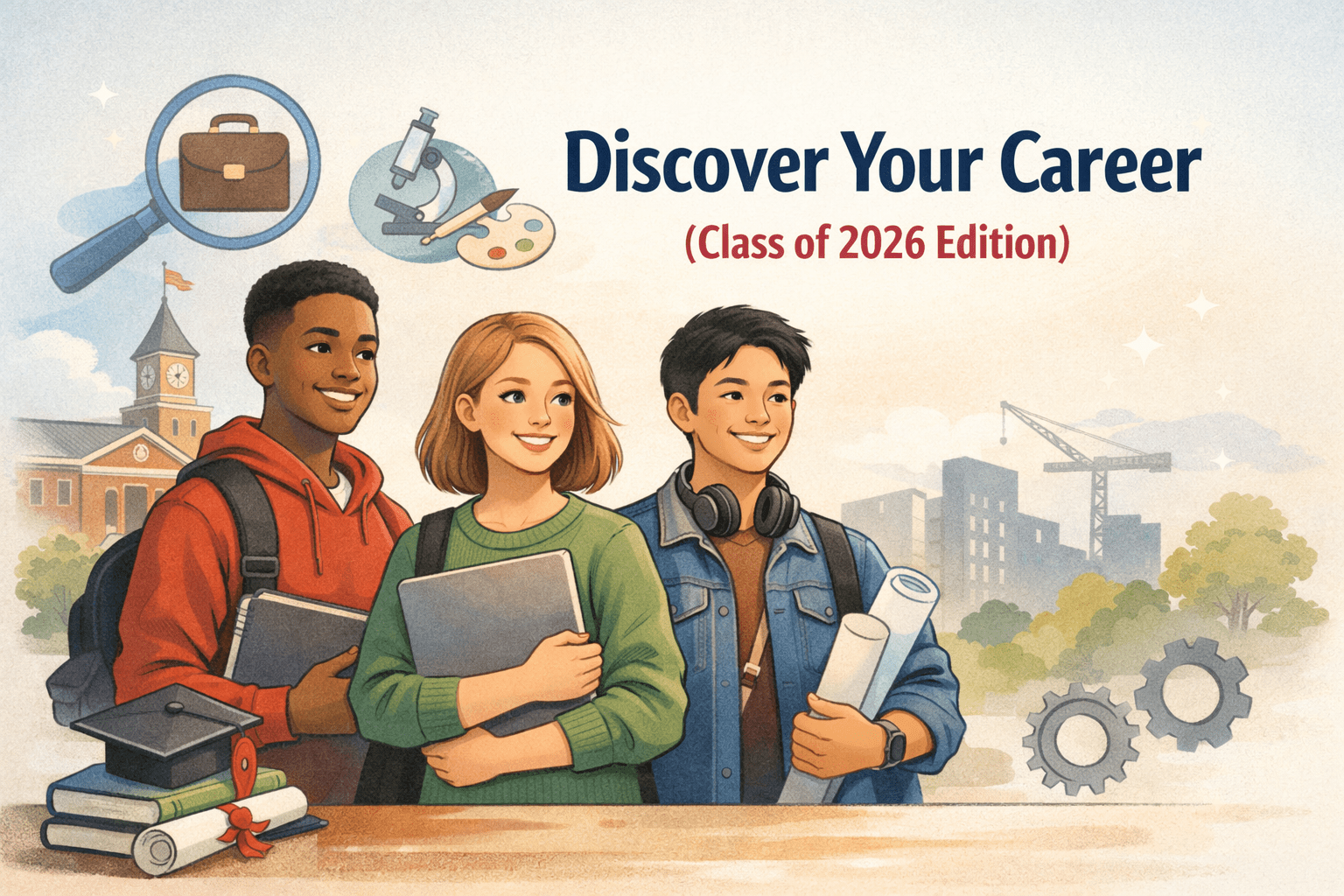
Discover Your Career (Class of 2026 Edition)
Your 60-Minute Career Sprint
-
Take one quick interest quiz (free).
-
Pull 3 jobs that match.
-
Compare pay, training, and growth.
-
DM or email one adult for a 15-minute informational chat.
-
Try a job shadow/experience before winter break.
Use the tools below. (They’re all trusted and current.) My Next Move
Step 1 — Find Your Fit (Free, science-based quizzes) 🧭
-
O*NET Interest Profiler (My Next Move) — 60 Qs → careers that match your interests. Free & mobile-friendly. My Next MoveO*NET Resource Center
-
CareerOneStop Interest Assessment — 30 Qs → careers by interest areas; includes quick explainers. CareerOneStop
-
BigFuture Career Quiz (College Board) — 15 minutes; powered by O*NET; saves to your College Board account. BigFuture+1
👉 Tip: Screenshot your results and star 3–5 careers to research next.
Step 2 — Research Like a Pro 🔎
-
BLS Occupational Outlook Handbook (OOH) — official job data: pay, required education, work-environment, and 2024–34 job outlook (freshly updated Aug 28, 2025). Bureau of Labor Statistics+1
-
My Next Move (O*NET) — plain-English career pages with skills, tasks, and “Bright Outlook” lists. My Next MoveO*NET OnLine
Copy-this mini chart:
| Career | Typical Education | Median Pay | Job Outlook | 3 Skills to Build Now |
|---|---|---|---|---|
| ex: Radiologic Technologist | Associate’s | $— | Faster than avg | Anatomy basics, patient comms, tech fluency |
Fill with OOH/My Next Move data for your 3 short-listed careers. Bureau of Labor StatisticsMy Next Move
Step 3 — Talk to a Human (Informational Interviews) 💬
Ask someone doing the job for 15 minutes of advice—no pressure, not a job interview.
Starter Qs (pick 5):
-
“What do you actually do in a typical day?”
-
“Which entry-level roles do people start in?”
-
“What classes/certs helped most for your first job?”
-
“What does growth look like in 2–3 years?”
-
“If you were me (HS senior), what would you do before June?” Penn State Student AffairsUB School of Management
How to find people: Parents/guardians, teachers, coaches, neighbors, alumni, LinkedIn, or your school counselor’s network.
Step 4 — Try It IRL (Before Winter Break) 🛠️
-
Job Shadow / Experience Hours — follow a pro for a few hours to see the real day-to-day. Your counselor can help set it up; also check local organizations. CareerOneStop+1
-
Apprenticeships & Pre-apprenticeships — paid, learn-while-you-earn pathways across tons of industries (not just trades). Search Apprenticeship.gov for openings in your state. Apprenticeship.gov+2Apprenticeship.gov+2
-
Youth Work & Volunteering — build skills now: internships, community orgs, campus clubs, and projects count. CareerOneStop
Class of 2026 Timeline (Now → Graduation) 📅
-
September–October 2025: Take 1–2 interest quizzes, shortlist 3 careers, read their OOH pages, schedule one informational interview. Bureau of Labor StatisticsBigFuture
-
November–December: Do a job shadow or short experience; update your resume with new skills/tasks. CareerOneStop
-
January–March 2026: If a hands-on path interests you, apply to apprenticeships or training programs; compare offer details (pay during training, length, certification). Apprenticeship.gov
-
April–June: Confirm your path (college, training, apprenticeship, direct-to-work). Double-check job outlook and required credentials on OOH/My Next Move before committing. Bureau of Labor StatisticsMy Next Move
Swipe-and-Use Scripts 📨
Ask for a job shadow:
“Hi ___, I’m a senior at ___ exploring ___ careers. Could I shadow you for 2–3 hours to learn about your day-to-day? I can come ___ (times). Thanks for considering!”
Ask for an informational interview:
“Hi ___, I’m researching ___ roles. Could I ask you 5–6 questions in a 15-minute call? Your advice would help me plan courses and next steps.”
Quick Skill-Building Ideas (you can start this week) 🧪💻📸
-
Health: volunteer at clinics, first-aid/CPR cert.
-
Tech: build a tiny app/site; contribute to an open-source issue.
-
Creative: photo/video series for a local club or small biz.
-
Green careers: help a local park or garden; track a simple data project.
Use OOH/My Next Move to match skills to real roles you’re eyeing. Bureau of Labor StatisticsMy Next Move
Save This: Career Journal Template 🗒️
-
My top 3 careers: ___ / ___ / ___
-
Why they fit my interests: ___
-
What I learned from a pro: ___
-
Next step + date: ___
-
Proof of action (link, screenshot, hours): ___
Best-of Resources (All Free & Trusted)
-
O*NET Interest Profiler / My Next Move — interest quiz + browsable career pages. My Next Move+1
-
CareerOneStop — interest & skills assessments, videos, youth programs. CareerOneStop+2CareerOneStop+2
-
OOH (BLS) — official pay, training, and latest job-outlook data (2024–34). Bureau of Labor Statistics+1
-
BigFuture (College Board) — career quiz + exploration hub with student-friendly guides. BigFuture+1
-
Apprenticeship.gov — find registered apprenticeships by state. Apprenticeship.gov
Discover Your Career: A Data-Driven, Evidence-Based Framework for High School Seniors’ Career Discovery and Postsecondary Pathway Alignment
High school seniors face a high-stakes transition in an economy where job growth is uneven across sectors, credentials vary widely in return, and early postsecondary choices often change. National data illustrate both the opportunity and the risk: most high school completers immediately enroll in college, but enrollment pathways differ substantially by sector (2-year vs. 4-year), and major switching is common—about 30% of beginning undergraduates who declared a major changed it within three years, with ~1 in 10 switching more than once. At the same time, labor-market outcomes remain strongly associated with educational attainment (e.g., median weekly earnings rise with degrees), while fast-growing occupational clusters (healthcare, data/AI-adjacent roles, and clean-energy technicians) require very different training routes. This research paper synthesizes contemporary evidence on adolescent career interventions and proposes a practical, measurable “Discover Your Career” model for seniors that integrates validated interest assessment, labor-market information (LMI), work-based learning, and decision-architecture practices drawn from career-development science. A key conclusion is that career discovery should be treated as an applied research cycle—hypothesis, test, revise—rather than a one-time “pick a job” decision, with equity-focused design to expand access to high-value experiences such as paid internships and registered apprenticeships.
Keywords: career discovery, high school seniors, career interventions, work-based learning, O*NET, labor-market information, career adaptability, postsecondary alignment
1. Why “Discover Your Career” Is an Urgent Senior-Year Problem
Senior year compresses multiple irreversible-seeming decisions—college major, training route, financing plan, geographic moves—into a narrow timeframe. Yet national participation patterns show that the transition is widespread and heterogeneous. The U.S. Department of Education’s Condition of Education indicator defines immediate college enrollment as enrollment in October following high school completion; in 2022, about 45% of high school completers immediately enrolled in 4-year institutions and 17% in 2-year institutions. Those rates imply that for a large share of seniors, postsecondary entry begins immediately, often before robust career exploration is complete.
Mismatch costs are not hypothetical. NCES longitudinal evidence finds that within three years of initial enrollment, about 30% of associate’s and bachelor’s degree students who declared a major had changed it at least once; ~1 in 10 changed majors more than once. This degree of switching can be developmentally normal, but it can also signal weak initial alignment among interests, academic preparation, and occupational reality—factors associated with extra time-to-degree, sunk costs, and stress. A senior-year career discovery process therefore functions as risk management: it reduces the probability of costly trial-and-error by making the “trial” smaller, earlier, and cheaper (e.g., job shadowing before committing to a program).
2. The Labor-Market Case: Returns, Risk, and Rapidly Shifting Demand
2.1 Education still “pays,” but pathways are diverse
BLS data for adults (age 25+) show a strong association between education level and earnings/unemployment: in 2024, median usual weekly earnings were $930 for high school diploma holders versus $1,543 for bachelor’s degree holders, with unemployment 4.2% vs. 2.5%, respectively. This gradient supports the long-standing rationale for postsecondary education. However, the same BLS table explicitly notes that it does not capture forms of training such as apprenticeships and other on-the-job training that also influence outcomes—an important reminder that “college vs. no college” is an outdated binary.
2.2 Growth clusters: healthcare, data/AI-adjacent roles, and energy technicians
BLS 2024–2034 projections point to structural demand: healthcare support occupations are projected to grow 12.4%, computer and mathematical occupations 10.1%, with a projected overall employment growth of 3.1%—meaning these fields outpace the economy-wide baseline. The same projections highlight the role of automation and AI in reducing demand for some office/administrative roles while increasing demand for data analysis and cybersecurity. At the occupation level, BLS lists many of the fastest-growing roles (e.g., operations research analysts, physician assistants, computer and information research scientists), underscoring that “growth” often coincides with higher skill thresholds and clearer credential requirements.
2.3 Apprenticeship as a scaled alternative route
Registered Apprenticeship is no longer niche. An Apprenticeship.gov factsheet reports 949K+ apprentices served and 26K+ active apprenticeship programs, “as of FY2024.” For seniors, this matters because apprenticeship can convert career exploration into paid skill acquisition—particularly in fields where “learn-and-earn” models reduce debt exposure. Recent federal communications also indicate continued policy emphasis on expanding apprenticeships and related systems.
Implication: Career discovery must be “LMI-literate.” Students should explore not only what they like, but what is growing, what credentials are actually required, and what training routes are financially viable.
3. What the Evidence Says About Career Discovery Interventions in High School
3.1 Contemporary intervention science: what works and why
A systematic review of career interventions for high school students finds that leading theoretical frameworks include Career Construction Theory, Social Cognitive Career Theory (SCCT), and Cognitive Information Processing (CIP), with common modalities such as group counseling and career courses and outcomes concentrated in career adaptability and career decision-making. Notably, the review recommends a three-tier model (universal curriculum → targeted group counseling → individualized counseling), aligning with the idea that seniors need both broad exposure and individualized decision support.
A separate meta-analysis of school-based career guidance interventions (nine studies; 1,433 participants) reports a weighted mean effect size of 0.42 (95% CI 0.19–0.65), interpreted as moderate-to-high, indicating that structured guidance improves career-related outcomes relative to control conditions. While effect sizes vary across program types, the consistent direction supports a central premise: career discovery is teachable and responds to intervention.
3.2 Work-based learning: “testing” careers with real constraints
Career discovery improves when it includes authentic exposure. Strada’s synthesis on work-based learning (WBL) emphasizes that paid internships are linked to higher-paying first jobs one year after graduation and to noneconomic outcomes like confidence and perceived value of education; it also notes that less than one-third of recent graduates participated in a paid internship and that access gaps persist by race/ethnicity, gender, income, and first-generation status. This matters for high school seniors because it reframes “experience” as an equity lever: systems should not treat internships and job shadowing as optional extras available only to the well-connected.
Implication: The strongest “discover your career” programs combine (1) identity development and self-efficacy work, (2) decision skills, and (3) real-world exposure that produces feedback.
4. A Data-Driven “Discover Your Career” Model for High School Seniors
This section proposes a structured model designed for a 10–12 week senior-year window. The model is intentionally iterative and measurable—closer to applied research than inspirational advising.
Phase 1: Self-Specification (Weeks 1–2) — Build a testable “career hypothesis”
Goal: Translate self-knowledge into hypotheses about work environments and tasks (not job titles).
Tools and measures:
-
Validated interest assessment using RIASEC-aligned instruments. The O*NET Interest Profiler is designed to help individuals identify work activities they find exciting and link results to hundreds of occupations across O*NET tools (e.g., My Next Move).
-
Strengths and values clarification (e.g., autonomy vs. structure; people-focused vs. systems-focused).
Deliverable: A one-page “career hypothesis statement,” such as:
“I’m likely to thrive in investigative/analytical environments with moderate teamwork, clear skill progression, and a mission-driven context.”
Phase 2: Opportunity Mapping (Weeks 2–4) — Convert interests into pathways
Goal: Use labor-market information to filter options by growth, wages, credential requirements, and geographic viability.
Data sources:
-
BLS fastest-growing occupations and projected growth clusters.
-
Education/earnings baselines to understand long-run tradeoffs.
Deliverables: -
A shortlist of 8–12 roles grouped into “near,” “stretch,” and “wildcard” options.
-
For each role: required education/training, typical entry steps, and a realistic “time-to-earn” estimate.
Phase 3: Micro-Experiments (Weeks 4–8) — Test careers before committing
Goal: Replace abstract preference with evidence from exposure.
Recommended minimum set (choose 2–3):
-
Job shadow (half-day)
-
Informational interview (30 minutes)
-
Short project simulation (e.g., build a small dataset, design a mock campaign, basic EMT observation where allowed)
-
Paid or structured internship when available (even if short)
WBL evidence indicates that paid internships are particularly associated with improved early labor-market outcomes and confidence, so schools should prioritize compensable placements whenever possible.
Deliverable: A structured reflection log (what energized me, what drained me, what skills I lacked, what surprised me).
Phase 4: Pathway Design (Weeks 8–10) — Build an aligned postsecondary plan
Goal: Convert the best-supported option(s) into an actionable plan with fallback routes.
Plan components:
-
Primary pathway (e.g., 4-year program + target internships; 2-year program + transfer; apprenticeship; military + credential plan)
-
Financial plan (aid, scholarships, work plan)
-
Skill plan (which technical + employability skills to build in the next 6 months)
Why this matters: High rates of major switching suggest students benefit from planning that anticipates revision rather than pretending certainty is required.
Phase 5: Decision Architecture + Commitment (Weeks 10–12) — Make a “good-enough” decision well
Goal: Prevent analysis paralysis while preserving flexibility.
Methods:
-
Use a weighted decision matrix (fit, cost, time, growth outlook, mentorship access)
-
Pre-commit to a review checkpoint (end of first college semester, or 90 days into training)
Outcome metrics: Career decision-making self-efficacy, career adaptability, and clarity—outcomes emphasized in the high school intervention literature.
5. CTE and “Multiple On-Ramps”: Evidence on Pathway Diversity
Career discovery for seniors should not default to a single “best” route. NCES transcript-linked outcomes for 2013 public high school graduates show that among those ever enrolled in postsecondary education by June 2021, CTE concentrators were more likely than nonconcentrators to have an associate’s degree as their highest credential (about 13.6% vs. 9.4%) and less likely to have a bachelor’s or higher as their highest credential (about 47.7% vs. 54.1%). These differences do not imply deficit; they indicate that concentrators often pursue different credential ladders—and therefore need advising that optimizes for their pathway ROI (including transfer, certificates, and apprenticeship-aligned credentials).
Equity lens: Because high-value WBL (especially paid internships) remains unequally distributed, schools should treat access as an intervention target, not a student responsibility.
6. Recommendations for Schools, Counselors, and Families
-
Adopt a three-tier career development model (universal curriculum, targeted groups, individualized counseling), consistent with the intervention literature.
-
Institutionalize “micro-experiments” (job shadows, informational interviews, project simulations) as graduation-capstone options—career discovery improves when students test hypotheses in real contexts.
-
Teach labor-market literacy explicitly (how to read growth projections, credential requirements, and wage distributions) using public sources like BLS.
-
Normalize revision without normalizing drift: major switching is common, so students need structured checkpoints that trigger adjustment based on evidence, not panic.
-
Expand apprenticeship awareness and partnerships: registered apprenticeships operate at national scale (hundreds of thousands served; tens of thousands of active programs), yet are often invisible to college-bound students.
-
Measure outcomes: track career decision-making self-efficacy, postsecondary alignment (first-year persistence), and WBL participation rates, disaggregated by student subgroup to detect access gaps.
Conclusion
“Discover your career” is not a personality quiz moment; it is a structured learning process that should be designed with the rigor of an evidence-based intervention. National data reveal why: most students move quickly into postsecondary education, many change majors early, labor-market demand is increasingly polarized by skill, and access to high-value experiences like paid internships is unequal. The research on high school career interventions indicates measurable gains in career adaptability and decision-making, and the most robust models integrate validated self-assessment, labor-market information, and real-world exposure. For high school seniors, the best career decision is rarely the “perfect” one—it is the one made through a disciplined cycle of exploration, testing, feedback, and revision, supported by systems that make high-quality opportunities accessible to all.