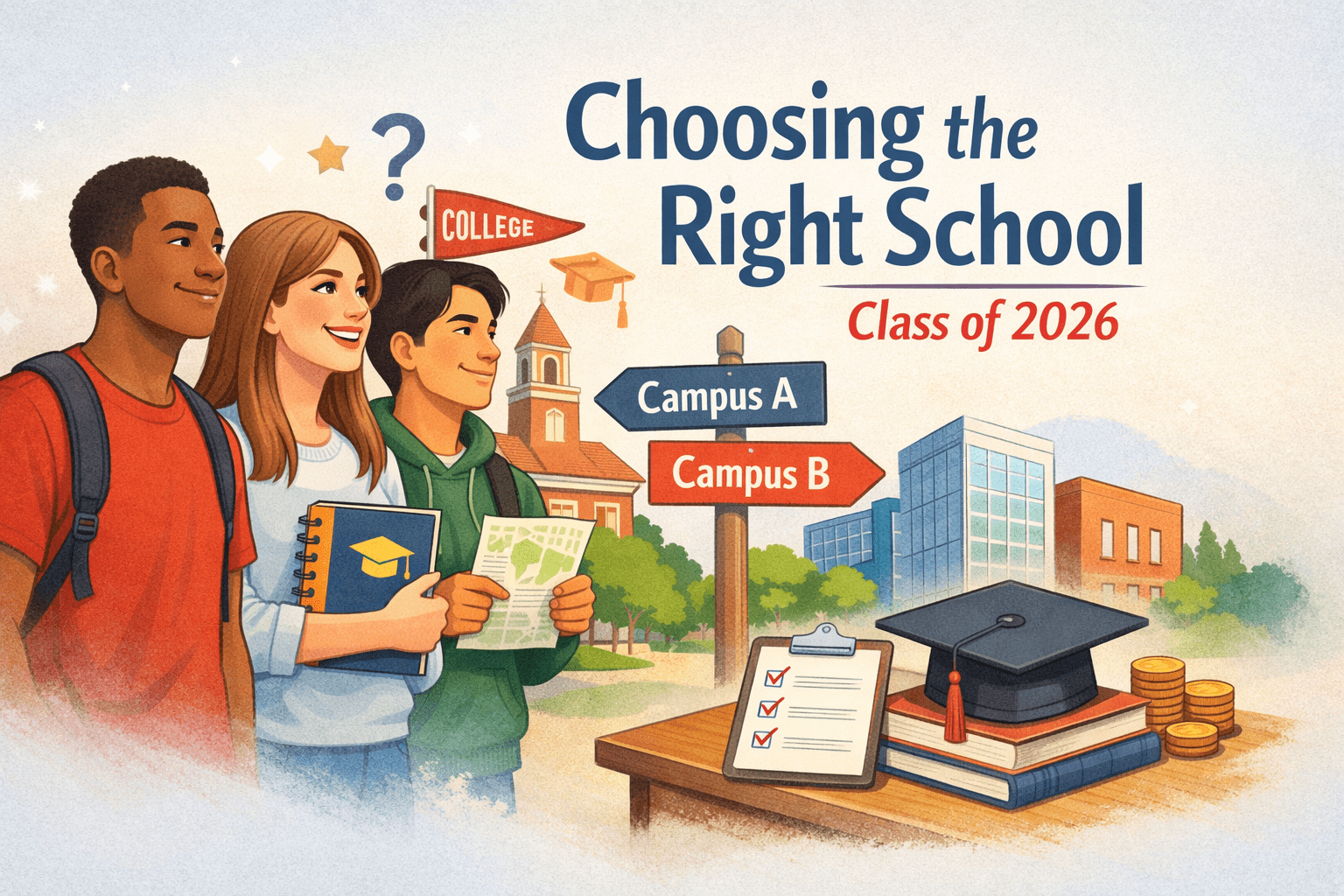
Choosing the Perfect School? Let’s Make It Exciting (and Totally You!)
Learn how to match your personality, goals, and lifestyle with a school that fuels your future. From real-world outcomes and experiential learning to budget hacks and early application hacks—this guide helps Class of 2026 find not just the best school, but the right school.
1. What’s Your “You Factor”?
Forget rankings. Start with what actually fits you:
-
Academic vibe: Are you a STEM whiz? A creative writer? Unsure? That’s okay—look for schools with solid exploratory programs.University of Cincinnati
-
Social atmosphere: Big stadiums or chill coffee hangouts? Urban pulse or small‑town charm?
-
Money matters: Know what’s realistic. Use net price calculators on college websites to estimate real costs—not just the sticker price.University of CincinnatiWikipedia
2. Hands-On Is the Real Power Move
Prioritize schools where you can do stuff, not just listen:
-
Internships, research, service learning, creative projects—you’ll learn, build confidence, and stand out.The Times of India+15College Essay Guy | Get Inspired+15East Ohio University+15
3. Future-Proof Your Choice with Outcomes Data
Check real-world results, not just shiny prestige:
-
LinkedIn’s “Top Colleges” list shows which schools actually deliver jobs, internships, and strong networks after graduation.Tuition Rewards+6Town & Country+6Business Insider+6
4. Budget Smarter (You’ll Thank Yourself Later)
-
Families are choosing high-value state schools or honors programs over pricier options—and still thriving.Wikipedia+9Business Insider+9The Times of India+9
-
Don’t let future debt outpace your potential salary—it’s about long-term sustainability.MarketWatch+1
-
Early College and dual‑enrollment programs? Big savings, free credits, and a head start. Think average‑$33K tuition saved.Wikipedia
-
Also consider community college → transfer pathways, especially if your state has a smooth pipeline.Wikipedia
5. Choose Your Timing—Early Apps Done Smartly
-
Early Decision (ED): Apply mid‑October to early November, you’ll know by mid‑December—but it’s binding!Tuition Rewards+5Wikipedia+5Wikipedia+5
-
Early Action (EA): Same timeline, but non-binding. You can say yes elsewhere later.Tuition Rewards+5Wikipedia+5Common App+5
6. Don’t Skip the Essentials
-
Start early—junior year, or the summer before senior year. Refine your list, visit campuses, prep essays.The Times of India+15Wikipedia+15University of Cincinnati+15
-
Build a “fit matrix”: rate schools on factors like finance, social vibe, academics, and location—then weigh what matters most to you.Tuition Rewards+4Business Insider+4MarketWatch+4
-
Think about demonstrated interest—college visits, tours, thoughtful emails can make a difference.Wikipedia
7. Real Talk: Get Pro Tips
-
FAFSA opens October 1 during senior year—don’t wait! Don’t miss out on financial aid.Common App
-
FAFSA, 529 plans, scholarship planning—matter for families.Barron’s
Class of 2026 Quick-Start Checklist
| Step | What to Do (Gen Z Style) |
|---|---|
| 1⃣ | Discover your “you” (academic, social, financial vibe) |
| 2⃣ | Follow the data: outcomes, internships, real-life success |
| 3⃣ | Think cost: net price tools, dual-enrollment, transfer paths |
| 4⃣ | Plan your timeline: regular vs early decision/action—choose wisely |
| 5⃣ | Organize: create your fit matrix + pros/cons list |
| 6⃣ | Show interest, polish essays, hit deadlines—stay ahead |
| 7⃣ | Apply for aid on Oct 1, explore 529 plans and scholarships |
Tips to Keep Content Pop and Engaging for Gen Z
-
Use bold, casual headlines: “Hands-On > Just Listening” or “Net Price, Not Sticker Shock”
-
Emojis and playful fonts—keep it light (✨, , etc.)
-
Highlight real student stories (like choosing affordability with thriving outcomes)
-
Buzzy sidebars: “Did you know? Dual enrollment could save you thousands before freshman year!”
Summary Snapshot for the Home Page
Choosing the Right School—Let’s Make It Fun, Not Overwhelming
Learn how to match your personality, goals, and lifestyle with a school that fuels your future. From real-world outcomes and experiential learning to budget hacks and early application hacks—this guide helps Class of 2026 find not just the best school, but the right school.
Choosing the Right College: Outcomes-First Framework for Students and Families
Choosing a college is one of the highest-stakes consumer decisions most families will ever make: it bundles a multi-year financial commitment, a formative developmental experience, and a labor-market bet under uncertainty. Yet the “best” college is not a universal ranking outcome—it is a match problem constrained by affordability, probability of completion, and post-college outcomes. This paper synthesizes the strongest available U.S. evidence on price and net price, student success metrics (retention, graduation, transfer), and labor-market returns (earnings and unemployment by degree level and major), and then translates that evidence into a practical decision framework. Key findings: (1) published price is a weak predictor of what families actually pay; net price varies widely by income and institution type, and federal definitions explicitly emphasize post-grant cost. (2) Completion is the central risk variable: national 6-year graduation rates differ sharply by sector, and persistence gaps between full-time and part-time entrants are large. (3) Returns to college remain high on average—recent Federal Reserve estimates place the typical annual return at 12.5% in 2024—yet returns vary meaningfully by major, institution, borrowing, and time-to-degree. The paper concludes with an “outcomes-first” decision model (a multi-criteria scorecard), guidance on which public data to use (Net Price Calculators, College Scorecard, NCES/IPEDS), and a worked example comparing three common pathways (public in-state, private nonprofit, and community college transfer).
1. Why “Choosing the Right College” is a Research Problem, Not a Vibe
Families are told to “find the best fit,” but fit is often framed as tours, traditions, and brand prestige. Those elements matter—but the data show that affordability and completion probability frequently dominate long-run outcomes. The decision resembles a portfolio choice under uncertainty: you are selecting an institution that jointly produces (a) credential completion, (b) skills and networks, and (c) labor-market positioning—while requiring upfront cost and foregone earnings (opportunity cost).
Three economic ideas help structure the choice:
-
Human capital investment: college can raise productivity and earnings, but the payoff depends on field of study, labor demand, and whether the credential is completed.
-
Matching and constraints: students do best where academic preparation, support systems, and program structures align with their needs—especially for first-generation, low-income, or working students.
-
Information asymmetry: colleges know more about true costs and likely outcomes than applicants do; public data tools exist to reduce this gap, but families must use them deliberately (net price calculators, Scorecard outcomes).
In other words: a smart college decision is less “Which name feels impressive?” and more “Which option maximizes the probability of graduating with manageable costs and strong post-college outcomes?”
2. The Cost Reality: Sticker Price vs Net Price vs “Budget”
2.1 Published tuition is only one line item
National “published” tuition and fees in 2025–26 average $11,950 for in-state students at public four-year colleges and $45,000 at private nonprofit four-year colleges. But tuition is not the full cost of attendance. When you include housing, food, books, transportation, and personal expenses, College Board estimates average annual student budgets of roughly $30,990 for public four-year in-state, $50,920 for public four-year out-of-state, and $65,470 for private nonprofit four-year students (2025–26).
Implication: A tuition discount can still leave a high total cost if housing/fees dominate (or if the school is in a high-cost city). Conversely, an in-state public option may be meaningfully cheaper even when tuition looks similar across choices.
2.2 Net price is the number that matters
Federal guidance defines net price as what a student pays after subtracting grants and scholarships. NCES (using IPEDS) shows net price varies sharply by income and sector; for example, at public four-year institutions in 2021–22, the lowest-income group (≤$30,000) paid an average net price around $9,700, while higher-income families paid more, and net prices differed by institution type.
This is why the Net Price Calculator requirement exists: institutions must provide an estimate based on historical aid patterns for similar students.
Actionable rule: Do not compare colleges until you have (1) each school’s net price estimate, and (2) a realistic annual budget including housing.
2.3 Student debt: typical levels and why “no degree” is the danger zone
The Federal Reserve’s survey of household finances reports that the median education debt in 2024 among borrowers with outstanding debt for their own education was in the $20,000–$24,999 range. But debt is only “good” or “bad” relative to outcomes. Borrowing can be rational if it buys a high probability of completion and a labor-market boost; borrowing becomes dangerous when students stop out, transfer poorly, or take long detours to completion.
3. Completion is the Core Metric: Retention, Graduation, Time, and Transfer
3.1 National graduation rates differ sharply by sector
NCES reports that among first-time, full-time students seeking a bachelor’s degree, the 6-year graduation rate is about 63% at public institutions, 68% at private nonprofit institutions, and 29% at private for-profit institutions (cohort beginning fall 2014). These are not “quality” measures in a moral sense—but they are highly relevant probabilities for families.
NCES also notes graduation rates vary by selectivity (e.g., acceptance rates under 25% vs open admissions), underscoring that institutional structure, student preparation, and resources shape outcomes.
Interpretation: If you are comparing two colleges with similar net price, the one with a meaningfully higher completion rate is often the better “investment,” because the credential itself drives much of the payoff.
3.2 Retention is an early warning sign
IPEDS trend data show a full-time retention rate of 77.5% in fall 2023 across reporting institutions. Retention matters because it captures whether students can realistically continue—academically, financially, socially, and logistically. A college with weak first-year retention may be under-resourced in advising, gateway course support, housing stability, mental health services, or emergency aid.
3.3 Enrollment intensity matters: part-time students face steep persistence gaps
National Student Clearinghouse data show large persistence differences: among fall 2023 starters, first-spring persistence was 67.4% for part-time vs 92.1% for full-time; second-fall persistence was 53.2% for part-time vs 84.4% for full-time.
Implication: Students planning to work significant hours should prioritize colleges with strong part-time/working-student support (evening sections, predictable course scheduling, childcare access, proactive advising, generous transfer credit policies).
3.4 Transfer is not failure—it’s a major pathway
The Clearinghouse reports transfer enrollment is rebounding; fall 2024 transfer enrollment grew 4.4%, and transfers comprise 13% of non-freshmen undergraduates. Transfer can be a cost-minimizing strategy, but only when credits move cleanly and the receiving institution supports transfer students.
What families should evaluate about transfer:
-
Articulation agreements (community college → university)
-
Transfer credit acceptance (especially for major prerequisites)
-
“Junior standing” guarantees and major capacity constraints
-
Transfer graduation rates (where available) and advising resources
4. The Returns: Earnings, Unemployment, and Why Major + Completion Drive the Payoff
4.1 Degree level still strongly predicts earnings and unemployment
BLS data for 2024 show a clear pattern: median weekly earnings rise with education, while unemployment falls. For example, the median weekly earnings for bachelor’s degree holders are $1,543, with 2.5% unemployment, compared to $930 and 4.2% unemployment for high school graduates.
This is not a promise to any individual student, but it is a strong population-level signal: education remains associated with higher earnings and lower unemployment risk.
4.2 The “typical” ROI to college remains high, but variation is the whole story
A Federal Reserve Bank of New York analysis estimates the return to college has remained between ~12–13% for decades and was 12.5% in 2024, exceeding common investment benchmarks. But the same body of research emphasizes dispersion: returns depend on costs, time to degree, borrowing, and post-college earnings.
Translation for families: “College is worth it on average” is not enough. Your goal is to choose a college where the expected return is high for you, which requires estimating costs (net price), completion probability (retention/graduation), and realistic earnings (by major/program).
4.3 Major choice is a major determinant of outcomes
Georgetown’s Center on Education and the Workforce reports that prime-age workers with a bachelor’s degree earn ~70% more at the median than those with only a high school diploma, but median earnings vary substantially by field—citing ranges such as $58,000 in education/public service fields versus $98,000 in STEM fields (prime-age).
This does not mean “only do STEM.” It means that:
-
Students pursuing lower-paying fields should pay extra attention to net price, debt, and time to degree, and
-
They should seek programs with strong placement pipelines (licensure pass rates, internships, clinical placements, graduate school outcomes).
4.4 Use outcomes data, but understand what it measures
The U.S. Department of Education’s College Scorecard provides program and institution outcomes including completion, earnings, and debt. Its documentation notes that some elements pool data across multiple years and suppress small denominators to reduce volatility and protect representativeness.
How to use Scorecard intelligently:
-
Compare institutions within the same sector (public vs private vs for-profit)
-
Filter by program/field when available (earnings and debt can differ dramatically within the same college)
-
Treat “median earnings” as one signal, not destiny—look for consistency with regional labor markets and your planned pathway
5. Admissions Reality Check: What Selective Colleges Actually Reward
Students sometimes over-optimize for what they think admissions wants, then choose a college that is financially or academically fragile. The more sustainable approach is to build a list that balances admission probability with affordability and outcomes.
NACAC’s recent reporting on admission factors highlights that the importance of test scores has declined since widespread adoption of test-optional/test-free policies, while grades and strength of curriculum remain top factors.
What this means for college choice (not just application strategy):
-
A school’s selectivity is not a guarantee of fit
-
Your list should include financial safeties (schools likely to admit you and be affordable)
-
The “right college” is often one where you can graduate on time with strong support and low financial stress
6. A Practical, Outcomes-First Decision Model (Built for Real Families)
This section turns the evidence into a repeatable method. Think of it as a dissertation-level rubric—but usable at the kitchen table.
6.1 Step 1: Build a shortlist of viable pathways (not just campuses)
A “pathway” is a sequence: major/program + financing + housing + timeline. Common pathways:
-
Public in-state 4-year (direct entry)
-
Public out-of-state 4-year (higher cost; sometimes merit offsets)
-
Private nonprofit 4-year (higher sticker; aid can change net)
-
Community college → transfer to 4-year
-
Work + part-time enrollment (high risk unless designed well)
6.2 Step 2: Compute a realistic annual budget and 4-year net cost
Use College Board “budget” logic: tuition/fees + housing/food + books + transportation + personal.
Then estimate net price, defined as cost minus grants/scholarships.
-
Use each school’s Net Price Calculator (required)
-
Validate against IPEDS/NCES net price patterns when helpful
Deliverable you want for every college:
-
Estimated net price per year (year 1 and “likely years 2–4”)
-
Expected 4-year out-of-pocket total
-
Expected total borrowing at graduation
6.3 Step 3: Estimate completion probability using the best available proxies
At minimum, collect:
-
First-year retention (institution-reported / IPEDS where available)
-
6-year graduation rate (by sector and ideally by institution)
-
Transfer credit friendliness (policies + articulation agreements)
Why this is central: A low-cost college that students don’t finish can be worse than a higher-cost college with strong completion—because the labor-market payoff is credential-linked.
6.4 Step 4: Tie the pathway to plausible earnings
Use three layers:
-
Degree-level baseline (BLS education earnings and unemployment)
-
Major-level expectations (e.g., ranges in Georgetown CEW)
-
Institution/program outcomes (College Scorecard earnings and debt, where robust)
6.5 Step 5: Stress-test affordability with a debt payment “reality check”
A simple stress test:
-
Compute expected monthly payment under a standard 10-year repayment (Scorecard uses a 10-year amortization convention in related debt-to-earnings contexts).
-
Ask: can this payment be handled in the first 1–3 years after graduation, given likely entry earnings in the chosen field?
Illustration (not a rate promise): borrowing $25,000 repaid over 10 years at ~6% yields a payment around $278/month. The question is not whether that’s “good” or “bad,” but whether it is sustainable for your pathway.
6.6 Step 6: Score options using a multi-criteria rubric
A research-grounded rubric can weight the variables that predict outcomes:
Suggested weights (customize):
-
Affordability (net price + borrowing): 30%
-
Completion probability (retention/graduation + pathway fit): 25%
-
Program strength (major resources, accreditation/licensure, internship pipeline): 20%
-
Outcomes (earnings, placement, grad school, repayment metrics): 15%
-
Personal fit (campus culture, distance, support services): 10%
This structure reflects what the data imply: fit matters, but affordability and completion are often the largest levers.
7. Worked Example: Three Common Choices, One Student
Using College Board’s 2025–26 average annual budgets as rough anchors:
-
Public 4-year in-state budget: $30,990/year
-
Private nonprofit 4-year budget: $65,470/year
-
Public 2-year in-district budget: $21,320/year
Path A: Public in-state (4 years)
Estimated total budget cost: 4 × $30,990 = $123,960.
Path B: Private nonprofit (4 years)
Estimated total budget cost: 4 × $65,470 = $261,880.
Path C: Community college (2 years) → transfer to public in-state (2 years)
Estimated total budget cost: 2 × $21,320 + 2 × $30,990 = $104,620.
What the example shows:
-
Even before aid, the pathway changes the cost structure dramatically.
-
The right comparison is not “public vs private,” but “net price + completion probability + outcomes.”
-
If the student is likely to work part-time, Path C may need special scrutiny because persistence is lower for part-time starters nationally—unless the pathway is designed for working students.
Now layer in completion and outcomes logic:
-
National 6-year graduation rates differ by sector, with for-profit outcomes especially low; families should be cautious when costs and completion are misaligned.
-
Earnings and unemployment differences by degree level and major affect how much debt is reasonable.
-
Public tools (Scorecard, net price calculators) help estimate the likely “true” cost and payoff.
8. Evidence-Based Recommendations for Students and Families
8.1 Make net price your default language
If a college cannot give a clear, written estimate of net price and renewal conditions for aid, treat that as risk. Net price is the federal consumer metric for a reason.
8.2 Choose the college you can finish
Completion probability is the hinge. Use retention and graduation rates as signals, and interrogate support systems for your specific situation (commuter, first-gen, major prerequisites, mental health, disability services, childcare, transfer).
8.3 Align borrowing with major-linked earnings realism
BLS degree-level earnings data and major-level variation evidence imply a simple rule: the lower the expected early-career earnings in your field, the more aggressively you should minimize net price and borrowing.
8.4 Use public outcomes tools—but interpret them like a researcher
College Scorecard is powerful, but medians mask variation and geography. Use it comparatively, check data notes, and prioritize outcomes most relevant to your pathway (program-level where available).
8.5 Treat transfer as a designed pathway, not a backup plan
Transfer is increasingly common, and enrollment data show it is rebounding. But transfer success depends on credit mobility and major sequencing. Choose community college and target university together, not separately.
8.6 Don’t over-index on admissions prestige
Admissions factors have shifted, and test score emphasis has declined in many contexts; what matters for life outcomes is graduating with skills, manageable costs, and a credible next step.
9. Conclusion
The “right college” is the one that maximizes your probability of completing a valuable credential at a cost structure that is sustainable for your family—while positioning you for labor-market returns that justify the investment. National data are unambiguous on three points: (1) costs must be evaluated as net price and full budget, not sticker tuition; (2) completion varies widely and is the central risk variable; and (3) returns remain strong on average, but vary by major, cost, and time to degree. A disciplined decision model—net price + completion probability + outcomes—turns an emotional, brand-driven process into an evidence-based plan.
References (selected, APA-style)
-
Abel, J. R., & Deitz, R. (2025, April 16). Is College Still Worth It? Federal Reserve Bank of New York, Liberty Street Economics.
-
College Board. (2025). Trends in College Pricing and Student Aid 2025.
-
Georgetown University Center on Education and the Workforce. (2025). The Major Payoff.
-
National Center for Education Statistics. (2022/2024). Undergraduate Retention and Graduation Rates; Graduation rates fast facts; Price of Attending an Undergraduate Institution (net price).
-
National Center for Education Statistics (IPEDS). (n.d.). Net Price Calculator Center; Average Net Price FAQs.
-
National Student Clearinghouse Research Center. (2025). Transfer Enrollment and Pathways / Transfer enrollment grew by 4.4% in Fall 2024; Persistence & Retention.
-
U.S. Bureau of Labor Statistics. (2025, Aug 28). Education pays: Unemployment rates and earnings by educational attainment, 2024.
-
U.S. Department of Education. (2025). College Scorecard (consumer tool and data documentation).
-
U.S. Federal Reserve Board. (2025, Jun 12). Economic Well-Being of U.S. Households in 2024: Higher Education and Student Loans.
-
National Association for College Admission Counseling. (2023/2024). Factors in the Admission Decision.