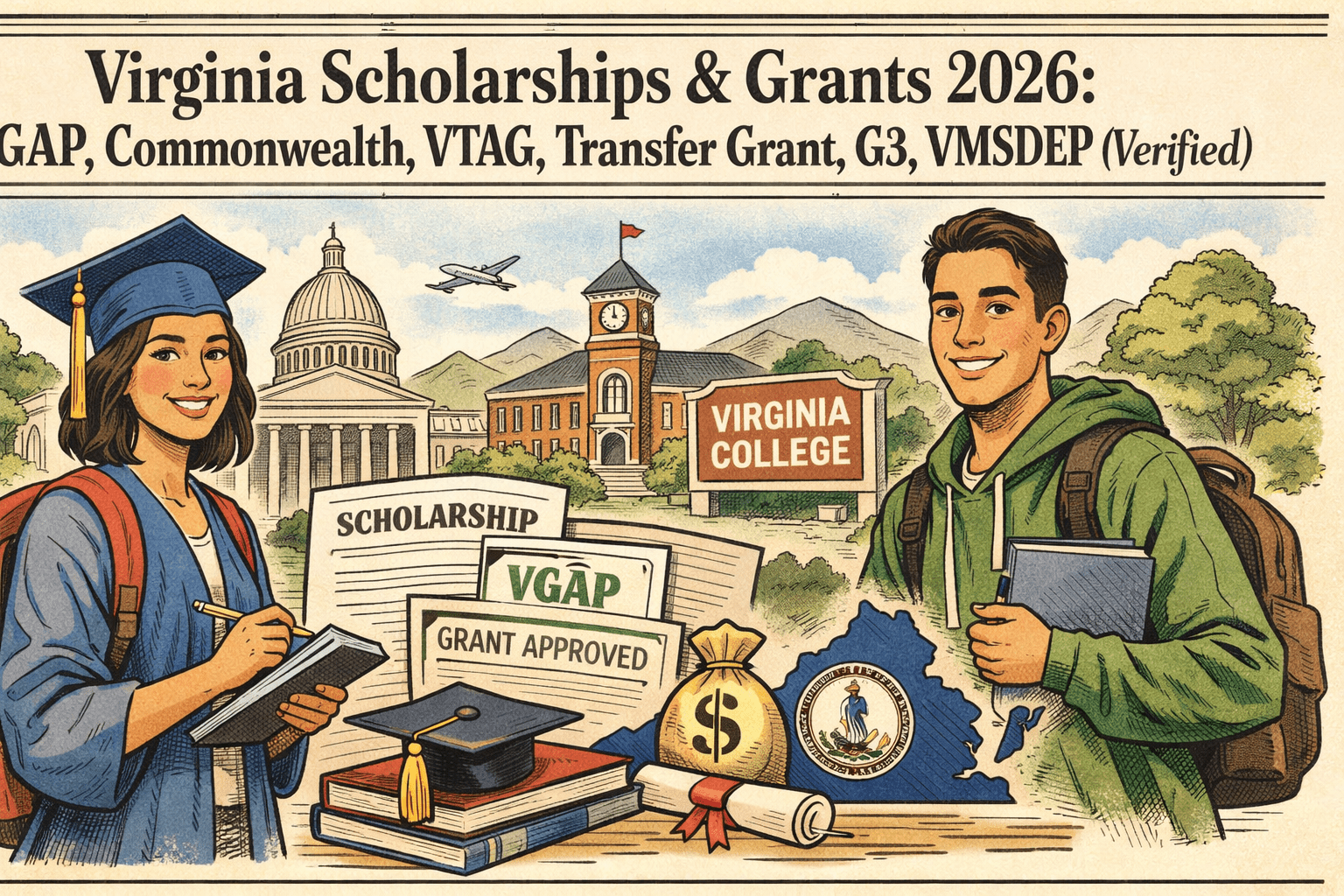
Virginia Scholarships & Grants: Cavalier-Level Cash for College
One-page guide to Virginia aid: VGAP, Commonwealth Award, VTAG (private colleges), Two-Year College Transfer Grant, G3 tuition help, Workforce Credential Grant (FastForward), VMSDEP (tuition+fees waiver), VA National Guard STAP, Brown v. Board Scholarship, VASA (FAFSA alternative).
Virginia Guaranteed Assistance Program (VGAP)
- Why it slaps
- 💸 Need-based grant at public colleges
- 🔁 Renewable if you meet progress & full-time rules
- 💡 Basics: VA HS grad/homeschool + financial need; largest awards go to highest need, per statute.
- 🔗 Apply/info: https://www.schev.edu/financial-aid/financial-aid/federal-state-financial-aid/virginia-guaranteed-assistance-program
Virginia Commonwealth Award
- Why it slaps
- 🧾 Need-based aid for undergrad + grad at VA public institutions
- 🧩 Campus-awarded to fill gaps after other aid
- 🔗 Info: https://www.schev.edu/financial-aid/financial-aid/federal-state-financial-aid/virginia-commonwealth-award
Virginia Tuition Assistance Grant (VTAG) — eligible private nonprofits
- Why it slaps
- 🏛️ Non-need grant for VA residents at participating private colleges
- 📝 Separate VTAG application (not the FAFSA)
- 💡 Amount: SCHEV posts maximum authorized awards each year; final amounts depend on appropriations/recipients. (Many colleges project ~$5,250 for 2025–26; confirm with SCHEV/campus.)
- 🔗 Info: https://www.schev.edu/financial-aid/financial-aid/federal-state-financial-aid/virginia-tuition-assistance-grant-program
- 🔎 Background (projection example): Council of Independent Colleges in Virginia.
Two-Year College Transfer Grant (CTG)
- Why it slaps
- 🔁 Finish a VA community-college associate, transfer to an eligible 4-year, and get $$
- 🧠 Extra boost for specific STEM/teaching/engineering majors (campus rules)
- 💡 Amount: Up to $1,000 base + $1,000 for eligible majors ($2,000/yr total at some schools).
- 🔗 Official overview: https://www.schev.edu/financial-aid/financial-aid/federal-state-financial-aid/two-year-college-transfer-grant
- 🔎 Amount example (Virginia Tech): details and GPA/SAI criteria. — https://finaid.vt.edu/…/two-year-college-transfer-grant.html
G3 — Get Skilled, Get a Job, Get Ahead (community colleges)
- Why it slaps
- 🛠️ Tuition assistance for in-demand fields (IT, healthcare, trades, public safety, early childhood)
- 🧭 Offered across Virginia’s Community Colleges
- 🔗 Info/programs: https://virginiag3.com/
Workforce Credential Grant (WCG / FastForward for noncredit)
- Why it slaps
- ⚡ Pay-for-performance model reduces your upfront cost for short-term credentials
- 🔧 Targets high-demand fields statewide
- 🔗 Info: https://www.schev.edu/financial-aid/financial-aid/federal-state-financial-aid/workforce-credential-grant
VMSDEP — Military Survivors & Dependents Education Program
- Why it slaps
- 🧡 Waives tuition & mandatory fees for 8 semesters at VA public colleges (eligibility required)
- 🔗 Apply/info: https://www.dvs.virginia.gov/benefits-services/education/virginia-military-survivors-dependents-education-program-vmsdep
Virginia National Guard — State Tuition Assistance Program (STAP)
- Why it slaps
- 🪖 Term-based tuition grants for eligible VA Guard members (service obligation applies)
- 🔗 Portal: https://statetuition.vangweb.com/
- 🔎 Guard info page: https://va.ng.mil/Programs-Resources/Tuition-Assistance/
Brown v. Board of Education Scholarship (incl. descendants, per 2023 law)
- Why it slaps
- ✊ Supports Virginians personally locked out of public school (1954–64) and eligible descendants
- 🔗 Official site & application packet: https://brownscholarship.virginia.gov/
VASA — Virginia Alternative State Aid (for students who can’t file FAFSA)
- Why it slaps
- 🧭 Opens pathways to state aid for FAFSA-ineligible students
- 🔗 Apply/info: https://www.levelupvirginia.org/finance/financial-aid/vasa-application
Speed-Run Your Virginia Aid Stack 🏁
- File FAFSA (or VASA if you’re ineligible) — schools use these for VGAP, Commonwealth, CTG, G3, WCG, VTAG eligibility.
- Public university? Ask about VGAP/Commonwealth. Private nonprofit? Add VTAG (separate app).
- Finishing an associate at a VA community college? Use CTG the very next term you transfer.
- Short-term skills? Combine G3 (credit programs) with WCG/FastForward (noncredit).
- Military family/Guard? Compare VMSDEP (waiver) vs STAP (grant); stacking must fit cost-of-attendance rules.
Helpful Virginia Resources 🧭
- SCHEV — State aid program list: deadlines, rules, contacts — https://www.schev.edu/financial-aid/financial-aid/undergraduate-and-graduate-financial-aid-programs
- Financial-aid deadlines (incl. VTAG app notice): https://www.schev.edu/financial-aid/financial-aid-deadlines
- G3 program hub: https://virginiag3.com/
- Workforce Credential Grant (FastForward): https://www.schev.edu/financial-aid/financial-aid/federal-state-financial-aid/workforce-credential-grant
- VMSDEP: https://www.dvs.virginia.gov/benefits-services/education/virginia-military-survivors-dependents-education-program-vmsdep
- VA National Guard STAP: https://statetuition.vangweb.com/
- Virginia Space Grant Consortium (STEM scholarships): https://vsgc.odu.edu/scholarships-fellowships/ Virginia Scholarships & Grants: Affordability, Equity, and Workforce ROI (January 2026)
Virginia’s scholarship and grant ecosystem is not a single “program” but a layered financing system spanning federal aid, state need-based grants, targeted transfer incentives, private-college subsidies, and a nationally distinctive pay-for-performance workforce model. Using the most recent statewide reporting available (SCHEV’s 2025 Key Facts and 2025–26 tuition findings; the 2023–24 NASSGAP survey; Virginia legislative reports on workforce and military-related benefits), this paper quantifies the scale and composition of Virginia grant aid, evaluates how program design choices shape equity and take-up, and connects aid policy to attainment and workforce outcomes. Findings highlight three structural strengths—(1) a high share of state grant dollars directed to need, (2) unusually strong workforce credential financing with measurable wage gains, and (3) transfer-path incentives that reduce total bachelor’s costs—alongside persistent pressure points: affordability relative to income, uneven completion and credential attainment across subgroups, and fast-growing benefit costs in the military-dependent pipeline. The conclusion proposes a pragmatic policy and implementation agenda for Virginia’s next iteration of aid modernization: “automaticity” (fewer extra forms), integrated advising (FAFSA/VASA → award → enrollment), and performance metrics that reward both access and completion.
1. Virginia’s higher-education affordability problem is large—and measurable
Virginia educates at scale: total fall headcount is 553,296 across public four-year, public two-year, regional centers, private nonprofit, and a large set of for-profit/out-of-state/vocational providers. Students of color represent 44.7% of enrollments; 23% of students enrolling in 2023 are first-generation; and 34% receive Pell Grants (2023–24).
Cost pressure appears in both sticker price and debt signals. SCHEV reports average total charges (tuition + mandatory fees + room/board where applicable) of $29,538 for in-state undergraduates at public four-year institutions in 2025–26, with year-over-year growth of $898 (3.1%); tuition and mandatory fees increased 2.1%, or $206 systemwide. The median borrower debt reported in SCHEV’s Key Facts is $25,000 for bachelor’s completers and $10,640 for associate completers.
A critical systems insight: Virginia’s affordability challenge is not merely “high prices,” but high prices relative to household capacity, plus friction in navigating aid. SCHEV flags that Virginia’s in-state undergraduate total tuition and fee charges (four-year) as a share of per-capita disposable income remains above the national average. This matters because even a well-funded grant system can underperform if families miss deadlines, fail verification, or misunderstand transfer/workforce pathways.
2. The state grant portfolio is big—and unusually need-weighted
NASSGAP’s 2023–24 survey data show Virginia state grant aid totaling $773.27 million, of which $616.99 million (≈79.8%) is need-based and $156.28 million (≈20.2%) is non-need/merit or other non-need categorization in the survey’s framework.
Two implications follow:
-
Equity orientation (by dollars): A roughly 80/20 need-to-non-need split is a strong signal of redistributive design—especially compared with states where merit dominates.
-
Scale relative to enrollment: Spreading total state grant dollars across total headcount is about $1,398 per enrolled student (a rough “system capacity” indicator, not an average award). This helps frame why many students still borrow: grant dollars are substantial, but not sufficient to cover full costs for a large Pell-eligible population plus middle-income students facing high net price.
NASSGAP also reports Virginia’s primary need-based grant program serving 89,193 recipients with $407.81 million in expenditures, averaging $4,572 per recipient. That average is meaningful: it represents ~18% of the median bachelor’s borrower debt ($25,000), suggesting that (for recipients) state need-based dollars can materially reduce borrowing—yet are rarely large enough alone to eliminate it.
3. Virginia’s “core” student aid architecture: five pillars
Virginia’s state-administered programs can be understood as five interacting pillars, each solving a different constraint.
Pillar A — Broad need-based grants (access + persistence)
Virginia Commonwealth Award (VCA) and Virginia Guaranteed Assistance Program (VGAP) function as primary need-based mechanisms. VGAP is designed as an early-expectations signal: it incentivizes academically prepared, financially needy Virginia students to view college as attainable; awards are proportional to need and can reach tuition/fees plus book allowance (capped by cost constraints and class-level rules).
Systems note: When need-based grants are delivered through campus financial aid offices (rather than a separate state application), they can reduce friction—but only if FAFSA/VASA completion is high and institutional awarding is predictable.
Pillar B — Private nonprofit affordability subsidy
Virginia’s Tuition Assistance Grant (VTAG) is explicitly a private nonprofit tuition relief mechanism. SCHEV’s program list indicates a maximum 2025–26 undergraduate award of $5,250. This matters because Virginia has 45 private nonprofit colleges/universities (plus many other providers).
Policy logic: VTAG partially “buys down” tuition at private nonprofits, sustaining sector diversity and capacity without requiring the state to expand public seats at the same rate.
Pillar C — Transfer pathway incentive (cost minimization strategy)
Virginia’s data consistently highlight transfer as an affordability lever: SCHEV reports that students who complete an associate degree at a community college first and then transfer can save about $21,961 on the tuition cost of a bachelor’s degree.
The Two-Year College Transfer Grant (CTG) operationalizes this strategy with defined award components: a base award up to $1,000 per year, a STEM-N bonus up to $1,000, and an additional $1,000 incentive award for students at selected institutions (subject to eligibility and funding).
Design strength: CTG is “behavioral economics in policy form”—it nudges students toward a lower-cost pathway while rewarding timely transfer and STEM/teaching/nursing alignment.
Pillar D — Workforce credential financing (rapid reskilling + measurable ROI)
Virginia’s New Economy Workforce Credential Grant (WCG) is nationally distinctive because of its pay-for-performance reimbursement logic. In FY2024, institutions enrolled 15,753 participants; 94% completed training; 69% reported earning a credential. The model splits costs so that students pay as little as one-third when they complete, and state reimbursement is tied to completion/credential milestones (with a state cap of $4,000).
Outcome signal: since WCG launched (2017), median annual wages for participants increased by $10,551 (50%) in the 12 months following completion (as reported in the FY2024 annual report).
Equity warning inside success: The same report notes subgroup gaps in credential attainment (e.g., credentialing rates below the overall average for Hispanic and Black participants). That is precisely the kind of “second-order” equity issue Virginia can address with targeted supports (tutoring, testing fees, transportation, childcare).
Pillar E — “Last-mile” affordability + access supports (application + advising infrastructure)
Virginia’s aid system increasingly depends on reducing administrative barriers. SCHEV’s Level Up Virginia guidance emphasizes that most state programs require FAFSA or VASA (Virginia Alternative State Aid) completion, and it points families to advising supports (including a staffed text help line).
Implementation insight: Even well-designed grant programs underperform without high completion of FAFSA/VASA and clear, early communication of eligibility and deadlines.
4. The G3 program: turning community college into a high-demand workforce engine
Virginia’s G3 (“Get Skilled, Get a Job, Give Back”) strategy aligns tuition assistance with high-demand fields, delivered through participating community colleges and linked supports. Virginia’s 2024 reporting indicates that from July 2021 through December 2024, 20,512 students were served and $32.3 million in G3 funds were awarded (with additional completions and persistence indicators tracked in the report).
On average, that funding level is about $1,575 per student served over that window—suggesting G3 functions less like a “full ride” and more like a gap-closing, persistence-enabling subsidy, likely interacting with Pell and WCG where applicable.
Strategic value: G3 complements WCG. WCG targets short, noncredit credentials with performance reimbursement; G3 supports community-college pathways in high-demand areas (often credit-bearing or structured programs), adding wraparound support where needed.
5. Military-connected benefits: VMSDEP’s scale is now a budget driver
Virginia’s Military Survivors and Dependents Education Program (VMSDEP) is a major affordability commitment and a major fiscal exposure. Legislative reporting shows beneficiaries rising from ~9,700 (2014–15) to 33,824 (2023–24), with the estimated waiver value increasing to $181.2 million (2023–24) and projected higher in 2024–25.
Why this matters for the scholarship ecosystem: VMSDEP growth can crowd the policy agenda—because large entitlement-like benefit costs can limit room for expanding need-based grants unless appropriations rise. At the same time, VMSDEP improves access for a clearly defined population with compelling public purpose.
(Transparency note: the PDF table for VMSDEP was available as extracted text; the PDF screenshot-render tool failed repeatedly due to a tool validation error in this environment, so I relied on the document’s text layer.)
6. Affordability is a “shared responsibility” system—Virginia’s cost-share signals
SCHEV reports that Virginia undergraduates, on average, pay 42% of education-related costs while the state provides 58%—below the Commonwealth’s stated cost-share policy target of 67% state support. This is a structural reason tuition pressure persists even when grant aid expands: state support levels influence institutional pricing decisions, and grants (while crucial) are often deployed to offset price increases rather than fully reduce net price.
Notably, SCHEV also reports that the Governor and General Assembly continued additional state support in the 2024–26 biennium, including targeted dollars for affordability and financial aid.
Interpretation: Virginia is attempting a dual strategy—moderate tuition growth through operating support while simultaneously increasing targeted aid. This is consistent with evidence from higher-ed finance: tuition restraint and need-based aid perform best when deployed together, not separately.
7. Where Virginia’s scholarship & grant system is strongest
Strength 1 — Need-dominant dollars, with large recipient reach
The NASSGAP composition data (≈80% need-based) plus 89k recipients in the primary need-based program indicate a grant system that is not merely symbolic; it is materially redistributive.
Strength 2 — Transfer as a cost-control mechanism is embedded in both data and policy
Virginia not only promotes transfer rhetorically; it quantifies savings (~$21,961) and funds incentives (CTG award stack).
Strength 3 — Workforce credential policy is outcome-measured
WCG publishes completion, credential attainment, and wage outcomes—rare among state aid programs—and uses a pay-for-performance design that pressures providers to support completion.
8. Where Virginia’s system remains vulnerable (and what to do about it)
Vulnerability 1 — Affordability relative to income remains high
SCHEV’s income-relative tuition indicator (above national average) implies persistent middle-income squeeze: families who are not Pell-eligible often still face high net price and borrowing.
Action: Expand “near-Pell” eligibility bands in need-based programs and publish clear award look-up tables (predictability is itself an affordability tool).
Vulnerability 2 — Credential attainment gaps threaten equity in workforce programs
WCG shows high training completion (94%) but meaningfully lower credential attainment (69%), with subgroup gaps.
Action: Treat the credential exam as part of the program (fees, prep time, retakes). Build a “last-mile credential completion micro-grant” and require providers to report credential attempts, not only credentials earned.
Vulnerability 3 — Administrative friction (FAFSA/VASA, deadlines, verification)
Virginia’s reliance on FAFSA/VASA is rational, but it can suppress take-up if students miss institutional deadlines or struggle with form changes. Level Up Virginia’s advising infrastructure is a strong start.
Action: Default students into state consideration with minimal extra steps (“file once, qualify for many”), and push proactive nudges earlier in senior year (texts, in-school completion events, and community-based partner outreach).
Vulnerability 4 — Rapid growth in VMSDEP costs can constrain new investments
VMSDEP’s scale makes it a dominant affordability line item.
Action: Protect benefit integrity while improving forecasting, coordination with federal GI benefits, and transparent appropriation planning so other need-based priorities are not unintentionally crowded out.
Conclusion
Virginia’s scholarship and grant ecosystem is best understood as an interlocking set of affordability pathways rather than a single aid pipeline. The data show a state that is (a) directing most grant dollars toward need, (b) embedding transfer as an explicit cost-savings strategy, and (c) leading nationally in outcome-measured workforce credential financing.
The next frontier is not inventing new program types, but improving delivery and precision: reduce friction (FAFSA/VASA → automatic eligibility), expand “last-mile” supports that convert training into credentials and credentials into wages, and maintain sustainable budgeting for large entitlement-like benefits. If Virginia pursues those implementation upgrades, the Commonwealth’s aid system will be better positioned to reach its attainment ambitions while protecting equity and workforce competitiveness.
References (selected, for editorial use)
-
State Council of Higher Education for Virginia (SCHEV). Key Facts About Higher Education in Virginia (Accessible Version).
-
SCHEV. SCHEV Report: Virginia public colleges and universities increased tuition and fees 2.1% in 2025–26 (Aug. 1, 2025).
-
National Association of State Student Grant & Aid Programs (NASSGAP). Annual Survey 2023–2024 (state grant totals; Virginia program figures).
-
SCHEV. New Economy Workforce Credential Grant Annual Report FY2024 (March 2025).
-
Virginia SCHEV. Two-Year College Transfer Grant Program Application (2025–26) (award structure and bonuses).
-
Commonwealth of Virginia (Legislative reporting). VMSDEP growth and estimated waiver value (report PDF).
-
SCHEV / Level Up Virginia. Federal & State Financial Aid overview (FAFSA/VASA and primary programs).
FAQ — Virginia Edition 💬
Q1) VGAP vs. Commonwealth Award — what’s the diff?
Both are need-based at public institutions. VGAP is for undergrads with VA HS/homeschool + need; Commonwealth supports undergrad & grad without the HS criteria. Award amounts are campus-determined and vary with funding.
Q2) What’s the current VTAG amount?
SCHEV sets maximums yearly based on appropriations and recipient counts; colleges often project ~$5,250 for 2025–26, but actual awards depend on final funding. Always confirm with SCHEV or your FA office.
Q3) CTG: can I take a gap after my associate?
No — you must enroll at an eligible 4-year by the fall or spring immediately following the associate (plus GPA/need criteria).
Q4) G3 vs. WCG — which one for me?
- G3: credit programs at community colleges (often covers tuition/fees; program lists by pathway).
- WCG/FastForward: noncredit workforce credentials with tiered state funding that reduces upfront cost.
Q5) What exactly does VMSDEP cover?
By law, tuition & mandatory fees are waived for 8 semesters at VA public institutions for eligible survivors/dependents; separate stipends vary by funding.
Q6) I can’t file FAFSA — can I still get state aid?
Yes. Complete the VASA application to be considered for certain Virginia state aid programs. Your college will tell you which funds you can access.
Q7) Any other state-connected STEM scholarships?
Check the Virginia Space Grant Consortium (NASA-partnered) for STEM scholarships/fellowships; deadlines and award sizes vary.