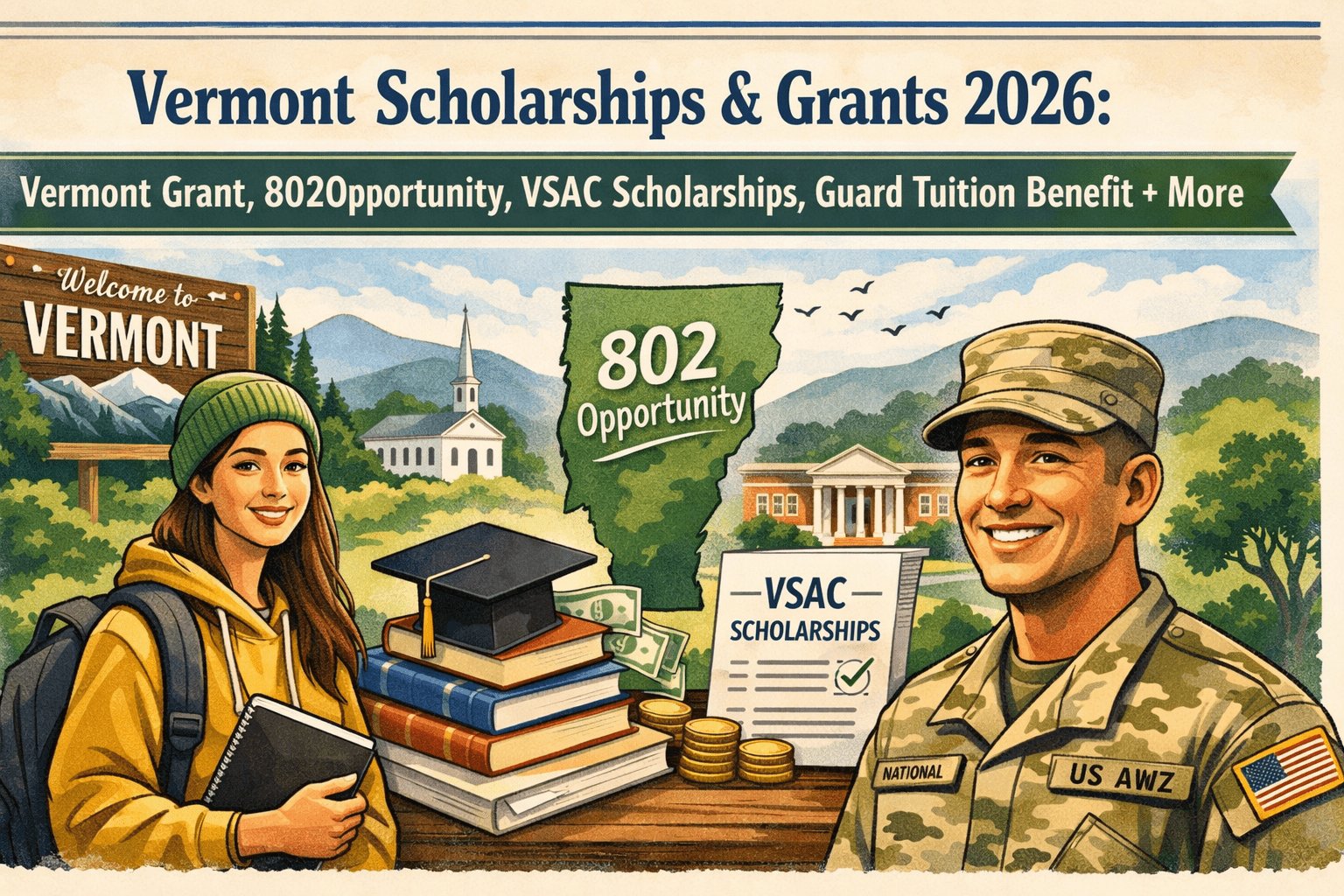
Vermont Scholarships & Grants
Meta description: One-page, verified guide to Vermont aid: Vermont Grant (need-based), Advancement Grant (non-degree), 802Opportunity (free CCV tuition ≤$100k AGI), VSAC-assisted scholarships (150+), VT Guard Tuition Benefit (up to full tuition), Dual Enrollment/Early College, VTSU Free Tuition Guarantee.
Vermont Grant (full- & part-time undergraduate — VSAC)
- Why it slaps
- 💸 Need-based aid you don’t repay (portable in/out of state)
- ⚡ Rolling review; first-come while funds last
- 💰 Amount: Varies by need, cost, timing (set each year).
- ⏰ Deadline: No single hard date, but apply early (funding limited).
- 🔗 Apply/info: https://www.vsac.org/pay/student-aid-options/grants
Advancement Grant (short-term/non-degree training)
- Why it slaps
- 🛠️ Pays for career upskill classes & certificates (non-degree)
- 🔁 Up to 2 courses/term, 6 terms total limits
- 💰 Amount: Varies by course cost, need, funding.
- 🔗 Apply/info: See VSAC overview & brochure https://www.vsac.org/sites/default/files/uploads/pdf_resources/VSAC_Loan_Brochure.pdf
802Opportunity — Free CCV tuition (income ≤ $100,000 AGI)
- Why it slaps
- 🧾 Tuition-free at Community College of Vermont for eligible Vermonters
- 🧩 Auto-awarded after FAFSA + VT Grant apps (if eligible)
- 💰 Amount: Covers CCV tuition (admin fee covered; books/other fees not).
- Eligibility: VT resident; family AGI ≤ $100,000; no prior bachelor’s.
- 🔗 Apply/info: https://ccv.edu/financial/802-opportunity-tuition-free-college-for-vermonters/
VSAC-Assisted Scholarships (150+ awards with one app)
- Why it slaps
- 📚 One Unified Scholarship Application (USA) for tons of awards
- 🧭 Booklet also lists non-VSAC scholarships by deadline
- ⏰ Typical timing: 2025–26 cycle closed Feb 12, 2025; new dates post each fall.
- 🔗 Info & booklet: https://www.vsac.org/pay/student-aid-options/scholarships/vsac-assisted-scholarships
Vermont National Guard Tuition Benefit Program (VNGTBP)
- Why it slaps
- 🪖 Up to full tuition at Vermont State University or UVM; up to UVM rate elsewhere
- 📜 Service commitment (see statute details)
- 💰 Amount: Up to 100% tuition per program rules.
- 🔗 Apply/info: VSAC program page & VT statute https://www.vsac.org/sites/default/files/uploads/pdf_resources/Memorandum_of_Understanding.pdf
Armed Services Scholarship (dependents of fallen service members)
- Why it slaps
- 🧡 Free tuition at VT publics for eligible spouses/children
- 💰 Amount: Tuition exemption up to 4 academic years (per program doc).
- 🔗 Info: VSAC military funding hub https://www.vsac.org/pay/student-aid-options/scholarships/military-servicemembers
Dual Enrollment & Early College (finish HS + earn college credit)
- Why it slaps
- 🎓 Two tuition-free college courses (Dual Enrollment)
- 🏁 Senior-year Early College options at VT publics/CCV
- 💰 Amount: State pays tuition for 2 courses (DE); EC funding varies by program.
- 🔗 Start here: VSAC DE voucher & steps; Early College portals https://www.vsac.org/resources/vermont-dual-enrollment-voucher
Vermont State University Free Tuition Guarantee (VTSU)
- Why it slaps
- 🏛️ Free tuition at VTSU for AGI ≤ $65,000 (FAFSA required)
- 💰 Amount: Tuition waiver for eligible first undergrad degree seekers.
- 🔗 Info: https://vermontstate.edu/admission/vermont-state-university-free-tuition-guarantee/
Green Mountain Job & Retention Program (GMJRP) — loan repayment
- Why it slaps
- 💼 $5,000 loan repayment if you graduate in VT (Jul 2024–Jun 2025 window) and work full-time in Vermont
- 💰 Amount: $5,000 one-time repayment.
- 🔗 Info: UVM/VSAC GMJRP details https://www.vsac.org/news/releases/graduate-college-or-university-vermont-you-could-be-eligible-5000-student-loan
Speed-Run Your Vermont Aid Stack 🏁
- FAFSA + Vermont Grant app in MyVSAC (even if you think you won’t qualify).
- Community college bound? Check 802Opportunity (≤$100k AGI).
- Short-term training? Use Advancement Grant (non-degree).
- Scholarship hunting? Do the VSAC USA; track new cycle dates each fall.
- Guard/Family of Fallen? Compare VNGTBP vs Armed Services Scholarship (tuition coverage).
- Still in HS? Stack Dual Enrollment (2 free courses) or Early College.
Vermont Scholarships & Grants: Access, Affordability, and Workforce Alignment (2026)
Vermont’s scholarship-and-grant ecosystem is shaped by a distinctive combination of demographic pressure (a small, older population), high college-going constraints, and a policy response that increasingly emphasizes tuition-free pathways layered on top of federal and state need-based aid. Using state-aid expenditure data (NASSGAP 2023–24), FAFSA participation benchmarks (U.S. Department of Education and VSAC reporting), and program-design documentation from Vermont’s principal aid administrator (VSAC) and Vermont institutions (UVM, CCV, Vermont State University), this paper maps Vermont’s current affordability architecture and evaluates its performance through the lenses of equity, administrative burden, and labor-market relevance. The evidence suggests Vermont runs an unusually need-centric state-aid portfolio (roughly 73% of state aid as need-based grants) while relying on last-dollar tuition models to broaden eligibility into middle-income ranges. However, because many flagship “tuition-free” programs exclude or only partially address non-tuition costs (fees beyond covered categories, books, childcare, transportation, housing), affordability gaps persist—especially for rural learners, adult students, and first-generation applicants. The paper concludes with a set of implementation-ready recommendations: (1) stabilizing and simplifying the state grant pipeline, (2) reducing FAFSA friction and timing mismatches, (3) converting portions of last-dollar tuition into first-dollar supports for living/learning expenses, and (4) aligning forgivable-loan and scholarship dollars more tightly with Vermont’s priority occupations.
1. Vermont’s context: why the scholarship system carries extra weight
Vermont is a small state (population 648,493 in 2024) with an older age structure (22.8% age 65+), which intensifies the economic importance of postsecondary completion for workforce replacement and long-run tax capacity. The state’s median household income (2019–2023, inflation-adjusted) is $78,024, a figure that can mask meaningful within-state variation—especially across rural counties where transportation, broadband reliability, and childcare availability complicate college participation.
In this environment, scholarships and grants function less like “nice-to-have discounts” and more like structural connectors that determine whether students can (a) start, (b) persist, and (c) finish credentials without destabilizing debt or stopping out.
2. Data and methods
This analysis triangulates four evidence streams:
-
State-funded aid expenditures from NASSGAP’s 55th Annual Survey (Academic Year 2023–24), used to quantify Vermont’s total state-aid “envelope,” its composition (need-based vs. nonneed vs. nongrant), and trend direction since 2013–14.
-
FAFSA participation benchmarks from the U.S. Department of Education’s state-by-state submission rates and VSAC’s FAFSA completion updates, used as a proxy for how effectively students enter the aid pipeline.
-
Program design documents from VSAC and Vermont institutions (UVM Promise, 802Opportunity, Freedom & Unity, Vermont Grant parameters), used to analyze “stacking” rules and what costs are/are not covered.
-
Private scholarship capacity signals, especially the Vermont Community Foundation’s Curtis Fund and VSAC’s administered scholarship catalog, used to characterize non-state supplementation.
Limitations: Vermont-wide outcomes (e.g., persistence, completion, net price distributions) are not directly estimated here because program-eligible cohorts and institutional aid packages vary by sector and student type. The analysis therefore focuses on system design, spending levels, and entry frictions—the levers most actionable for policy and for your Vermont scholarship/grant hub page.
3. A systems map of Vermont scholarships & grants
Vermont’s aid ecosystem can be understood as six interacting layers:
Layer A — Federal foundation (baseline grants and tax benefits)
Pell Grants, Federal Work-Study, federal education tax credits, and federal loans create the starting affordability frame. Vermont’s state and institutional models are explicitly designed to “sit on top” of this foundation, not replace it (critical for last-dollar tuition designs).
Layer B — State grant core (VSAC-administered Vermont Grants)
VSAC’s Vermont Grant programs (including the Vermont Incentive Grant and related categories) represent the primary state need-based grant channel. For 2024–25, the Vermont Incentive Grant is described as ranging from $1,000 up to $15,350 depending on sector and enrollment/eligibility conditions.
Importantly, VSAC also flags funding uncertainty: applications received on/after January 1, 2026 for the Vermont Full-Time Grant, Vermont Part-Time Grant, and Vermont Advancement Grant were placed “on hold pending funding availability.”
That single administrative sentence has real behavioral consequences: uncertainty changes whether students commit to enrollment, whether institutions can counsel accurately, and whether “tuition-free” messaging is trusted.
Layer C — Tuition-free pathways (institution + state + federal stacking)
Vermont increasingly uses “tuition-free” guarantees that supplement other aid.
1) UVM Promise (flagship public university)
UVM Promise targets dependent Vermont undergraduates starting Fall 2025+ with parental AGI ≤ $100,000 (with “typical assets”), and is explicitly designed to “close the financial gap” by supplementing federal/state/secured grants and scholarships so that tuition and comprehensive fees are covered.
2) 802Opportunity (Community College of Vermont)
802Opportunity is structured as a last-dollar tuition mechanism: when combined with federal and state grants, it covers CCV tuition and also covers the $100 CCV administrative fee, while explicitly not covering textbooks or other course-related costs.
3) Freedom & Unity (Vermont State University)
Freedom & Unity covers general tuition (when stacked with federal/state/institutional grants) for Vermont residents with family income ≤ $65,000 who do not already have a bachelor’s degree, while excluding multiple non-tuition costs (mandatory fees, books, materials, program-specific tuition).
Layer D — Workforce development and forgivable loans (career-aligned aid)
Vermont uses forgivable-loan structures (a conditional grant model) to align education financing with in-state service needs. VSAC’s workforce development funding includes programs “up to $23,000” for the skilled trades and “up to $5,000” for an accelerated paramedic program (per VSAC’s program description), among other career-focused pathways.
Layer E — Private scholarships (philanthropy + community foundations + local awards)
Two large conduits matter for Vermont families:
-
VSAC-administered scholarships and forgivable loans: VSAC notes “150+” administered scholarships/forgivable loans, plus additional outside scholarships referenced in its 2026–27 materials, with annual award amounts “generally” ranging $500–$6,500, and a key application deadline of February 11, 2026.
-
Vermont Community Foundation (Curtis Fund): VCF reports that the Curtis Fund awards over $1.5 million annually in scholarships and grants, positioning philanthropy as a meaningful (though still capacity-limited) supplement.
Layer F — Regional price-reduction (NEBHE Tuition Break)
A distinctive New England lever is the NEBHE Tuition Break (New England Regional Student Program), which reduces out-of-state tuition for eligible majors at public institutions across New England. NEBHE reports average annual savings of about $8,600 and notes that regional tuition is capped at a percentage (up to 175%) of in-state rates.
4. Vermont state-aid spending: what the numbers say (NASSGAP 2023–24)
4.1 Total state-funded student aid in Vermont
NASSGAP reports Vermont’s total state-funded student aid (grants + nongrant aid) at $30.764 million in AY 2023–24.
Breakdown:
-
Need-based grant aid: $22.419M
-
Nonneed-based grant aid: $0.064M
-
Nongrant aid (loans/conditional grants/work-study/waivers): $8.281M
Two structural interpretations follow:
-
Vermont’s state-aid portfolio is overwhelmingly need-focused: about 72.9% of total state aid is need-based grants (22.419 / 30.764).
-
Vermont devotes a nontrivial share to nongrant mechanisms (~26.9%), consistent with the state’s use of forgivable-loan/workforce-alignment tools.
4.2 Trend: stability with a recent dip
NASSGAP’s trend table indicates Vermont need-based grant aid was $25.006M in 2022–23 and $22.419M in 2023–24, a -10.3% year-over-year change.
However, Vermont’s 2023–24 need-based level remains above 2013–14 ($20.400M) and modestly above 2018–19 ($20.809M).
Interpretation: Vermont is not “disinvesting” in the long-run sense, but it is operating in a funding environment where annual volatility can meaningfully affect student decision-making—especially when VSAC also signals “on hold pending funding availability” for some programs.
4.3 Scale: per-capita framing and national share
Using Vermont’s 2024 population estimate (648,493), Vermont’s $30.764M in total state aid translates to about $47 per resident.
Relative to the national total of $18.624B in state-funded aid (NASSGAP total), Vermont’s share is about 0.17%, reflecting Vermont’s small population and enrollment base.
4.4 Regional comparison snapshot (New England)
From the same NASSGAP table (total aid, 2023–24):
-
Massachusetts: $308.942M
-
Connecticut: $182.740M
-
Maine: $31.014M
-
Rhode Island: $9.509M
-
New Hampshire: $4.449M
-
Vermont: $30.764M
This highlights a policy reality for Vermont: it cannot “outspend” larger neighbors, so program design (simplicity, targeting, stacking efficiency) becomes the main way to raise effective generosity per student.
5. The pipeline problem: FAFSA entry friction as a binding constraint
Scholarships and grants do not matter if eligible students fail to enter the application pipeline. The U.S. Department of Education’s state-by-state FAFSA metrics show Vermont’s FAFSA submission rate at 55.0%, with an “incomplete” rate of 44.3% (as presented in the ED table).
VSAC’s own FAFSA completion update underscores similar dynamics across cycles—showing Vermont at 54% for 2025–26 (as of August 29, 2025) and providing a state-rank context.
Why this matters in Vermont specifically:
-
Vermont’s “tuition-free” programs typically require FAFSA and/or state grant applications (e.g., UVM Promise requires applying for the Vermont State Grant through VSAC, and 802Opportunity explicitly stacks with Pell/state grants).
-
FAFSA friction therefore becomes a first-order determinant of whether “free tuition” is real or merely advertised.
6. Program design evaluation: what Vermont covers well—and what it doesn’t
6.1 Vermont’s strengths: targeted generosity + stacked tuition closure
Vermont’s architecture has three high-performing design features:
-
Tuition closure via supplementation
UVM Promise explicitly supplements federal/state/secured grants to close remaining tuition and comprehensive fees for eligible families (AGI ≤ $100k with typical assets). -
Broad access at the two-year level
802Opportunity makes CCV tuition and the $100 administrative fee cost-free when stacked with existing aid—an unusually clean on-ramp for adult learners and reskillers, given CCV’s statewide footprint. -
Workforce-aligned conditional aid
Forgivable loans (e.g., trades/paramedic support) are a rational strategy in a small labor market: they reduce debt while also increasing the likelihood that publicly supported credentials translate into in-state employment.
6.2 Vermont’s weakness: non-tuition costs remain the persistence killer
Across Vermont’s major “tuition-free” models, books, materials, technology, transportation, childcare, and housing are commonly excluded or only indirectly addressed:
-
802Opportunity: tuition + $100 admin fee are covered, but textbooks/other fees are not.
-
Freedom & Unity: general tuition can be covered, but mandatory fees, books, and materials are not.
From a doctoral-level affordability perspective, this is not a minor caveat—it is the most common mechanism through which low-income and rural students stop out: the budget gap shifts from tuition to liquidity-sensitive expenses that hit at the start of term.
6.3 Volatility and “aid credibility”
VSAC’s “on hold pending funding availability” notice for applications received on/after Jan 1, 2026 for key grants introduces a second systemic risk: students may rationally discount promised aid if timing and certainty are unclear.
In behavioral economics terms, uncertainty increases perceived risk, raising the psychological “price” of enrollment even when posted tuition is reduced.
7. Recommendations (policy + program operations + site-ready guidance)
Recommendation 1 — Treat FAFSA completion as Vermont’s highest-ROI “scholarship”
Because Vermont’s major aid programs require FAFSA/state grant completion, FAFSA is not paperwork—it is the access gate. Vermont should expand high-touch completion infrastructure (school-based events, rural pop-up advising, and simplified “what to do this week” nudges), and measure success by completion timing (by priority deadlines), not just eventual submission.
Recommendation 2 — Stabilize and communicate funding certainty earlier
When grants are “on hold pending funding availability,” the state should counteract uncertainty through (a) earlier appropriations decisions, (b) contingency guarantees for already-admitted students, and (c) a transparent queue/timeline. Even modest improvements in predictability can increase enrollment yield among cost-sensitive applicants.
Recommendation 3 — Add “first-dollar” micro-grants for non-tuition costs
Vermont’s tuition-free programs would likely produce higher completion gains if paired with small, targeted supports: textbook stipends, transportation vouchers, emergency micro-grants, and childcare offsets. Because these costs are relatively small compared to tuition, they can be cost-effective if they reduce stop-out and restart cycles.
Recommendation 4 — Tighten the bridge between scholarships and workforce priorities
Maintain forgivable loans, but refine targeting using Vermont’s in-demand occupations and regional employer needs, ensuring the aid is large enough to change behavior. The state should also publish clear service/forgiveness pathways so students can treat “forgivable loans” as predictable conditional grants rather than confusing debt instruments.
Recommendation 5 — Scale private scholarship discovery through a single user journey
VSAC’s scholarship catalog and the philanthropic ecosystem (e.g., Curtis Fund) should be surfaced in an integrated, time-sequenced application journey. VSAC’s 2026–27 scholarship deadline (Feb 11, 2026) is a natural anchor date for statewide “application sprints.”
8. Practitioner appendix for your Vermont hub page (high-conversion, student-ready)
Below is a research-backed structure you can place near the top of your Vermont page to convert visitors into action:
A. “Start Here” (3-step Vermont pipeline)
-
File FAFSA (critical for nearly all Vermont pathways).
-
Apply for the Vermont State Grant / Vermont grants through VSAC.
-
Stack one tuition-free pathway if eligible:
-
UVM Promise (AGI ≤ $100k, dependent undergrads, full-time).
-
802Opportunity at CCV (covers tuition + $100 admin fee; not books).
-
Freedom & Unity at Vermont State University (income ≤ $65k; tuition when stacked; not fees/books).
B. “Free Money Deadlines” box
-
VSAC scholarships & forgivable loans deadline: Feb 11, 2026.
C. “Don’t miss this” warning
-
Note funding-hold language for certain grants (applications on/after Jan 1, 2026 may be pending availability).
D. “Expand your map” (regional savings)
-
NEBHE Tuition Break: average savings ~$8,600; reduced regional tuition up to 175% of in-state.
Conclusion
Vermont’s scholarships and grants are best understood as a deliberately layered system: a need-based state grant core, tuition-free “last-dollar” programs that broaden the affordability promise into middle-income households, and workforce-aligned forgivable loans designed to keep human capital in-state. The quantitative evidence shows Vermont deploys a strongly need-based portfolio ($22.419M need-based grants out of $30.764M total state aid in 2023–24), but also experiences year-to-year volatility that can undermine student confidence.
The next performance frontier is not simply “more tuition coverage.” It is pipeline reliability (FAFSA completion), predictability (funding certainty), and persistence supports (non-tuition costs). If Vermont can reduce friction at entry and close small but decisive living/learning expense gaps, the state’s existing tuition-free framework becomes far more likely to translate into credential completion, workforce resilience, and reduced outmigration among young adults.
Helpful Vermont Resources 🧭
- VSAC — Grants hub & MyVSAC: https://www.vsac.org/pay/student-aid-options/grants — ✅ Verified.
- VSAC — Scholarships (USA + booklet): https://www.vsac.org/pay/student-aid-options/scholarships/vsac-assisted-scholarships — ✅ Verified.
- 802Opportunity (CCV): https://ccv.edu/financial/802-opportunity-tuition-free-college-for-vermonters/ — ✅ Verified.
- VT National Guard Tuition Benefit: https://www.vsac.org/vermont-national-guard-tuition-benefit-program — ✅ Verified.
- Dual Enrollment voucher: https://www.vsac.org/resources/vermont-dual-enrollment-voucher — ✅ Verified.
- VTSU Free Tuition Guarantee: https://vermontstate.edu/admission/vermont-state-university-free-tuition-guarantee/ — ✅ Verified.
FAQ — Vermont Edition 💬
Q1) Vermont Grant vs. Advancement Grant — what’s the diff?
- Vermont Grant = degree/certificate programs (full- or part-time), need-based, portable in/out of state. Amount varies by need/cost/timing.
- Advancement Grant = non-degree short-term training (career upskill), with term/attempt limits.
Q2) Is 802Opportunity still income ≤ $75k?
No. Current guidance shows ≤ $100,000 AGI and clarifies what costs are covered. Always check CCV’s page for updates.
Q3) How “free” is 802Opportunity?
It covers CCV tuition (and the $100 admin fee). Books/other fees aren’t covered; you can layer Pell/VT Grant to help.
Q4) VSAC scholarships — when are they due?
For 2025–26, the deadline was Feb 12, 2025; new cycles usually open each fall with February due dates. Watch the page & booklet.
Q5) What exactly does the Guard Tuition Benefit pay?
Up to full tuition at VTSU or UVM; up to the UVM tuition rate at other VT colleges or out-of-state schools; you sign a service commitment per statute.
Q6) I’m the spouse/child of a service member who died in service — is there state help?
Yes, Vermont’s Armed Services Scholarship provides tuition-free study at VT public institutions for eligible dependents.
Q7) Any “free tuition” beyond CCV?
VTSU offers a Free Tuition Guarantee for Vermont residents with AGI ≤ $65,000 (first undergrad degree). Rules differ from 802Opportunity.