
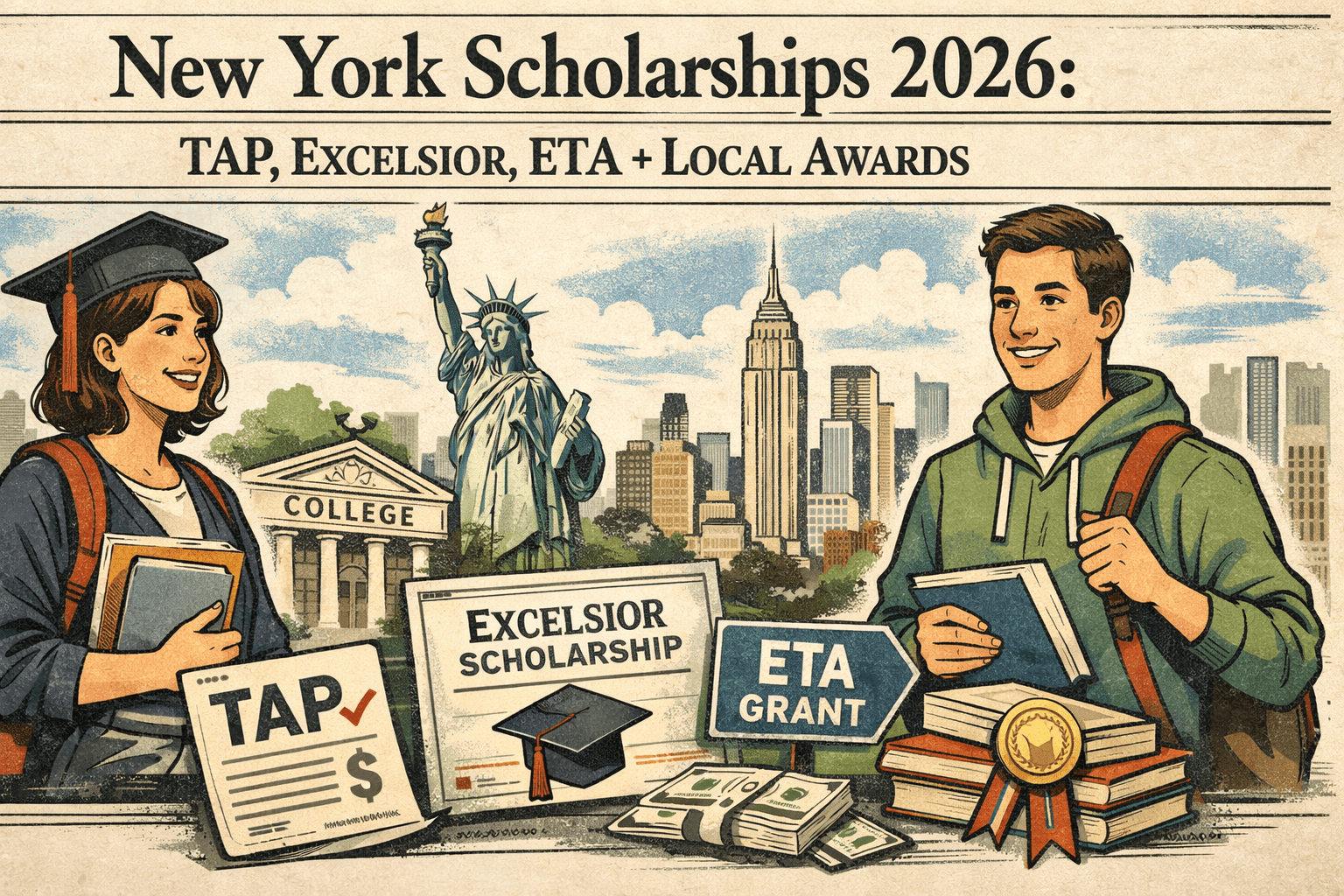
New York Scholarships 2026: TAP, Excelsior, ETA + Local Awards
New York’s aid stack can cover tuition at SUNY/CUNY for many families (Excelsior), add need-based grants (TAP, Part-time TAP, APTS), and layer on specialty scholarships (STEM, teachers, veterans, memorial, Native American). Translation: build a stack and pay less.
New York Scholarships 2026 (Sorted by Month → Earliest First)
January 2026
New York Credit Union Association (NYCUA) College Scholarships
💥 Why It Slaps: Dozens of awards statewide via participating credit unions; single application can qualify you for local + statewide awards.
💰 Amount: Varies (often $500–$2,500+).
⏰ Deadline: Jan 9, 2026.
🔗 Apply/info: https://nycua.org/uniting/scholarship-program/college-scholarship-program-applicants
New York Women in Communications (NYWICI) Scholarships
💥 Why It Slaps: Prestigious NYC-based network; awards span journalism, PR, advertising, digital media; mentorship & industry access.
💰 Amount: Typically $2,500–$10,000 (varies by fund).
⏰ Deadline: Expected Jan–Feb 2026 (2026 window announced on program page).
🔗 Apply/info: https://nywici.org/advance/students/scholarships/
February 2026
New York Water Environment Association (NYWEA) Scholarships
💥 Why It Slaps: Multiple environmental/STEM awards for HS seniors and college students; state and chapter scholarships.
💰 Amount: Commonly $1,000–$12,000 (e.g., Bartilucci up to $8,000 over four years).
⏰ Deadline: Feb 28, 2026 (state scholarship cycle).
🔗 Apply/info: https://nywea.org/scholarships/
March 2026
Horatio Alger State/National Scholarships (NY Eligible)
💥 Why It Slaps: Major need-based awards for students who’ve overcome adversity; strong alumni support.
💰 Amount: State scholarships commonly $10,000; national up to $25,000.
⏰ Deadline: Mar 1, 2026.
🔗 Apply/info: https://scholars.horatioalger.org/scholarships/
NYWEA Brian Romeiser Pre-Certification Operator Scholarship (Spring)
💥 Why It Slaps: Supports pre-certification training for future water/wastewater operators (in-demand careers).
💰 Amount: Up to $1,000; 5 spring awards.
⏰ Deadline: Mar 1, 2026 (spring cycle).
🔗 Apply/info: https://nywea.org/operator-certification/
Columbus Citizens Foundation (Italian Heritage) — HS & College
💥 Why It Slaps: Long-running Italian-American program; strong NYC presence and alumni network.
💰 Amount: Varies by program.
⏰ Deadline: Mar 14, 2026 (next cycle; check program page).
🔗 Apply/info: https://columbuscitizens.org/scholarships/
April 2026
New York Farm Bureau Agricultural Youth Scholarship
💥 Why It Slaps: Statewide ag-pathway award; open to HS seniors headed into agriculture or ag-adjacent fields (including skilled trades).
💰 Amount: Up to $3,000 (district/state awards).
⏰ Deadline: Apr 1, 2026.
🔗 Apply/info: https://nyfb.org/programs/promotion-education/scholarship
May 2026
Associated General Contractors (AGC) of New York State Scholarships
💥 Why It Slaps: Construction/civil engineering/CM awards; repeated winners possible; undergrad & select grad.
💰 Amount: Varies.
⏰ Deadline: Expected early May 2026 (watch page; 2025 deadline was May 2).
🔗 Apply/info: https://www.agcnys.org/programs/scholarship/
Ascend Educational Fund (NYC Immigrant Students — Any Status)
💥 Why It Slaps: Powerful NYC-based scholarship for first/second-gen & immigrant students (regardless of status); mentorship included.
💰 Amount: Typically $2,500–$20,000 (varies).
⏰ Deadline: Expected May 2026 (date posted on program page).
🔗 Apply/info: https://ascendfundny.org/
June 2026
New York State Tuition Assistance Program (TAP)
💥 Why It Slaps: NY’s flagship need-based grant — now includes full-time, part-time, and non-degree workforce credential students at participating SUNY/CUNY/private colleges.
💰 Amount: Up to $5,665/year (based on income & status).
⏰ Deadline: Jun 30, 2026 for the 2025–26 aid year (and Jun 30, 2027 for 2026–27).
🔗 Apply/info: https://www.hesc.ny.gov/find-aid/nys-grants-scholarships/tuition-assistance-program-tap
Part-Time TAP for Non-Degree Workforce Programs (SUNY/CUNY)
💥 Why It Slaps: Helps cover tuition for short, career-focused credentials while studying part-time.
💰 Amount: Pro-rated from your TAP estimate; based on credits/tuition.
⏰ Deadline: Jun 30, 2026 (AY 2025–26) / Jun 30, 2027 (AY 2026–27).
🔗 Apply/info: https://www.hesc.ny.gov/find-aid/nys-grants-scholarships/non-degree-part-time-tuition-assistance-program-tap
July–August 2026 (Typical Windows)
Excelsior Scholarship (SUNY/CUNY tuition-free for eligible families ≤$125k)
💥 Why It Slaps: “Last-dollar” program that can zero out tuition at state-operated SUNY/CUNY (credit-completion + residency service terms apply).
💰 Amount: Covers remaining tuition after Pell/TAP.
⏰ Deadline: Fall window typically late spring → late August (for reference, Fall 2025 was open through Aug 31, 2025); Spring window usually opens in winter.
🔗 Apply/info: https://www.hesc.ny.gov/find-aid/nys-grants-scholarships/excelsior-scholarship-program
Enhanced Tuition Awards (ETA) — NY Private Colleges
💥 Why It Slaps: Up to $6,000 toward tuition at participating NYS private colleges for families ≤$125k.
💰 Amount: Up to $6,000 (school match rules apply).
⏰ Deadline: Similar seasonal windows to Excelsior; check site for fall/spring application periods.
🔗 Apply/info: https://www.hesc.ny.gov/find-aid/nys-grants-scholarships/enhanced-tuition-awards-eta
NYS STEM Incentive Program (Top 10% HS grads → SUNY/CUNY STEM majors)
💥 Why It Slaps: Covers full SUNY/CUNY tuition for top-10% students who commit to work in-state in a STEM field after graduation.
💰 Amount: Full SUNY/CUNY tuition (tuition portion).
⏰ Deadline: Apps typically open spring/summer (e.g., 2025–26 opened Apr 18, 2025).
🔗 Apply/info: https://www.hesc.ny.gov/find-aid/nys-grants-scholarships/nys-science-technology-engineering-and-mathematics-stem-incentive
Fall 2025 (for 2026 Starts)
Macaulay Honors College @ CUNY (Full-tuition scholarship package for NYS residents)
💥 Why It Slaps: Premier CUNY honors with tuition, special advising, opportunities fund, and NYC cultural passport.
💰 Amount: Full tuition (NYS residents at senior CUNYs; see details).
⏰ Deadline: Nov 17, 2025 (Fall 2026 entry).
🔗 Apply/info: https://macaulay.cuny.edu/admissions/apply/
The Posse Foundation — New York City
💥 Why It Slaps: Cohort-based full-tuition leadership scholarships with partner colleges; nomination required.
💰 Amount: Full tuition (varies by partner).
⏰ Timeline (Class of 2026): Nomination by Oct 7, 2025; application due Dec 1, 2025 (see program timeline).
🔗 Apply/info: https://www.possefoundation.org/cities/new-york
Year-Round & Rolling (Apply Anytime / Per-Term)
NYS Regents Award for Children of Deceased & Disabled Veterans
💥 Why It Slaps: Straightforward aid recognizing military families.
💰 Amount: $450/year.
⏰ Deadline: Open year-round (establish eligibility, then request payment each year).
🔗 Apply/info: https://www.hesc.ny.gov/regents
NYS Memorial Scholarship (Families of Fallen Fire/Police/EMS/Peace Officers)
💥 Why It Slaps: Significant support for families of NYS public safety heroes who died in the line of duty.
💰 Amount: Up to full SUNY cost of attendance (tuition + set allowances).
⏰ Deadline: Open year-round.
🔗 Apply/info: https://www.hesc.ny.gov/find-aid/nys-grants-scholarships/nys-memorial-scholarship
World Trade Center Memorial Scholarship
💥 Why It Slaps: Guarantees college access for 9/11 families and permanently disabled survivors.
💰 Amount: Up to SUNY cost of attendance (tuition + allowances).
⏰ Deadline: Open year-round (initial eligibility + annual payment request).
🔗 Apply/info: https://www.hesc.ny.gov/find-aid/nys-grants-scholarships/world-trade-center-memorial-scholarship
Flight 3407 Memorial Scholarship
💥 Why It Slaps: Dedicated support for families affected by the 2009 Clarence, NY tragedy.
💰 Amount: Up to SUNY cost of attendance (per program rules).
⏰ Deadline: Open year-round.
🔗 Apply/info: https://www.hesc.ny.gov/find-aid/nys-grants-scholarships/flight-3407-memorial-scholarship
Veterans Tuition Award (VTA)
💥 Why It Slaps: Expanded in 2025 — more veterans now qualify for full-tuition awards (including those with ≥4 years active duty).
💰 Amount: Up to full tuition (see program rules).
⏰ Deadline: Open year-round (establish eligibility + annual application).
🔗 Apply/info: https://www.hesc.ny.gov/vta
Aid to Native Americans (NYS Indian Aid — NYSED/HESC)
💥 Why It Slaps: Per-term grant for enrolled members of NYS tribes or children of enrolled members attending NY colleges.
💰 Amount: Up to $2,000/year.
⏰ Deadline: Apply each term (see application guidance).
🔗 Apply/info: https://www.hesc.ny.gov/find-aid/nys-grants-scholarships/aid-native-americans
NYS DREAM Act (Jose Peralta NYS DREAM Act)
💥 Why It Slaps: Unlocks TAP, Excelsior, ETA, STEM, and other state aid regardless of federal status for eligible NY students.
💰 Amount: Varies by program unlocked.
⏰ Deadline: Rolling; apply before your aid program’s cutoff.
🔗 Apply/info: https://www.hesc.ny.gov/applying-aid/nys-dream-act
Part-Time Scholarship (PTS) — SUNY/CUNY Community Colleges
💥 Why It Slaps: Helps part-time students cover up to 6 credits/term (or max $1,500/term).
💰 Amount: Up to 6 credits (or $1,500) per term.
⏰ Deadline: Varies/rolling by term.
🔗 Apply/info: https://www.hesc.ny.gov/find-aid/nys-grants-scholarships/part-time-scholarship
Aid for Part-Time Study (APTS)
💥 Why It Slaps: Campus-awarded grant for part-time degree students at participating NY colleges.
💰 Amount: Up to $2,000/year (varies; college-selected).
⏰ Deadline: Campus-set/rolling (apply through your college).
🔗 Apply/info: https://www.hesc.ny.gov/find-aid/nys-grants-scholarships/aid-part-time-study
NYS Math & Science Teaching Incentive (Undergrad/Grad)
💥 Why It Slaps: Covers up to SUNY tuition for future 7–12 math/science teachers; service commitment required.
💰 Amount: Up to average SUNY tuition (e.g., $7,070 for 2024–25).
⏰ Deadline: Applications open annually; see site for current window.
🔗 Apply/info: https://www.hesc.ny.gov/find-aid/nys-grants-scholarships/nys-math-and-science-teaching-incentive-program
Masters-in-Education Teacher Incentive (Grad @ SUNY/CUNY)
💥 Why It Slaps: Pays graduate tuition (SUNY rate) for high-achieving future NY teachers; 5-year NY teaching service.
💰 Amount: Up to SUNY grad tuition (e.g., $5,655/semester in 2024–25).
⏰ Deadline: Annual window posted each year.
🔗 Apply/info: https://www.hesc.ny.gov/find-aid/nys-grants-scholarships/masters-education-teacher-incentive-scholarship — ✅ Link verified October 05, 2025.
NYS Child Welfare Worker Incentive Scholarship
💥 Why It Slaps: For employees of NYS-licensed child welfare agencies pursuing degrees that advance child welfare skills.
💰 Amount: Varies (tuition support).
⏰ Deadline: Rolling/posted by HESC each cycle.
🔗 Apply/info: https://www.hesc.ny.gov/find-aid/nys-grants-scholarships/nys-child-welfare-worker-incentive-scholarship
Opportunity Promise Scholarship (Free Community College for Adult Learners)
💥 Why It Slaps: New HESC program to waive tuition and fees at SUNY/CUNY community colleges for eligible adult learners (NY residents 18+, diploma/GED).
💰 Amount: Tuition/fees gap coverage (with caps).
⏰ Deadline: Rolling (college-by-college participation; check your campus).
🔗 Apply/info: https://www.bmcc.cuny.edu/admissions/nysop/
SUNY Educational Opportunity Program (EOP)
💥 Why It Slaps: Academic + financial support package for income-eligible students; includes grants and robust advising.
💰 Amount: Varies (grant + supports).
⏰ Deadline: With SUNY admissions (apply early).
🔗 Apply/info: https://www.suny.edu/attend/academics/eop/
CUNY SEEK & College Discovery
💥 Why It Slaps: CUNY’s access programs with tuition gap coverage + advisement, tutoring, and stipends.
💰 Amount: Varies (gap + supports).
⏰ Deadline: With CUNY admissions (program capacity limits).
🔗 Apply/info: https://www.cuny.edu/academics/academic-programs/seek-college-discovery/
HEOP (Private Colleges in NYS)
💥 Why It Slaps: Powerful access program at private NY colleges (grant + academic support) for income/academic-eligible students.
💰 Amount: Varies by campus.
⏰ Deadline: With college admissions.
🔗 Apply/info: https://www.nysed.gov/postsecondary-services/heop-projects-and-contact-information
CUNY ASAP/ACE (Associate & Baccalaureate Support)
💥 Why It Slaps: Covers tuition gap after aid + free MetroCards, textbooks support, and dedicated advisors to speed graduation.
💰 Amount: Tuition gap + supports.
⏰ Deadline: Rolling by campus/program.
🔗 Apply/info: https://www.cuny.edu/about/administration/offices/student-success-initiatives/asap/
Peter F. Vallone Academic Scholarship (CUNY Freshmen)
💥 Why It Slaps: Merit award for entering CUNY freshmen based on HS academic achievement (no extra application).
💰 Amount: Historically ~$1,300/year (varies; check campus FA).
⏰ Deadline: Automatic (meet criteria; enroll at CUNY).
🔗 Apply/info: https://www.cuny.edu/financial-aid/scholarships/new-york-city-scholarships/
Albert Shanker College Scholarship Fund (UFT — NYC Public HS Seniors)
💥 Why It Slaps: ~$1M/year awarded; strong NYC educator network.
💰 Amount: Typically $5,000 over four years (historical).
⏰ Deadline: Posted annually in spring on UFT site.
🔗 Apply/info: https://www.uft.org/your-union/uft-programs/uft-scholarship-fund
One Hundred Black Men of New York — Scholarships
💥 Why It Slaps: Scholarships plus access to mentorship and internships via OHBMNY’s corporate partners.
💰 Amount: Varies ($1,000–$5,000 typical via national/chapter programs).
⏰ Deadline: Spring (generally before June 1; confirm locally).
🔗 Apply/info: https://www.ohbm.org/scholarships/ — ✅ Link verified October 05, 2025.
New York State Hospitality & Tourism Association (NYSHTA) — Student Scholarships
💥 Why It Slaps: Multi-semester support for hospitality/tourism students; strong industry connections statewide.
💰 Amount: Up to $6,000 total (typical program structure).
⏰ Deadline: Announced annually (see Foundation page).
🔗 Apply/info: https://www.nyshta.org/student-scholarships.html
New York State Grange Scholarship Programs
💥 Why It Slaps: Multiple awards (general, nursing, Cornell CALS transfer fund, and more) serving rural & ag-connected students.
💰 Amount: Varies (e.g., $1,000+).
⏰ Deadline: Apr 15 annually (most programs).
🔗 Apply/info: https://nysgrange.org/education-opportunities/
AGC NYS (Construction) — see above (sector-specific)
💥 Why It Slaps: (Listed in May) robust pathway to fund construction-related majors plus industry visibility.
💰 Amount: Varies.
⏰ Deadline: Early May (announced each cycle).
🔗 Apply/info: https://www.agcnys.org/programs/scholarship/
NYC Mayor’s Graduate Scholarship Program (NYC Employees)
💥 Why It Slaps: Tuition assistance partnerships for NYC government employees pursuing graduate study.
💰 Amount: Varies by school partnership.
⏰ Deadline: Posted annually (late fall/winter).
🔗 Apply/info: https://www.nyc.gov/site/dcas/employees/graduate-scholarship.page
JFEW (Jewish Foundation for Education of Women) — NYC Partner Campus Scholarships
💥 Why It Slaps: Cohort-style scholarships with advising & internships at select NYC campuses/majors.
💰 Amount: Varies by campus program.
⏰ Deadline: Program-specific (see “For Students” page).
🔗 Apply/info: https://jfew.org/
NY Women in Communications — listed above (January)
NYWEA scholarships — listed above (February)
That’s 30+ verified New York-specific scholarships and grants covering state programs, SUNY/CUNY access initiatives, NYC/regional awards, and private foundations.
Monthly Update (October 2025)
-
Verified all links and current program language on HESC, SUNY/CUNY, and official org sites.
-
Notable changes:
- Veterans Tuition Award expanded in 2025—more veterans now eligible for full-tuition benefits. HESC
- NYCUA 2026 scholarship deadline set: Jan 9, 2026. NYCUA
- NYWEA state scholarship deadline remains Feb 28; chapter opportunities vary. New York Water Environment Association
- Opportunity Promise (adult learners) live on HESC; check your community college for participation details. TEACH New York
Quick Notes on Using This List
- Tuition-only vs. full COA: Programs like Excelsior/STEM cover tuition (fees/room/board not covered), while certain memorial scholarships can cover up to SUNY cost of attendance. Always read service/credit completion commitments. HESC
- Deadlines can shift year-to-year. We list the latest known or expected windows and link to the official page for final dates.
- Stacking: Many awards can stack with Pell/TAP; “last-dollar” programs (e.g., Excelsior) fill tuition gaps after other aid. HESC
Bonus Support Programs (not typical “scholarships,” still clutch)
- SUNY EOP / NYSED HEOP — admission support + modest grant toward non-tuition costs, advising, tutoring. SUNY
- CUNY SEEK/CD — academic support + stipends/book aid for eligible students. The City University of New York
Local Portals to Stack More (examples)
-
Community Foundation for Greater Buffalo — one app → many funds (typical awards $1,000–$6,000). Apply via CFGB portal. ✅ Verified today. Community Foundation for Greater Buffalo
-
Point Foundation (LGBTQ+ students, NY eligible) — flagship/community college awards + mentorship. ✅ Verified today. pointfoundation.org+1
How to speed-run your NY stack 🏁
- File FAFSA (or NYS DREAM Act if eligible) → unlock TAP/Excelsior/APTS. HESC
- If SUNY/CUNY + income ≤ $125k → add Excelsior; private college? ETA. HESC
- Part-time? Check Part-time TAP and APTS (apply via your college). HESC
- STEM top-10%? Grab STEM Incentive. Teaching? MSTI/MIE. Veterans/military families? VTA/MERIT. HESC
Helpful Resources 🔗
- HESC (All NY programs): hesc.ny.gov — program directory + applications. ✅ HESC
- Apply for TAP (NY.gov service page): deadline & steps. ✅ The Official Website of New York State
- Excelsior (SUNY info w/ current deadline): “Open through Aug 31, 2025.” ✅ SUNY
- APTS details (handbook): rules & campus process. ✅ HESC
- NYSED Indian Aid: dates, forms, and contact. ✅ New York State Education Department
FAQ (New York Edition) ❓
Q1) Can I be tuition-free without being full-time?
Yes for many students via TAP + Part-time TAP/APTS (tuition help at 3–11 credits). Excelsior requires full-time + 30 credits/yr. HESC
Q2) What’s the difference between TAP and Excelsior?
TAP = need-based grant (full- or part-time; can be used at SUNY/CUNY/private nonprofits). Excelsior = last-dollar tuition scholarship for SUNY/CUNY with income cap and credit completion requirements. HESC
Q3) Private colleges get love too?
Yes — ETA gives up to $6,000 at participating private colleges (check list). HESC
Q4) I’m undocumented—can I access these?
If you qualify under the NYS DREAM Act, you can access state-administered aid (TAP, Excelsior/ETA, STEM, etc.) via the DREAM portal. HESC
Q5) Do veterans and families have state aid beyond the GI Bill?
Yes — VTA (tuition up to SUNY cap) for eligible veterans; MERIT for dependents of service members killed/severely disabled (tuition, fees, room/board within caps). HESC
Q6) Memorial & WTC programs—what do they cover?
They can cover up to cost of attendance within NY caps for eligible families/dependents. HESC
Q7) I’m part of a NY State tribe—what’s available?
Aid to Native Americans offers up to $2,000/yr (pro-rated if part-time); apply with NYSED. HESC, New York State Education Department