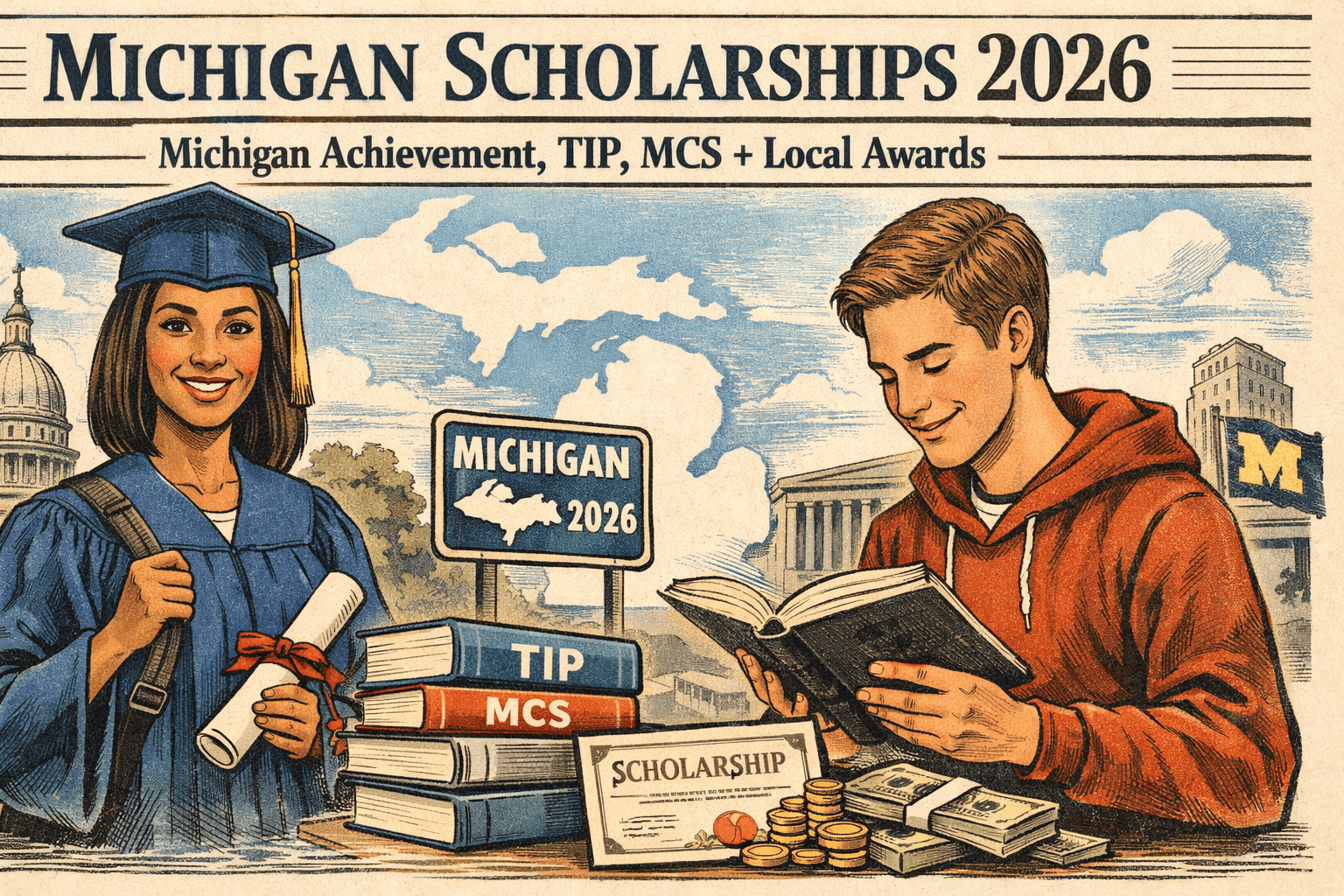
Michigan Scholarships & Grants (State + Local) — 2026 Edition
Michigan State Programs (Start Here)
Michigan Achievement Scholarship — University Path
-
Why it slaps: Big, renewable state money for bachelor’s programs; stacks after Pell and school grants.
-
💰 Amount: Up to $5,500/year for up to 5 years (max $27,500).
-
⏰ Deadline: File FAFSA ASAP; aid packages roll as schools process.
-
🔗 Apply/info: https://www.michigan.gov/mistudentaid/programs/michigan-achievement-scholarship
Michigan Achievement Scholarship — Community College Guarantee
-
Why it slaps: Tuition-free at your in-district community/tribal college + $1,000 bonus if Pell-eligible. No income cap.
-
💰 Amount: Covers in-district tuition, contact hours, mandatory fees (+$1,000 bonus for Pell-eligible). Renew up to 3 years (then transferable).
-
⏰ Deadline: File FAFSA; enroll within 15 months of graduation.
-
🔗 Apply/info: https://www.michigan.gov/mistudentaid/programs/michigan-achievement-scholarship/community-college-guarantee
Michigan Competitive Scholarship (MCS)
-
Why it slaps: Classic merit+need award—great for SAT crushers.
-
💰 Amount: Up to $1,500/year for tuition/fees.
-
⏰ Deadline: Submit FAFSA by the state’s annual MCS deadline (recently July 1 for the coming year).
-
🔗 Apply/info: https://www.michigan.gov/mistudentaid/programs/michigan-competitive-scholarship
-
FYI: SAT 1200+ required (Class of 2017+). Michigan.gov
-
Deadline note: State comms listed July 1, 2025 for 2025–26 filings (pattern repeats—file early). GovDelivery
Tuition Incentive Program (TIP)
-
Why it slaps: Massive help for students who had Medicaid for 24+ months in middle/high school.
-
💰 Amount: Phase I: pays approved certificate/associate tuition; Phase II: help after 56+ credits toward bachelor’s.
-
⏰ Deadline: Start within 4 years of HS completion; benefits expire 10 years after first use.
-
🔗 Apply/info: https://www.michigan.gov/mistudentaid/programs/tuition-incentive-program
Michigan Tuition Grant (MTG) — private, non-profit colleges
-
Why it slaps: Targeted help if you choose a Michigan private non-profit.
-
💰 Amount: Up to $3,000/year (tuition/mandatory fees).
-
⏰ Deadline: FAFSA by the state’s MTG deadline (recently July 1 for next year).
-
🔗 Apply/info: https://www.michigan.gov/mistudentaid/programs/michigan-tuition-grant
Children of Veterans Tuition Grant (CVTG)
-
Why it slaps: Honors families’ service with real tuition help.
-
💰 Amount: Up to $2,800/year (scaled by enrollment).
-
⏰ Window: Apply and file FAFSA annually (see site for age/timing rules).
-
🔗 Apply/info: https://www.michigan.gov/mistudentaid/programs/children-of-veterans-tuition-grant
Police Officer’s & Fire Fighter’s Survivor Tuition Grant
-
Why it slaps: Tuition waiver at MI public colleges for eligible spouses/children.
-
💰 Amount: Tuition waived at public universities/CCs.
-
⏰ Deadline: See program page (includes application timing rules).
-
🔗 Apply/info: https://www.michigan.gov/mistudentaid/programs/police-officers-and-fire-fighters-survivor-tuition-grant
Fostering Futures Scholarship (foster youth)
-
Why it slaps: Covers more than tuition—think books, housing, supplies.
-
💰 Amount: Up to $3,000/year (subject to funding).
-
⏰ 2025–26: Priority deadline Dec 31, 2025 (first-come).
-
🔗 Apply/info: https://www.michigan.gov/mistudentaid/programs/fostering-futures-scholarship
Education & Training Voucher (ETV) (foster care)
-
Why it slaps: Flexible up to $5,000/year for college or job training.
-
💰 Amount: Up to $5,000/year (eligibility rules apply).
-
🔗 Apply/info: https://www.michigan.gov/fyit/education/michigan-education-and-training-voucher
Michigan Reconnect (adult learners)
-
Why it slaps: Last-dollar scholarship for tuition-free in-district community college (age-based).
-
**💡 25+ ongoing; 21–24 temporary expansion required enrollment by summer 2025—check site for status.
-
🔗 Info: Michigan.gov
Michigan National Guard State Tuition Assistance (MINGSTAP)
-
Why it slaps: State tuition help for Guard members at MI colleges/trade schools.
-
🔗 Program: https://www.michigan.gov/dmva/about/mingstap — ✅ Link verified Aug 26, 2025.
-
🔗 Portal: https://www.dmva.state.mi.us/mingstap
MI GEAR UP Scholarship (program alumni)
-
Why it slaps: Keeps the support going post-high school.
-
💰 Amount: Up to $2,000/year, lifetime $4,000.
-
🔗 Apply/info: https://www.michigan.gov/mistudentaid/programs/mi-gear-up-scholarship
🌟 Michigan-Wide Private & Local Scholarship Hubs
Michigan Council of Women in Technology (MCWT) — Tech majors
-
Why it slaps: $2K–$5K awards + a powerhouse women-in-tech network.
-
🔗 Apply/info: https://mcwt.org/programs/university-initiatives/scholarship-program/
Community Foundation for Southeast Michigan — One app, many funds
-
Why it slaps: Single portal → tons of scholarships for metro Detroit & beyond.
-
🔗 Info/portal: https://cfsem.org/scholarships/
Grand Rapids Community Foundation — West MI pipeline
-
Why it slaps: Hundreds of awards; Dec 1–Mar 1 window most years.
-
🔗 Info/portal: https://www.grfoundation.org/apply-for-scholarships
🧭 Quick Playbook (Do This Next)
-
File FAFSA (free): https://studentaid.gov — then make/confirm your MiSSG account to track state awards. Michigan.gov
-
Claim the big two: Michigan Achievement (university or Community College Guarantee) + any MCS/MTG/TIP you qualify for. Michigan.gov
-
Layer local: Hit CFSEM + GR Foundation portals. cfsem.orggrfoundation.org
Michigan Scholarships in 2026
State aid architecture, FAFSA pipeline mechanics, and “Promise” scholarship ecosystems
Michigan’s scholarship system is no longer a loose patchwork of small awards—it is a coordinated finance-and-attainment strategy built around (1) broad, FAFSA-linked state programs (Michigan Achievement Scholarship; Tuition Incentive Program; Michigan Reconnect), (2) targeted aid for specific populations (foster youth, veterans’ families, Native students, future educators), and (3) a nationally distinctive place-based layer of “Promise” scholarships (Kalamazoo Promise, Detroit Promise, and legislatively authorized Promise Zone authorities). The state’s policy ambition is explicit: raise statewide postsecondary attainment from 51.5% to 60% by 2030.
Using Michigan’s published cost-of-attendance data (2022–23) and FY24–FY26 state funding appropriations (authorized for AY 2025–26), this paper quantifies coverage gaps, explains the incentives created by “last-dollar” designs, and evaluates Michigan’s dual strategy of expanding eligibility while increasing FAFSA completion. Key findings include: (i) average published tuition/fees at Michigan public four-years (~$14.4k) substantially exceeds the flagship annual award cap for many students ($5,500), meaning the typical award covers ~38% of tuition/fees and ~19% of on-campus cost of attendance; (ii) community-college “tuition-free” pathways reduce price barriers but do not eliminate non-tuition costs, which remain material even for students living with family; (iii) “Promise” programs can measurably increase enrollment and credential completion when structured as predictable, easy-to-understand guarantees and paired with advising supports; and (iv) FAFSA completion is the primary gatekeeper—Michigan has invested directly in FAFSA behaviors via incentives (Ticket to Tuition) and district grants (Universal FAFSA Challenge), signaling a shift from “aid availability” to “aid take-up” as a core policy lever.
1) Michigan’s scholarship strategy: from “aid programs” to an attainment-and-workforce system
Michigan’s scholarship portfolio is best understood as an implementation layer of its attainment policy (“Sixty by 30”), anchored in programs that translate FAFSA-derived need metrics into predictable tuition relief.
Two governance signals matter:
-
Scale and stability of appropriations. Michigan’s FY26 line for Michigan Achievement Scholarship/Skills Scholarship rises to $380 million (from $300 million in FY24), and Tuition Incentive Program (TIP) rises to $122.3 million (from $96.8 million in FY24). These are not marginal programs—they are system-defining.
-
FAFSA as an operational hinge. Multiple programs require FAFSA filing and on-time enrollment, and Michigan’s recent policy toolkit explicitly invests in FAFSA completion behavior (see Section 5).
2) What Michigan college actually costs: tuition is only part of the constraint
Michigan’s published Average Cost of Attendance (COA) data show why scholarships that focus on tuition can still leave substantial “persistence risk” (housing, food, transport, books, child care).
Table 1. Published averages by sector (Michigan, 2022–23)
(Dollar figures are published averages from Michigan’s COA report.)
| Sector | Avg tuition & fees | Avg COA (on-campus) | Avg COA (off-campus, not w/ family) | Avg COA (off-campus, w/ family) |
|---|---|---|---|---|
| Community college | ~$4,558 | — | ~$16,921 | ~$9,052 |
| Public 4-year | ~$14,406 | ~$29,082 | ~$28,585 | ~$19,163 |
| Private 4-year | ~$32,680 | ~$47,358 | ~$47,100 | ~$36,919 |
| Tribal colleges | ~$3,390 | — | ~$14,478 | ~$8,039 |
Two quantitative implications follow:
-
Flagship award vs. typical public-university price. Michigan Achievement Scholarship can be up to $5,500/year for eligible students at four-year institutions.
-
Relative to the average public 4-year tuition/fees (~$14.4k), $5,500 covers about 38% of tuition/fees (simple ratio).
-
Relative to on-campus COA (~$29.1k), $5,500 covers about 19% of total cost (simple ratio).
-
-
“Free tuition” still leaves non-tuition costs. Even at community colleges, average COA for students living with family is about $9,052, while tuition/fees average $4,558—implying roughly $4,500 in non-tuition costs that scholarships or emergency aid must address to stabilize enrollment.
This cost structure explains why Michigan’s ecosystem increasingly mixes tuition-focused awards with support services and flexible-use funds (notably in Promise models and some population-specific programs).
3) The state-funded core: Michigan’s major scholarship “pillars”
Michigan’s primary statewide programs can be grouped into four functional pillars: (A) recent high school graduates, (B) low-income pipeline supports, (C) adult learners, and (D) targeted population/workforce programs.
A) Recent high school graduates: Michigan Achievement Scholarship as the flagship
The Michigan Achievement Scholarship is the keystone program for graduates of 2023 and beyond, designed to make multiple postsecondary pathways cheaper (community college, four-year, private, and career training). Michigan describes the policy reach as broad—“7 in 10” high school graduates may qualify—and ties eligibility to FAFSA-derived financial need metrics and enrollment timing.
Core design features include:
-
Up to $5,500/year for up to five years for eligible students pursuing degrees at four-year institutions.
-
A community-college pathway commonly described as the Community College Guarantee, which pays in-district tuition (and related required charges) and can be paired with a $1,000 Michigan Achievement Bonus for Pell-eligible students.
-
A career-training pathway via the Michigan Achievement Skills Scholarship, typically cited as up to $2,000/year for up to two years for eligible short-term training.
At the budget level, Michigan’s line item for Michigan Achievement/Skills increases from $300M (FY24) to $380M (FY26), signaling continued expansion and/or higher utilization.
B) Low-income on-ramp: Tuition Incentive Program (TIP)
TIP is Michigan’s long-running “pipeline” scholarship: it encourages high school completion and supports low-income students by paying standard tuition at participating institutions, with a clear two-phase structure.
-
Phase I covers standard in-district tuition at participating community colleges, and covers lower-level resident tuition at participating public universities (with program restrictions).
-
Phase II provides tuition/mandatory-fee assistance up to $500/semester ($400/term), with a maximum of $2,000 for credits earned in a four-year program, subject to eligibility milestones (certificate/associate/56 transferable credits).
Michigan’s FY26 appropriation for TIP is $122.3M, up from $96.8M in FY24, consistent with TIP’s role as a “financial-aid pipeline” into both two-year credentials and bachelor’s completion.
C) Adult learners: Michigan Reconnect
Michigan Reconnect targets a large, historically underserved market: adults with “some college, no degree” and workers needing re-skilling. The program pays for adults 25 and older to attend their in-district community college and provides a discount mechanism for out-of-district attendance.
Outcome reporting from Michigan indicates scale:
-
66,500+ enrolled since launch,
-
8,100+ earning a certificate/degree, and
-
thousands more continuing enrollment (figures reported by the state).
Rather than a single annual appropriation line, Reconnect appears in budget documents largely as carry-forward plus added funds, reflecting multi-year utilization patterns.
D) Targeted programs: population equity and workforce pipelines
Michigan also funds and administers targeted scholarships that function as equity correctives or workforce supply instruments:
-
Fostering Futures Scholarship (for students who experienced foster care in Michigan at/after age 13). Notably, the program’s maximum award increases to up to $5,000 per academic year starting AY 2025–26, with improved distribution rules (including a portion usable for tuition/fees/books/supplies).
-
MI Future Educator Fellowship: a $10,000 scholarship for up to 2,500 future educators per year (a direct teacher-pipeline strategy).
-
MI Future Educator Stipend: a $9,600 stipend intended to support student teachers (practicum support as a barrier-removal tool).
-
Michigan Indian Tuition Waiver: established by Public Act 174 of 1976, waiving tuition costs for eligible Native Americans at Michigan public community colleges or universities.
-
Children of Veterans Tuition Grant and Police Officer’s/Fire Fighter’s Survivor Tuition Grant: tuition assistance/waivers for families of disabled/deceased/MIA veterans and for survivors of line-of-duty deaths.
These targeted programs matter analytically because they address “thin spots” where tuition-only programs often fail: homelessness risk, family instability, child care costs, and unpaid clinical/practicum requirements.
4) Place-based scholarships: Michigan’s “Promise” layer and why it works
Michigan is unusual for authorizing the creation of local Promise scholarship authorities at scale. The legal foundation is the Michigan Promise Zone Authority Act (Act 549 of 2008).
4.1 The Kalamazoo Promise: a globally studied scholarship intervention
The Kalamazoo Promise is one of the most studied U.S. place-based scholarships. It was announced in 2005 and provides up to 100% of tuition and mandatory fees at in-state public colleges/universities for eligible graduates, with public reporting of more than 9,000 scholars and $250M+ in awarded support.
Peer-reviewed evidence finds that the Promise increases enrollment and credential attainment, with stronger effects for some subgroups (e.g., women).
Mechanism: The scholarship is framed as a simple guarantee, which (i) changes household expectations earlier, (ii) reduces “price uncertainty,” and (iii) can improve K–12 retention and behavior through a credible future payoff.
4.2 Detroit Promise and “Promise + Supports”
Detroit Promise operates as a last-dollar scholarship that aims to ensure a tuition-free path for eligible Detroit residents across multiple credential types at participating colleges.
Evidence from rigorous evaluations of the Detroit Promise Path highlights a key policy insight: scholarship dollars alone are often weaker than scholarship + coaching/advising. Random assignment evaluations and research syntheses report improved enrollment intensity and early persistence when coaching supports and structured engagement are part of the package.
4.3 Promise Zones as “last-dollar infrastructure”—and the new shift toward non-tuition supports
Promise Zones typically fill remaining tuition gaps after other aid (“last-dollar”), creating a guaranteed minimum pathway to (at least) an associate degree.
A central evolution in Michigan has been pressure to allow Promise funds to address non-tuition costs (room/board, transportation, child care), reflecting the COA reality in Section 2. Recent reporting indicates expanded flexibility in some zones to cover these out-of-pocket barriers.
5) FAFSA completion: Michigan’s highest-leverage bottleneck
Michigan’s most generous programs are FAFSA-linked, which makes FAFSA completion the practical “front door” to state aid.
5.1 Baseline and recent trend signals
Michigan’s FAFSA completion metrics show both progress and remaining headroom:
-
For the Class of 2025, Michigan reported a record-high completion level (state communications reference ~67k completions).
-
For the Class of 2026, the public FAFSA tracker shows completion well below 100% mid-cycle (e.g., ~35% as of January 19, 2026), underscoring that “aid exists” is not the same as “aid is captured.”
5.2 Policy tools focused on take-up (not just eligibility)
Michigan has used at least three distinct levers:
-
Cash-like incentives tied to FAFSA behavior. In 2025, Michigan launched the “Ticket to Tuition” FAFSA sweepstakes: forty $10,000 prizes and ten $50,000 prizes delivered as deposits into Michigan’s 529 plan (MESP).
-
District capacity grants. MiLEAP awarded $10 million to 75 districts under the Universal FAFSA Challenge to support local implementation and FAFSA completion supports.
-
Messaging that connects FAFSA to specific, named Michigan programs (Achievement Scholarship, TIP, community college guarantees), reducing the “why bother?” barrier for students who do not view themselves as “college-bound.”
From an implementation-science standpoint, these tools treat FAFSA as a behavioral pipeline problem: awareness + assistance + incentive + norm-setting.
6) The design debate: last-dollar vs. first-dollar, and the risk of aid displacement
A large share of Michigan’s ecosystem (Achievement pathways, Promise zones, Detroit Promise) is designed as last-dollar or gap-filling tuition relief. This approach has advantages—political palatability, simplicity of “tuition-free” messaging, and cost containment because Pell and other grants apply first. But it creates two well-documented tensions:
-
Non-tuition costs remain. Last-dollar designs can produce a “tuition-free but still unaffordable” outcome when housing/food/transport dominate. Michigan’s COA data show that this is common, especially for independent students and those not living with family.
-
Award displacement. Research literature documents “aid displacement” where institutions reduce their own grants in response to external scholarships, or where scholarship structure inadvertently crowds out flexible grant dollars.
Michigan-specific implication: If the state’s policy goal is not merely enrollment but credential completion, then scholarship architecture increasingly needs either (a) built-in allowances for non-tuition COA items, or (b) paired supports (coaching, emergency aid, wraparound services) that stabilize attendance—exactly the direction seen in effective Promise Path-style models.
7) System-level findings: what Michigan is doing “right,” and where gaps remain
What’s working (structural strengths)
-
Scale of need-linked aid. The growth of Achievement/Skills funding to $380M and TIP to $122.3M indicates Michigan is underwriting a substantial share of tuition relief through state appropriations.
-
Multiple on-ramps. Michigan covers: recent grads (Achievement), low-income pipeline students (TIP), and adults (Reconnect), a rare three-lane structure among states.
-
Evidence-aligned Promise ecosystem. Michigan hosts flagship Promise interventions with strong evidence bases (Kalamazoo Promise; Detroit Promise Path), and it has a legislative framework for replicability (Promise Zones).
Persistent gaps (where scholarship dollars alone are insufficient)
-
Completion-risk costs. Books, transportation, child care, and housing remain primary attrition drivers—especially for community college students and adult learners—even when tuition is covered.
-
FAFSA take-up remains below universal. Michigan’s investments (sweepstakes + district grants) are rational responses to a continuing bottleneck: many eligible students still do not file.
-
Program complexity over a student lifecycle. Students can move between program categories (TIP → transfer → completion; Achievement → stop-out → Reconnect). Administrative friction—timelines, credit thresholds, enrollment requirements—can become “hidden eligibility cliffs,” particularly for first-generation students.
8) Recommendations: toward a completion-centered Michigan scholarship stack
-
Treat COA stabilization as the next frontier. Expand flexible-use components (transport, child care, emergency aid) within statewide programs or via standardized add-ons administered through colleges and Promise authorities, with clear guardrails and auditability.
-
Scale “Promise + Supports,” not just “Promise.” Evidence from Detroit Promise Path-type interventions suggests advising/coaching can materially improve early persistence; Michigan could incentivize Promise zones and institutions to adopt minimum support standards (coaching contact, early alerts, navigation).
-
Make FAFSA completion a default norm statewide (with opt-out), then fund implementation. Michigan’s Universal FAFSA Challenge is directionally consistent; the next step is sustained operational support and simplified playbooks for districts, paired with public dashboards that translate FAFSA into concrete eligibility messages (“You likely qualify for X”).
-
Mitigate aid displacement through transparency and “no-displacement” partnerships. Where feasible, Michigan can encourage institutions and private scholarship providers to adopt no-displacement pledges (or at least clear disclosure policies), preserving the intended net-price reduction for students.
-
Align scholarship messaging with workforce ROI—without narrowing options. Programs like Reconnect and the Skills Scholarship can be marketed through earnings and job-placement pathways, while still preserving student choice across sectors and credentials.
Conclusion
Michigan’s scholarship landscape in 2026 is best described as a layered affordability system: large-scale FAFSA-linked state aid (Achievement/Skills and TIP), a major adult upskilling scholarship (Reconnect), and a uniquely dense place-based Promise network with demonstrated potential to raise enrollment and completion. The data show why this system matters: published COA levels are high enough that tuition-only relief, while necessary, is often insufficient for completion. Michigan’s recent policy moves—expanded appropriations, FAFSA take-up investments, and evolving Promise models—signal an accurate diagnosis: access is now as much about administrative and behavioral pipeline design as it is about dollars.
❓ Michigan Scholarships — FAQ
When are Michigan state deadlines?
For MCS and MTG, Michigan has used July 1 as the FAFSA deadline for the upcoming year—file earlier to be safe since processing affects aid packaging. GovDelivery
Is the Community College Guarantee really tuition-free?
Yes—in-district tuition, contact hours, and mandatory fees are covered for recent grads; Pell-eligible students also get a $1,000 bonus. No income requirement. Michigan.gov
How much can I get from the Michigan Achievement Scholarship at a university?
Up to $5,500/year for 5 years (max $27,500). Need is considered; complete the FAFSA. Michigan.gov
What are the key TIP rules?
Start within 4 years of HS completion; Phase I supports certificate/associate pathways; Phase II kicks in after 56+ credits toward a bachelor’s; benefits expire 10 years after first use. Michigan.gov
Any help for foster youth?
Yes: Fostering Futures Scholarship (up to $3,000/year, priority Dec 31, 2025) and ETV (up to $5,000/year). Michigan.gov
Private college in Michigan—anything extra?
Michigan Tuition Grant adds up to $3,000/year at participating private non-profits. Michigan.gov
Adult learners—free community college?
Michigan Reconnect is a last-dollar CC scholarship (25+ ongoing; the 21–24 expansion required enrollment by summer 2025). Michigan.gov
Guard/Reserve benefits?
Check MINGSTAP for state tuition assistance; pair with federal TA/VA benefits. Michigan.gov
📚 Helpful Resources (Official)
-
MI Student Aid — Program list & MiSSG portal: https://www.michigan.gov/mistudentaid — ✅ Verified Aug 26, 2025. Michigan.gov
-
Michigan Achievement Scholarship hub: https://www.michigan.gov/mistudentaid/programs/michigan-achievement-scholarship — ✅ Verified Aug 26, 2025. Michigan.gov
-
Payment/award operations (for context): https://www.michigan.gov/mistudentaid/aid-administrators/payment-schedule — ✅ Verified Aug 26, 2025. Michigan.gov