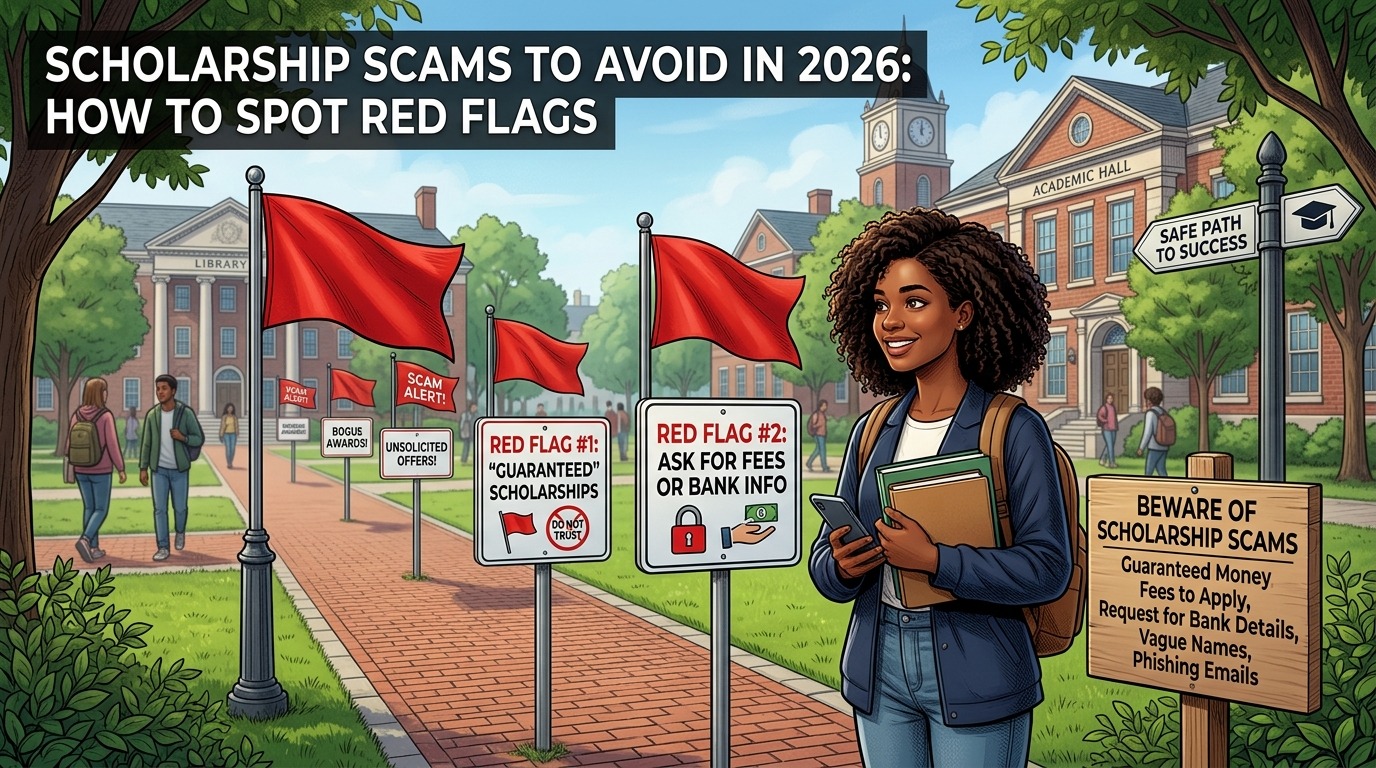
Scholarship Scams to Avoid in 2026: How to Spot Red Flags
If you are looking for college money in 2026, here is the most important truth to remember: real scholarships do not make you pay to get considered, and real financial aid help does not require you to hand over your password, rush into a payment, or trust a random message that says you were “selected.”
That sounds obvious. But scholarship scams still work because they target students exactly when students are stressed. You are juggling deadlines, essays, financial aid forms, admissions decisions, and maybe family pressure about college costs. Scammers know that. They build fake urgency around something students want badly: free money for school.
And in 2026, the digital environment is not getting safer. Students are finding opportunities through search, social media, text messages, email, short videos, and sponsored ads. Those same channels are also where scammers operate best.
This guide breaks down what scholarship scams look like now, the biggest red flags to watch for, how fake scholarship offers usually work, how to verify an award before you apply, and what to do if you already shared personal information or paid someone.
The goal is simple: help you protect your money, your identity, and your FAFSA account while still finding real scholarships that can actually help you pay for college.
The short version
- Never pay an upfront fee to apply for, unlock, hold, or receive a scholarship.
- Never share your StudentAid.gov login or FSA ID with anyone.
- Be suspicious of “guaranteed” scholarships, surprise winner notices, and “finalist” messages for contests you never entered.
- Do not trust pressure tactics like “pay today,” “limited spots,” or “claim this in 15 minutes.”
- If an offer claims to be government money, verify it directly on a real .gov website.
- If something feels off, stop, verify, and ask a school counselor or financial aid office before clicking or paying.
Why this matters so much in 2026
Students are not imagining the fraud problem. The broader scam environment is large and getting more expensive for victims. The FTC said consumers reported more than $12.5 billion in fraud losses in 2024, up 25% from the prior year. The same FTC data also showed that younger adults lost money more often than older adults, and that scams starting on social media or by text caused major losses. That does not mean all of those cases were scholarship scams. It does mean students are searching for aid inside the exact online spaces where scammers already perform well.
That matters for a high school senior because scholarship scams are rarely isolated. A fake scholarship pitch often overlaps with one or more of these other fraud types:
- identity theft
- government impersonation
- fake payment requests
- account takeover
- data harvesting for future scams
- fake check or refund tricks
So the real cost of a scholarship scam is usually bigger than losing $20, $35, or $99 to a so-called “processing fee.” The bigger risk is giving away your Social Security number, banking information, or federal aid credentials.
What counts as a scholarship scam?
A scholarship scam is any fake, deceptive, or misleading offer that pretends to help you get money for school but is really designed to do one of three things:
- take your money,
- steal your personal information, or
- gain access to your financial aid account.
Some scams are fully fake from the beginning. Others mix a tiny amount of real information with deceptive promises. For example, a company may give you a generic list of scholarships anyone could find for free, but market it as an exclusive award database and charge you to access it. Another scammer may claim to “help” with FAFSA paperwork, then use your login or submit false information.
That is why students need to stop thinking only in terms of “real scholarship” versus “fake scholarship.” In practice, there are at least four dangerous categories:
- Fake scholarship offers: there is no real award at all.
- Deceptive search services: the service charges fees and overpromises results.
- Fake FAFSA or aid help: the scam targets your federal aid information.
- Government or school impersonation scams: the scammer pretends to be an official source.
The biggest scholarship-scam red flags in 2026
Here are the warning signs that matter most.
1) You have to pay money first
This is still the clearest red flag. Real scholarships do not charge an upfront fee to apply, reserve your place, confirm eligibility, release the award, or “process” the payment. If someone asks for a redemption fee, application fee, holding fee, or membership payment before you can get the money, treat it as a scam unless you independently verify the organization and the fee is clearly unrelated to winning the scholarship itself.
A real scholarship may require essays, transcripts, recommendation letters, or proof of enrollment. It should not require you to buy access to your own opportunity.
2) They say the scholarship is guaranteed
Scholarship decisions involve selection criteria. Real scholarships have eligibility rules, deadlines, judging standards, or at least basic requirements. They do not guarantee that you will win. If a company says, “The scholarship is guaranteed or your money back,” that is a classic warning sign.
Scammers love guaranteed language because it lowers your skepticism. It makes you think you are already past the hard part.
3) You are a “finalist” for something you never entered
If you get a message saying you are a finalist, selected candidate, or preapproved award recipient for a scholarship you never applied for, stop immediately. Real scholarship programs do not usually choose random strangers off the internet and then ask those strangers for money or banking details.
Sometimes scammers use the psychology of almost winning. “You have been selected as a finalist” sounds believable because it suggests competition, not a total giveaway. But if you never submitted anything, that status does not mean anything.
4) They want your credit card, bank account, or debit card to “hold” the award
This is not how scholarships work. A real scholarship sponsor might ask for paperwork after you win, such as a W-9 in some cases, a student ID number, your college information, or instructions for sending the award to your school. They do not need your card number to keep your place.
If you hear, “We just need your bank account to confirm eligibility,” or “enter a card so we can release your funds,” back out.
5) They want your FAFSA login or FSA ID
This is one of the most dangerous scams because it can reach beyond one fake scholarship and into your federal student aid account. Federal Student Aid says your StudentAid.gov account works as your legal electronic signature. That means nobody else should be logging in as you, and nobody legitimate needs your password to “help” you get aid.
If someone asks for your FSA ID, your StudentAid.gov username and password, or any verification code tied to your federal aid account, do not give it to them.
6) The pressure is intense
Scammers hate slow thinking. That is why they use countdowns, fake urgency, seminar deadlines, and phrases like “act now,” “limited spots,” “your award expires tonight,” or “submit payment before midnight.”
Real scholarships have deadlines, yes. But a real deadline is a posted date on an official page, not a pressure script in a text message demanding immediate payment.
7) The website looks vague or evasive
Even before you research the organization deeply, bad scholarship pages often reveal themselves through basic missing information. Watch for pages that do not clearly show:
- who runs the scholarship,
- who is eligible,
- what the deadline is,
- how winners are chosen,
- how many awards are given,
- how previous recipients are identified, or
- how to contact the sponsor.
A vague page is not automatically fraudulent, but it should lower your trust level fast.
8) The “government grant” language sounds too broad
Scammers often mix up scholarships, grants, FAFSA, and “free government money” to confuse students and parents. The FTC warns that government grant scammers may claim you can get free education money and then ask for Social Security numbers, banking information, or upfront payments by gift card, wire transfer, or cryptocurrency.
That is not how real federal aid works. Real federal student aid starts with the FAFSA and official aid systems. The government does not randomly text students promising grant money if they just pay a release fee.
9) The organization name sounds official, but you cannot verify it
Scammers choose names that sound national, federal, academic, or nonprofit. They may use words like “National,” “Federal,” “Academic,” “Education Assistance,” or “Grant Administration” to sound legitimate. Do not trust a serious-sounding name by itself.
Also, do not assume that a .org website is automatically safe. BBB specifically described a reported FAFSA-related scam where the site looked trustworthy partly because it used a .org domain. The real question is whether the organization is verifiable, transparent, and connected to a legitimate school, government office, foundation, employer, or nonprofit.
10) They avoid direct questions
When you ask simple questions, real organizations usually have direct answers. Scammers dodge. Ask these:
- Who sponsors this scholarship?
- Where are the official rules?
- How are winners selected?
- How many recipients were chosen last year?
- Can you show me the terms in writing?
If the answers stay slippery, stop.
How scholarship scams usually work
Most scholarship scams follow a familiar playbook.
The “you’ve been selected” message
You see a post, text, email, or letter saying you were chosen for a special scholarship or financial aid package. The message sounds personalized, urgent, and exciting. It may include official-looking seals, patriotic language, or a callback number.
Then comes the catch: you must pay a small fee, verify a bank account, or give personal information right away.
This trick works because the amount requested is often small. A student might think, “It is only $25.” But if the offer is fake, the scammer now has your payment details and possibly your identity data too.
The seminar or webinar pitch
The FTC warns that some so-called financial aid seminars are really high-pressure sales events. You are promised insider scholarship secrets, hidden grants, or access to private funding. Then, during or after the session, the company pressures families to buy services immediately.
If a presentation does not let you leave, think, compare, and research, that is a bad sign. Real opportunities survive overnight. Scams usually do not.
The fake FAFSA helper
This is one of the worst versions because it can pull students into fraud without them even understanding what happened. A scammer says they can handle the FAFSA for you, improve your eligibility, or unlock more aid. They may ask for your StudentAid.gov credentials or encourage false answers about family income and assets.
That can cost you in two ways. First, you may lose control of your account. Second, you can end up attached to false information on a federal aid form. The FTC warns that false FAFSA information can lead to serious consequences, including fines and possible jail time.
The fake government grant
This scam often targets both students and parents. The caller or message claims you qualify for a government education grant. The next step is always the giveaway: they need money or personal information first.
The FTC says real government agencies do not contact you out of the blue to offer grants, and they do not demand payment by gift card, cash reload card, wire transfer, or cryptocurrency.
The fake-check twist
BBB has warned that scholarship scams can also use fake checks. The scammer sends a check that looks like a scholarship payment, then tells the student to send back part of the money for “taxes,” “processing,” “equipment,” or a third-party service. The check later bounces, but the money the student sent is gone.
Any scholarship that asks you to receive money and forward a portion somewhere else should be treated as toxic until proven otherwise.
How to verify a scholarship before you trust it
Here is a practical five-step verification routine you can use in under ten minutes.
Step 1: Verify the sponsor
Find the real organization behind the award. Is it a college, employer, professional association, community foundation, nonprofit, government agency, union, or civic group? If you cannot identify a real sponsor, do not move forward.
Step 2: Read the full rules
A real scholarship should have written details. Look for eligibility, deadline, required materials, selection criteria, award amount, number of winners, and payment method. If the page is all marketing language and no rules, that is a problem.
Step 3: Check whether the scholarship is listed or referenced somewhere credible
You do not need a scholarship to appear everywhere online, especially local awards. But you should be able to connect the award to a real sponsor site, school office, or trusted directory. If the only references are ads, social posts, or cloned pages, be careful.
Step 4: Confirm the contact information
Use the sponsor’s main website to find a phone number or email. Do not rely only on the contact information inside the suspicious message. If needed, call the organization directly and ask, “Is this scholarship real?”
Step 5: Pause before sharing sensitive information
Before entering your Social Security number, bank information, or StudentAid.gov credentials, ask whether that information is actually necessary at this stage. For most scholarships, the answer early in the process is no.
Where high school seniors should look for legit scholarships instead
If you want the safest path, start with sources that do not require mystery, pressure, or payment.
- Your high school counselor: StudentAid.gov specifically recommends high school counselors as a free scholarship source.
- Your college financial aid office: if you already have schools on your list, check institutional scholarships and official aid pages directly.
- StudentAid.gov: use it for federal aid information and official scam guidance.
- CareerOneStop Scholarship Finder: this is tied to the U.S. Department of Labor and is a stronger choice than random ad-heavy sites.
- Official college cost tools: use the federal College Scorecard and Net Price Calculator pages to understand affordability instead of trusting marketing claims.
In other words, build your search from official and school-connected sources outward, not from viral posts inward.
What to do if you already got scammed
If you paid money or shared information, move fast. Speed matters.
If you paid by card or bank transfer
Call your bank or card company immediately. Tell them the payment was connected to a scam. Ask whether the charge can be disputed, reversed, or blocked from recurring.
If you gave away your StudentAid.gov login or think your FAFSA account was compromised
Change your StudentAid.gov password right away. Then contact the Federal Student Aid Information Center. The U.S. Department of Education Office of Inspector General says students who think their FSA account has been compromised should contact Federal Student Aid Information Center at 1-800-433-3243.
If you shared Social Security numbers or identity information
The Department of Education OIG says to contact your loan servicer if your identity was used to fraudulently obtain federal student aid or loans, freeze your credit with the credit bureaus, report the issue to the OIG, and file an identity theft report at IdentityTheft.gov.
If you were targeted by a scholarship or aid scam
Report it to the FTC at ReportFraud.ftc.gov. You can also report education-related scams to the U.S. Department of Education Office of Inspector General.
And save evidence before deleting anything:
- screenshots of the message,
- email headers if possible,
- the website address,
- payment receipts,
- phone numbers, and
- chat logs.
The smartest mindset for students in 2026
When you are trying to pay for college, it is easy to think the main challenge is finding more opportunities. But in 2026, one of the smartest financial-aid skills is filtering bad opportunities quickly.
You do not need to become paranoid. You just need a better standard.
Here is the standard:
- If it asks for money first, stop.
- If it asks for your FSA ID, stop.
- If it promises guaranteed money, stop.
- If it pressures you to act right now, stop.
- If it cannot be verified through a real sponsor, school office, or official website, stop.
That one habit will save some students hundreds of dollars. It will save others from identity theft. And for many families, it will prevent the most expensive mistake of all: putting false information into a federal aid process because a fake “helper” told them to.
Scholarships are real. Grants are real. Financial aid is real. But so are scams. The safest students are not the ones who trust nothing. They are the ones who verify everything important before they click.
Official help and legit websites
- Federal Student Aid (StudentAid.gov)
- FAFSA Form
- Avoiding Student Aid Scams
- FTC: How to Avoid Scholarship and Financial Aid Scams
- ReportFraud.ftc.gov
- IdentityTheft.gov
- U.S. Department of Education OIG: Education-Related Scams
- CareerOneStop Scholarship Finder
- College Scorecard
- Net Price Calculator Center
Suggested internal links
- Avoid These 8 FAFSA Mistakes: A 2026 Checklist for High-School Seniors
- Legit Scholarships in 2026: Identifying Real Awards
- Verified Scholarships in U.S. Higher Education
- 2026 Guide to Finding Actually Accurate Sources
FAQ
Are scholarship application fees ever legit?
For a scholarship itself, an upfront fee is a major warning sign. Some third-party services may charge for coaching or database access, but paying for help is not the same as paying to win an award. The safest move is to avoid any scholarship opportunity that conditions eligibility on payment.
Can a real scholarship contact me first?
Sometimes, yes, especially if it is from your school, a local organization, or a program you already joined. But unsolicited contact by itself should never be enough to trust the offer. Verify the sponsor independently before you respond.
Should I ever give my Social Security number to a scholarship?
Usually not at the beginning. Some legitimate organizations may eventually need tax or identity information from winners, but that should happen after selection, through a clearly verified process, and only when you know exactly who the sponsor is.
Is FAFSA help from paid consultants always a scam?
No. But you should be extremely cautious. FAFSA filing is free, and nobody legitimate needs to log in as you using your StudentAid.gov account. Never share your FSA ID or let someone submit information you have not reviewed carefully.
What if a scholarship says I need to act today?
That is a reason to slow down, not speed up. Real deadlines can be real, but pressure language is also one of the oldest scam tactics. Verify first.
What is the safest first step when I am unsure?
Pause and ask a trusted adult, school counselor, or college financial aid office before you click, pay, or upload documents. One extra check can save you a huge problem later.