Paying for College: The Complete Guide for Students and Families
Paying for college is not usually about finding one giant scholarship or writing one check. In real life, most families build a funding stack: grants, scholarships, savings, part-time work, tax benefits, and sometimes loans. The smartest approach is to lower the price before borrowing, compare schools by net price instead of sticker price, and use federal aid first because it usually has stronger protections than private loans.
In 2025–26, the average published tuition and fees are $4,150 at public two-year colleges for in-district students, $11,950 at public four-year colleges for in-state students, $31,880 at public four-year colleges for out-of-state students, and $45,000 at private nonprofit four-year colleges. When housing, food, books, transportation, and other costs are added, the average full student budget rises to about $21,320 at public two-year colleges, $30,990 at public four-year in-state schools, $50,920 at public four-year out-of-state schools, and $65,470 at private nonprofit four-year schools.
The good news is that the sticker price is often not the real price. College Board reports that, on average, first-time full-time students at public two-year colleges receive enough grant aid to cover tuition and fees, and the average net tuition and fees paid by first-time full-time in-state students at public four-year colleges is estimated at $2,300 in 2025–26 after grants are subtracted. That is why families should obsess over net price, not the number printed at the top of a college website.
What “paying for college” really means
A college bill is usually covered from multiple directions at once. The basic categories are grants, scholarships, work-study or wages, student loans, parent loans, family savings, and tax benefits. Federal Student Aid defines grants as aid that usually does not have to be repaid, work-study as part-time employment connected to financial need, and loans as money that must be repaid with interest.
For many students, the first major step is the FAFSA. The FAFSA is the free form used to apply for federal aid, and states, colleges, and some scholarship providers also use FAFSA information to award their own aid. That means a student can miss out on state grants, school grants, work-study, or even some merit aid by skipping the FAFSA just because they assume they will not qualify for federal money.
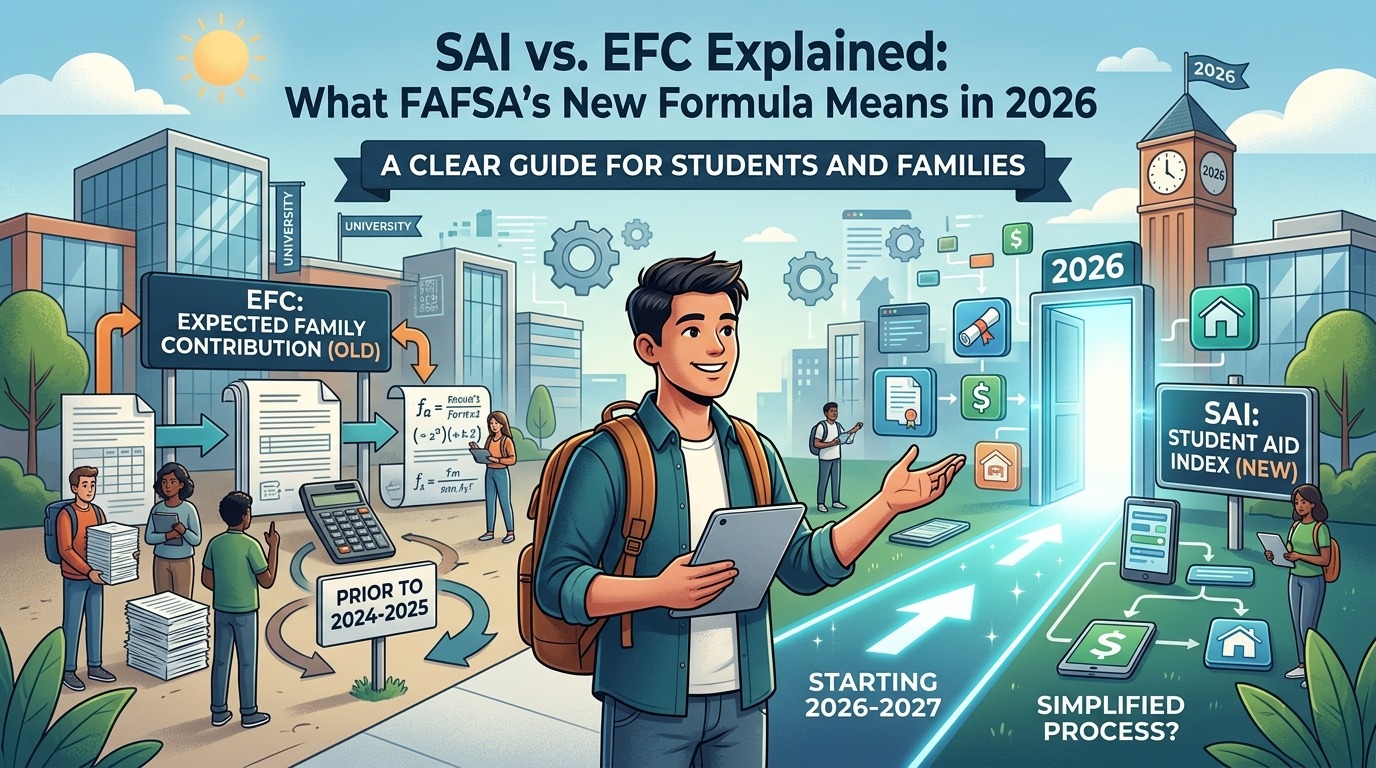
The FAFSA produces a Student Aid Index (SAI), but that number is not a bill and not a guaranteed aid amount. It is an eligibility index schools use, alongside their own cost of attendance, to determine aid. Students often misunderstand this point and think the SAI is what their family must pay. It is not.
The best order to pay for college
The safest order is simple:
-
Grants and scholarships first
-
Work-study and student earnings second
-
Federal student loans third
-
Parent PLUS or private loans last
That order matters because grants and scholarships usually do not have to be repaid, work-study and wages reduce how much you must borrow, federal loans come with standardized protections and repayment options, and private loans usually depend more heavily on credit and lender terms. Federal Student Aid explicitly recommends federal aid first and warns students to compare private loan terms carefully before accepting them.
The major ways students actually pay for college
1) Federal grants
The best-known federal grant is the Pell Grant. For the 2026–27 award year, the maximum Pell Grant is $7,395. College Board also reported that Pell activity rose sharply in 2024–25, with recipients increasing from 6.4 million to 7.3 million and total Pell aid helping drive grant growth nationwide.
Pell Grants matter because they reduce college price directly. They do not work like a coupon that covers every cost at every school, but they are one of the strongest anti-borrowing tools available to low- and middle-income students. For families trying to judge whether a school is realistic, Pell eligibility is often the first important signal that real grant aid may be available.
2) Institutional grants and state grants
A lot of “free money” does not come from Washington. Colleges award their own institutional grants, and states run their own grant programs and priority deadlines. That is one reason the FAFSA matters even if a family thinks income is too high for Pell: schools and states may still use FAFSA data to decide whether a student qualifies for aid.
The rule for high school seniors is simple: file early enough for school and state priority deadlines, not just the federal deadline. Federal FAFSA deadlines run all the way to June 30 of the academic year, but school deadlines are often much earlier, commonly around February, and state deadlines vary widely. Waiting until summer can be financially expensive even if the FAFSA is technically still open.
3) Scholarships
Scholarships come from colleges, nonprofits, employers, religious groups, local community organizations, and private foundations. Some are merit-based, some are need-based, and many are based on interests, identity, major, location, service, or family background. Federal Student Aid notes that students may be eligible for some scholarships simply by completing the FAFSA, while additional scholarship searching can be done through schools, counselors, employers, local organizations, and other legitimate community sources.
The smartest scholarship strategy is not only to chase national awards. Local scholarships often have fewer applicants, and school-specific scholarships can be more valuable than public “big name” competitions because they may renew every year. A $2,500 annual award renewed for four years beats a one-time headline scholarship that sounds bigger on social media. Federal Student Aid specifically highlights local and school-connected scholarship sources as important places to look.
4) Federal Work-Study and regular student jobs
Federal Work-Study can help, but students should understand what it is and what it is not. It is not a grant applied directly to the bill. It is a chance to earn wages through an eligible part-time job, and students usually must submit the FAFSA, be awarded work-study, and then actually secure a qualifying position. Work-study jobs can be on campus or off campus with approved nonprofit or community employers.
This means work-study is best treated as a way to pay ongoing living costs like books, transportation, food, or personal expenses during the year. It is helpful, but it should not be mistaken for upfront gift aid.
5) Federal student loans
Federal student loans are common, but they should be used carefully and after gift aid. For undergraduates, current federal loan interest rates for loans first disbursed from July 1, 2025, to June 30, 2026 are 6.39% for Direct Subsidized and Direct Unsubsidized Loans. The current loan origination fee for Direct Subsidized and Direct Unsubsidized Loans first disbursed from October 1, 2025, through September 30, 2026 is 1.057%.
The annual federal loan limits for dependent undergraduates are $5,500 for first year, $6,500 for second year, and $7,500 for third year and beyond, with an aggregate limit of $31,000, of which no more than $23,000 may be subsidized. For independent undergraduates, the limits are $9,500, $10,500, and $12,500, with an aggregate limit of $57,500, again with no more than $23,000 subsidized.
Those limits matter because they show that federal student loans alone usually do not cover a high-price college. If a school is far above what grants, savings, earnings, and federal student loans can cover, the family is often being pushed toward Parent PLUS or private loans. That is a major warning sign, not a minor paperwork issue.
6) Parent PLUS loans
Parent PLUS loans are federal loans for parents of dependent undergraduates. For loans first disbursed from July 1, 2025, to June 30, 2026, the interest rate is 8.94%. For Direct PLUS loans first disbursed from October 1, 2025, through September 30, 2026, the loan fee is 4.228%. Parents can generally borrow up to the school’s cost of attendance minus other financial aid.
That “up to cost of attendance” phrase is why Parent PLUS can become dangerous. It makes a gap look solvable even when the school is fundamentally unaffordable. A family may qualify to borrow enough to attend, but that does not mean borrowing that much is wise. Parents should treat PLUS as a final-gap tool, not a blank check.
7) Private loans
Private loans can fill a gap, but they are usually the least student-friendly mainstream option because rates, fees, repayment rules, and cosigner requirements vary by lender. Federal Student Aid advises students to compare offers carefully and look closely at penalties, fees, repayment terms, credit requirements, and academic progress rules before signing.
For a high school senior, the practical lesson is blunt: if private loans are necessary, the student should first ask whether there is a lower-cost college choice that produces the same degree goal with far less risk.
8) 529 plans, tax credits, and employer help
A 529 plan is a qualified tuition program that lets earnings grow tax-free and generally lets distributions stay tax-free when used for qualified education expenses. IRS guidance says qualified expenses can include items such as tuition, fees, books, and, in many cases, room and board at eligible institutions.
The American Opportunity Tax Credit (AOTC) can be worth up to $2,500 per eligible student for the first four years of higher education, and up to $1,000 can be refundable. The Lifetime Learning Credit (LLC) can be worth up to $2,000 per tax return and is available for more years and some job-skill coursework, but it is not refundable. Families cannot claim both credits for the same student and the same expenses in the same tax year.
Some employers also help. IRS guidance says tax-free educational assistance under a qualifying employer program is generally limited to $5,250 per employee per year, and eligible benefits can include tuition, fees, books, supplies, equipment, and in some cases student loan payments, subject to the tax rules in effect.
A smarter step-by-step plan for high school seniors
Step 1: Estimate net price before applying
Students should run each college’s net price calculator early. The U.S. Department of Education’s Net Price Calculator Center explains that these calculators estimate what students like you paid after grants and scholarships, not just the published sticker price.
This step matters because two colleges with similar tuition can have very different real prices after aid. A school with a high sticker price may offer stronger grant aid than a lower-sticker school, and a public option may still be the better deal once commuting, housing, and merit aid are compared honestly.
Step 2: File the FAFSA as early as possible
Federal Student Aid is clear: complete the FAFSA before school and state deadlines to maximize aid eligibility. Even though the federal deadline is much later, many state and college deadlines arrive early, and some aid is effectively first-come, first-served.
Step 3: Check whether the college also requires the CSS Profile
Some colleges use the CSS Profile to award nonfederal institutional aid. College Board says the CSS Profile unlocks access to more than $14 billion in nonfederal aid. It is free for many domestic undergraduate families with adjusted gross income up to $100,000, along with some other waiver pathways.
Step 4: Compare aid offers like a buyer, not like a fan
When offers arrive, look at:
-
net price after grants and scholarships
-
how much is gift aid versus loans
-
whether scholarships renew each year and on what conditions
-
how much Parent PLUS or private borrowing would be needed
-
graduation rates, debt, and earnings outcomes at the school and major level
The federal College Scorecard is useful here because it lets students compare average annual cost, debt, graduation information, and earnings data. A lower-cost school with better completion outcomes can easily beat a “dream school” that looks better only on reputation.
Step 5: Appeal if your family’s finances changed
If your family had a major change such as a job loss, pay cut, divorce, death in the family, or unusually high medical expenses, submit the FAFSA as required and then contact the school’s financial aid office to request an aid adjustment or professional judgment review. Federal Student Aid says schools may ask for documentation and that the school’s decision is final.
Step 6: Reapply every year
Aid is not always one-and-done. Federal Student Aid explains that financial information must be provided every year because eligibility can change as family circumstances change. A student who received little aid one year may qualify for more later, and a student who does not renew paperwork can lose aid they otherwise would have kept.
How much borrowing is “too much”?
There is no perfect universal number, but there is a practical rule: undergraduate borrowing should stay low enough that the student can manage repayment without choosing jobs only for debt survival. College Board’s 2025 student aid highlights report says the average amount borrowed by 2023–24 bachelor’s degree recipients who took out loans was $29,560. That is an average, not a target. Students should aim lower whenever possible.
The reason caution matters is that degree payoff is real, but it is not automatic. BLS reported that in 2025, full-time workers age 25 and older with a high school diploma had median weekly earnings of $966, while those with a bachelor’s degree and higher had $1,740. In BLS’s 2024 education-pay chart, unemployment was 4.2% for high school graduates and 2.5% for bachelor’s degree holders. That earnings gap helps explain why college can pay off, but students still need a price they can handle.
Common mistakes families make
The first big mistake is treating sticker price as final price. Families often cross schools off too early without checking net price calculators or aid policies.
The second mistake is filing the FAFSA too late. Federal deadlines are not the only deadlines, and state or institutional money may run on earlier calendars.
The third mistake is confusing grants with loans. An aid package can look generous while quietly loading in debt and parent borrowing. Students must separate gift aid from money that must be repaid.
The fourth mistake is choosing a school without checking outcomes. Students should compare cost with graduation, debt, and earnings using federal tools, not just rankings and campus vibes.
Official websites worth using
Use official or institution-controlled tools first:
-
StudentAid.gov — federal grants, loans, work-study, FAFSA, loan limits, interest rates, repayment tools.
-
FAFSA Deadlines — federal and state FAFSA deadlines.
-
College Scorecard — compare cost, debt, graduation, and earnings.
-
Net Price Calculator Center — find college net price calculators.
-
CSS Profile — used by many colleges for institutional aid.
-
IRS Education Credits — AOTC and LLC rules.
-
IRS Publication 970 — tax benefits for education, including 529-related rules and education tax guidance.
Bottom line
The smartest way to pay for college is to think like an optimizer, not a gambler. Start with net price, file the FAFSA early, complete the CSS Profile when required, chase grants and scholarships before loans, compare colleges using cost plus outcomes, and treat Parent PLUS and private loans as last-resort gap fillers, not normal first choices. Students who understand that sequence usually make better college decisions and keep more future freedom after graduation.