Paying for College 101: The Complete Guide for High School Seniors
Paying for college is usually not one giant payment from one source. It is a mix of grants, scholarships, state aid, college aid, work-study earnings, family savings, tax benefits, and sometimes loans. That matters because most students do not pay the full sticker price. In 2023–24, 85.5% of full-time, first-time undergraduates received some form of financial aid. In 2024–25, students received $275.1 billion in total aid, and the average aid per undergraduate full-time-equivalent student was $16,810.
The smartest way to think about college money is simple: first understand the real cost, then grab all the free money, then use savings and tax breaks, and only after that think about borrowing. That order keeps debt lower and gives families a clearer picture of what college will really cost year after year.
What college really costs
A college’s “price” has two different meanings. The first is the published price, sometimes called the sticker price. The second is the net price, which is what remains after grants and scholarships are subtracted. Net price is the more useful number because it reflects what families actually need to cover. Federal definitions of net price do not count loans as price reductions, which is important because borrowed money still has to be repaid.
For 2025–26, average total student budgets for full-time undergraduates were about $21,320 at public two-year colleges for in-district students, $30,990 at public four-year colleges for in-state students, $50,920 at public four-year colleges for out-of-state students, and $65,470 at private nonprofit four-year colleges. Average published tuition and fees alone were $4,150 at public two-year colleges, $11,950 at public four-year in-state colleges, and $45,000 at private nonprofit four-year colleges.
Cost of attendance is bigger than tuition. It usually includes tuition and fees, room and board, books and supplies, transportation, and personal expenses. That is why a college that looks “cheap” on tuition alone can still be expensive once housing, travel, and everyday living costs are added in.
There is one encouraging data point for families looking at community college. College Board reports that, on average, first-time, full-time students at public two-year colleges have been receiving enough grant aid to cover tuition and fees since 2009–10. That does not mean community college is free for every student, because books, transportation, food, and housing still matter, but it does show why two-year colleges can be a strong affordability play.
The FAFSA comes first
If you are a high school senior, the FAFSA is usually step one. The 2026–27 FAFSA is the form used for aid for the school year running from July 1, 2026, through June 30, 2027. It is used to apply free for federal grants, work-study, and loans, and many states and colleges also use FAFSA information to award their own aid. For federal aid, the 2026–27 FAFSA can be submitted no earlier than October 1, 2025, and the federal deadline is June 30, 2027. For state and college aid, deadlines may be much earlier, including as early as October 1, 2025.
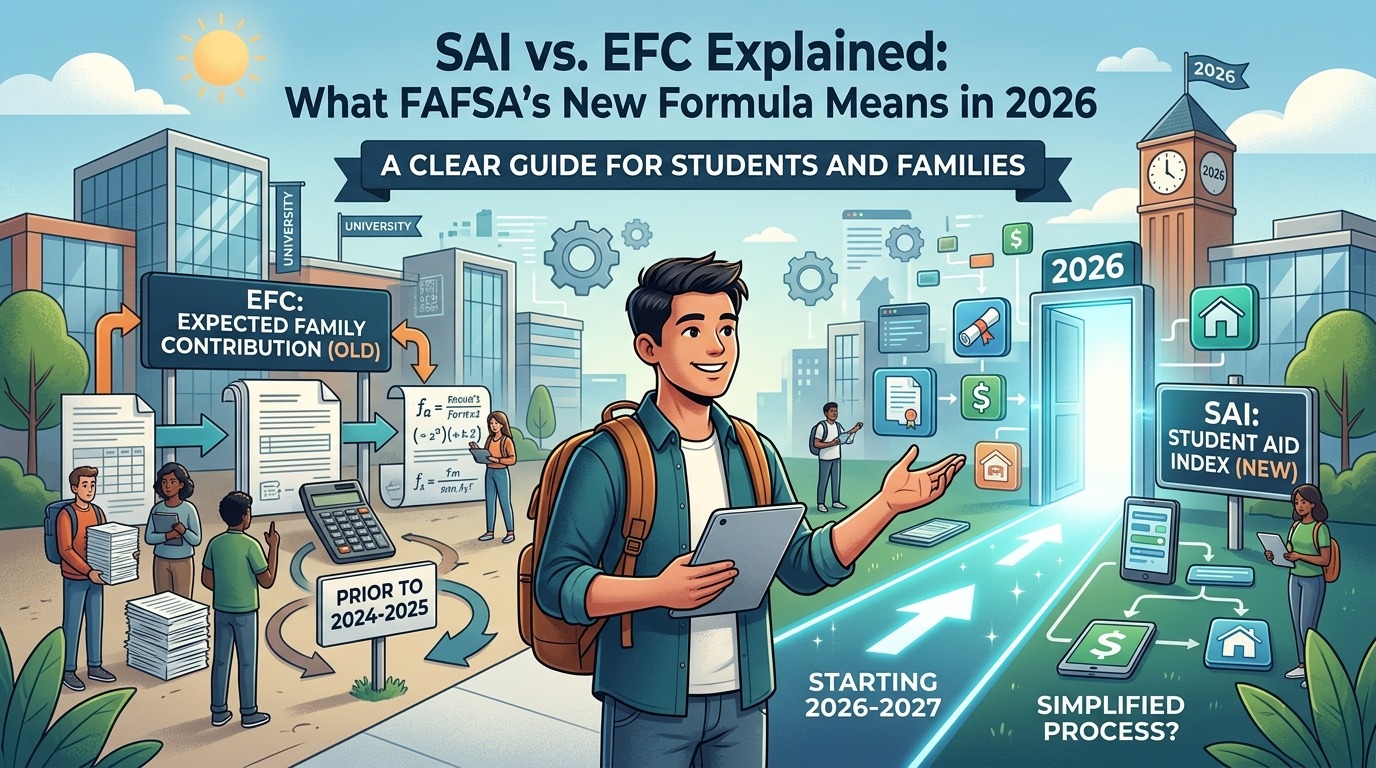
The FAFSA now produces a number called the Student Aid Index, or SAI. The SAI ranges from –1500 to 999999. It is an index used by colleges to help determine financial aid eligibility. It is not a dollar amount, not a bill, and not a promise of what a college will offer. Lower or negative numbers generally indicate higher financial need.
After you file, your FAFSA Submission Summary will show your SAI and estimated federal aid eligibility, including an estimated Pell amount if you may qualify. But the summary is still not the final award letter. Your college makes the final decision about the aid package it offers after you are admitted.
Free money first: grants and scholarships
The best college money is the kind you do not repay. Federal Student Aid divides aid into grants, work-study, and loans, and grants are the most valuable because they reduce what you owe without creating debt. Scholarships work the same way for most students: they lower the amount your family must cover from income, savings, or borrowing.
The biggest federal grant for many students is the Pell Grant. For the 2026–27 award year, the maximum Pell Grant is $7,395. Pell eligibility depends on more than family income alone; federal formulas also consider factors such as family size and tax filing status. Some students may also qualify for “year-round Pell,” which can allow up to 150% of a yearly Pell award if they attend an extra term, such as summer.
Another federal grant is the Federal Supplemental Educational Opportunity Grant (FSEOG). It is aimed at undergraduates with exceptional financial need, and awards can range from $100 to $4,000. Not every school participates, and funds are limited, which is another reason filing early matters.
Many colleges also offer their own need-based and merit-based aid. Some of those colleges require the CSS Profile, which is a separate application used to award non-federal institutional aid. For domestic undergraduate students, CSS Profile is free for families with income up to $100,000; otherwise the initial application fee is $25 and additional reports are $16.
Work-study can help, but it is not a discount
Federal Work-Study is a part-time employment program for eligible students. The money is earned through work rather than given upfront like a grant, and unlike a federal student loan, it does not need to be repaid. To be considered for Federal Work-Study, you must submit the FAFSA. That makes work-study useful, but families should remember it usually helps with ongoing expenses during the year rather than slashing the bill on day one.
Savings, 529 plans, and tax breaks
Savings still matter, even in a grant-heavy plan. A 529 plan, also called a qualified tuition program, is a state-sponsored education savings tool that lets families contribute toward future education costs. IRS guidance says 529 distributions can be tax-free when used for qualified higher education expenses, and IRS Publication 970 notes that room and board can count as a qualified expense for a QTP in the right circumstances.
Tax credits can also reduce the real cost of college. The American Opportunity Tax Credit can be worth up to $2,500 per eligible student for the first four years of higher education, and up to $1,000 of that can be refundable. The Lifetime Learning Credit can be worth up to $2,000 per tax return. These are tax benefits, not upfront aid, so they do not help with the first bill in the same way a grant does, but they can still reduce what a family effectively pays over time.
Families should also know that “qualified education expenses” are not identical across every tax benefit. IRS guidance says qualified education expenses for some education credits include tuition, fees, and certain required course materials, while room and board does not qualify for those credits. That means it is important to match the expense to the specific benefit instead of assuming every college expense counts everywhere.
Loans: use them carefully and in the right order
Loans are sometimes necessary, but they should usually come after grants, scholarships, work-study, savings, and tax benefits. Federal undergraduate loans are generally safer than private loans because they come with federal rules and protections, and subsidized loans are better than unsubsidized loans when you qualify because the government covers the interest while you are in school at least half-time and during certain other periods. Unsubsidized loans begin accruing interest earlier.
For dependent undergraduates, current federal annual borrowing limits are $5,500 in the first year, $6,500 in the second year, and $7,500 in the third year and beyond, with a total undergraduate limit of $31,000, no more than $23,000 of which may be subsidized. For independent undergraduates, the annual limits are higher and the total limit is $57,500, again with no more than $23,000 subsidized.
For federal undergraduate Direct Subsidized and Direct Unsubsidized Loans first disbursed from July 1, 2025, through June 30, 2026, the interest rate is 6.39%. For Direct PLUS Loans to parents first disbursed in that same period, the interest rate is 8.94%. Parent PLUS loans also have no set borrowing limit, but parents generally cannot borrow more than the school’s cost of attendance minus other financial aid. Those facts are why Parent PLUS and private loans should usually be treated as gap-fillers, not the starting plan.
How to compare colleges the smart way
Do not compare colleges by sticker price alone. Compare them by net price, by how much free aid is included, and by how much you would need to borrow across all four years, not just year one. Federal Student Aid recommends adding up total costs, federal aid, state aid, school aid, and any remaining gap before ranking your options.
A good rule is to ask four questions for every college on your list: What is the net price after grants and scholarships? How much of the package is loans instead of free aid? Does the aid renew each year, and under what GPA or enrollment rules? What is the likely four-year total, not just the freshman-year cost? Your FAFSA Submission Summary is only an estimate, while the college’s aid offer is the final package you compare.
Use College Scorecard and each school’s net price calculator before you commit. Federal Student Aid specifically points students toward College Scorecard for comparing schools and out-of-pocket costs, and College Scorecard can show average annual cost and net price estimates by income.
The simplest paying-for-college strategy
Here is the cleanest “101” plan for most high school seniors:
-
File the FAFSA as early as possible.
-
Check your state aid deadlines right away.
-
Complete the CSS Profile only if your colleges require it.
-
Target grants and scholarships before borrowing.
-
Compare aid offers by net price, not by headline scholarship amount.
-
Use savings, 529 money, and tax credits where they fit.
-
Borrow federal student loans before considering Parent PLUS or private loans.
Common mistakes to avoid
A very common mistake is waiting too long. Federal FAFSA eligibility runs later, but state and college aid can run on much earlier deadlines and limited funds. Another mistake is confusing a big merit scholarship with a low final price; a school can offer a large scholarship and still leave you with a higher net price than a less flashy competitor. A third mistake is treating loans like aid when comparing offers. Loans can help you enroll, but they do not lower the real price the way grants and scholarships do.
Trusted websites to use
-
StudentAid.gov — the official place to file the FAFSA, understand Pell Grants, federal loans, work-study, and next steps after filing.
-
FAFSA Deadlines — official federal, state, and school deadline information.
-
College Scorecard — compare colleges by cost, majors, debt, earnings, and net price estimates.
-
CSS Profile — check whether a college uses this form for non-federal institutional aid.
-
BigFuture Scholarship Search — College Board says its scholarship tools cover more than 29,000 programs awarding over $1.5 billion a year.
-
CareerOneStop Scholarship Finder — a U.S. Department of Labor tool that searches more than 9,500 scholarships, fellowships, grants, and other aid opportunities.
-
U.S. Department of Education State Contacts — useful for finding your state education contacts and grant resources.
-
IRS Education Credits and IRS 529 Plan Q&A — best for checking tax-credit and 529 rules before you assume an expense qualifies.
Bottom line
Paying for college is not about finding one magic scholarship. It is about building the smartest possible stack of money in the right order: FAFSA first, free money first, net price first, loans last. Students who understand that system are in a much better position to pick an affordable college, limit debt, and avoid expensive mistakes.