Not Going to College? A Complete Guide for High School Seniors
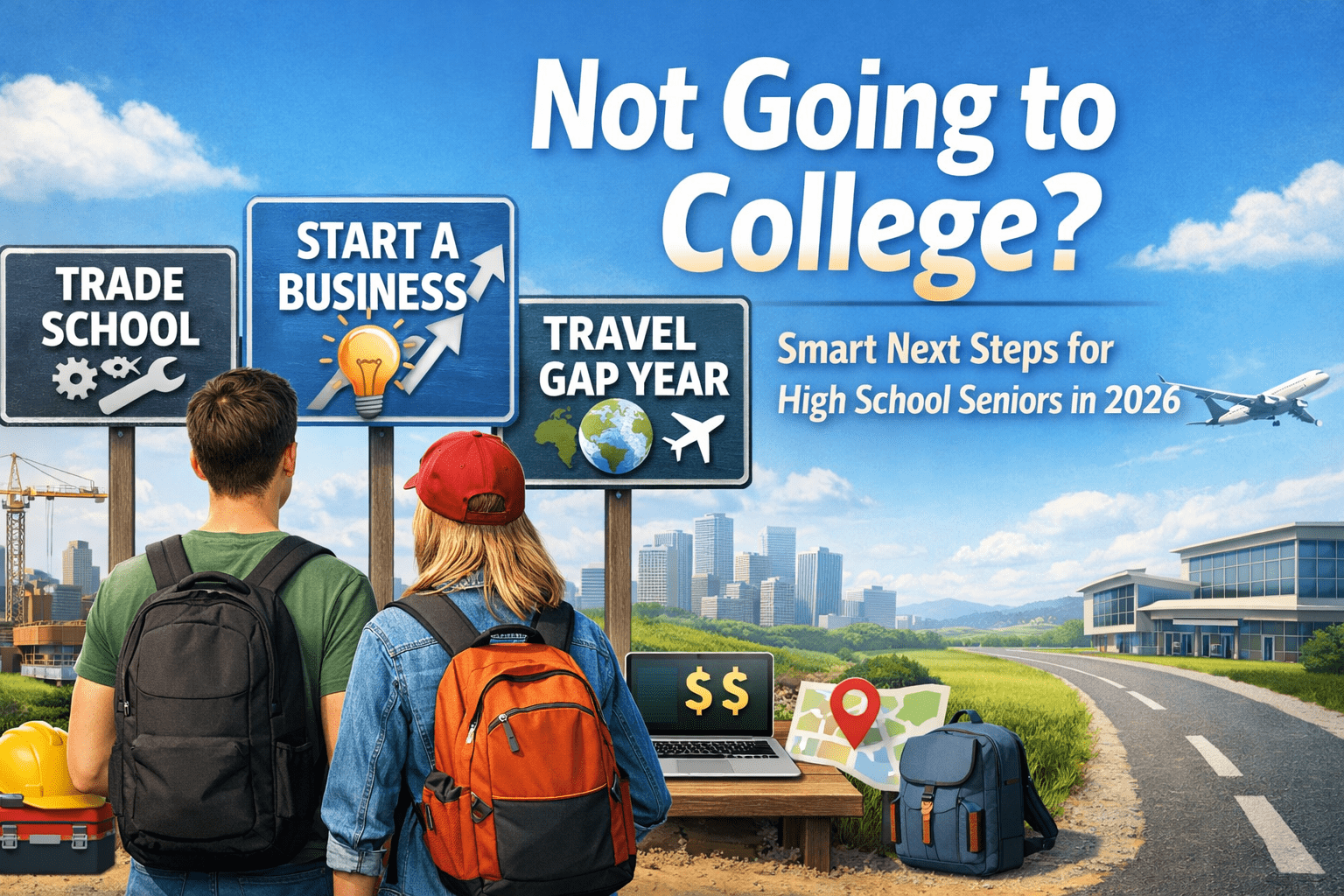
Not going to college right after high school does not mean you are failing, falling behind, or giving up on your future. It means you need a plan that is just as serious as a college plan. The real question is not “college or no college.” The real question is: What are you doing next that builds skills, income, and options?
This matters because college is still the most common path, but it is not the only one. The National Center for Education Statistics says that of the 3.0 million students who finished high school in the first 9 months of 2022, about 1.9 million, or 62%, enrolled in college by October. That also means roughly 38% did not enroll immediately. So if you are not going to college right away, you are not alone.
At the same time, “not going to college” should never become “doing nothing.” NCES warns that young adults who are neither enrolled in school nor working can have a harder time building a work history that leads to future employability and higher wages. That is the key idea for seniors: skipping college can work, but drifting usually does not.
What the data really says about skipping college
The most honest answer is this: on average, more education still pays more. According to the U.S. Bureau of Labor Statistics, median usual weekly earnings in 2024 were $930 for workers with only a high school diploma, $1,020 for those with some college but no degree, $1,099 for associate degree holders, and $1,543 for bachelor’s degree holders. Unemployment rates also generally fell as education levels rose. That does not mean every bachelor’s degree beats every non-college path. It does mean that if you skip college, you need another way to prove skill, discipline, and value to employers.
BLS also reports that occupations requiring more education for entry are projected to grow faster overall than average. So the goal is not to pretend college never helps. The goal is to choose a path that gives you a real return: a credential, a license, an apprenticeship completion certificate, a military training record, a portfolio, or paid experience that employers trust.
There is also a short-term transition risk that students often underestimate. In October 2024, recent high school graduates ages 16 to 24 who were not enrolled in college had a labor-force participation rate of 66.4%, but their unemployment rate was 20.4%. That does not mean skipping college causes unemployment forever. It does mean the months right after graduation can be unstable if you do not already have a plan lined up.
Why some students choose not to go to college
For many seniors, the decision is practical. Some want to start earning money immediately. Some do not want student debt. Some are burned out after high school and want a different type of learning. Some want hands-on work, not lecture halls. Some are unsure about a major and do not want to spend thousands of dollars “figuring it out” on campus. Those reasons are understandable. What matters is whether your next step creates momentum instead of closing doors.
Cost is part of that conversation. College Board reports that average published 2025–26 tuition and fees are $11,950 for public four-year in-state students, $31,880 for public four-year out-of-state students, $4,150 for public two-year in-district students, and $45,000 for private nonprofit four-year students. Those are sticker prices, not always what families actually pay, but they explain why many seniors hesitate.
Debt is part of the picture too. The Federal Reserve reported that in 2024, 42% of 18- to 29-year-olds who had at least attended college had taken on student loan debt. Among borrowers with outstanding debt for their own education, the median amount was between $20,000 and $24,999. That does not make college a bad investment by itself, but it does make careful decision-making necessary.
Still, there is an important correction to the “college is always unaffordable” story. College Board says the majority of full-time undergraduates receive grant aid, and that at public two-year colleges, first-time full-time students have, on average, been receiving enough grant aid to cover tuition and fees since 2009–10. In other words, some students reject college based on sticker price when their real price could be much lower.
The smartest alternatives to college
1) Registered apprenticeship
For many students, this is the strongest non-college option. Apprenticeship.gov defines a Registered Apprenticeship as an industry-driven pathway where you get paid work experience, a mentor, progressive wage increases, classroom instruction, and a portable, nationally recognized credential. That combination matters because you are not just working a job. You are building a recognized career pathway.
Apprenticeship.gov says there are 800,000+ apprentices annually across the nation. The same site also advertises an average starting salary of $80,000 after completion and 90% employment retention, while noting those figures are based on Kansas Department of Commerce reporting. That means the numbers should be read as promising, but not as a guarantee for every field or every state.
If you like construction, manufacturing, utilities, transportation, technology, or other hands-on career tracks, apprenticeship deserves serious attention. For example, the Occupational Outlook Handbook says electricians had a median annual wage of $62,350 in May 2024, with projected employment growth of 9% from 2024 to 2034 and about 81,000 openings each year on average. That is exactly the kind of occupation where structured training can outperform a random entry-level job.
Official places to start:
Apprenticeship Finder
Become an Apprentice
2) Career school, trade school, or short-term technical training
A lot of seniors say “I’m not going to college” when what they really mean is “I’m not going to a traditional four-year campus.” Those are not the same thing. Short-term certificate programs, career schools, and technical programs can lead to jobs in health care, IT, HVAC, welding, automotive repair, cosmetology, public safety, and more. The right program can be much shorter than a bachelor’s degree and much more directly tied to a specific job.
Federal Student Aid is not just for four-year universities. The U.S. Department of Education says federal student aid can help pay for college, career school, or trade school, and Pell Grant funds can be used at eligible community colleges, career schools, trade schools, online schools, and four-year colleges and universities. So even if you are not going to a traditional college, you may still want to file the FAFSA if you are considering an eligible training program.
If your main goal is speed, this path can make sense. But be careful: not every short program is worth the money. Check completion rates, licensing pass rates if relevant, total cost, job placement, and expected starting pay before signing anything. A short bad program is still a bad investment. That is why official training finders and state-approved training lists matter.
Official places to start:
Federal Student Aid
WIOA-Eligible Training Program Finder
3) Community college as a low-cost “not now, maybe later” strategy
Some students should not go straight to a four-year college, but they also should not close the door on higher education entirely. Community college can work as a lower-risk way to earn credits, complete a vocational associate degree, or get a certificate while staying closer to home and paying less. College Board’s 2025–26 average published tuition and fees for public two-year in-district students is $4,150, much lower than public or private four-year sticker prices.
The employment numbers for recent associate degree recipients are also worth noticing. BLS reported that among 20- to 29-year-olds who earned an associate degree between January and October 2024, 78.1% were employed in October 2024 and the unemployment rate was 2.1%. That does not mean every associate degree is a gold mine, but it does show that shorter, targeted postsecondary education can have strong labor-market value.
So if you are saying “I’m not going to college,” make sure you know whether you mean never, not right now, or not four-year residential college. Those are very different choices with very different consequences.
4) Job Corps and publicly supported training
If money, housing, or life circumstances are major barriers, Job Corps may be worth a look. Job Corps says it is the nation’s largest free, residential career training and education program for low-income young adults ages 16 through 24. The program offers hands-on training in fields such as manufacturing, health care, technology, and construction.
This option is especially important for seniors who want structure and training but do not have strong family financial support or a clear local opportunity. A free residential training program is very different from just “getting a job somewhere.” It can create stability, routine, and a path into employment or further training.
Official place to start:
Job Corps
5) Full-time work with a real advancement plan
Taking a job right after high school is not automatically a bad move. It becomes a bad move only when the job has no training, no wage progression, no transferable skills, and no real ladder upward. If you go directly into work, you want one of three things: employer-paid training, a clear promotion pathway, or experience that can later turn into a license, certification, apprenticeship, or management role.
The Occupational Outlook Handbook and BLS Occupation Finder exist for this exact reason. They let you compare jobs by typical entry-level education, pay range, growth outlook, and training needed. BLS shows that many occupations can be entered with a high school diploma or a postsecondary nondegree award, but the key is to choose fields with stable demand instead of dead-end churn.
A useful rule for seniors is this: do not accept a low-wage job just because it is available; accept a starting job only if you can explain how it becomes a better job in 12 to 24 months. That is an inference from the data, but it fits what the labor-market evidence is telling you.
Official places to start:
Occupational Outlook Handbook
Occupation Finder
6) National service or the military
Service paths are another alternative, but they should be chosen with open eyes, not just because you feel stuck. AmeriCorps says that after successfully completing a term of service, eligible alumni can receive a Segal AmeriCorps Education Award that can be used for future education costs at qualified institutions or to repay qualified student loans, and the award generally must be used within seven years of the end of service.
The VA says GI Bill benefits help qualifying servicemembers, veterans, and families pay for school and cover expenses while they are training for a job, not only while attending college. The VA also states that veterans may use benefits in approved on-the-job training and apprenticeship programs. That means military service can create future education and training options, but it is a serious commitment and should never be treated like a casual financial-aid hack.
Official places to start:
AmeriCorps
GI Bill Benefits
7) Entrepreneurship, but only with support
Some seniors are wired for business. They want to freelance, start a service company, sell online, or build something small and local first. That can work, but “be your own boss” is often romanticized. Good entrepreneurship is not just hustle. It is budgeting, customer acquisition, compliance, taxes, and learning from experienced people.
The good news is that official support exists. SBA says its network and partners offer free or low-cost counseling and training, including through Small Business Development Centers and SCORE mentors. So if you want to skip college and try business, do not do it alone. Use the free help that already exists.
Official places to start:
SBA Local Assistance
SBA Resource Partners
How to know whether not going to college is the right decision
Ask yourself four questions:
1. What am I doing instead?
If your answer is vague, the plan is weak. “I’ll work for now” is not a plan. “I’ll start a registered apprenticeship in electrical work” is a plan.
2. What skill or credential will I have in 12 months?
If the answer is “none,” you are probably trading short-term comfort for long-term risk. BLS and NCES data both suggest that structured training and work history matter.
3. What will this path cost me, and what will it likely pay?
That means comparing tuition, tools, transportation, lost earnings, and expected wages. Use official career databases, not TikTok guesses.
4. Does this path keep doors open?
The best non-college plans usually keep future choices alive. Apprenticeship, technical training, service, and community college can all preserve future education options better than drifting through random jobs.
A practical 90-day plan after graduation
If you are not going to college, your first three months matter a lot.
First 2 weeks: take a career interest assessment, list three target careers, and compare them on pay, training time, and job outlook. CareerOneStop’s GetMyFuture is built for ages 16 to 24 and offers free career, training, and job-search resources.
Weeks 3 to 4: apply to at least one structured path, such as an apprenticeship, a technical program, Job Corps, AmeriCorps, or a full-time job with training. Do not wait for motivation to magically appear. Build a schedule.
Month 2: if you may attend any eligible career, trade, or community-college program, file the FAFSA. Federal aid may still apply even if you are not headed to a traditional four-year school.
Month 3: set a measurable checkpoint. You should know your work schedule, income, training plan, next credential, and six-month goal. If you cannot explain those in one paragraph, your plan needs revision. This is an inference, but it matches what the transition data suggests about the risk of unstructured time after high school.
Final answer: Is it okay to not go to college?
Yes. It is okay to not go to college.
But it is not okay to confuse freedom with lack of direction.
The strongest non-college futures usually have three traits:
-
You are learning something that employers value.
-
You are building a track record or credential.
-
You are keeping future options open.
If college is not your next step, make sure growth still is. The students who do best without college are usually not the ones who reject education. They are the ones who choose a different form of education: apprenticeship, technical training, service, supervised work experience, or disciplined entrepreneurship. That is the real lesson from the data.
Official resources for students
FAQ
Is not going to college a bad idea?
Not automatically. It is a bad idea only if you do not replace college with another serious path to skills, work experience, or credentials.
Can I still get financial aid if I am not going to a four-year college?
Yes, if you attend an eligible community college, career school, or trade school. Federal Student Aid explicitly says aid can be used for college, career school, or trade school, and Pell Grants can be used at eligible community colleges, career schools, trade schools, online schools, and four-year institutions.
What is the best alternative to college?
For many students, the best alternatives are registered apprenticeship, high-quality technical training, community college with a career focus, Job Corps, service programs, or a job with structured advancement. The best choice depends on your interests, local opportunities, cost, and time to a credential.
Can I go to college later if I change my mind?
Yes. In fact, some students are better off going later, after they have clearer goals, work experience, savings, or a specific career reason to enroll. The important thing is to avoid losing momentum in the meantime.
Is community college still worth considering if I say I am not going to college?
Yes, because many students who reject a four-year residential college are still a good fit for a lower-cost, shorter, more career-focused two-year option. Recent associate degree recipients had strong employment outcomes in the latest BLS release.