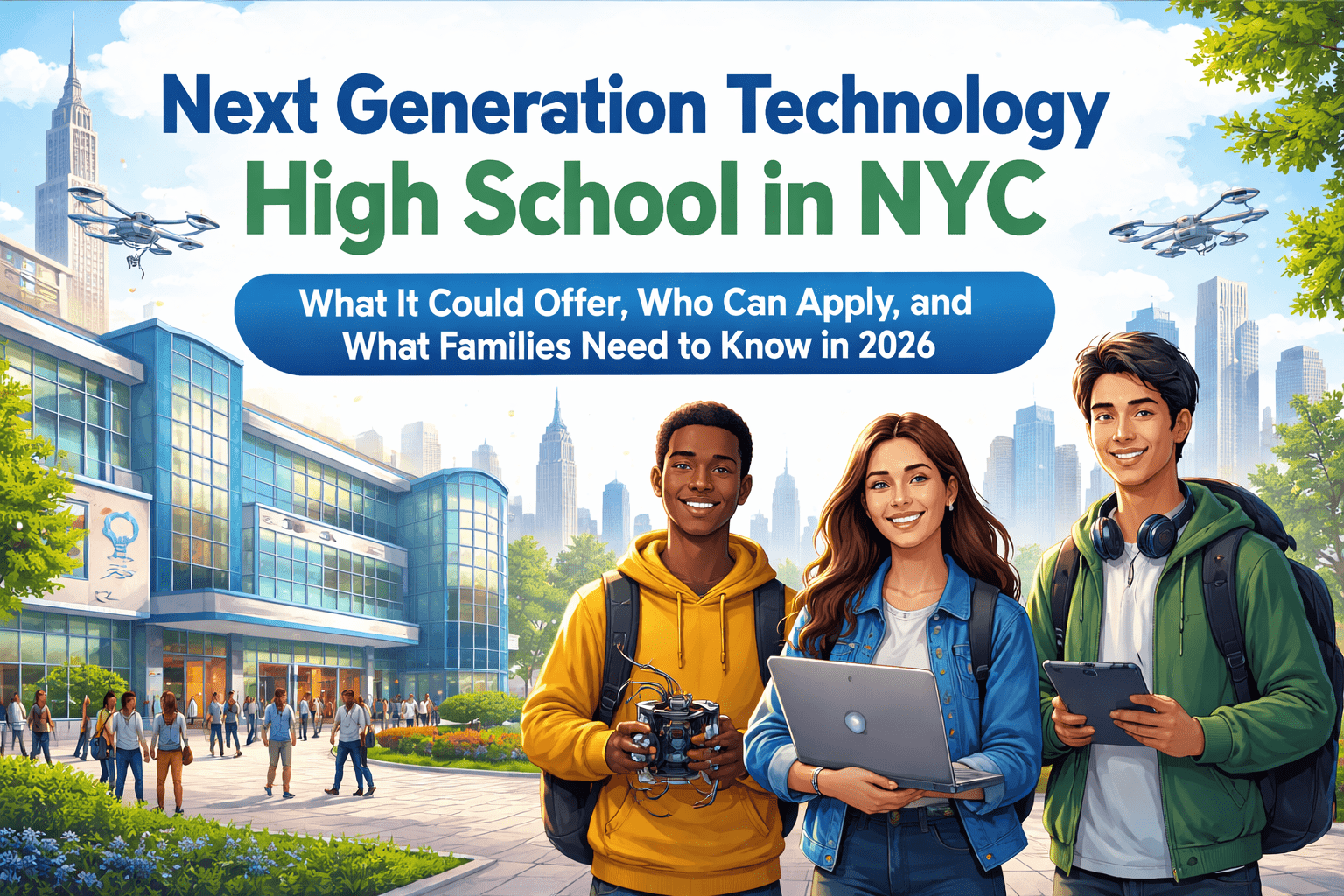
Next Generation Technology High School is one of the most closely watched new-school proposals in New York City right now because it would create an AI- and technology-focused public high school in Lower Manhattan. But families should understand one big fact first: as of March 16, 2026, this school is still proposed, not fully approved. NYC Public Schools has scheduled a public hearing for April 14, 2026 and lists the proposal for a Panel for Educational Policy vote on April 29, 2026. The school’s own admissions page says it is anticipated to open in Fall 2026 pending PEP approval.
For students who love math, coding, design, and problem-solving, this proposal is important. If approved, Next Generation Technology High School would be a New York City public high school serving grades 9–12, starting with a 9th-grade opening in September 2026 under school code 02M426. School-run materials list a capacity at scale of about 450–500 students and describe a mission centered on advanced engineering, civic leadership, and “ethical technological literacy,” meaning students would be taught not just how to use technology, but how to think critically about its social impact.
Quick answer: what is this school?
Next Generation Technology High School is a proposed screened-admissions NYC public high school planned for Lower Manhattan. NYC Public Schools says the proposal would place it in Building M282 alongside Richard R. Green High School of Teaching and Lower Manhattan Community Middle School. Chalkbeat reported that the building is at 26 Broadway and described the school as the city’s first public school proposal with a curriculum focused on AI and computer science.
What the school says it will offer
The school’s official admissions page says the academic program would emphasize advanced mathematics, computer science, and real-world project-based learning. It also says students would be prepared not only to use technology, but to understand, build, and govern it responsibly. That matters because many schools teach digital tools, but fewer explicitly combine technical skill with ethics, public policy, and community problem-solving.
According to the school’s posted materials, students could expect CTE-aligned pathways, chances to earn industry-facing credentials, and a senior-style culminating project tied to real community needs. The admissions page specifically mentions certifications such as Python, Google Cloud, and other digital-literacy and technical credentials. It also advertises extracurriculars, leadership opportunities, and creative options such as Digital Audio Production, plus language study in Mandarin, Spanish, and Japanese.
The proposal materials posted by the school go even further. In its interest form, the founding team says students would learn through a competency-based, collaborative, and project-based model; earn college credit; conduct research with industry partnerships; and graduate ready to create technology for the public good. Because those details come from the school’s proposal materials rather than a final approved city program guide, families should read them as planned offerings, not yet guaranteed final program features.
Chalkbeat also reported that school leaders said the program would use Google’s new Skills platform and that the school hopes to create a summer internship program with Carnegie Mellon University. Google’s own platform describes Google Skills as a place where learners can build skills, earn badges, and pursue certificates and certifications, while Carnegie Mellon officially runs pre-college programs for high school students in areas including AI Scholars, CS Scholars, computational biology, and math and science. That does not prove a finalized CMU partnership contract, but it does show that the type of high-school tech enrichment mentioned publicly is consistent with real existing programs at both organizations.
Who could apply?
The school’s interest form is aimed at current 8th grade students and families, and its admissions page says students will be able to apply through the New Schools Application in MySchools. The posted dates are:
-
Application opens: March 19, 2026
-
Application closes: April 17, 2026
-
Offers released: May 4, 2026
That timing is unusual because it comes after the main NYC high school offer release on March 5, 2026. In other words, this appears to be a special late-round option for students who want to reconsider their placement or explore a newly proposed school.
What are the qualifications for enrollment?
The biggest admissions fact confirmed so far is that the school is listed in its own materials as Screened Admissions. In NYC, screened programs use a student’s academic record rather than the SHSAT. Under the city’s Fall 2026 screened-admissions rules, students are grouped based on the average of their final 7th-grade core course grades in ELA, math, science, and social studies. Offers start with the highest-performing group, and if there are more applicants than seats inside a group, the city uses a random number as a tiebreaker.
For Fall 2026, NYC Public Schools says the citywide grade benchmarks for screened groups begin at these levels:
-
Top 15% (Group 1): 94.33 average
-
Top 30% (Group 2): 90.25 average
-
Top 50% (Group 3): 83.33 average
-
Top 70% (Group 4): 76.67 average
That does not mean Next Generation Technology High School will automatically require a 94+ average. It means that, under NYC’s screened-admissions system, grades matter and students are sorted into citywide groups before offers are made. The exact competitiveness of this school will depend on how many students apply and how the program is finally posted in MySchools.
Just as important, the school is not currently listed on NYC Public Schools’ public page of screened high schools using additional assessments for 2026 admissions. As of March 16, 2026, that means there is no publicly posted school-specific essay, interview, or exam requirement for Next Generation Tech on the city’s assessment page. Families should still watch the eventual MySchools listing carefully in case the final program page adds more detail.
What is confirmed, and what is still uncertain?
Here is the most accurate way to think about the school right now.
Confirmed or officially posted: it is a proposed NYC public high school; it would serve grades 9–12; it is tied to school code 02M426; it is planned to open with 9th grade in September 2026 if approved; it is using a March 19–April 17 special application window; and the city has scheduled a public hearing on April 14 and a PEP vote on April 29.
Proposed but not yet final: the exact curriculum mix, the depth of AI instruction, the final role of Google learning tools, the structure of industry partnerships, and the possible Carnegie Mellon-linked summer opportunity. Chalkbeat reported that even the amount of AI-powered Google coursework was still in flux based on the educational impact statement.
Still unclear for families: how a screened school opening after the main admissions cycle will handle final ranking details, and whether any school-specific selection activity will appear later. Chalkbeat reported that NYC’s Office of District Planning did not answer questions about how screening requirements would work for this fall.
Why this kind of school is being proposed now
The labor-market logic behind a technology-focused school is real. The U.S. Bureau of Labor Statistics says the median annual wage for the broader computer and information technology occupations group was $105,990 in May 2024, compared with $49,500 for all occupations overall. BLS also projects 15% growth from 2024 to 2034 for software developers, QA analysts, and testers, and 34% growth for data scientists over the same period.
That does not mean every student should rush into AI just because job growth is strong. But it does help explain why school systems, colleges, and training providers are moving quickly to build computer science, data, cloud, and AI pathways. Google’s official training materials emphasize certificates, skill badges, and industry-recognized certifications, and Google says some of its career-certificate pathways can connect learners with more than 150 U.S. employers and may even carry college-credit recommendations through ACE.
Why some families are pushing back
A strong article on this topic should also include the controversy, because that is part of the real story. Chalkbeat and Gothamist both reported concern from Manhattan families and education advocates about the speed of the rollout, the building location, and the role of private technology companies in shaping curriculum. Gothamist also reported that NYC had not yet finalized broader AI guidance for schools even as the city considered an AI-focused high school proposal.
That means students and parents should avoid two extremes. This is not just hype with no substance; the proposal contains concrete dates, admissions steps, and academic themes. But it is also not a finished school with every detail locked in. The smartest reading is that this is a serious public-school proposal with real momentum, paired with real unanswered questions.
Is Next Generation Technology High School a good fit?
This school could be a strong fit for a student who:
-
enjoys math, coding, engineering, design, or problem-solving
-
wants a project-based rather than lecture-heavy environment
-
is interested in technology ethics, not just technology use
-
likes the idea of combining technical skills with real community projects
-
is competitive enough for a screened-admissions environment
It may be a weaker fit for a student who wants a traditional liberal-arts high school, dislikes selective admissions pressure, or wants a school with a long public track record, because this proposal is brand-new and still pending approval.
Best practical advice for families
If you are advising students on whether to apply, the most practical guidance is this: treat Next Generation Technology High School as a high-upside but still developing option. If approved, it could become one of NYC’s most distinctive public high school pathways for students interested in AI, coding, cloud tools, and ethical technology. But because it is new, students should compare it carefully against more established screened or STEM programs already in MySchools.
Families should especially verify four things before making a final choice: the final MySchools program page, the exact screening method, the confirmed course sequence, and the concrete details of any college-credit or industry-partnership claims. Those are the details that separate a promising concept from a fully defined high school program.
Official and legitimate resources
For WordPress readers, these are the most useful legitimate sources to check:
-
Next Generation Technology High School admissions page for the school’s own description of courses, credentials, and application dates.
-
Next Generation Technology High School interest form for proposal details such as DBN, capacity, screened-admissions status, and opening year.
-
NYC Public Schools high school admissions page for the broader Fall 2026 admissions calendar.
-
NYC Public Schools screened admissions page for how grades are used in screened admissions.
-
NYC Public Schools proposal page for the April 14, 2026 hearing and April 29, 2026 vote schedule.
-
Google Skills official site for the type of certificates, badges, and certifications school leaders say they want to connect students to.
-
Carnegie Mellon Pre-College Programs for examples of real tech-focused high school summer learning opportunities at CMU.
FAQ
Is Next Generation Technology High School officially open?
No. As of March 16, 2026, it is still a proposed school pending NYC approval. The public hearing is set for April 14, 2026, and the proposal is listed for a April 29, 2026 PEP vote.
What grade will it start with?
The posted materials say the school would open with 9th grade in September 2026 and grow into a grades 9–12 high school.
Is this a specialized high school?
No current posted materials describe it as a Specialized High School. The school’s own materials say Screened Admissions, which is a different NYC admissions method from the SHSAT-based specialized-school process.
What subjects would students study?
The school says it would focus on advanced math, computer science, project-based applications, CTE-aligned pathways, industry-facing credentials, and ethics-centered technology learning, along with extracurriculars and creative options such as Digital Audio Production.
What should students have to be competitive?
Because it is a screened school, strong 7th-grade core-course averages matter under NYC’s admissions rules. There is no publicly posted school-specific assessment for this program on the city’s current 2026 screened-school assessment page.
Bottom line
Next Generation Technology High School is one of the most ambitious public-school ideas now on the table in New York City. If approved, it could give students a rare chance to study AI, computer science, cloud tools, advanced math, and technology ethics inside a public high school setting. But the responsible way to cover it in 2026 is to be precise: the vision is bold, the application window is real, and the approval is still pending.
If you want, I can turn this into an even more SEO-focused WordPress version with a meta title, meta description, excerpt, FAQ schema, and slug.