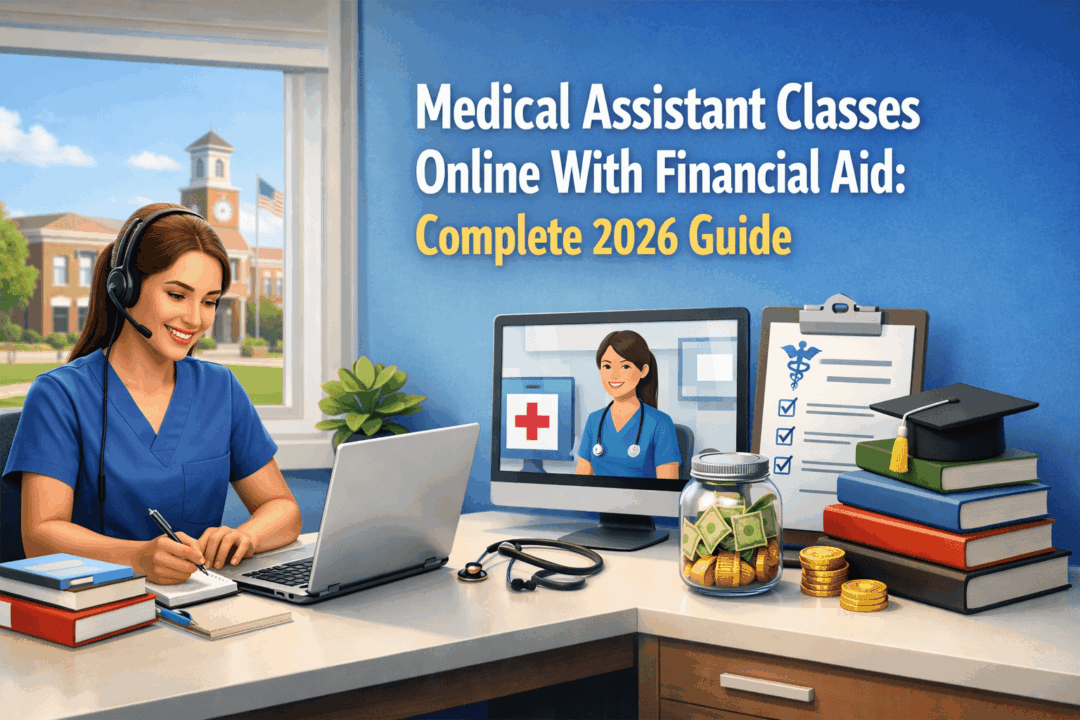
Medical Assistant Classes Online With Financial Aid: Complete 2026 Guide
If you are a high school senior searching for medical assistant classes online with financial aid, the most important truth is this: good programs are usually online for the lecture part, but not fully online for the whole training. Legit medical assistant programs typically include hands-on learning, labs, or a supervised practicum/externship because the job involves real clinical and administrative skills. The U.S. Bureau of Labor Statistics says medical assistants usually complete a postsecondary certificate or associate program, often in 1–2 years, and those programs typically include supervised experience such as a practicum or internship. In the CAAHEP pathway, MAERB standards require at least 160 contact hours of supervised practicum in a healthcare setting.
That matters because employers often want graduates who can do more than pass online quizzes. They want people who can take vital signs, work with patient charts, communicate professionally, and function safely in a clinic. It also matters for certification. The American Association of Medical Assistants says candidates for the CMA (AAMA) exam generally must graduate from a CAAHEP- or ABHES-accredited medical assisting program.
The short answer
Yes, financial aid is available for many online or hybrid medical assistant programs, but only if the school and program are eligible. Federal Student Aid says the FAFSA gives students access to federal grants, work-study, and loans for college, career school, or trade school. For the 2026–27 award year, the maximum Federal Pell Grant is $7,395, and some students may qualify for up to 150% of their annual Pell amount if they attend an additional term in the same year.
Why this career gets so much attention
Medical assisting is one of the bigger entry points into healthcare because the training is shorter than a nursing degree, the work is broad, and the labor market is strong. BLS reports that medical assistants held about 811,000 jobs in 2024, had a median annual wage of $44,200 in May 2024, and are projected to grow 12% from 2024 to 2034, with about 112,300 openings per year on average.
For students who want a healthcare career without spending four years in college first, that combination matters. It means the field is large enough to hire a lot of new workers, and the training path is short enough that the cost-benefit question becomes very important. That is exactly why students should care about accreditation, total cost, debt, and job outcomes before enrolling.
What “online medical assistant classes” usually really means
A strong program often looks like this:
-
Online theory classes for topics like medical terminology, anatomy, billing, coding basics, law and ethics, and office procedures.
-
Skills training in labs or supervised settings.
-
Externship or practicum in a real clinic, medical office, or healthcare setting.
-
Sometimes exam preparation for certification.
So when a school says “online medical assistant program,” read that as “online or hybrid” unless the school clearly explains how clinical skills are taught and where the practicum happens. If the school cannot clearly explain where you will complete your hands-on training, that is a warning sign.
How financial aid works for these programs
The FAFSA is the starting point. Federal Student Aid says completing the FAFSA is free and opens access to the largest source of federal student aid, including grants, work-study, and federal student loans. State aid, schools, and some private aid providers also use FAFSA information. The 2026–27 FAFSA can be submitted for federal aid as early as October 1, 2025, while some state or school deadlines may also be as early as that date.
For a medical assistant student, the normal order of smart funding is:
-
Grants and scholarships first
-
Work-study second
-
Federal student loans next
-
Private loans last
That order matters because grants usually do not have to be repaid, work-study can reduce borrowing, and federal loans usually come with more protections than private loans. Federal Student Aid materials say federal loans often have lower fixed rates, flexible repayment, and added benefits compared with private loans, while private loans are more like bank loans and can depend on credit.
The biggest mistake students make
The biggest mistake is assuming that if a school is online, it must be flexible and affordable, or that if a school advertises financial aid, the whole program is automatically a good deal. That is not how it works.
Federal Student Aid recommends using College Scorecard to compare schools on:
-
average annual cost
-
graduation rate
-
debt and repayment
-
typical earnings after enrollment
That advice is especially important for short healthcare certificates, where the program may look fast and convenient but still leave students with more debt than the credential is worth. The right question is not just “Can I get aid?” The better question is “How much will I still owe after aid, and what do graduates usually earn?”
How to tell whether an online medical assistant program is legit
A program is much more trustworthy if you can verify all of these:
1. The program is accredited by a recognized body
For medical assisting, two names matter a lot:
-
CAAHEP
-
ABHES
2. The program’s graduates qualify for certification pathways you care about
The AAMA says CMA (AAMA) eligibility generally requires graduating from a CAAHEP- or ABHES-accredited medical assisting program.
3. The school appears in federal consumer tools
Use College Scorecard and College Navigator to review the school’s cost, graduation information, financial aid data, and other consumer information. Federal Student Aid says College Scorecard was designed to answer questions about costs, graduation, debt, and earnings; FTC consumer guidance also points students to College Navigator when verifying whether a school or certificate program is real and accredited.
4. The school clearly explains the practicum
If the program is online, it should still tell you:
-
where externships happen
-
whether the school arranges them or you must find them yourself
-
what happens if no local site accepts you
-
whether extra travel is required
Red flags that should make you stop and verify
The FTC warns that many scam or low-value education offers use tactics like unrealistic speed, weak academics, or fake credibility. Be careful if a school says:
-
you can finish with almost no real coursework
-
you can earn the credential mainly from “life experience”
-
you can complete the program unbelievably fast
-
the sales staff pressures you to enroll right away
-
the accreditor sounds unfamiliar and cannot be independently verified
For medical assistant training specifically, another red flag is a school that cannot clearly explain how clinical skills are taught or whether graduates are eligible for major certification pathways.
What high school seniors should do before applying
Start with this simple process:
Step 1: File the FAFSA early
Use the FAFSA as soon as possible after it opens for your school year. It is free, and some aid is limited or deadline-sensitive.
Step 2: Make a short list of programs
Look for online or hybrid medical assistant programs at community colleges, technical colleges, and career schools. Then verify them using CAAHEP, ABHES, College Scorecard, and College Navigator.
Step 3: Ask the admissions or financial aid office these questions
Ask:
-
Is this exact medical assistant certificate or degree eligible for federal aid?
-
Is the program fully online, or hybrid?
-
Where is the practicum completed?
-
Are there extra fees for scrubs, immunizations, labs, insurance, background checks, or certification exams?
-
What percentage of students graduate?
-
What do students typically borrow?
-
Do graduates sit for certification exams?
Step 4: Compare net cost, not sticker price
Federal Student Aid says average annual cost is the sticker price minus grants and scholarships. That is closer to what students actually pay out of pocket.
Step 5: Borrow carefully
Use grants and scholarships first. If you still need loans, federal student loans are usually a safer first stop than private loans because of their repayment protections and borrower benefits.
Best-fit advice for this topic
For most students, the strongest value is usually found in one of these paths:
Community college or public technical college path: often lower cost, more transparent public data, and a better chance of limiting debt. Use College Scorecard to compare total cost and outcomes.
Accredited career-school path: can be faster and more flexible, but it needs extra scrutiny on debt, externship placement, and certification eligibility. That is where CAAHEP, ABHES, College Scorecard, and College Navigator become essential.
The worst path is choosing a school based only on ads, speed, or the phrase “financial aid available.” That phrase only tells you aid may exist. It does not prove the program is affordable, accredited, or worth the debt.
FAQ
Can I become a medical assistant fully online?
Usually, not in the strongest sense of the word. Coursework may be online, but legitimate training usually includes a supervised practicum, internship, or other hands-on experience.
Can online medical assistant students get Pell Grants?
Yes, students at eligible schools and programs may qualify. For 2026–27, the maximum Pell Grant is $7,395.
Do I need accreditation?
Yes, it is one of the smartest filters you can use. Accreditation can affect quality, transferability, and certification options. For CMA (AAMA), CAAHEP or ABHES accreditation is especially important.
How long do medical assistant programs take?
BLS says they often take about 1 or 2 years, depending on whether the student is in a certificate or associate pathway.
Are private loans a good idea for a short certificate?
Only after you understand your grants, scholarships, and federal loan options. Private loans are more like bank loans and can depend on credit, so they should usually be a later option, not the first option.
Official websites to use
Bottom line
The smartest version of this search is not “Which online medical assistant school says it has financial aid?” It is:
Which accredited online or hybrid medical assistant program has real hands-on training, qualifies students for certification, offers federal aid, and leaves graduates with manageable debt relative to earnings?
That is the version of the question that protects students.