Ivy Day 2026: Expected Date, Time, and What High School Seniors Should Know
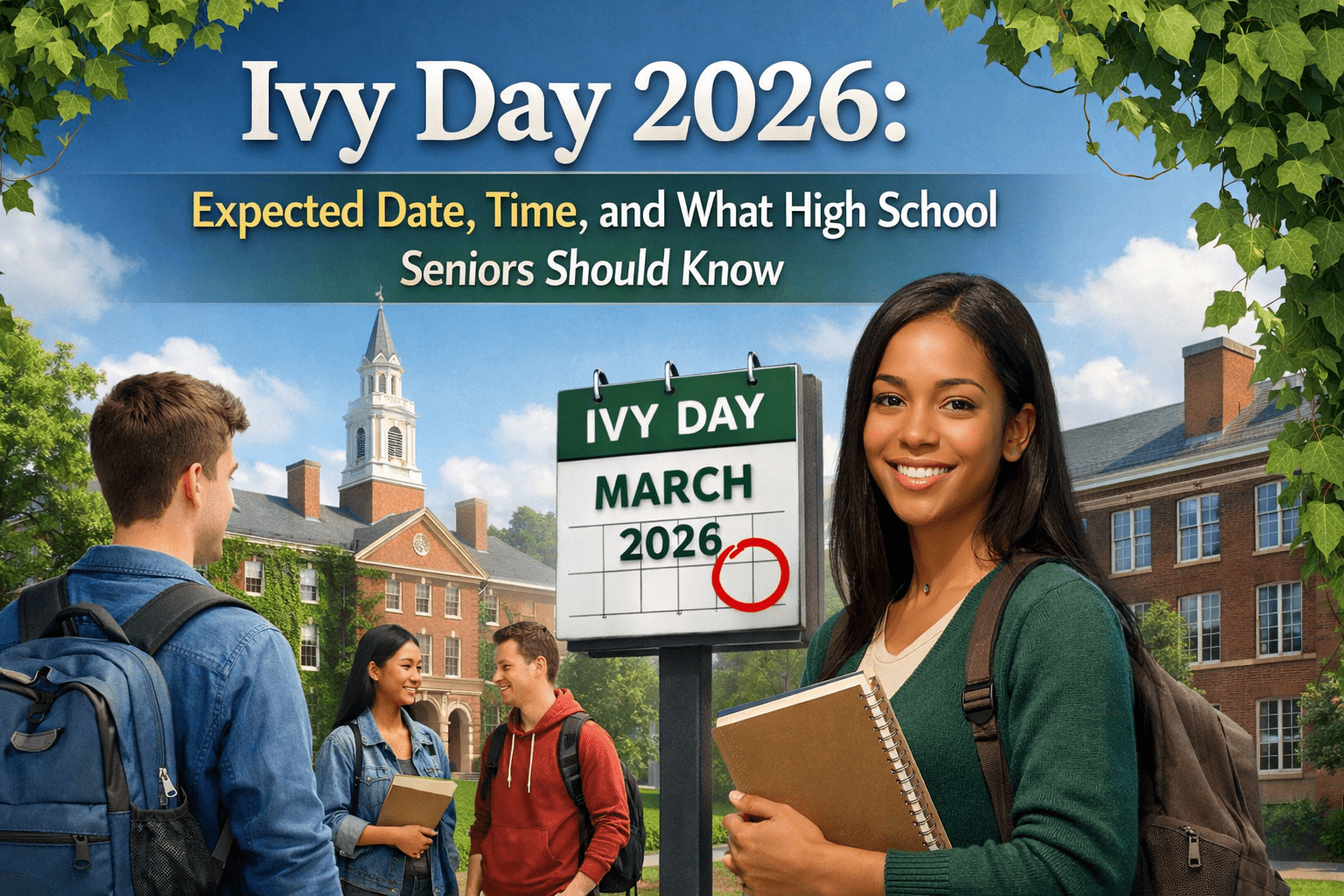
For students waiting on Ivy League regular decision results, the best-supported answer right now is this: Ivy Day 2026 is most likely Thursday, March 26, 2026, in the evening Eastern Time. But there is an important nuance. As of March 17, 2026, most Ivy schools’ public admissions pages still describe their release window only as “late March,” “end of March,” or “early April,” rather than posting one universal public date on every site. What is officially clear is that Ivy schools coordinate a common notification date, usually in late March, and admitted students generally have until May 1 to reply.
In plain English, that means students should treat March 26, 2026 as the leading expectation for Ivy Day, but keep checking their applicant portals and email because some schools do not publicly pin down the exact hour until closer to release. Dartmouth says regular decision applicants will get an email in late March with the date and time their decision will be available, and Penn says all official decisions are released through the applicant portal. Current admissions trackers and date roundups also point to March 26 and generally expect an evening ET release.
What Ivy Day means
“Ivy Day” is the nickname for the day the eight Ivy League schools release their regular decision results together: Brown, Columbia, Cornell, Dartmouth, Harvard, Penn, Princeton, and Yale. Yale’s admissions volunteer guide states that, by agreement, all eight Ivy schools release decisions online on the same day, usually at the end of March. Penn’s admissions material says Ivy applicants are notified on a common date, usually in late March, and that decisions and financial aid awards are released then.
That coordinated release is why “Ivy Day” matters so much. It is not a separate application or a separate admissions round. It is simply the moment when many seniors learn whether they were admitted, waitlisted, or denied at some of the most selective colleges in the country. Princeton, Cornell, Yale, and Penn all publicly describe those core regular-decision outcomes on their admissions pages.
Why March 26, 2026 is the strongest current prediction
The strongest evidence comes from three places. First, Ivy schools coordinate a common late-March release. Second, the official Ivy notification date in 2025 was Thursday, March 27, 2025, as shown in official Brown, Dartmouth, Cornell, Yale, and Penn releases. Third, current 2026 decision trackers report Thursday, March 26, 2026 for this cycle, with Ivywise specifically noting that Yale, Dartmouth, and Penn have announced that date. Put together, that makes March 26 the most defensible working date for students and families right now.
School-by-school status for Ivy Day 2026
Here is the cleanest school-by-school reading of what is public right now:
-
Brown: Regular decision applicants receive a decision by early April. Brown’s application checklist also says regular decision letters are available online in late March.
-
Columbia: The admissions calendar says late March for regular decision admissions and financial aid decisions, with a May 1 response deadline.
-
Cornell: Regular decision applicants learn their admission decision by early April, and students who filed for aid receive a financial aid award at the time of admission.
-
Dartmouth: Regular decision applicants receive an admission decision by late March or early April, and applicants get an email in late March telling them the date and time their decision will be available.
-
Harvard: Regular decision applicants are notified by the end of March.
-
Penn: Regular decision applicants hear in late March through the applicant portal. Penn also notes that Ivy League regular decision notifications and financial aid awards come on a common date, usually in late March.
-
Princeton: The admissions calendar says late March for decision notification, and students who completed the Princeton Financial Aid Application are notified of any aid award at the time of admission.
-
Yale: Regular decision materials say decisions are released at the end of March, and applicants may be admitted, denied, or placed on the waiting list.
What time do Ivy decisions usually come out?
The safest answer is that the exact time is not yet uniformly posted on official public pages. Dartmouth explicitly says students will receive an email telling them the date and time. That said, the current outside consensus is evening Eastern Time, often around 7:00 p.m. ET. Brown’s official Class of 2029 release also noted that applicants began logging in at 7 p.m. Eastern on March 27, 2025. So evening ET is the best expectation, but students should trust the email or portal notice from each college over any rumor thread.
How competitive Ivy admissions remain
One reason Ivy Day feels so intense is simple: the competition is extraordinary. Recent official class data show Harvard reporting 47,893 applicants and 2,003 admitted for the Class of 2029; Yale reporting 50,228 applicants and 2,308 admitted; Princeton reporting 42,303 applicants and 1,868 admitted; Brown reporting 42,765 applicants and 2,418 total admitted; Dartmouth reporting 28,230 applicants and 1,702 admitted; and Penn saying it reviewed more than 72,000 applications, the largest first-year pool in Penn’s history. Those numbers mean that a denial on Ivy Day usually reflects intense competition, not a weak student.
What appears in the portal on Ivy Day
For most students, the portal will show one of three main regular-decision outcomes: admit, waitlist, or deny. Penn adds one more category on its page because it also explains how deferred early applicants move through the cycle, but for regular decision applicants the practical outcomes are the usual three. Princeton, Yale, and Cornell all spell this out clearly on their admissions pages.
At several Ivies, a completed financial-aid application also means your aid information appears with or alongside the admission result. Columbia says regular decision admissions and financial aid decisions are released in late March; Princeton says completed aid applicants are notified of awards at admission; Cornell says aid-eligible regular decision admits receive aid at the time of admission; and Penn states that Ivy regular-decision notifications and financial aid awards come on the common date.
What to do if you are admitted
If you get good news on Ivy Day, the next step is not celebration alone. It is comparison. Because regular decision is nonbinding, students generally have until May 1 to decide. Use that time to compare not just prestige or ranking, but also net cost, academic fit, major options, campus culture, geography, research access, and support for first-generation or low-income students. Princeton, Yale, and Penn all emphasize the May 1 reply date or common reply date.
Financial aid matters especially at Ivy schools because institutional aid is usually need-based, not merit-based. Penn says its undergraduate aid is need-based only and does not include merit scholarships. Harvard says its aid is entirely need-based and meets demonstrated need. Brown says it does not offer merit aid and meets 100% of demonstrated need. Columbia says its aid is need-based and it awards no merit scholarships. Yale says all admitted students’ need is met without loans. Cornell likewise says its aid is need-based and does not offer merit aid.
What to do if you are waitlisted
A waitlist is not an admission offer, but it is also not a final no. At Penn, students placed on the waitlist are told to follow the instructions in the portal if they want to remain active. Penn’s Ivy guidance also notes that students can stay on active waiting lists after May 1, and that final responses normally arrive no later than July 1. The smart move is to accept a place on one college by May 1, then follow any waitlist instructions exactly and send only the updates the college permits.
What to do if you are denied
A denial on Ivy Day hurts, but it should not be read as a verdict on your future. The official applicant numbers make clear that many extraordinary students are turned away every year simply because these schools have far more qualified applicants than seats. Students with strong non-Ivy options should move quickly into decision mode: compare aid, visit campuses, and focus on the colleges that said yes.
A financial-aid reality check for Ivy admits
One of the biggest misconceptions about Ivy Day is that every Ivy offer costs roughly the same. That is false. The Ivies are generous, but they use different formulas and thresholds.
Princeton says its no-loan policy means students are not required to borrow and that most families with incomes up to $250,000 receive aid covering full tuition. Harvard says starting in 2025-26, families with income below $100,000 are not expected to contribute, and families below $200,000 get at least full tuition covered. Penn’s Quaker Commitment says families making up to $200,000 with typical assets are guaranteed at least full tuition, and families under $75,000 with typical assets get all billed expenses covered. Yale says aid meets 100% of demonstrated need without loans, with $0 parent share for many families below $75,000, and Yale’s affordability page notes a new policy for the Class of 2030 offering free tuition to families below $200,000. Brown meets 100% of demonstrated need and has eliminated packaged loans through the Brown Promise. Columbia says it covers 100% of demonstrated need and includes no loans in aid packages, while Dartmouth says it meets 100% of demonstrated need without a required student loan. Cornell also meets 100% of demonstrated need for eligible undergraduates, though its packages may include zero or low student loans depending on income.
That is why the smartest admitted students do not ask only, “Which school is ranked highest?” They ask, “Which offer gives me the best education at the best long-term price?” That is the more adult and often more important question.
Official pages to bookmark
For students tracking Ivy Day, the best sources are the colleges’ own admissions and aid pages: Brown admissions and aid pages, Columbia undergraduate admissions, Cornell admissions and financial aid, Dartmouth admissions and financial aid, Harvard admissions and financial aid, Penn admissions and affordability pages, Princeton admission and cost-and-aid pages, and Yale admissions and undergraduate financial aid. The citations throughout this guide link to those official pages directly.
FAQ for high school seniors
Is Ivy Day 2026 officially confirmed?
Not publicly in one single Ivy-wide announcement that every school has posted on its front-facing admissions page as of March 17, 2026. The strongest public consensus is Thursday, March 26, 2026, but most schools are still using wording like late March, end of March, or early April on their official pages.
What time should I check?
Plan for the evening Eastern Time, but rely on your portal email for the exact hour. Brown used 7 p.m. ET in 2025, and current 2026 trackers point to a similar evening release.
Do Ivy schools send merit scholarships on Ivy Day?
Usually no. Ivy institutional aid is primarily need-based, not merit-based. That means your family’s financial picture matters much more than GPA-based merit formulas that are common at other private colleges.
How long do I have to decide?
In regular decision, students generally have until May 1 to reply.
What is the best one-sentence advice for Ivy Day?
Open every portal, save every letter, compare the net price before the emotion of the moment makes the choice for you.