How Do Scholarships Work? Complete 2026 Guide for High School Seniors
If you are a high school senior asking, “How do scholarships work?” here is the simplest accurate answer: a scholarship is money that helps pay for college, career school, or trade school, and unlike a loan, it usually does not have to be paid back. But that simple definition hides the real system. Scholarships can be awarded by colleges, nonprofits, employers, religious groups, community organizations, and private sponsors. Some are based on grades or talent. Some are based on financial need. Some are for athletes, future nurses, first-generation students, artists, veterans’ families, or students from a certain city, school, background, or major.
Scholarships also do not operate in a vacuum. They sit inside a larger financial-aid system that includes federal aid, state aid, institutional grants, work-study, and loans. Federal Student Aid says the FAFSA is the gateway to federal grants, work-study, and loans, and schools, states, and some private aid providers also use FAFSA information to determine aid eligibility. If a college uses the CSS Profile, that form may also be required for nonfederal institutional aid.
The big reason this matters is cost. Among full-time, first-time degree- or certificate-seeking undergraduates at degree-granting institutions, 85.5% received some financial aid in 2023–24, and the average grant or scholarship aid for that group was $13,783. Across all undergraduates, 32.4% received a Pell Grant in 2023–24. In other words, “free money” is not rare. It is a central part of how many students pay for school.
Quick Answer: How Scholarships Work in Real Life
A scholarship usually works like this:
- You find scholarships that match your profile.
- You submit an application, often with grades, activities, essays, and recommendation letters.
- A sponsor reviews applications and chooses recipients using its own criteria.
- If you win, you receive an award notice with rules about amount, timing, and renewal.
- The scholarship is usually sent to your college and applied to your bill, though some awards may be sent directly to you or split across terms.
- Your college may adjust your total aid package because total aid generally cannot exceed your cost of attendance.
- If the scholarship is renewable, you must meet the renewal rules each year.
That is the real answer. Scholarships are not magic money. They are awarded under rules, layered into your aid package, and often tied to deadlines, enrollment status, GPA, or other conditions.
What a Scholarship Actually Is
Federal Student Aid defines a scholarship as a monetary gift that can help you pay for college, career school, or trade school. Unlike student loans, you do not need to pay back a scholarship. Scholarships can be merit-based, need-based, or limited to certain groups of students. They can come from schools, individuals, employers, private companies, nonprofits, professional groups, social organizations, and community or religious groups.
That means two students can both say they “got a scholarship” and be talking about very different things. One student may have an automatic college merit scholarship based on GPA and test scores. Another may have a local Rotary Club award worth $1,000. Another may have a need-based institutional scholarship that required FAFSA. Another may have a renewable nursing scholarship tied to a service commitment after graduation. The label is the same, but the mechanics are different.
Where Scholarships Fit in the College Money Stack
The smartest way to think about paying for college is not “I need one giant scholarship.” It is “I need to build a funding stack.”
That stack can include:
- federal grants and work-study through the FAFSA
- state grants and scholarships
- college or university scholarships
- outside private scholarships
- savings, family support, or payment plans
- loans only after gift aid is counted
Federal Student Aid recommends understanding which aid is money you do not repay, which aid you earn through work, and which aid you borrow. Its aid-offer guidance also tells students to calculate net price, not just look at the sticker price. Net price is your total cost minus grants and scholarships.
That last point is huge. A college with a higher sticker price can end up cheaper than a college with a lower sticker price if the first school gives more grant and scholarship aid. So scholarships do not just “help a little.” They can change which college is actually affordable.
The Main Types of Scholarships
Merit Scholarships
These are usually based on academic achievement, leadership, talent, athletics, or another measurable strength. A college may offer them automatically to admitted students, or you may need a separate application. Federal Student Aid notes that schools may offer institutional aid based on high academic achievement, athletics, specialized fields, and more.
Need-Based Scholarships
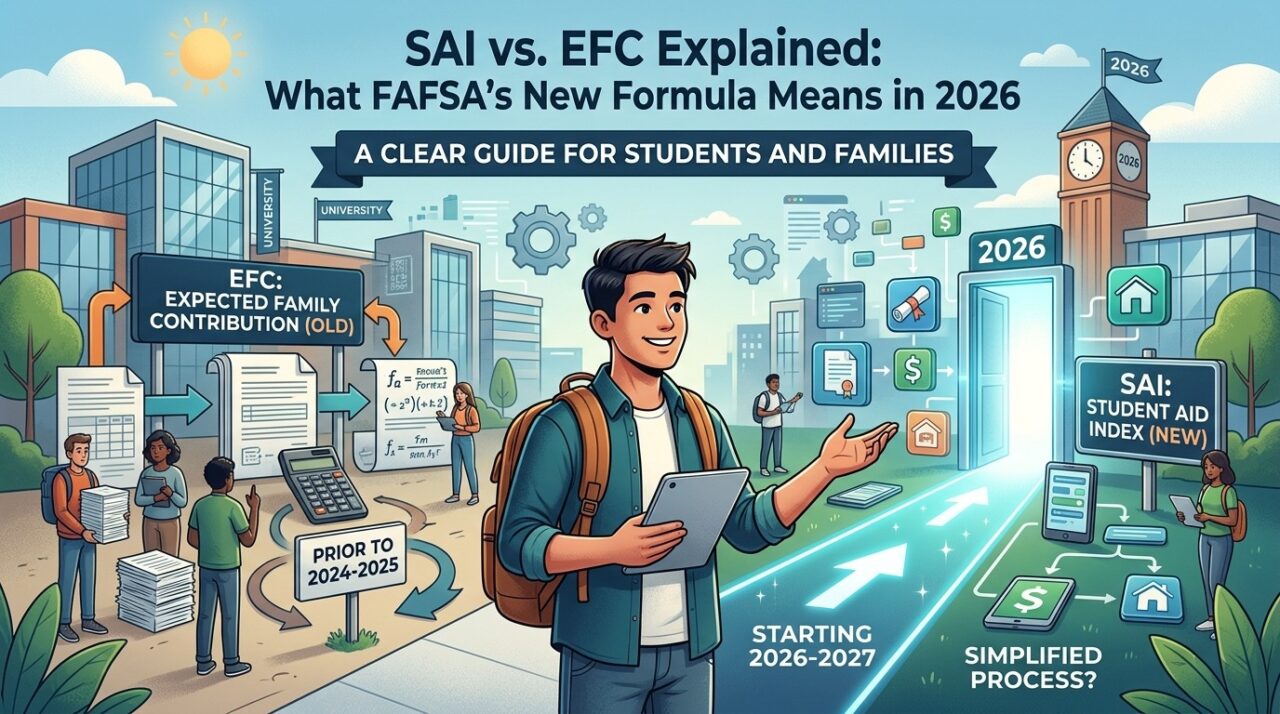
These use family financial information to determine eligibility. Many colleges use the FAFSA for this. Some also use the CSS Profile for nonfederal institutional aid. A lower Student Aid Index, or SAI, generally signals higher financial need, and schools use SAI, other assistance, and cost of attendance to calculate need-based support.
Identity, Community, and Background Scholarships
Some scholarships are targeted to first-generation students, women, students from certain communities, students with disabilities, children of veterans, students from a certain county, or students attending a certain high school. These are common in local and private scholarship programs. Federal Student Aid’s scholarship guidance specifically points students to colleges, community organizations, religious groups, employers, state agencies, and interest-based organizations as scholarship sources.
Major and Career Scholarships
These are tied to a field of study such as nursing, engineering, teaching, agriculture, public service, computer science, or the arts. Some are purely private. Some are college-funded. Some are really grants with service obligations attached.
One-Time vs. Renewable Scholarships
Some awards are paid once. Others renew each year if you meet conditions such as GPA, credit completion, full-time enrollment, or satisfactory academic progress. Federal Student Aid says every school has its own satisfactory academic progress policy, and students must follow it to stay eligible for federal aid. Schools may expect a certain GPA or number of completed credits.
Do You Need FAFSA for Scholarships?
Sometimes yes. Sometimes no.
You do not need FAFSA for every scholarship. Many private scholarships never ask for it. But FAFSA matters much more than many families realize because schools, states, and some private aid providers use FAFSA information to award aid, not just the federal government. Federal Student Aid is explicit on this point.
So the practical answer is this:
- If you want access to federal aid, you need FAFSA.
- If you want the strongest shot at need-based institutional aid, you often need FAFSA.
- If you want many state aid programs, you usually need FAFSA.
- If a college requires the CSS Profile for institutional aid, you may need that too. College Board says the CSS Profile is used by colleges and scholarship programs to award nonfederal institutional aid.
For high school seniors, the safest strategy is to file the FAFSA early and check every college’s financial-aid page to see whether the CSS Profile is also required.
How Colleges Use Scholarships in Your Aid Package
This is where many students get confused.
A scholarship award does not always sit on top of every other dollar you already received. Federal Student Aid says a scholarship can affect your other student aid because all your aid added together cannot be more than your school’s cost of attendance. That means a new outside scholarship may lower unmet need, reduce loans, reduce work-study, or, at some colleges, change other parts of your package depending on institutional policy.
This is why you should ask each college’s financial-aid office these questions before you commit:
- If I win an outside scholarship, do you reduce loans first?
- Do you reduce work-study first?
- Do you ever reduce institutional grant aid?
- Is there a cap on outside scholarship stacking?
- Can outside scholarships be used for housing, books, or indirect costs?
You are not being difficult by asking. You are protecting your net price.
How Scholarship Money Is Usually Paid
In many cases, scholarship money is disbursed through the college. That often means the funds are credited to your student account first, usually for tuition, mandatory fees, and sometimes housing if you owe the school directly. Some aid may also be paid directly to the student, or partly to the school and partly to the student, depending on the scholarship terms and school procedures. Federal Student Aid materials on grant disbursement describe schools disbursing aid by crediting your account, paying you directly, or both.
This creates two common scenarios:
Scenario 1: You owe the school money.
The scholarship reduces what you owe.
Scenario 2: Your scholarship creates a credit balance.
The school may send you the remaining amount as a refund, which can help cover books, transportation, supplies, or off-campus living costs if the scholarship terms allow it.
Always read the award letter carefully. Some scholarships are restricted to tuition only. Others can be used more flexibly.
Are Scholarships Taxable?
Sometimes.
The IRS says scholarships, fellowship grants, and similar grants can be tax-free if they are used for tuition and fees required for enrollment or attendance, and for required books, supplies, and equipment. But amounts used for room and board, travel, optional equipment, or payment for services are generally taxable.
That means a “full tuition scholarship” and a “full cost scholarship” are not the same thing. A scholarship that covers tuition may be fully tax-free. A scholarship that also pays for housing and meals can create a taxable portion depending on how the money is used. Families should save award letters, school billing statements, and receipts, and review IRS guidance each tax year.
Can You Lose a Scholarship?
Yes.
Students sometimes assume winning is the finish line. It usually is not. Renewal rules can include:
- minimum GPA
- full-time enrollment
- completing a certain number of credits
- staying in a certain major
- participating in a program or service requirement
- meeting the school’s satisfactory academic progress standard
Federal Student Aid says schools use satisfactory academic progress policies to decide whether students remain eligible for federal aid, and those policies may include GPA and credit-completion expectations.
So when you win a scholarship, do not just ask “How much is it?” Ask “What keeps it active?”
The Best Scholarship Strategy for High School Seniors
The strongest students do not just “apply harder.” They apply smarter.
Start with institutional and local scholarships first. Federal Student Aid specifically tells students to look at the college’s financial-aid office, community and religious groups, local businesses, community foundations, employers, a state higher-education agency, and the U.S. Department of Labor’s free scholarship search tool. Local awards can have smaller applicant pools, which can improve your odds.
Then build reusable application assets early:
- a clean scholarship résumé
- a master activities list
- a brag sheet
- 2 to 4 essay modules you can adapt
- an unofficial transcript
- at least one recommender ready to help
Federal Student Aid also notes that common scholarship materials often include FAFSA information, recommendation letters, a transcript, and an essay. It recommends staying organized and submitting before deadlines.
Common Scholarship Myths
Myth 1: Scholarships are only for straight-A students.
False. Some are merit-based, but others are based on financial need, community service, identity, intended major, career interests, local residency, or life experience.
Myth 2: FAFSA is only for low-income students.
False. Federal Student Aid says FAFSA is used for federal aid, and schools, states, and some private aid providers also use it for their own programs. Even students who do not qualify for Pell may still need FAFSA for other aid.
Myth 3: A scholarship always lowers what you owe by the exact same amount.
Not always. Because total aid cannot exceed cost of attendance, a new scholarship can trigger a packaging change.
Myth 4: If a scholarship says “free money,” there are no strings attached.
False. Renewal rules, enrollment requirements, major restrictions, tax treatment, and service obligations can all matter.
Scholarship Scam Red Flags
The FTC warns students to watch for classic scam phrases such as:
- “The scholarship is guaranteed or your money back.”
- “You can’t get this information anywhere else.”
- “I just need your credit card or bank account number to hold this scholarship.”
- “We’ll do all the work. You just pay a processing fee.”
- “The scholarship will cost some money.”
- “You’re a finalist” for a contest you never entered.
Federal Student Aid also reminds students that you do not have to pay to find scholarships or other financial aid. If a site asks for payment just to search or “unlock” awards, treat that as a major red flag.
What High School Seniors Should Do This Week
- Fill out the FAFSA if you have not already.
- Check whether each college on your list requires the CSS Profile.
- Run each college’s net price calculator.
- Ask your counselor about local scholarships.
- Build one scholarship résumé and one core essay bank.
- Track deadlines in a spreadsheet.
- Read every scholarship’s renewal and usage rules before applying.
Final Takeaway
Scholarships work best when you treat them as part of a full college-financing system, not as random prizes. The students who usually do best are not always the “most impressive” on paper. They are often the most organized. They understand that scholarships have rules, that FAFSA and sometimes CSS Profile matter, that net price matters more than sticker price, and that every award should be checked for renewal terms, tax treatment, and how it interacts with the rest of the aid package. That is how scholarships really work.
Official Resources
- Federal Student Aid: Scholarships
- Federal Student Aid: FAFSA Guide and Form
- Steps for Students Filling Out the FAFSA Form
- Student Aid Index (SAI) Explained PDF
- CSS Profile Overview
- Check Whether a College Requires CSS Profile
- Net Price Calculator Information Center
- College Affordability and Transparency: Net Price
- College Scorecard
- FTC: How to Avoid Scholarship and Financial Aid Scams
- IRS Topic No. 421: Scholarships, Fellowship Grants, and Other Grants
- U.S. Department of Labor Scholarship Search Tool
- U.S. Department of Education State Contacts
Related Articles on ScholarshipsAndGrants.us
- FAFSA 2026–27: Complete Guide for High School Seniors
- Student Aid Index (SAI) in 2026
- Compare Financial Aid Offers: Complete 2026 Guide
- How to Apply for Scholarships
- How to Apply for a Scholarship
- How to Win Scholarships in 2026
- Scholarship Essay Examples for High School Seniors
- How to Write a Winning Scholarship Résumé
- Letters of Recommendation
- Scholarship Scams