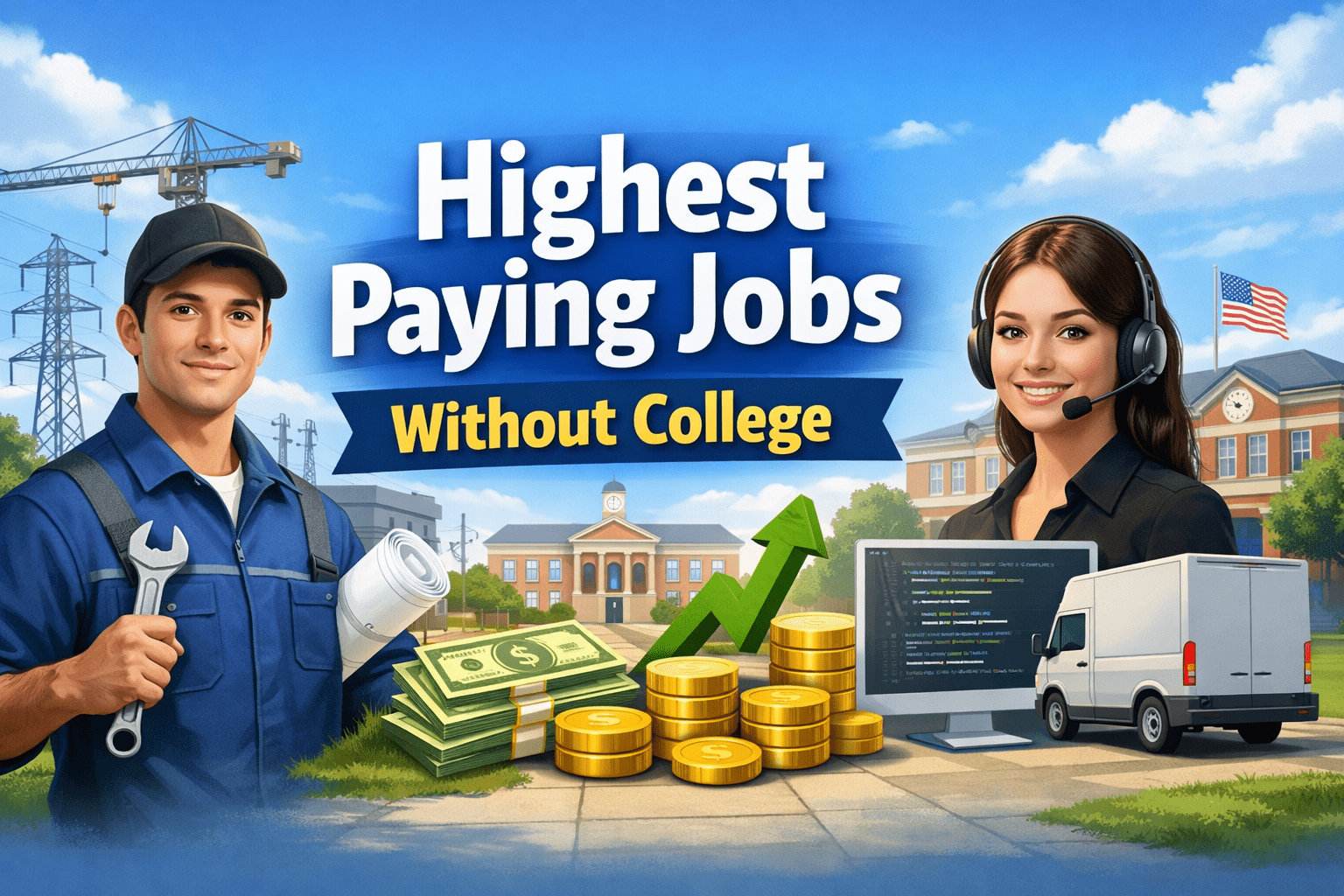
Highest Paying Jobs Without College
When students hear “jobs without college,” they often picture low pay and limited growth. That idea is outdated. In the real U.S. labor market, some of the highest-paying careers do not require a four-year bachelor’s degree. What they usually do require is something else: an apprenticeship, FAA training, a professional license, a certificate, an associate degree, or several years of experience in a related field. That distinction matters. The best-paying no-bachelor paths are not “easy money.” They are skilled, regulated, and often safety-critical careers.
For high school seniors, the smart question is not just, “Can I skip college?” The smarter question is, “Which training path gives me the best mix of pay, hiring demand, time to enter, and long-term stability?” On that score, the strongest options are usually found in aviation, skilled trades, utilities, transportation, and certain healthcare roles that require less than a bachelor’s degree. Many of these careers pay far above the U.S. median annual wage for all occupations, which BLS lists at $49,500 in 2024.
What “without college” really means
For this guide, without college means without a four-year bachelor’s degree. That is the most accurate way to explain this topic to readers, because some of the very highest-paying jobs on this list still require an associate degree, a postsecondary certificate, or a long paid apprenticeship. BLS classifies commercial pilots as typically entering with a postsecondary nondegree award, air traffic controllers with an associate’s degree, dental hygienists with an associate’s degree, and many top trades such as electricians and elevator installers through apprenticeship or high-school-plus-training routes.
Quick answer: the highest-paying jobs without a bachelor’s degree
The top-paying non-bachelor paths in current BLS data include air traffic controllers ($144,580 median annual pay), commercial pilots ($122,670 median for commercial pilots), elevator and escalator installers and repairers ($106,580), nuclear technicians ($104,240), power plant operators, distributors, and dispatchers ($103,600), transportation, storage, and distribution managers ($102,010), radiation therapists ($101,990), nuclear medicine technologists ($97,020), dental hygienists ($94,260), and electrical power-line installers and repairers ($92,560).
Top jobs to know about
1) Air Traffic Controller
Median pay: $144,580 a year
Typical entry path: Associate degree plus FAA hiring and long-term training
Outlook: 1% growth from 2024 to 2034
This is one of the highest-paying careers available without a bachelor’s degree, but it is also one of the hardest to enter. Air traffic controllers manage aircraft movement and have to stay focused for long periods in a high-stakes environment. BLS lists the occupation at a median pay of $144,580, and the FAA says entry-level applicants must complete required training and spend several months at the FAA Academy before moving into on-the-job development. FAA qualification rules also include U.S. citizenship, medical and security clearance, strong English communication, and age-related eligibility rules for most entry-level hires. This is a serious career path, not a casual alternative to college.
2) Commercial Pilot
Median pay: $122,670 a year for commercial pilots
Typical entry path: Postsecondary nondegree award, flight training, FAA certificates
Outlook: 4% growth from 2024 to 2034 for airline and commercial pilots combined
Commercial piloting is one of the clearest examples of a career that can pay extremely well without requiring a four-year degree. The catch is that flight training is intensive, expensive, and heavily regulated. BLS classifies commercial pilots as typically entering through a postsecondary nondegree award, while FAA materials explain that aspiring pilots must earn the relevant certificates and ratings depending on what they want to fly. This path can be excellent for students who love aviation and can handle technical training, but it is not a shortcut. It is more accurate to think of it as “specialized professional training instead of college.”
3) Elevator and Escalator Installer and Repairer
Median pay: $106,580 a year
Typical entry path: High school diploma plus apprenticeship
Outlook: 5% growth from 2024 to 2034
This is one of the best pure trade jobs in America. The pay is outstanding, the entry path is usually apprenticeship-based, and the work is highly specialized. BLS notes that nearly all workers learn through apprenticeship, and many states require licensure. The pay is high because the job combines electrical, mechanical, and safety responsibilities in equipment people rely on every day. For students who like hands-on work and want a union-friendly path with strong wages, this is one of the best no-bachelor options on the board.
4) Nuclear Technician
Median pay: $104,240 a year
Typical entry path: Associate degree
Outlook: –8% from 2024 to 2034
Nuclear technicians test equipment, monitor radiation, and support nuclear research or power operations. The pay is strong, but students need to understand the tradeoff: this is a smaller field with declining projected employment. That means it can still be a good fit for the right student, especially one who likes science and precision work, but it is not the same kind of mass-opportunity field as dental hygiene, electrical work, or aircraft maintenance. The wage is attractive; the job market is narrower.
5) Power Plant Operator, Distributor, or Dispatcher
Median pay: $103,600 a year
Typical entry path: High school diploma plus long-term on-the-job training
Outlook: –10% from 2024 to 2034
This occupation pays extremely well because utilities depend on workers who can manage complex systems reliably and safely. But students should not read the salary alone and assume this is a top pick. BLS projects a decline in employment over the decade. In other words, this is a high-paying field with real barriers and real market limits. It may fit students who are specifically targeting utility-sector work, especially in regions with legacy power infrastructure, but it is less growth-friendly than several lower-paying alternatives.
6) Transportation, Storage, and Distribution Manager
Median pay: $102,010 a year
Typical entry path: High school diploma plus 5+ years of related experience
Outlook: 6% growth from 2024 to 2034
This is a great reminder that some of the best-paying non-bachelor jobs are not entry-level jobs. Transportation, storage, and distribution managers usually build their careers from the floor up. They may start in warehousing, dispatch, logistics support, or transportation operations and move into leadership after several years. For high school seniors, this is less a “first job” and more a long-term roadmap. The upside is real: BLS reports six-figure median pay and faster-than-average projected growth.
7) Radiation Therapist
Median pay: $101,990 a year
Typical entry path: Associate degree
Outlook: 2% growth from 2024 to 2034
Radiation therapists help deliver cancer treatment under carefully controlled conditions. The pay is excellent, and the training time is shorter than a bachelor’s pathway. The job is also a reminder that “without college” should never be confused with “without education.” This field is regulated, clinical, and patient-facing. It can be a strong choice for students who want healthcare pay without the length and cost of becoming a physician or pharmacist.
8) Nuclear Medicine Technologist
Median pay: $97,020 a year
Typical entry path: Associate degree
Outlook: 3% growth from 2024 to 2034
This role combines imaging, patient care, and highly technical diagnostic work. The pay is strong, but the field is much smaller than some other healthcare pathways. BLS projects about 900 openings per year on average over the decade, so students should see it as a specialized niche rather than a broad labor-market category. It is best for students who want high-skill healthcare work and are comfortable with science-heavy training.
9) Dental Hygienist
Median pay: $94,260 a year
Typical entry path: Associate degree
Outlook: 7% growth from 2024 to 2034
For many students, this is one of the smartest no-bachelor paths in the country. The pay is high, the work is clinical but accessible through an associate-degree route, and projected growth is solid. BLS also recently highlighted dental hygienists as the highest-paid occupation in one of its “careers that don’t require a bachelor’s degree” comparisons. For readers who want a realistic, respected, and stable path, dental hygiene is one of the strongest options on this list.
10) Electrical Power-Line Installer and Repairer
Median pay: $92,560 a year
Typical entry path: High school diploma plus long-term on-the-job training
Outlook: 7% growth from 2024 to 2034
Line work pays well because it is skilled, dangerous, physically demanding, and essential. Workers may climb poles, work in bad weather, and respond during outages and emergencies. The combination of high pay and faster-than-average growth makes this one of the strongest non-college utility careers for students who can handle the physical and safety demands. It is not for everyone, but for the right person it can be a very strong path.
11) Aircraft and Avionics Equipment Mechanic or Technician
Median pay: $79,140 a year
Typical entry path: Postsecondary nondegree award
Outlook: 5% growth from 2024 to 2034
Aircraft maintenance is one of the best technical careers for students who like mechanical systems, diagnostics, and aviation without becoming pilots. BLS lists a postsecondary nondegree award as the typical entry path, which usually means a focused career-school or technical-program route rather than a full bachelor’s degree. The occupation offers a solid blend of respectable wages, specialized skills, and steady demand.
12) Electrician
Median pay: $62,350 a year
Typical entry path: High school diploma plus apprenticeship
Outlook: 9% growth from 2024 to 2034
Electricians are not the highest-paid job on this list today, but they may be one of the best overall choices for a high school senior. The field is large, the skills are transferable, the apprenticeship model allows people to earn while learning, and BLS projects strong growth with 77,400 new jobs over the decade. In practical terms, this means electricians offer one of the best combinations of access, scale, and long-term career mobility.
13) Plumber, Pipefitter, or Steamfitter
Median pay: $62,970 a year
Typical entry path: High school diploma plus apprenticeship
Outlook: 4% growth from 2024 to 2034
Plumbing and pipefitting remain core skilled-trade careers with solid wages and a clear training model. These jobs are less flashy than aviation or healthcare, but they are dependable, difficult to outsource, and often stronger than many white-collar entry jobs when viewed through the lens of debt, time to enter, and wage growth. Students who want stable, practical work with room to specialize should take this field seriously.
14) Wind Turbine Technician
Median pay: $62,580 a year
Typical entry path: Postsecondary nondegree award
Outlook: 50% growth from 2024 to 2034
This is not one of the absolute highest-paying jobs on the list, but it deserves attention because BLS identifies it as the fastest-growing occupation in the country over the 2024–34 period. For students who care about renewable energy, field work, and future-facing infrastructure, wind turbine service can be a strong long-term play even though its median wage is below some of the utility and healthcare roles above.
Which paths are best for most high school seniors?
If the goal is not just “highest salary on paper” but a realistic and smart launch after high school, the best overall options are usually dental hygienist, electrician, elevator installer/repairer, electrical power-line installer/repairer, aircraft mechanic, and radiation therapist. These paths balance wages with clearer entry routes and stronger labor-market logic than narrow or declining fields like nuclear tech or power plant operations. Healthcare is especially attractive because BLS says overall healthcare employment is projected to grow much faster than average, with about 1.9 million openings each year from 2024 to 2034, while the skilled trades continue to benefit from apprenticeship pathways and steady infrastructure demand.
The biggest mistake readers make
The biggest mistake is confusing median pay with starting pay. A job may show a six-figure median wage because many workers have years of experience, overtime, union scale, premium shifts, or supervisory duties. That is especially true in transportation management, utilities, and some aviation roles. Students should read salary numbers as a picture of the middle of the profession, not a promise of first-year earnings. BLS also shows that several eye-catching high-wage non-bachelor jobs have weak growth or even projected decline, which means pay alone should never be the only filter.
How to pay for training without taking on unnecessary debt
A lot of students do not realize that federal aid can support more than traditional four-year college. Federal Student Aid says the FAFSA can open access to aid for career school or trade school, and Pell Grant funds can be used at eligible two-year community colleges, career schools, trade schools, online schools, and four-year colleges. That matters because many of the best-paying jobs in this guide sit in exactly those education lanes.
Apprenticeship is the other major financing advantage. Registered Apprenticeship programs are approved by the U.S. Department of Labor or a State Apprenticeship Agency and are designed to provide paid work experience, wage progression, classroom instruction, and a nationally recognized credential. For students entering electrical work, plumbing, elevator repair, and many other skilled occupations, apprenticeship can be one of the strongest debt-avoidance strategies in the entire postsecondary system.
There is also evidence that shorter credentials can produce strong financial returns. Georgetown University’s Center on Education and the Workforce reported in 2025 that the median 10-year ROI for public institutions that predominantly offer certificates was $233,000, and for those predominantly offering associate’s degrees it was $232,000, compared with $174,000 for public institutions that predominantly offer bachelor’s degrees. That does not mean every certificate beats every bachelor’s degree. It does mean students should stop assuming that “more school automatically equals better value.”
Best official websites to explore these careers
-
Occupational Outlook Handbook (BLS) – best source for national pay, education, and job outlook data.
-
CareerOneStop Compare Occupations – useful for side-by-side career comparisons and local wage data.
-
Apprenticeship.gov – official place to explore registered apprenticeships and apprenticeship job openings.
-
Federal Student Aid – use FAFSA information to check aid for community college, trade school, and career school options.
-
FAA Aviation Careers and Pilot Resources – essential for pilot and air traffic control pathways.
Bottom line
The highest-paying jobs without college are real, but most are not “no-training” jobs. The winning pattern is simple: the more technical, regulated, or safety-sensitive the work is, the more likely it is to pay well without requiring a bachelor’s degree. For most high school seniors, the smartest non-bachelor choices are not just the occupations with the biggest salary numbers. They are the ones with the best combination of pay, job openings, affordable training, and long-term stability. Right now, that puts careers like dental hygienist, elevator installer, electrical power-line worker, aircraft mechanic, electrician, radiation therapist, and some aviation paths near the top of the list.