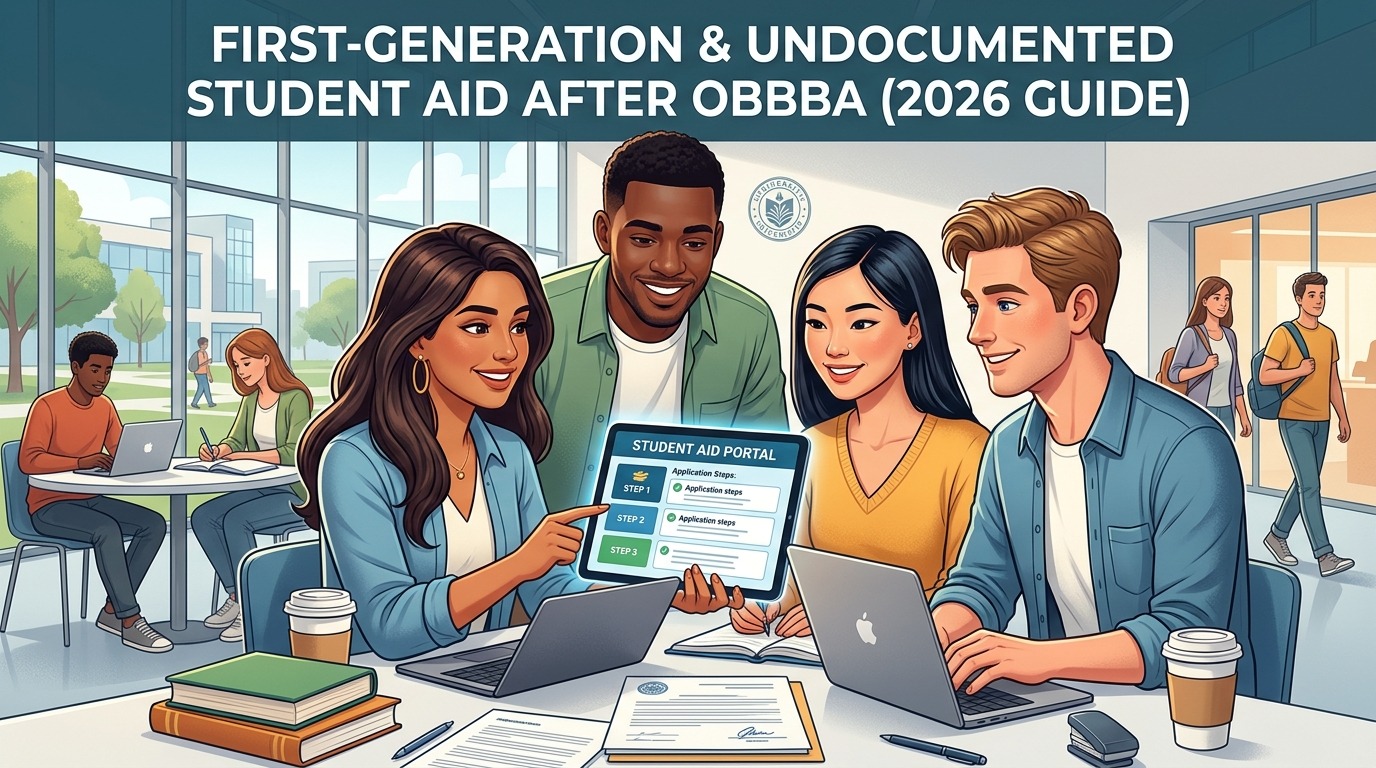
First-Generation & Undocumented Student Aid After OBBBA
If you are a high school senior trying to pay for college in 2026, two phrases may sound like they belong in the same conversation but actually mean very different things: first-generation student and undocumented student. The difference matters a lot after the One Big Beautiful Bill Act (OBBBA), which was signed into law on July 4, 2025. Some of its higher-education provisions took effect right away, while many of the biggest student-aid changes are being implemented for July 1, 2026 and beyond. Federal Student Aid has also said that the student-facing FAFSA changes tied to OBBBA were already built into the 2026–27 FAFSA, with more back-end processing updates scheduled for April 26, 2026.
The biggest headline for families is this: OBBBA changes parts of federal aid, but it does not erase the old line between students who are federally eligible and students who are not. A student being first-generation does not automatically create federal aid eligibility by itself. Meanwhile, undocumented students, including most DACA students, still generally cannot receive federal Pell Grants, federal student loans, or other federal Title IV aid, even after OBBBA. At the same time, many undocumented students can still find real money through state aid, in-state tuition policies, institutional grants, and private scholarships.
That is why this guide separates the issue into three questions. First, what did OBBBA actually change? Second, what should a first-generation student do now? Third, what should an undocumented student do now, especially if the student is also first-generation or comes from a mixed-status family? This is the practical roadmap.
Start with the definitions, because most families mix them up
In everyday college-access language, a first-generation student usually means a student whose parents did not complete a four-year college degree. That label often matters for advising, mentoring, college-access programs, and some campus or scholarship opportunities. But federal student aid eligibility is still built around things like financial need, citizenship or eligible noncitizen status, enrollment in an eligible program, and satisfactory academic progress, not around the first-generation label by itself.
An undocumented student is different. For federal student aid purposes, the key question is whether the student is a U.S. citizen, U.S. national, citizen of a Freely Associated State, lawful permanent resident, or another “eligible noncitizen.” If the student does not fit a federally eligible category, the student is generally outside the federal aid system. That is true even if the student has lived in the United States for years, graduated from a U.S. high school, or has excellent grades.
This means there are really four common student situations:
- A first-generation student who is a U.S. citizen or eligible noncitizen.
- A first-generation student who is undocumented.
- A U.S. citizen or eligible noncitizen student with undocumented parents.
- An undocumented student who is not first-generation.
Those groups can overlap, but the aid strategy is not the same.
What OBBBA changed that high school seniors should actually care about
The 2026–27 FAFSA and Pell rules changed in several ways under OBBBA. Some of the most practical ones are these:
- Certain family assets are now excluded from FAFSA reporting, including the net worth of a family-owned business with 100 or fewer full-time employees, the family’s home on a farm where the family lives, and a family-owned commercial fishing business. For some small-business or farm families, that can lower the asset amount reported on FAFSA.
- For Pell Grant eligibility, the foreign earned income exclusion reported on FAFSA is added back into adjusted gross income for Pell calculations. That can matter for some immigrant and internationally mobile families.
- OBBBA bars Pell eligibility for applicants whose SAI is equal to or greater than twice the maximum Pell amount. For 2026–27, Federal Student Aid says the maximum Pell Grant is $7,395, so the OBBBA Pell cutoff for this rule is $14,790.
- Starting in July 2026, the law opens the door to Workforce Pell for certain short-term programs. The Department’s March 2026 proposed rule says eligible workforce programs would be 150–599 clock hours and run for at least 8 weeks but less than 15 weeks.
- OBBBA also reshapes borrowing. The Department’s implementation materials show new limits for federal borrowing, including new Parent PLUS caps that are being built into federal aid systems for 2026–27. Draft regulatory text released by the Department shows Parent PLUS limits of $20,000 per year per dependent student and $65,000 total per student for periods beginning on or after July 1, 2026, with transition rules for some continuing borrowers.
Now the crucial part: none of those OBBBA changes turn undocumented students into federal-aid-eligible students. Workforce Pell is still part of the federal aid structure. So if a student is not federally eligible, OBBBA’s new federal pathways do not suddenly unlock Pell or federal loans for that student. The Department underscored this in July 2025 when it announced that Pell Grants and federal student loans remain inaccessible to undocumented immigrants and said federal postsecondary benefit programs must follow federal eligibility rules.
What first-generation students should do after OBBBA
If you are first-generation and you are also a U.S. citizen or eligible noncitizen, your main federal playbook still begins with the FAFSA. The law changed pieces of the formula, but the FAFSA is still the front door to federal grants, loans, work-study, and much institutional aid.
That matters because many first-generation families make a common mistake: they assume first-generation status itself brings a separate federal grant category. It usually does not. Instead, first-generation status tends to help in three other ways:
- It can make you a target student for TRIO and similar support programs. The U.S. Department of Education says TRIO includes eight programs designed to serve low-income students, first-generation college students, and students with disabilities.
- It can matter for campus support such as mentoring, bridge programs, textbook help, emergency grants, and academic coaching.
- It can matter for institutional scholarships, especially at colleges that actively recruit first-generation students.
So if you are a first-generation student, think of the FAFSA as the money application and the first-generation label as a support-and-opportunity signal.
If your parents are undocumented, do not assume you are blocked from FAFSA
This is one of the biggest myths in college planning. If you are a U.S. citizen or eligible noncitizen, your parents’ immigration status does not by itself block your federal aid eligibility. Federal Student Aid says plainly that a parent’s citizenship status does not affect a student’s eligibility and that the FAFSA does not ask about the parents’ immigration status.
That point is huge for mixed-status families. A student who says, “My mom and dad are undocumented, so I guess I cannot get aid,” may be walking away from Pell, loans, work-study, and campus grants by mistake. In many cases, the student absolutely should complete FAFSA.
Contributors without an SSN can still participate
Another old fear was that a parent without a Social Security number could not properly complete the FAFSA process. Federal Student Aid now says contributors without an SSN can create a StudentAid.gov account and fill out and sign their required FAFSA sections. FSA also says contributors without an SSN may have to answer identity questions or manually enter financial information.
In plain English, that means many mixed-status families should no longer stop at the first technical obstacle. If the student is FAFSA-eligible, the family should usually keep moving, create the contributor account correctly, and work through the form carefully.
What undocumented students should do after OBBBA
If you are undocumented, the first hard truth is still the same in 2026: federal student aid is generally not available to you. The Federal Student Aid fact sheet says undocumented students, including DACA students, are not eligible for federal student aid, though they may be eligible for state aid, college aid, and private scholarships. The Department’s July 2025 announcement reinforced that Pell and federal loans remain inaccessible to undocumented immigrants.
That means OBBBA did not create a new federal aid opening for undocumented students. Not for traditional college programs. Not for federal loans. Not for federal Pell. And not automatically for the new Workforce Pell pathway either. If you are undocumented, your real strategy is still built around state systems, institutional aid, local scholarships, and tuition policy.
But “not eligible for federal aid” does not mean “no aid exists”
This is where families often give up too early. Federal Student Aid itself says undocumented students may still be eligible for state or college financial aid and private scholarships. Also, state policy can change the price of college dramatically through in-state tuition.
So the question for an undocumented student is not, “Can I get federal aid?” The answer there is usually no. The smarter question is, “What is my best nonfederal path in my state and at my colleges?”
That path can include:
- A state alternative financial aid application
- In-state tuition eligibility
- Institutional grants from colleges
- Need-based aid using a college-specific form
- Private scholarships that do not require federal aid eligibility
- Community-college-first transfer plans that cut total cost
The most practical rule in 2026: file the right form, not the familiar form
For many students, the single biggest mistake is using the wrong application.
If you are federally eligible, the FAFSA is usually the right starting point because it opens federal aid and often state and college aid too. If you are not federally eligible, you should look for your state’s alternative application or state-specific process instead of assuming there is no aid. Washington State’s official WASFA page says clearly that the WASFA is for state aid only and that students eligible for federal aid should understand that filing only the state form can mean missing federal money.
Here are six official examples that show how real this state pathway is:
California
The California Dream Act Application (CADAA) is California’s state-aid route for eligible students who are not using the FAFSA. California’s official student aid pages say the application is used to determine eligibility for California student financial aid. See the official pages here: California Dream Act Application and CSAC Dream Act information.
New Jersey
New Jersey’s official Alternative Financial Aid Application is for students who live in New Jersey, are not eligible for FAFSA, and meet the state’s school-attendance and diploma rules. HESAA says the form can be used to determine eligibility for state grants and scholarships, and colleges may use the data for their own aid too. Official page: New Jersey Alternative Financial Aid Application.
New York
The official NYS DREAM Act gives qualifying students, including undocumented students meeting the rules, access to New York State-administered financial aid. Official page: NYS DREAM Act.
Washington
Washington’s official WASFA is a state-aid application for students who do not file FAFSA, including many students or parents with undocumented status and families with privacy concerns. Washington also states that applicants using WASFA are applying only for state aid. Official page: WASFA.
Illinois
Illinois’s official RISE Act / Alternative Application for Illinois Financial Aid gives eligible undocumented students a path to state aid, including the MAP grant and some other ISAC programs. Official page: RISE Act / Alternative Application.
Oregon
Oregon’s official ORSAA is for Oregon residents with undocumented status, DACA, TPS, or a valid U-visa who should not use FAFSA. Oregon also states that undocumented students can be eligible for the Oregon Opportunity Grant if they meet the program rules. Official pages: FAFSA / ORSAA and Oregon Opportunity Grant.
These examples matter because they prove the larger point: the college-aid map for undocumented students is state-built, not federally built.
What if you are both first-generation and undocumented?
Then your strategy needs to be honest and layered.
Your first-generation status may help you with advising, outreach, mentorship, special support programs, and some scholarships. Your undocumented status, however, still limits federal aid access. So you should build your funding plan in this order:
- Check whether you are truly undocumented for federal aid purposes or whether you qualify as an eligible noncitizen. Some students who think they are excluded may actually fit an eligible category such as lawful permanent resident or certain humanitarian statuses.
- Use the correct application path. FAFSA if federally eligible. State alternative application if not.
- Target colleges that publish clear aid policies for undocumented and first-generation students. A transparent aid office is not a small detail; it can be the difference between a workable package and a dead end.
- Ask directly about institutional aid. Even when federal money is off the table, campus grants may still exist.
- Look for TRIO, bridge, and advising supports. Those may not replace tuition money, but they can reduce the hidden costs of college failure, transfer mistakes, and delayed graduation.
Four myths families should stop believing
Myth 1: “I’m first-generation, so I automatically get extra federal money.”
Not necessarily. First-generation status is important, but federal aid eligibility still turns on need and federal eligibility rules, not on the first-generation label alone.
Myth 2: “My parents are undocumented, so I cannot get FAFSA money.”
Wrong if the student is a U.S. citizen or eligible noncitizen. Federal Student Aid says the parents’ status does not determine the student’s eligibility.
Myth 3: “OBBBA opened Pell for undocumented students in short workforce programs.”
No. Workforce Pell is still a federal program, and the Department has separately stated that Pell and federal student loans remain inaccessible to undocumented immigrants.
Myth 4: “If I am not FAFSA-eligible, there is no point applying for aid.”
Also wrong. State alternatives in places like California, New Jersey, New York, Washington, Illinois, and Oregon show that meaningful aid may still exist outside the FAFSA system.
A 2026 action checklist for high school seniors
If you want the shortest possible plan, use this one.
Step 1: Identify your aid status correctly.
Ask: am I a U.S. citizen, eligible noncitizen, or not federally eligible? Do not guess. Check the official Federal Student Aid noncitizen eligibility rules.
Step 2: File the right application.
Use the FAFSA if you are federally eligible. Use your state’s alternative form if you are not. Do not substitute a state-only form for FAFSA if you are actually eligible for federal aid.
Step 3: If your parent has no SSN, do not quit.
Set up the contributor account the right way and complete the process carefully.
Step 4: Build a college list around net cost, not prestige alone.
If your family may be affected by the new Parent PLUS limits in 2026–27, make sure your college choices do not depend on impossible borrowing.
Step 5: Ask each college three direct questions.
Do you award institutional aid to undocumented students? Do you offer first-generation grants or support? What form do you require beyond FAFSA or the state application?
Step 6: Search for campus support, not just scholarships.
TRIO, first-gen centers, and advising programs can improve the odds that aid actually turns into completion.
Step 7: Recheck every assumption after July 1, 2026.
OBBBA implementation is still moving through federal guidance and rulemaking, so families should watch official StudentAid and Department announcements for updates.
Final takeaway
After OBBBA, the smartest way to think about student aid is this: first-generation status shapes support, access, and sometimes scholarship opportunity; immigration status shapes federal eligibility. OBBBA changed formulas, timelines, Pell rules, workforce-program access, and borrowing rules. But it did not erase the federal eligibility wall for undocumented students. What it did do is make accurate form choice, state-by-state research, and college-by-college planning even more important in 2026.
For a high school senior, the practical advice is simple. If you are FAFSA-eligible, file the FAFSA and do not let your parents’ immigration status scare you away. If you are not FAFSA-eligible, shift fast to your state aid system, in-state tuition rules, and colleges that openly support undocumented students. And if you are first-generation, treat that identity as an advantage in finding guidance, support, and community, even when the money rules are complicated.
Official resources to link in the post
- Federal Student Aid OBBBA updates
- Federal Student Aid eligibility for non-U.S. citizens
- How contributors without an SSN can complete FAFSA-related steps
- Financial Aid and Undocumented Students fact sheet
- California Dream Act Application
- New Jersey Alternative Financial Aid Application
- NYS DREAM Act
- WASFA
- Illinois RISE Act / Alternative Application
- Oregon FAFSA / ORSAA page