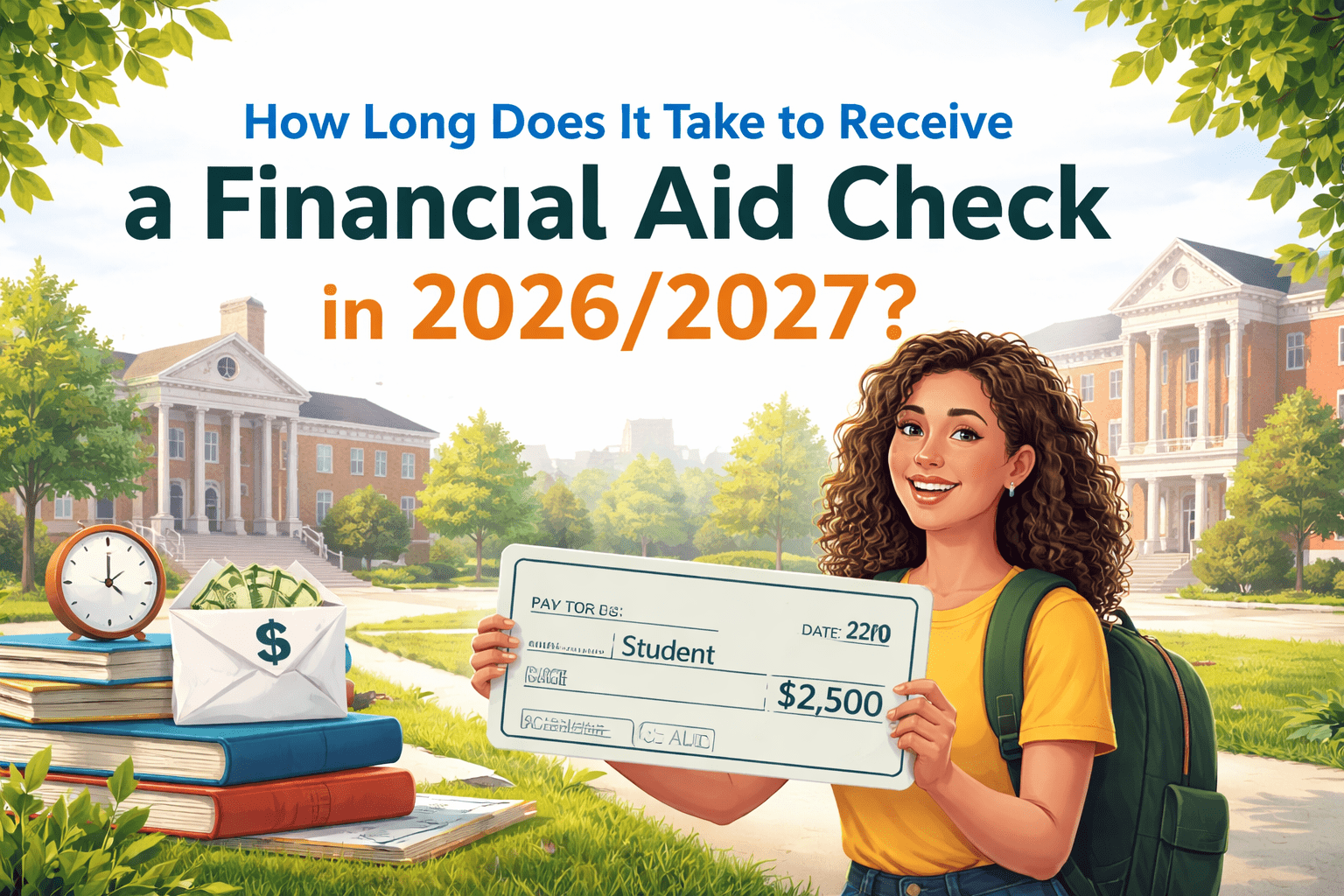
If you are waiting for your financial aid check, the most important thing to know is this: most students do not actually receive a paper check anymore. In many cases, schools send the money by direct deposit after federal, state, institutional, and scholarship funds are applied to tuition, fees, and other school charges.
For the 2026/2027 financial aid year, the usual answer is:
You may receive your refund in a few days to about two weeks after your aid is officially disbursed and creates a credit balance on your student account. Under federal Title IV rules, if federal student aid creates a credit balance, the school generally must pay that credit balance within 14 days. The exact date still depends on your college’s calendar, your enrollment status, whether your file is complete, and whether your aid includes loans with special timing rules. See Federal Student Aid and the federal cash management regulation at 34 CFR § 668.164.
In plain English, that means:
-
Fastest case: direct deposit after aid posts and your college releases the refund.
-
Slower case: paper check by mail, incomplete paperwork, verification, or a delayed loan disbursement.
-
Much slower case: you are a first-year, first-time borrower whose federal loan cannot be disbursed right away, or your school is waiting for attendance confirmation, late-start classes, or add/drop adjustments.
The Quick Answer
Here is the short version most students and parents need:
-
If your aid file is complete and classes have started, many students get their refund within a few business days to two weeks after the school disburses aid.
-
If federal aid creates a credit balance, the school generally must release it within 14 days under federal rules.
-
Direct deposit is usually fastest.
-
Paper checks usually take longer because of printing, batching, and mail delivery.
-
First-year, first-time federal loan borrowers may wait longer because the first loan disbursement can be delayed by federal rules.
-
Verification, missing documents, SAP issues, attendance problems, enrollment changes, and holds can all delay payment.
What Is a “Financial Aid Check,” Really?
When students say “financial aid check,” they usually mean a refund.
That refund happens only after this order:
-
Your college calculates your aid.
-
The college disburses the aid.
-
The money is applied to your school bill.
-
If money is left over, that leftover amount becomes your credit balance or refund.
Example:
-
Tuition and fees: $3,800
-
Pell Grant and federal loans disbursed: $5,200
-
Remaining balance after charges: $1,400
That $1,400 is the money students often call the “financial aid check.”
Important detail: that money is not extra free cash. If part of it came from a student loan, it must still be repaid later with interest according to your loan terms. Learn more at Federal Student Aid.
The Federal Rule That Matters Most
For federal Title IV aid, the big timing rule is the credit balance rule.
Under 34 CFR § 668.164, if Title IV funds create a credit balance on your account, the school generally must pay it to you:
-
By the first day of class if the credit balance exists before classes begin, or
-
Within 14 days if the credit balance happens on or after the first day of class.
That is the key federal protection students should know.
But there is an important catch: the 14-day clock usually starts after the credit balance actually exists, not when you first submitted the FAFSA and not when you accepted your aid offer.
So if your school has not yet disbursed the aid, or if your file is still incomplete, the refund may not exist yet.
Typical 2026/2027 Timeline From FAFSA to Refund
For high school seniors entering college in the 2026/2027 award year, this is the basic sequence.
1) Submit the FAFSA
The FAFSA is the starting point for federal grants, loans, and work-study. Use the official FAFSA page at StudentAid.gov.
2) The College Reviews Your File
Your school may ask for extra documents, especially if you are selected for verification or if there are conflicting details in your file.
3) You Accept or Decline Aid
You may need to accept loans, complete entrance counseling, and sign a Master Promissory Note for federal Direct Loans through Federal Student Aid.
4) The School Disburses Aid
This usually happens close to the start of the term, but colleges set their own disbursement calendars. Some disburse right before classes. Others wait until attendance is confirmed or the add/drop period begins.
5) The School Pays School Charges First
Tuition, fees, and sometimes on-campus housing and meal charges are paid first.
6) Any Remaining Balance Becomes a Refund
If federal aid creates that credit balance, federal rules generally require payment within 14 days.
7) Delivery Method Affects Speed
-
Direct deposit: often the fastest option
-
Paper check: often slower
-
Third-party refund vendors: may add an extra processing step
How Long Does It Usually Take After Disbursement?
There is no single national number for every college, because each school controls its own refund schedule. Still, these are reasonable student-friendly expectations:
Direct deposit
Many students receive the money within a few business days after the school releases the refund.
Paper check
Paper checks often take longer, especially if the school prints them in batches or mails them through regular postal service.
Official federal rule
If the refund is a Title IV credit balance, the school generally must issue it within 14 days after the balance occurs.
That is why students often hear two different answers:
-
“My school says 2 to 3 days”
-
“Federal rules say up to 14 days”
Both can be true. The school may process the refund quickly, but federal law sets the outer protection for Title IV credit balances.
Why Your Financial Aid Check May Be Late
1) Your file is incomplete
Missing tax documents, identity documents, citizenship proof, or verification paperwork can stop disbursement.
2) You have not started attendance
Some colleges do not fully release aid until your attendance or academic participation is confirmed.
3) Your enrollment changed
Dropping below full-time, adding a late-start class, or withdrawing from a class can reduce or delay aid.
4) You are a first-year, first-time borrower
This is one of the biggest surprises for freshmen.
Under federal student loan rules, a first-year, first-time borrower may face a 30-day delay before the first federal Direct Loan disbursement. That means the refund tied to that loan may arrive much later than the Pell Grant portion. See Federal Student Aid.
5) Your school uses multiple disbursements
Some programs divide aid across terms, modules, or clock-hour milestones.
6) You have a hold on your account
Admissions holds, immunization holds, transcript holds, or financial aid holds can interfere with release.
7) Your school is waiting for outside funds
Private scholarships, state grants, tuition assistance, and other outside aid may arrive on a different calendar than federal aid.
A Realistic Fall 2026 Example
Let’s say your fall 2026 semester starts on August 24, 2026.
-
Your aid file is complete by early August.
-
Your school disburses Pell Grant and loans on August 25.
-
Tuition and fees are paid the same day.
-
A $1,250 credit balance remains.
What happens next?
If that credit balance is from federal Title IV aid, the school generally must release it within 14 days, which would put the deadline around September 8, 2026.
What you actually see in your bank account depends on the payment method:
-
Direct deposit: often a few business days after release
-
Paper check: possibly several more days, depending on mailing time
So a student in this example might see the money in late August, early September, or slightly later if a mailed check is used.
A Slower Freshman Example
Now imagine the same student is a first-year, first-time borrower and part of the refund depends on a federal Direct Loan.
-
Classes start: August 24, 2026
-
Federal loan disbursement cannot happen right away because of the 30-day delay rule
-
Pell Grant may post earlier
-
Loan money may not be available until late September
In that case, the student might get:
-
A small earlier refund from grant aid, then
-
A later second refund after the loan disburses
This is why some freshmen say, “My friend already got their money, but I’m still waiting.”
Does FAFSA Money Come Before School Starts?
Sometimes, but not always.
Many colleges do not send refunds far in advance of class. Even if your FAFSA was processed months earlier, schools usually wait until the term is about to begin, or until classes start, to disburse aid.
What matters most is not when you filed FAFSA. What matters is:
-
whether your file is complete,
-
whether you accepted your aid,
-
whether loan steps are finished,
-
whether the school has started disbursement,
-
and whether a refund balance exists.
2026/2027 Award Year: What Students Should Expect
For the 2026/2027 federal aid year, students should expect the same broad pattern that has existed under federal Title IV rules:
-
Aid is tied to the academic term or payment period
-
Schools apply aid to institutional charges first
-
Refunds happen only if money remains
-
Federal Title IV credit balances are generally subject to the 14-day rule
-
Freshmen with first-time federal loans may face slower first disbursements
-
School-level calendars still control the day-to-day timing
The federal structure is national. The actual date is local.
That is why the best answer is usually:
“Your school decides when to disburse, but once federal aid creates a Title IV credit balance, the school generally has to release it within 14 days.”
Direct Deposit vs. Paper Check
If you want your money faster, direct deposit is usually the smartest choice.
Direct deposit advantages
-
Faster than mail
-
Less risk of lost checks
-
Easier to track
-
Often reaches students sooner after refund release
Paper check disadvantages
-
Printing delays
-
Mail delays
-
Wrong-address problems
-
Weekend and holiday delays
If your college offers direct deposit, set it up as early as possible.
Special Cases Students Should Know
Parent PLUS Loans
If a Parent PLUS Loan creates a refund, the refund may go to the parent borrower, not automatically to the student, unless the parent authorized otherwise.
Work-study
Federal Work-Study is not usually paid as a lump-sum refund. It is generally earned as wages through a job. See Federal Student Aid.
Private scholarships
Private scholarship timing depends on the scholarship provider and the school’s posting process. A scholarship can arrive before, during, or after the term begins.
State grants and institutional aid
These may follow different calendars than federal aid, so a student can receive one type of funding before another.
What to Do If Your Financial Aid Check Is Taking Too Long
If your refund seems late, do these steps in order.
1) Check your student account
Look for these words:
-
Disbursed
-
Pending
-
Authorized
-
Refund
-
Credit balance
-
Hold
2) Confirm your banking setup
A wrong bank account number can delay or reject a deposit.
3) Make sure all loan steps are finished
For federal loans, check whether you completed:
-
entrance counseling
-
Master Promissory Note
-
any school-specific loan requirements
Use Federal Student Aid for federal loan tasks.
4) Ask whether you were selected for verification
Verification is a major reason aid is delayed.
5) Ask whether attendance or late-start classes are affecting disbursement
Some schools wait for actual participation or for all classes in a schedule to begin.
6) Ask the financial aid office one direct question
Use this exact sentence:
“Has my aid been disbursed yet, and if a federal Title IV credit balance exists, on what date will my refund be released?”
That question is specific and hard to dodge.
Best Official Resources for Students and Families
Use these sources first:
Bottom Line
For 2026/2027, most students should not ask, “How long after I filed FAFSA will I get my check?”
The better question is:
“How long after my college disburses aid and creates a credit balance will I get my refund?”
That is because FAFSA submission alone does not trigger payment.
The simplest accurate answer is:
If your aid file is complete and federal student aid creates a credit balance, your school will often send the refund within a few business days to about two weeks, and federal rules generally require Title IV credit balances to be paid within 14 days.
But if you are a freshman first-time borrower, selected for verification, waiting on attendance confirmation, or receiving a paper check, it can take longer.
Frequently Asked Questions
How long does it take to get a financial aid refund check after disbursement?
Usually a few business days to about two weeks, depending on your college and refund method. If federal Title IV aid creates a credit balance, the school generally must release it within 14 days.
Does financial aid come before the first day of class?
Sometimes, but not always. Some schools create and pay the credit balance before class starts, while others disburse on or after the first day.
Why did my friend get their money before I did?
Their file may have been complete earlier, they may have used direct deposit, or they may not have had a first-time borrower loan delay.
Can my Pell Grant be refunded to me?
Yes, but only if money remains after your school applies it to eligible charges.
Do student loans get sent straight to me?
Usually no. They are generally sent to the school first, then any leftover amount becomes a refund.
Is work-study included in my financial aid check?
Usually no. Work-study is commonly paid as wages from a job, not as an upfront refund.
Can a school hold my refund?
In some cases, a school may hold funds if you gave authorization for certain uses. Otherwise, federal credit balance rules still apply.