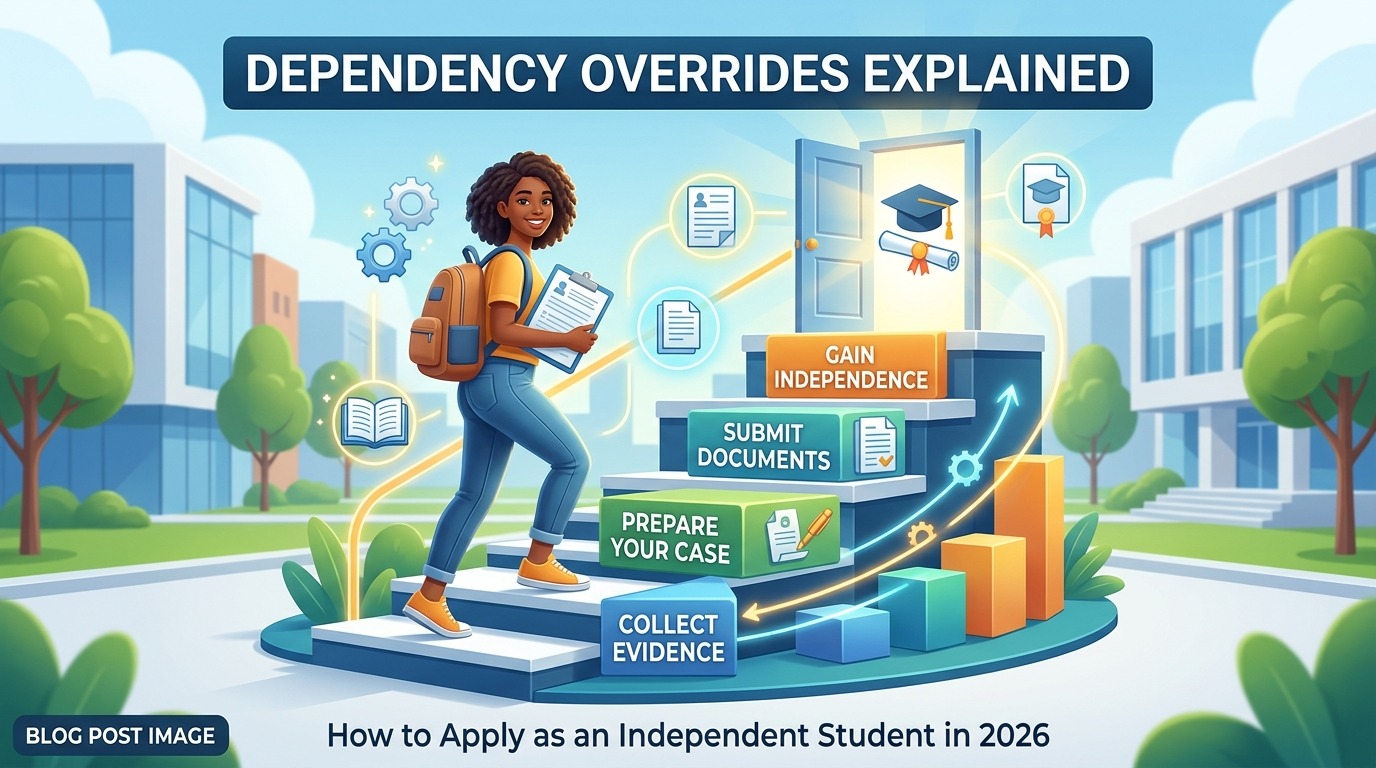
Dependency Overrides Explained: How to Apply as an Independent Student in 2026
If you are filling out the FAFSA for the 2026–27 school year and cannot safely contact your parents, or getting their information would put you at risk, you may be able to ask a college financial aid office for a dependency override. A dependency override can let a student who would normally be treated as dependent be treated as an independent student for federal student aid purposes. Under current federal guidance, students who indicate unusual circumstances on the FAFSA can submit the form without parent information, receive a provisional independent status, and then work with the school for a final decision. because FAFSA dependency rules are strict. For federal aid, your status is not based on whether you live on your own, whether your parents claim you on taxes, or whether you pay your own bills. The law uses a separate set of dependency questions. That means a lot of students who feel financially independent are still considered dependent for FAFSA purposes unless they meet one of the automatic independent-student categories or receive a dependency override. 6–27 FAFSA**, the award year runs from July 1, 2026, through June 30, 2027. The federal FAFSA deadline is 11:59 p.m. Central Time on June 30, 2027, and corrections or updates must be submitted by September 12, 2027. State and college deadlines can be much earlier, so students with unusual circumstances should start early and contact each financial aid office as soon as possible after filing. dependency override?
A dependency override is a school-level decision made by a financial aid administrator when a student has unusual circumstances that justify changing the student’s FAFSA dependency status from dependent to independent. The 2026–27 Federal Student Aid Handbook lists examples such as human trafficking, legally granted refugee or asylum status, parental abandonment or estrangement, and student or parental incarceration. The school must make the decision case by case and keep documentation supporting the decision. nt is important. A dependency override is not automatic. Even if a student checks the unusual-circumstances option on the FAFSA and gets provisional independent status, the record is still flagged for school review. The financial aid office must decide whether the student is truly eligible for a dependency override, whether the student may instead qualify under the homeless-youth rules, or whether the student must provide parent information after all. omatically independent without a dependency override?
Some students are already independent under FAFSA rules and do not need a dependency override. Examples include students who will be 24 or older for the award year, are married, are graduate or professional students, are veterans or active-duty service members, support a child or other legal dependent by more than half, were in foster care or a ward of the court after age 13, were an emancipated minor, were in a legal guardianship, or are an unaccompanied homeless youth or self-supporting and at risk of homelessness. se categories already fits you, you should use that path instead of a dependency override. For example, a student who qualifies as an unaccompanied homeless youth is already treated as independent, so a dependency override is unnecessary. Federal guidance explicitly says homelessness determinations are separate from dependency overrides. s as an “unusual circumstance” in 2026?
Federal guidance says unusual circumstances are situations where a student is unable to contact a parent or where contact with the parent poses a risk to the student. That is a much narrower standard than “my parents do not help me” or “I live on my own.” The current handbook examples include human trafficking, refugee or asylum status, parental abandonment or estrangement, and incarceration of the student or parent. ish, students are strongest for a dependency override when the parent relationship is not just strained or unhelpful, but unsafe, broken, or functionally unavailable. That can include serious abuse, abandonment, being forced out of the home, a total family breakdown with no meaningful access to parent information, or a situation where contact would create real harm. The school still decides case by case, but the federal framework clearly focuses on risk, separation, and unusual hardship, not ordinary family conflict. not qualify for a dependency override?
This is the part many students misunderstand. The 2026–27 Federal Student Aid Handbook says the following do not qualify, either alone or combined:
- Your parents refuse to help pay for college. refuse to provide FAFSA or verification information. do not claim you on their taxes. lly self-supporting. student can be paying rent, working, filing taxes independently, and living apart from parents, yet still be considered a dependent student for FAFSA purposes. Federal Student Aid also states that dependency status is not based on whether you live with your parents or whether they provide support in everyday life. override vs. homeless youth determination vs. unsubsidized-loan-only
Students often hear three different ideas and think they are the same. They are not. A dependency override is for unusual circumstances. A homeless youth determination is a separate route for students who are unaccompanied and homeless, or self-supporting and at risk of homelessness. A third path exists for some dependent students whose parents refuse to provide FAFSA information or support them, but that path usually leads only to a dependent-level Direct Unsubsidized Loan, not full independent status. ion matters because the aid outcome can be very different. If a school approves a dependency override, the student is treated as independent for federal aid purposes. If the school decides the student does not qualify for a dependency override, but the parents truly refuse to complete the FAFSA or provide support, the school may document that situation and award only a dependent-level Direct Unsubsidized Loan. That is better than nothing, but it is not the same as being approved as independent. ed under the newer FAFSA system?
The newer FAFSA process gives students with unusual circumstances a more usable starting point. Students can indicate on the FAFSA that unusual circumstances prevent contact with parents or make contact risky, skip parent information, and submit the form. The student then receives a provisional independent status and a provisional SAI while the school reviews the case. now have clearer obligations. Federal guidance says schools must publicly post that students can request an adjustment for unusual circumstances, notify students of the process and documentation requirements, provide a final determination and aid offer as soon as practical after reviewing documents, and keep the records for at least three years after the student’s last term of enrollment. rule helps students in later years. If a student gets an approved dependency override at the same institution, the school is generally supposed to presume the student remains independent in later award years unless the student says the situation changed or the school has conflicting information. In other words, students should not have to rebuild the same case from scratch every single year at the same college. oes the school have to decide?
Federal guidance says institutions must review requests for a determination of independence as quickly as practicable, but no later than 60 days after the student enrolls. The handbook also encourages schools to act within 60 days of the student making the request. Schools may deny requests if students do not provide requested documentation within that time frame. the practical lesson is simple: do not wait until move-in week. File the FAFSA early, alert each school early, and send documents fast. That gives you the best shot of getting a clean aid package before tuition bills come due. ep: how to apply as an independent student through a dependency override in 2026
Step 1: Complete the 2026–27 FAFSA as early as possible
When the FAFSA asks about unusual circumstances, answer honestly. If unusual circumstances prevent you from contacting your parents or make contact unsafe, the FAFSA allows you to submit without parent information and without a parent signature. That gets your form into the system and starts the school-review process. heck your FAFSA Submission Summary
After you file, review your FAFSA Submission Summary and any next-step notices. Federal Student Aid says students who indicate unusual circumstances may need to contact schools and provide additional documentation. ontact every school on your FAFSA list
This part is critical. Dependency overrides are handled by each institution’s financial aid office. A documented determination from one school can help another school, but approvals are not automatically universal. The handbook says schools may use a prior determination from another institution as documentation, and only the school performing the override receives that transaction. sk for the school’s unusual-circumstances or dependency-override process
Federal rules require schools to post and communicate their process. Many colleges have a special form, secure upload portal, or written statement requirement. Ask what documents they prefer, what deadline they use, and whether they need third-party letters. ather documentation
The current handbook says documentation can include a documented interview with the financial aid administrator, court or incarceration records, written statements or phone confirmations from a welfare agency, independent-living caseworker, abuse-services agency, attorney, guardian ad litem, court-appointed advocate, or TRIO/GEAR UP representative, plus other documents such as utility bills or health insurance records showing separation from parents. rite a clear personal statement
Your statement should explain the facts, not dramatize them. Include when the family breakdown started, whether you can safely contact your parents, what risk exists if you do, where you live now, how you support yourself, and what documents or third-party witnesses can support your case. This part is not spelled out word for word in federal guidance, but it aligns with the school’s need to document the circumstances case by case. espond fast to follow-up questions
If a school asks for more information, answer quickly. Federal guidance requires schools to resolve conflicting information before disbursing aid, and they can deny requests when requested documentation is not provided within the allowed time. f denied, ask what happened
If the school says no, ask whether they believe you should instead provide parent data, whether you might qualify under the homeless-youth rules, or whether you can at least be considered for the unsubsidized-loan-only path. A denial is not always the end of the road, but the next path depends on the exact reason for the denial. entation helps the most?
The strongest dependency-override files usually combine your written explanation with independent third-party support. The federal handbook specifically allows documentation from agencies, caseworkers, attorneys, advocates, TRIO/GEAR UP representatives, and other professionals with direct knowledge of the situation. It also allows documented interviews and other records showing separation from parents. useful evidence may include:
- A letter from a school counselor, social worker, therapist, clergy member, shelter worker, foster-youth advocate, or caseworker who knows your situation. s, custody orders, incarceration records, or other official documents. ance records, lease information, or similar documents showing you live separately from parents. ency-override approval from another college, if you have one. ot** have every ideal document, do not assume you are out of luck. The handbook allows a documented interview with the aid administrator, and current federal policy is designed to avoid blocking students just because paperwork is imperfect. But you still need as much credible support as you can gather. tatement template
You can adapt this for your own use:
Subject: Dependency Override Request for 2026–27 FAFSA
Dear Financial Aid Office,
I am requesting a dependency override for the 2026–27 FAFSA due to unusual circumstances that prevent me from contacting my parent(s) safely or obtaining their information.
My situation is as follows:
[Briefly explain what happened. Example: I left home on or about Month Day, Year because the home environment was abusive/unsafe. Since then, I have not been living with my parent(s). I do not have safe or practical access to their financial information.]
Current living situation:
[Explain where you live now and who, if anyone, is helping you.]
Why parent contact is not possible or would put you at risk:
[Be specific and factual.]
Supporting documentation included:
[List letters, records, or names of professionals who can confirm your circumstances.]
Thank you for reviewing my request. Please let me know if you need any additional documentation or if your school has a specific form I should complete.
Sincerely,
[Your Name]
[Student ID if available]
[Phone]
[Email]
Email template to send after you file the FAFSA
Subject: Follow-Up on FAFSA Unusual Circumstances / Dependency Override Request
Hello,
I submitted my 2026–27 FAFSA and indicated that I have unusual circumstances that prevent me from providing parent information. I am requesting information on your dependency override process.
Please let me know:
- Whether your office has a specific form for unusual circumstances
- What documentation you prefer
- Where I should upload documents
- Your timeline for review
Thank you,
[Your Name]
[Date of Birth or Student ID, if appropriate]
What happens if the school approves your request?
If the school approves the dependency override, you are treated as an independent student for federal aid at that institution. That means your aid eligibility is calculated without parent information. If you stay at the same institution in later years, federal guidance says the school should generally continue to treat you as independent unless your situation changes or there is conflicting information. ns if the school denies your request?
If the school decides your case does not qualify, the next step depends on why. If you actually qualify under the homeless-youth rules, the school can make that determination instead. If the real issue is that your parents refuse to cooperate or refuse to support you, the school may still document that and award you a dependent-level Direct Unsubsidized Loan only. If neither path applies, you may have to provide parent information for a full federal aid calculation. takes students make
1. Thinking “I support myself” is enough
It is not. The current federal handbook explicitly says self-sufficiency by itself does not qualify as an unusual circumstance. ing tax dependency with FAFSA dependency
IRS rules and FAFSA rules are different. A student can file taxes independently and still be dependent for federal student aid. g too long
Because state and school deadlines can come early, waiting can cost you grants even if the federal deadline is later. The 2026–27 FAFSA can be filed early in the cycle, and state or college deadlines may arrive far before June 30, 2027. ting only one school
Overrides are handled school by school. One office’s documentation may help another office, but you still need to follow each college’s process. g emotional but vague statements
Financial aid offices need facts, timeline, risk explanation, and supporting documentation. Clear, specific writing usually helps more than long emotional descriptions. This is a practical reality based on the federal documentation rules and case-by-case review requirement. esources
Use these official resources when you publish or fact-check this guide:
- Federal Student Aid: FAFSA Deadlines udent Aid: Steps for Students Filling Out the FAFSA Form** udent Aid: Reporting Parent Information** udent Aid Handbook 2026–27, Special Cases** udent Aid: What to Do After Submitting the FAFSA** an I skip parent information on the FAFSA in 2026?
Yes, if you indicate unusual circumstances that prevent contact with your parents or make contact risky, the FAFSA can allow you to submit without parent information and without a parent signature. But the school still must review the situation and make a final determination. ng on my own make me independent?
No. Living separately from your parents does not by itself make you independent for FAFSA purposes. ents have to refuse support before I can get a dependency override?
Not exactly. Parent refusal alone does not qualify for a dependency override. It may lead only to unsubsidized-loan-only eligibility if properly documented. A real dependency override requires unusual circumstances. am homeless or at risk of homelessness?
That may qualify you as an independent student through the homeless-youth rules, which are separate from dependency overrides. ve to do this every year?
Usually not at the same school if your situation stays the same. Current federal guidance says the institution should presume continued independence in later award years unless your circumstances changed or the school has conflicting information. away