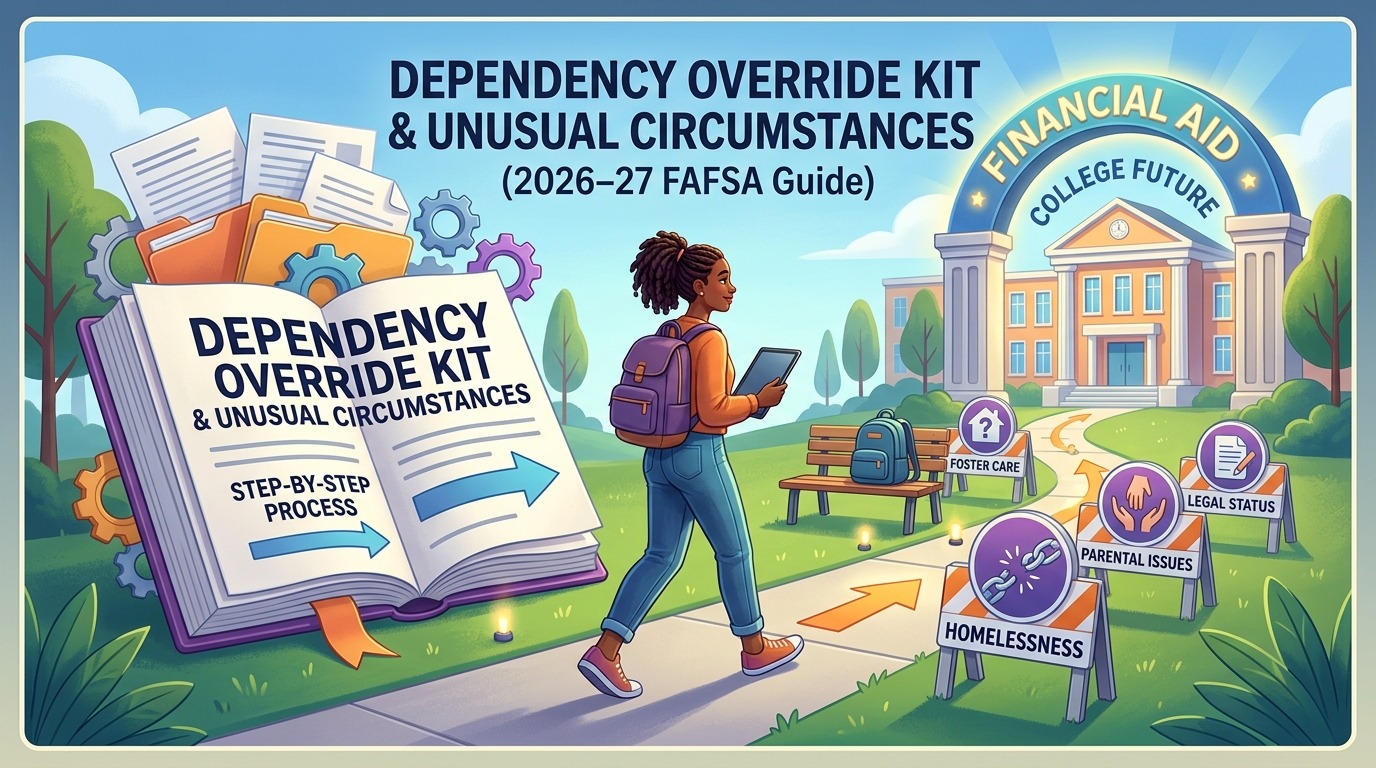
Dependency Override Kit & Unusual Circumstances: What Students Need to Know for 2026–27
If you are a high school senior filling out the FAFSA and you cannot safely contact a parent, or contacting a parent would put you at risk, you may be able to ask a college financial aid office for a dependency override. On the 2026–27 FAFSA, that issue appears under “Student Unusual Circumstances.” This is one of the most important protections in federal student aid because it gives some students a path to file without parent information and still be reviewed for aid.
This topic is easy to misunderstand, so start here: a dependency override is not for every student whose parents will not help. Federal guidance says unusual circumstances are situations where a student is unable to contact a parent or where contact with a parent poses a risk to the student. The Department of Education’s current guidance lists examples such as human trafficking, refugee or asylee status, parental abandonment or estrangement, and student or parental incarceration. It also says a school may override dependency only from dependent to independent, and the school must document the decision.
Just as important, federal guidance also says some situations do not qualify by themselves. A school cannot grant a dependency override just because parents refuse to pay for college, refuse to fill out the FAFSA, do not claim the student on taxes, or because the student is fully self-supporting. Those facts may feel unfair, but under current federal rules they are not enough on their own.
So what should a student do in 2026–27? The FAFSA form now asks directly whether unusual circumstances prevent the student from contacting parents or make contact risky. The 2026–27 paper FAFSA explains that this may apply to students who left home because of an abusive or threatening environment, were abandoned or estranged, have refugee or asylee status and are separated from parents, are victims of human trafficking, are incarcerated or have incarcerated parents where contact would pose a risk, or are otherwise unable to contact or locate parents. A student who answers “Yes” can submit the FAFSA without parent information and move forward for school review.
The fast answer
Here is the simple version high school seniors should remember:
A dependency override is the school’s decision to treat a student as independent for federal aid purposes because of unusual circumstances. A student who indicates unusual circumstances on the FAFSA can receive provisional independent status and a provisional SAI, but the school still has to make the final determination after reviewing documents. Schools are expected to review these requests as quickly as practicable, generally no later than 60 days after enrollment, and they must give students a final determination and aid offer as soon as practicable after reviewing the requested documentation.
That means the FAFSA question is the start of the process, not the end.
Dependency override vs. special circumstances
Students often mix up unusual circumstances and special circumstances, but federal student aid rules treat them differently. Unusual circumstances are about whether a dependent student can safely provide parent information. Special circumstances are about whether the financial information on the FAFSA does not reflect the family’s current reality, such as job loss, reduced income, or high medical expenses. Federal guidance specifically says a student may have both a special circumstance and an unusual circumstance.
That distinction matters because a student in crisis may need both kinds of help. For example, a student may qualify for a dependency override because of abandonment or abuse, and may also need a professional judgment review because the income year used on the FAFSA does not reflect the student’s current situation. The school decides both reviews on a case-by-case basis.
What usually counts as an unusual circumstance
Federal guidance does not give one closed list, but it does give clear examples. Current Department guidance says unusual circumstances include, but are not limited to:
- human trafficking
- legally granted refugee or asylum status
- parental abandonment or estrangement
- student or parental incarceration
- situations where the student cannot contact a parent or where contact would pose a risk to the student
The 2026–27 FAFSA form gives student-friendly examples that match this framework. It points to abusive or threatening environments, abandonment or estrangement, refugee or asylee separation from parents, human trafficking, incarceration with risk, and inability to contact or locate parents.
In practice, the strongest cases are usually the ones where the student can show that the family relationship is not just distant or tense, but truly unsafe, broken, or impossible to use for FAFSA purposes.
What does not count by itself
This is the part many families miss. Federal guidance is direct: these situations do not count as unusual circumstances by themselves:
- parents refuse to contribute to education
- parents refuse to provide FAFSA or verification information
- parents do not claim the student as a dependent on taxes
- the student is totally self-supporting
This is why students should not assume that living alone, paying their own bills, or not being claimed on taxes automatically makes them independent on the FAFSA. The 2026–27 handbook also reminds schools that simply reaching age 18 or 21 or living apart from parents does not by itself change dependency status.
If parents refuse to help, but there is no unusual circumstance
Some students do not qualify for a dependency override, but they still have parents who refuse to cooperate. In that narrower situation, the student may be considered for a Direct Unsubsidized Loan only. Federal guidance says this route can apply when parents refuse to complete the FAFSA or refuse to provide any financial support, but it does not make the student independent and does not open the door to Pell Grants, subsidized loans, or Federal Work-Study. The FAFSA student steps article says clearly that if a dependent student completes the form without parent information because parents refuse to participate, the student will be eligible for a Direct Unsubsidized Loan only.
The 2026–27 FAFSA form says the same thing. If the answer to the “Direct Unsubsidized Loan Only” question is “Yes,” the student may be reviewed only for unsubsidized loan eligibility and will not qualify for Pell, subsidized loans, or work-study through that path alone.
How the 2026–27 FAFSA process works
For 2026–27, the student workflow is more straightforward than it used to be. If a student has unusual circumstances, they can indicate that directly on the FAFSA. The 2026–27 handbook says the student may select “Yes” to Question 7, skip the parent sections, receive provisional independent student status, and then provide documentation to the financial aid office for a final determination. Federal guidance also explains that starting with the newer FAFSA system, applicants who indicate unusual circumstances can receive a provisional SAI and an estimate of aid eligibility, subject to the school’s final decision.
That means the correct order is:
- File the FAFSA.
- Indicate unusual circumstances if that truly applies.
- Submit without parent information.
- Contact the financial aid office at each school you may attend.
- Send the requested documents quickly.
- Wait for the school’s determination.
The school then decides whether to approve the dependency override. If approved, the student is treated as independent for federal aid at that institution. If denied, the student may still be limited to dependent-level Direct Unsubsidized Loan eligibility unless parent information is later provided.
The Dependency Override Kit: what students should gather
A strong dependency override request is not just a story. It is a clear, documented file. Federal guidance says schools may use documentation such as a documented interview with the financial aid administrator, court orders or official incarceration records, written statements or documented calls from welfare agencies, independent living caseworkers, programs serving victims of abuse or violence, attorneys, guardians ad litem, court-appointed advocates, TRIO or GEAR UP representatives, a prior determination from another institution, and even utility bills, health insurance records, or similar documents showing separation from parents or legal guardians.
A useful student “kit” usually includes:
1) A one-page personal statement
This should explain:
- what happened
- when it happened
- why contact with parents is unsafe or impossible
- where the student is living now
- whether the student has any third-party support person who can verify the situation
2) A short timeline
A simple timeline helps financial aid offices see the sequence clearly:
- month/year relationship broke down
- month/year student left home or lost contact
- month/year school counselor, shelter, caseworker, attorney, or other adult became involved
3) Third-party documentation
This is often the most persuasive piece. Good examples include:
- school counselor or social worker letter
- court, police, or protective order documents
- shelter or youth services letter
- foster care, caseworker, or welfare agency statement
- clergy, therapist, or attorney statement when appropriate
- TRIO or GEAR UP staff letter if they know the case
4) Proof of separation
This can include:
- lease or housing letter
- utility bills
- health insurance documents
- mail showing a different address
- records that show a long-term separation from parents
5) The school’s own form, if it has one
Federal guidance says schools must make students aware of the option to request an adjustment for unusual circumstances by posting that option publicly on their websites. So students should search each school’s site for terms like “dependency override,” “unusual circumstances,” or “professional judgment.”
What to write in your personal statement
Students often think they need to write a dramatic essay. They do not. Financial aid offices usually want a statement that is direct, chronological, and specific.
A strong statement usually does four things:
- names the circumstance
- gives a short factual timeline
- explains why parent contact is unsafe or impossible
- tells the school what documentation is attached
A useful structure looks like this:
Paragraph 1: Who you are, which award year you are requesting, and that you are asking for a dependency override due to unusual circumstances.
Paragraph 2: A short timeline of the separation, abandonment, abuse, estrangement, trafficking situation, refugee separation, incarceration-related risk, or inability to locate parents.
Paragraph 3: Why you cannot safely obtain parent information or parent signatures.
Paragraph 4: What documentation you are providing now, and whether additional documents are available.
Here is a simple model students can adapt:
I am requesting a dependency override for the 2026–27 award year due to unusual circumstances. I am unable to safely contact my parent(s), and providing parent information is not possible in my situation.
My circumstances began in [month/year]. Since then, I have been living at [general living situation only], and I have not had safe contact with my parent(s). Contact would pose a risk to me or is otherwise not possible because [brief factual reason].
Attached are statements and records that support my request, including [list documents]. I am available for an interview if needed.
A sample email students can send to a financial aid office
Subject: Request for Dependency Override Review for 2026–27 FAFSA
Hello Financial Aid Office,
I submitted my 2026–27 FAFSA and indicated that I have unusual circumstances that prevent me from safely providing parent information. I am requesting information about your dependency override process and any forms or documentation you require.
I can provide a personal statement and supporting documents. Please let me know the next steps, your preferred submission method, and any deadline I should know about.
Thank you,
[Student Name]
[Student ID if available]
[Phone]
[Email]
How schools review these requests
Federal guidance requires schools to review requests as quickly as practicable, and no later than 60 days after the student enrolls. The Department also clarified that this timeline is meant to speed reviews up, not block later requests in the award year. In other words, a student should act early, but a school is not automatically forbidden from reviewing a later-filed request.
Schools also must:
- explain their process and timeline
- provide a final determination and aid offer as soon as practicable after reviewing documents
- keep documentation for at least three years after the student’s last term of enrollment
This means students should treat the request like an admissions file: organized, complete, and submitted quickly.
What happens after approval
If the school approves the dependency override, the student is treated as independent for federal student aid at that institution. That can change Pell eligibility, loan eligibility, and the entire packaging process because parent information is no longer required for that federal aid determination.
There is also an important longer-term protection. Current federal guidance says that once a student has received an adjustment for unusual circumstances and a final determination of independence, the same institution should presume the student remains independent in later award years unless the student says circumstances changed or the school has conflicting information. The Department specifically warns schools not to create practices that delay packaging or disbursement for these returning students.
What happens if one school denies the request
A denial is serious, but it is not always the end of the road. First, ask the school whether the file is incomplete or whether the school needs more documentation. Second, if the facts truly do not meet the unusual-circumstances standard, ask whether you qualify for Direct Unsubsidized Loan only. Third, remember that another institution may review your case separately. Federal guidance says institutions may use a documented determination of independence made by a financial aid administrator at another institution in the same or a prior award year, but they still need documentation.
That matters because professional judgment is institution-based. A school’s decision is not a national automatic pass for every campus, but one approved file can help support review elsewhere if properly documented.
Dependency override is different from homeless youth status
Some students may actually fit a different independent-student path: unaccompanied homeless youth or self-supporting and at risk of homelessness. Federal guidance treats this as a separate route from a dependency override. The 2026–27 FAFSA asks about homelessness first, and the handbook says students under 24 who meet that standard may qualify as independent through that category. The handbook also explains that homelessness is broader than sleeping on the street and can include staying temporarily with others because the student has nowhere else to go.
This matters because some students who say “I’m estranged from my parents” may also meet the homeless youth standard. If a student does not have a safe, stable place to live because of family breakdown, they should review both questions carefully.
Common mistakes students should avoid
The biggest mistake is waiting too long to contact the financial aid office. Filing the FAFSA with unusual circumstances is only step one. The school still needs documents. Federal rules require review, but a school can deny requests when a student does not provide requested documentation within the applicable timeline.
The second mistake is sending a vague statement with no dates, no supporting adult, and no attached records. Federal guidance repeatedly emphasizes documentation. Even when a student’s situation is real, a weak file can slow the review.
The third mistake is using the wrong category. “My parent refuses to help” is frustrating, but it does not automatically equal “unusual circumstances.” If there is no abuse, abandonment, estrangement with risk, trafficking, refugee separation, incarceration risk, or comparable barrier, the student may be looking at the unsubsidized-loan-only route instead.
FAQs
Can I submit the FAFSA before I have all my documents?
Yes. Students with unusual circumstances can submit the FAFSA without parent information and then work with the financial aid office on documentation. The school still makes the final decision.
Will I get a real aid offer right away?
Not always. Federal guidance says students who indicate unusual circumstances can receive provisional independent status and a provisional SAI or estimate, but the school must still review the case before making the final determination.
Does being independent for tax purposes make me independent on the FAFSA?
No. Federal guidance says tax dependency is not the rule for FAFSA dependency status. A student can be independent for tax reasons and still be dependent for federal aid unless one of the FAFSA independence categories or a dependency override applies.
If my school approved me last year, do I have to start over?
Usually not at the same school. Current guidance says the school should presume continued independence in later years unless your circumstances changed or the school has conflicting information.
Can I appeal the school’s decision to the U.S. Department of Education?
For professional judgment decisions, the school’s decision is final and cannot be appealed to the Department.
Final takeaway
For 2026–27, the FAFSA is better than it used to be for students facing serious family breakdown because it now lets them identify unusual circumstances on the form and move into a provisional review path. But students still win these cases the same way they always have: by filing early, contacting each school quickly, and building a clean, factual, well-documented dependency override kit.
The smartest strategy is simple. Do not just click “Yes” and hope. File the FAFSA, email the financial aid office immediately, gather third-party documentation, and submit a clear timeline and statement. If your case is real, your file should show it clearly.
Official Resources
- Federal Student Aid: Steps for Students Filling Out the FAFSA® Form
- Federal Student Aid: Reporting Parent Information
- Federal Student Aid: How To Review and Correct Your FAFSA® Form
- FSA Partner Connect: 2026–27 Federal Student Aid Handbook, Chapter 5 Special Cases
- FSA Partner Connect: 2026–27 Federal Student Aid Handbook, Chapter 2 Filling Out the FAFSA Form