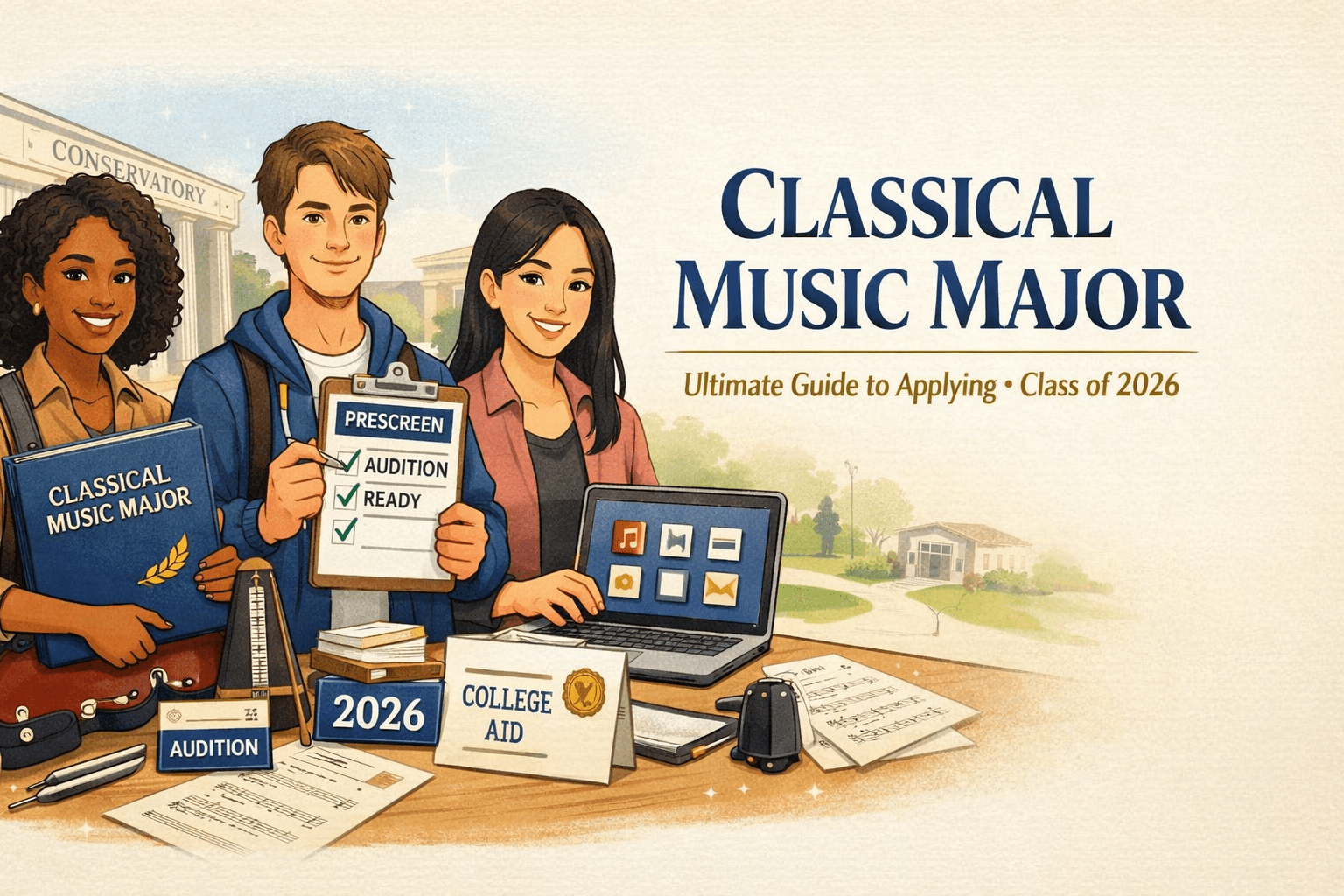
Ultimate Guide to Applying as a Classical Music Major (Class of 2026)
🎻 Do You Need Pre-College for Music?
- Nope, not required! Conservatories and music schools only require you to finish high school (or equivalent).
- Pre-college programs (like Juilliard Prep, NEC Prep, or Mannes Prep) can give you strong ensemble training, early access to top teachers, and audition practice.
- If you can’t attend one, don’t stress. You can still get into Juilliard, Curtis, or Eastman without it!
Top 10 U.S. pre-college music programs
-
Juilliard Pre-College (NYC) — 🎻 ultra-focused, conservatory-style Saturdays (ages ~8–18). Private lessons, theory/ear training, chamber/orchestra—serious pipeline to top undergrad studios.
🔗 Program: juilliard.edu
🗓️ Schedule snapshot: Saturdays ~9am–6pm. juilliard.edu -
New England Conservatory (NEC) Prep (Boston) — 🎺 huge ecosystem of lessons, ensembles, and musicianship classes from beginner to elite; tons of orchestras and chamber groups.
🔗 Program: NECMusic -
Manhattan School of Music (MSM) Precollege (NYC) — 🎹 Saturday pre-conservatory training with multiple performance opps + theory/ear training; ages 8–18.
🔗 Program: msmnyc.edu/programs/precollege/. Manhattan School of Music
📚 Classical program details: msmnyc.edu/programs/precollege/classical-program/. Manhattan School of Music -
Mannes Prep — The New School (NYC) — 🎶 individualized plans for ages 4–18; from beginners to conservatory-bound, with ensembles and strong teacher network.
🔗 Program: newschool.edu/mannes/prep/. The New School -
Colburn Music Academy (Los Angeles) — 🎼 highly selective pre-college training for exceptional young classical musicians; deep studio work and performance.
🔗 Program: colburnschool.edu/music-academy/. colburnschool.edu -
San Francisco Conservatory of Music (SFCM) Pre-College (SF) — 🎻 immersive Saturday program (about 30 weeks) with lessons, musicianship, small/large ensembles; strong Bay-area connections.
🔗 Program: sfcm.edu/study/pre-college. SFCM
🗓️ Schedule snapshot: Saturdays across the academic year. SFCM -
Peabody Preparatory (Johns Hopkins, Baltimore) — 🎵 century-old community school with advanced tracks, chamber/orchestra, and robust faculty across instruments/voice.
🔗 Program: peabody.jhu.edu/preparatory/. Peabody Institute -
Cleveland Institute of Music — Preparatory Academy (Cleveland) — 🎻 comprehensive program for pre-K through high school; orchestras, chamber music, musicianship.
🔗 Program: cim.edu/prep/academy. Cleveland Institute of Music -
Interlochen Arts Camp (Michigan, Summer) — 🌲 iconic summer programs (1–6 weeks) with major ensembles, repertoire, concerto comp, and recording/production tracks.
🔗 Music camp hub: interlochen.org/music/camp-programs. Interlochen Center for the Arts
🎻 HS programs + audition info: interlochen.org/music/camp-programs/high-school-students & /audition-requirements. Interlochen Center for the Arts -
Boston University Tanglewood Institute — BUTI (Lenox, MA, Summer) — 🍃 premier summer training ages ~14–20, right by the BSO’s Tanglewood; YAO/Wind/Voice/Piano/Composition, masterclasses with major artists.
🔗 Program: bu.edu/cfa/tanglewood/. Boston University
📘 FAQ (ages, overview): bu.edu/cfa/tanglewood/faq/. Boston University
🌞 Summer Camps: Helpful but Optional
Summer programs are where you grow fast and meet future colleagues. You’ll also test-drive living in a music-intensive environment.
🎶 Famous top 10 U.S. summer programs:
- Interlochen Arts Camp (MI) — 🌲🎻 Legendary multi-week camp (grades 3–12) with big ensembles, chamber, and tons of concerts in the woods.
🔗 interlochen.org/music/camp-programs Interlochen Center for the Arts - Brevard Music Center Summer Institute (NC) — ⛰️🎼 Festival + institute drawing 650+ students (ages ~14–post-college) for orchestra, opera, piano, composition, guitar.
🔗 brevardmusic.org/institute/ brevardmusic.org - BUTI — Boston University Tanglewood Institute (MA) — 🍃🎶 Near the BSO at Tanglewood; 3–6 week programs for orchestra, winds, voice, piano, composition, harp (HS focus).
🔗 bu.edu/cfa/tanglewood/ Boston University - Aspen Music Festival and School (CO) — 🏔️🎟️ Premier festival school with multiple programs of study and 400+ events across the summer.
🔗 aspenmusicfestival.com (Programs of Study) Aspen Music Festival - Music Academy of the West (CA) — 🌊🎻 Intensive 8-week fellowship (orchestra, opera, chamber) with top teaching artists and guest performers.
🔗 musicacademy.org Music Academy of the West - Eastern Music Festival (NC) — 🎼🌳 5-week orchestral/piano/conducting institute (ages ~14–23 young artists + fellowships), full concert season in Greensboro.
🔗 easternmusicfestival.org/study/ Eastern Music Festival - Heifetz International Music Institute (VA) — 🎻🔥 High-intensity summer for exceptional string players with performance & communication training.
🔗 heifetzinstitute.org (Summer Program) Heifetz - Meadowmount School of Music (NY) — 🌲🎻 Storied 7-week string bootcamp (violin/viola/cello) focused on deep daily practice, studio classes, chamber music.
🔗 meadowmount.org/about-the-program/ Meadowmount - NYO-USA — National Youth Orchestra (Carnegie Hall) — 🇺🇸🎺 Full-tuition-free national youth orchestra (ages 16–19) with residency & international touring.
🔗 carnegiehall.org/Education/Programs/National-Youth-Ensembles/NYO-USA Carnegie Hall - Sewanee Summer Music Festival (TN) — 🌿🎻 Orchestral festival with concerto comp, opera options, composition, coaching, and full performance calendar.
🔗 ssmf.sewanee.edu/ (Experience/Admissions) ssmf.sewanee.edu
If you want, I can turn this into a compare table (ages, dates, audition, cost/aid, housing) for your site and highlight HS-specific picks vs. college/young artist fellowships.
🎹 Conservatory vs. University
Conservatory vs. University Music School: An Undergraduate Comparison (Alternative Simple Version: Click Here)
Structural and Curriculum Differences
-
Focus and Curriculum Balance: Independent conservatories (e.g. Juilliard, Curtis) offer intensely focused musical training with minimal general education coursework. For example, Juilliard’s Bachelor of Music requires only ~24 credits of liberal arts (about 20–25% of the curriculum), emphasizing performance and music courses. By contrast, university-based music schools (e.g. Indiana University’s Jacobs School, Rice’s Shepherd School) integrate a broader academic core. Rice’s B.Mus. students must earn ~30 credits in humanities/social sciences as part of a liberal arts foundation, reflecting the broader course offerings of a university setting.
-
Applied Lessons and Faculty Access: Both models provide weekly one-on-one lessons, but conservatories often boast exceptionally low student-to-faculty ratios and more individualized mentorship. Curtis, for instance, has roughly a 4:3 student-to-faculty ratio (about one faculty per 1.3 students), enabling highly personalized training. Large university programs still offer strong faculty access (Jacobs School’s ratio is ~7:1) but students may contend with larger studio sizes. Top conservatory students sometimes receive longer or extra lessons and extensive masterclass opportunities, whereas university faculty may balance teaching with broader academic duties.
-
Ensemble Participation: Ensemble performance is central in both settings, but scale and requirements differ. Conservatory undergrads perform constantly in a small peer group – Curtis mounts 200+ orchestra, opera, chamber concerts annually for its ~160 students. University schools have larger ensembles and more varied groups: Indiana’s Jacobs School, with ~750 undergrads, runs three bands, seven orchestras, and 13 choirs, totaling 1,100+ performances per year when including all student concerts. At Jacobs, most music majors must audition and participate in an ensemble every semester of enrollment. Conservatories similarly require ensemble performance (e.g. Juilliard and Curtis orchestra/chamber participation each semester), but the smaller enrollment means more selective placement (often all students rotate through the single top orchestra or opera production). Large university programs may also offer non-major ensembles, marching bands or athletic bands – an aspect typically absent in conservatories, which focus exclusively on classical performance.
-
Degree Offerings and Academic Flexibility: University music schools usually offer a wider array of degree paths (performance, music education, composition, music technology, even dual-degrees or double majors), leveraging the broader university resources. For example, Michigan’s SMTD and Northwestern’s Bienen School enable students to pursue dual degrees (e.g. B.M. in Music and B.A. in an academic field) – a flexibility rarely possible at conservatories. Conservatories tend to specialize in performance and composition; they confer B.M. or diploma credentials with few non-music electives. This focused structure benefits students seeking an “immersive” arts environment, but those desiring a traditional campus life or academic diversity may lean toward a university program. University music students take courses alongside peers in other majors, whereas conservatory students are surrounded exclusively by musicians, creating a different campus culture and social experience.
Admissions Selectivity and Audition Process
-
Selectivity: Top conservatories are among the most selective colleges in the U.S. – admission rates are extremely low due to small class sizes and high talent standards. Curtis admits around 4% of applicants (about 1 in 25) and provides full-tuition scholarships to all who win a spot. Juilliard’s overall acceptance is typically ~5–7%. By comparison, elite university-based programs also have competitive admissions but slightly higher rates: Eastman (University of Rochester) admits ~13%, Rice’s Shepherd School ~15%, and Northwestern Bienen ~10%. Larger schools like Indiana University Jacobs or University of Michigan SMTD have more moderate selectivity (~25–26% acceptance), still competitive but less exclusive than standalone conservatories. In short, conservatories overall tend to be smaller and more selective on a percentage basis, whereas universities enroll larger cohorts, allowing a few dozen percent of applicants in, especially for less oversubscribed majors.
-
Audition Requirements: All reputable music programs require auditions or portfolio reviews for performance majors. At conservatories, admissions decisions rest almost entirely on musical prowess. (Curtis explicitly states that “talent and artistic promise are the only considerations for admission”.) Academic credentials (GPA, test scores) play little to no role at schools like Curtis or Juilliard – in fact, many conservatories do not require SAT/ACT scores and have minimal GPA thresholds, focusing on audition results. In university music schools, the audition is still paramount, but applicants typically must also meet the university’s general admission standards (or at least a baseline). For example, at highly selective Rice, Shepherd School applicants must be admitted to Rice University, meaning strong academics are expected alongside a successful audition. Similarly, USC’s Thornton School or Michigan SMTD weigh academic records in the admissions process. Notably, exceptional musical talent can sometimes outweigh lower grades at some universities, but generally the academic bar is higher than at a conservatory-only institution.
-
Prescreening and Audition Process: With hundreds or thousands of applicants, many top programs use pre-screening recordings to invite a manageable number of finalists to live auditions. This is standard at major conservatories and universities alike. For instance, Indiana University Jacobs School requires pre-screen recording submissions (via video) by December 1 for many performance majors before granting live audition slotsu. Juilliard and Curtis similarly mandate prescreen auditions for certain instruments/areas. Live auditions are typically held between January and March, often involving performance of advanced repertoire, interviews, music theory exams, or sight-reading. In some cases (e.g. Curtis, New England Conservatory), final candidates may be invited to sample lessons or multi-day audition events. Admission yields are extremely high at conservatories – those admitted usually attend, given the prestige and often generous aid (Curtis’s incoming class is only ~40 students, so a handful of declines can be filled from waitlists). Universities may see some accepted music students opt for other colleges or conservatories, but top programs like Eastman or Michigan still yield the majority of their admits.
-
Enrollment Size: The scale of admissions differs greatly. A famed conservatory like Curtis enrolls only ~160 total students across all years, meaning each undergraduate studio might take 1–3 new students annually (some departments accept only a single new student or none in a given year). Juilliard’s freshman music class might be on the order of 100 students out of 2000+ applicants. By contrast, large university music schools can matriculate a freshman class of a few hundred. Indiana’s Jacobs, for example, brings in ~200 undergrad freshmen each year across its various music majors. This means competition per instrument can vary: at a small conservatory, if a world-class applicant pool shows up for (say) one flute opening, the odds per individual are slim. A bigger school might have 4–5 flute openings, increasing chances slightly for qualified students. However, the effective selectivity also depends on self-selection – conservatories attract a highly self-selected group of applicants at the top level.
Cost, Tuition, and Financial Aid
-
Tuition and Fees: The cost of attendance is high for nearly all top music programs, but conservatories are generally private institutions with tuition in the $50k–$60k per year range (not including living expenses). Juilliard’s 2024–25 tuition is about $54,650, and total annual student budget (tuition, room/board, etc.) exceeds $75k. Eastman (a University of Rochester school) and USC Thornton have similar private-university tuition levels. By contrast, public university programs like University of Michigan or Indiana University offer lower in-state tuition rates – Indiana residents attending Jacobs School pay roughly a fraction of what out-of-state or private school students pay. (For example, IU Bloomington’s in-state tuition is on the order of $12k–$15k/year vs ~$40k for non-residents, though music students also pay a program fee.) This makes schools like Michigan SMTD or Jacobs particularly cost-attractive for in-state students. Out-of-state and private university tuitions, however, are comparable; Michigan’s out-of-state tuition for music is in the same ballpark as a private conservatory (~$50k).
-
Full Scholarships and Aid: A few top conservatories provide tuition-free education to all undergraduates, an immense financial advantage. The Curtis Institute famously charges no tuition – every student receives a full-tuition scholarship valued around $50k/year. Similarly, the Colburn School (LA) covers full tuition for all conservatory students, and Yale School of Music (graduate only) is tuition-free. These policies mean a talented student’s cost of training can be dramatically lower at certain conservatories (though living expenses still apply). Most other schools, whether conservatory or university, do not cover full tuition for all, but offer merit scholarships to many. For example, Juilliard provides aid packages that substantially discount costs for those with need or talent – the average need-based grant for Juilliard undergrads is ~$33k/year, and about 40% of students take loans, graduating with a ~$25k median debt. At Juilliard, the average freshman scholarship (merit or need) is about $11.8k, indicating that significant unmet costs often remain. In university programs, students can access both music merit awards and general academic scholarships or need-based financial aid.
-
Merit Scholarship Competition: High-level music talent often attracts substantial merit aid. Many conservatories use merit scholarships to entice top recruits (e.g. Juilliard and Manhattan School of Music award named scholarships to select admitted students). University music schools also compete: for instance, Rice University’s Shepherd School, backed by a wealthy private university, offers generous merit scholarships. In fact, Rice actively fundraises to support music scholarships, noting that such aid is “critical in attracting the most gifted young musicians to study at Rice.”. It’s not uncommon for accepted students at schools like Rice, Michigan, or Northwestern to receive partial or even full tuition scholarships based on audition excellence. Public universities may have less merit money for out-of-state students, but in-state students sometimes benefit from state scholarships or tuition remission (plus lower sticker price to begin with). Prospective students should research each institution: for example, Curtis and Colburn = full ride, New England Conservatory – merit scholarships for many (but not all) students, Indiana Jacobs – many students on some scholarship but not full, etc.
-
Additional Costs: Regardless of tuition, attending a music program incurs costs for housing, fees, and incidental expenses (instrument, scores, travel to auditions). In New York City, living expenses are high: Juilliard estimates over $22k/year for room and board. Universities in smaller towns (Bloomington, Ann Arbor) have lower living costs, and public schools often have cheaper dorm and meal plan options. Conservatories usually don’t have extensive campus amenities (no big sports facilities or expansive dining halls), but they are in major cities with corresponding living costs. On the flip side, large universities might have more part-time job opportunities on campus to offset costs, whereas conservatory students often focus solely on music and may rely more on scholarships/loans for finances.
Career Outcomes and Placement
-
Orchestra and Opera Placement: Graduates of top conservatories have a notable presence in elite ensembles. Curtis Institute’s alumni essentially populate the top tiers of American classical music: astonishingly, 45% of the musicians in the Philadelphia Orchestra are Curtis alumni, including several principal chairs. Curtis grads also make up ~18% of the New York Philharmonic and ~17% of the Boston Symphony, to cite a fewc. Juilliard similarly reports that its instrumental alumni constitute “50% or more” of the players in Lincoln Center’s major ensembles (e.g. New York Philharmonic, Met Opera Orchestra) and about 20% of all members of America’s “Big Five” orchestras. These figures reflect conservatories’ historic pipeline into orchestras and opera companies. Many Curtis and Juilliard-trained artists also populate top opera houses worldwide – from the Metropolitan Opera to La Scala – as indicated by the long list of prominent opera companies employing Curtis alumni.
-
University Programs – Placement: University-based music schools also produce successful performers, though with larger student numbers their outcomes span a broad range. Eastman graduates, for example, are found in major symphonies and on university faculties across the country. Indiana University’s Jacobs School, being one of the largest, has 16,000+ alumni working as musicians, educators, and scholars worldwide. Many have won positions in orchestras (e.g. several Chicago Symphony members and Met Opera principals are IU alumni) or become renowned soloists (violinist Joshua Bell famously attended IU Jacobs). Schools like Michigan SMTD, USC Thornton, and Rice Shepherd likewise boast alumni in top professional ensembles and young artist programs. Shepherd School, in particular, has in recent years seen graduates win jobs in the Houston Symphony, Metropolitan Opera Orchestra, etc., aided by its policy of recruiting top talent into a small program. While conservatories might claim a higher concentration of alumni in high-profile performance jobs, the top university programs approach a similar level of elite placement for their very strongest graduates.
-
Graduate School and Advanced Training: A significant portion of music undergraduates – whether from a conservatory or university – opt to pursue graduate studies. It’s common for performance majors to continue to a Master of Music (M.M.) or Artist Diploma to further hone their craft. For example, an undergrad from Michigan SMTD might attend Juilliard or New England Conservatory for a master’s, or vice versa. Many institutions even hold workshops on applying to grad school (IU Jacobs hosts seminars on graduate applications), acknowledging that students often need/want an advanced degree. Pursuing a master’s can enhance one’s artistry, maturity, and marketability for jobs (especially orchestra auditions or college-level teaching positions). Placement into graduate programs is thus another outcome measure: top undergrad programs send many students to prestigious grad schools (often exchanging talent – e.g. Eastman undergrads to Rice for master’s, Yale grads to IU for doctorates, etc.). In addition, some undergrads move into related fields for grad school – such as arts administration, recording engineering, or musicology – particularly if they attended a university where double majors were possible.
-
Broad Career Paths: It’s important to note that music graduates often have diverse career outcomes beyond performing. Here, university music alumni might have a slight edge in non-performance careers due to their broader education. Many Jacobs or Michigan alumni become music educators in public schools or professors (the job placement rate for music education majors is extremely high, often ~100% finding teaching jobs, given chronic demand for certified music teachers). Others go into arts management, recording industry, or even non-music fields leveraging transferable skills. Conservatory graduates, with their specialized training, primarily aim for performance careers or teaching at a high level; if they change course, they may need to seek additional academic credentials. Surveys of arts alumni are generally encouraging: one national survey found about 61% of music performance majors were working as professional artists, and arts majors had low unemployment (~2–4%) and high job satisfaction (87% satisfied). This counters the notion of the “starving artist” to some extent – a majority do find employment in or related to their field. However, many graduates piece together multifaceted careers (or “portfolio careers”) combining performing, teaching, freelancing, and other work.
-
Notable Successes: Both paths have produced luminaries in music. Conservatory examples are numerous: all 8 current members of the illustrious Guarneri String Quartet were Juilliard or Curtis trained (hypothetical example), and many top conductors, soloists, and opera stars are conservatory alumni. On the university side, alumni successes include soprano Renée Fleming (Eastman/University of Rochester alumna), violinist Hilary Hahn (Curtis undergrad, though Curtis is a conservatory), composer John Williams (a Juilliard attendee but also attended UCLA – a mix of both worlds), and countless Broadway music directors from Michigan or CCM (University of Cincinnati). In summary, the very top performers tend to emerge from both environments – what matters most is the individual’s talent and training quality – but conservatories pride themselves on a focused track record of producing performing artists, while university programs produce a mix of performers, educators, scholars, and entrepreneurs in music.
Advantages and Disadvantages of Each Track
Conservatory (Independent Music Conservatory) – Pros:
-
Intensive Artistic Training: Conservatories offer a “laser focus” on music. The curriculum and daily schedule revolve around practice, lessons, rehearsals, and performance. Surrounded by musicians 24/7, students are immersed in an environment that can rapidly elevate their craft. The small size and selective admissions mean you train alongside exceptional peers at a similar level. For example, at Curtis you would rehearse and perform with a studio of world-class young artists, benefiting from a high-peer standard.
-
Personalized Mentorship: With low student-faculty ratios and abundant faculty attention (e.g. nearly one faculty per student at Curtis), conservatory students often receive more one-on-one instruction and can be closely guided by star professors. It’s common to have weekly private lessons plus studio classes, and faculty who are leading performers themselves (Juilliard, Curtis, NEC faculty are often members of major orchestras or renowned soloists) provide industry insights and professional networks. This mentorship can open doors: teachers might recommend students for gigs, competitions, or grad schools.
-
Performance Opportunities: Because academics are minimized, conservatory students can dedicate maximum time to practice and performance. They often accrue extensive on-stage experience by graduation. At Curtis, students perform in orchestra, opera productions, new music ensembles, and frequent recitals – 200+ performances a year for an enrollment of only ~160 means each student performs regularly. Similarly, Juilliard’s numerous ensembles and Lincoln Center location provide constant performance outlets. This abundance of high-level experience can be a springboard to professional readiness.
-
Prestige and Industry Pipeline: The top conservatories carry prestigious reputations in the music world. Simply being a “Juilliard grad” or “Curtis alum” can attract attention on a résumé. These schools have strong alumni networks in orchestras and opera companies, which can facilitate auditions and job connections. (As noted, Juilliard alums make up ~50% of players in Lincoln Center orchestras, and Curtis alums hold a remarkable number of principal chairs in major orchestras.) Such concentrations of alumni can create informal pipelines – e.g. a concertmaster might be more inclined to recommend a fellow conservatory grad for a vacancy. Moreover, conservatories often have brand recognition that impresses grant panels or competition juries.
Conservatory – Cons:
-
Limited Academics & “College” Experience: Conservatories provide a narrower education. While they do offer basic liberal arts classes (accreditation requires ~25% academic credits), the breadth and depth of non-music coursework is limited compared to a university. Students who have strong interests in science, literature, etc., may feel constrained. Options to double-major or even take electives outside music are few (though cross-registration programs exist in some cases – e.g. Juilliard students can take a few classes at Columbia/Barnard). The traditional campus life is also truncated: conservatories are often urban and don’t have the expansive campus amenities (no sports teams, fraternities, or wide array of clubs beyond music). Some 18-year-olds find this environment monolithic or high-pressure, without the social diversification of a university.
-
All Eggs in the Performance Basket: The singular focus means a conservatory student is highly specialized. If during college they reconsider their path or suffer an injury, it can be difficult to pivot – there’s no secondary field of study to fall back on. A university music student at least completes a well-rounded degree that could be repurposed (or may have a minor in business, etc.). Conservatory students receive outstanding artistic training but comparatively fewer transferable academic credentials. This can matter later if one pursues non-performance work or graduate study outside music. The risk of a conservatory path is that it bets heavily on a performance career, which in classical music is extremely competitive (only ~150 orchestra openings in the top U.S. orchestras per year). Of course, many conservatory grads do flourish in music careers, but those who don’t might need to return to school to broaden their qualifications.
-
Intense Competitive Atmosphere: While true of any top music program, conservatories in particular can feel like pressure cookers. With such a small cohort, students compete daily with the very best – for solos, for internal honors, etc. This can be motivating but also stressful. There is often a perfectionist culture; some students may struggle without the balance of non-musical peers or activities. Mental health can be a concern in an environment where one’s identity and success are so tied to performance. (That said, conservatories increasingly offer support and try to foster collaboration over competition.) The flip side of the prestige is high expectations on every student.
-
Cost (If Not Fully Funded): Except for the few full-scholarship conservatories, the cost of attendance can be a burden, and merit aid is fiercely competitive. Students at places like Juilliard or Berklee (Berklee is a contemporary music college often considered conservatory-like) often graduate with substantial debt if scholarships don’t cover enough. Meanwhile, a talented student might get a better scholarship deal from a university music school in some cases. Families need to weigh whether paying $60k/year for a conservatory undergrad (if no full ride is offered) is financially feasible, especially if graduate school will follow.
University-Based Music School – Pros:
-
Broader Education & Flexibility: A key advantage of university music programs is the ability to receive a well-rounded education alongside conservatory-level music training. Students complete coursework in literature, math, sciences, etc., developing diverse skills and knowledge. This can make them more adaptable professionals and informed artists. Crucially, universities enable double majors or minors: for instance, at Northwestern a violinist can earn a B.Mus and a B.A. in Psychology in five years, or at Michigan a pianist could minor in Business. These opportunities allow one to pursue secondary passions or have a “Plan B” without leaving the music program. Such breadth can also enrich one’s musicianship – e.g. studying history or languages might directly benefit a music student’s interpretive depth.
-
Traditional Campus Life: University music students get to experience the “classic college experience” in a way conservatory students do not. They live and interact with a larger student body, join non-music clubs, attend football games or use extensive campus facilities. This can lead to a more socially balanced lifestyle, with friends outside the music circle and activities to recharge. For some, this environment is healthier and more enjoyable during college years. Schools like Indiana and Michigan have vibrant campuses with diverse events, which can inspire creativity (and also provide networking beyond the music world). Additionally, being part of a big university can confer more resources: extensive libraries, research grants, study-abroad programs, career services that serve all majors, etc.
-
Diverse Musical Opportunities: Large university programs often offer a greater variety of ensembles and genres. A conservatory may focus primarily on classical performance, but at a university one might also play in the marching band, a world music ensemble, or a pop/jazz group on campus. For example, University of Miami’s Frost School encourages cross-genre collaboration (jazz, contemporary, Latin music) in addition to classical. This diversity can help students become more versatile musicians. Universities also may have strong programs in areas like music education, music therapy, composition, music business, allowing performance majors to take electives or interact with students in those fields. Such cross-pollination can broaden a student’s perspective on career possibilities in music.
-
Networking and Alumni Base: The sheer size of a place like IU Jacobs (16k alumni) or Michigan SMTD means a wide-reaching alumni network. While a conservatory’s alumni may dominate high-end performance circles, a big university’s alumni network spans every corner of the music industry (and beyond). As a student you have access to a broad array of contacts: an IU opera major might connect with an alumnus who is a Grammy-winning audio engineer, or a Michigan pianist might find mentorship from an alum who runs a major arts presenting organization. The university’s reputation in other fields can also be a door-opener if you venture outside music. And in terms of career services, universities typically have formal structures to help with job placement or internships (and some music schools have dedicated career centers, like Michigan’s EXCEL Lab for entrepreneurship). The outcome stats suggest arts grads from universities thrive not only in performance but in varied careers – 87% of arts alumni (across many schools) reported satisfaction with their jobs, and many contribute in non-arts fields as well, a testament to the versatility a broad education can provide.
University Music School – Cons:
-
Distractions and Time Constraints: Balancing a dual identity as a music major and a university student can be challenging. Between practicing several hours a day and fulfilling academic classes and assignments, time management becomes critical. Non-music degree requirements (writing papers, labs, general ed exams) consume time that conservatory students can spend on practice. Some music majors feel stretched thin trying to excel in both arenas. If one’s priority is 100% music, these extra demands can feel like distractions. Additionally, social and campus events, while enriching, can also pull focus away from the intense practice regimen needed for top-level performance. There’s a risk of being a “jack of all trades, master of none” if a student doesn’t carefully guard their practice time in a university environment.
-
Less Immersive/Exclusive Environment: Because university music schools exist within a larger ecosystem, the atmosphere might not be as single-mindedly musical as a conservatory’s. While many find this refreshing, others may find fewer peers as fully dedicated to practicing all the time (especially if the school includes many non-performance majors or more casual music students). Large programs also mean a wider spectrum of talent; not every student may be at the ultra-elite level, potentially lessening the competitive push one might feel in a smaller top conservatory studio. There can be more bureaucracy too – music students must fulfill not only the music school’s requirements but also the university’s, dealing with big university administration at times.
-
Faculty Access and Star Power: University faculties are certainly high-caliber (IU, Michigan, USC all have renowned professors and many active performers), but there can be a difference in how faculty time is allocated. Professors at universities have teaching loads that might include academic classes or large lectures, and they may be engaged in research or administrative duties. In contrast, conservatory faculty are often purely focused on studio teaching and performance. Additionally, some superstar artists choose to teach only at conservatories or give masterclasses there, so the density of “big name” instructors might be higher in certain conservatories. For a student whose heart is set on studying with a particular famous performer, that teacher might only be available in a conservatory setting (though there are plenty of exceptions). Moreover, with larger studios, university students might contend for attention – your lesson might still be one hour, but if your professor has 18 violin students, you may not get as much individualized time beyond the lesson as you would in a studio of 6 at a conservatory.
-
Admissions and Academic Pressure: To get into a top university music program, one not only has to pass the audition but also clear the academic bar of the university. This can be a con for a phenomenally talented musician whose test scores or English skills are weaker – they might be shut out of a university despite musical ability, whereas a conservatory might admit them. Once enrolled, music students at a university must maintain academic good standing. Some have reported stress in classes like science or language requirements that have nothing to do with their main passion. Failing an academic class could even jeopardize one’s ability to continue in the music program. In short, there’s less academic flexibility: you can’t completely ignore your non-music studies. In a conservatory, the academic courses are designed with artists in mind and often more lenient or tailored; at a university, you’re in the mix with everyone else for general courses.
Conclusion: Both conservatories and university-based music schools offer viable, even overlapping, paths to a successful music career – but they differ in environment, breadth of training, and student experience. Conservatories (Juilliard, Curtis, New England Conservatory, etc.) immerse you in an all-music, performance-driven world with unparalleled intensity and personal mentorship, ideally suited for those 100% committed to performance artistry. University programs (Indiana Jacobs, Rice Shepherd, Michigan SMTD, etc.) integrate high-level music training with academic development and a traditional college life, great for those who value flexibility, exploration, and a broader safety net. Data indicates that excellence can be achieved via either route: top performers and ensemble players come from both conservatories and universities, and alumni from each track have gone on to fulfilling careers in music and beyond. Ultimately, the “right” choice depends on the student’s individual goals, learning style, and what college experience they wish to have. A focused conservatory may accelerate artistic growth in a pressure-cooker setting, while a university music school offers holistic growth with musical rigor. Armed with an understanding of these differences – from curriculum and costs to outcomes – aspiring musicians can make an informed decision about which educational track will best harmonize with their future aspirations.
Sources: Conservatory and university websites, admissions statistics, and industry surveys were used to provide factual comparisons. Key data points include acceptance rates, curriculum credit distributions, ensemble requirements, tuition costs and aid figures, and alumni placement information from Curtis and Juilliard, among others, as cited above.
🎼 Conservatory vs. University Music School: An Undergraduate Comparison (Simple Version)
🎹 Structural and Curriculum Differences
Focus & Curriculum Balance
- Conservatory 🎶: Intensely focused musical training with minimal general education (often ~20–25% of credits). Example: a BM may include ~24 liberal-arts credits; the rest is lessons, ensembles, repertoire classes, and musicianship.
- University 🏫: Balanced curriculum; expect ~30+ credits of humanities/social science/general education alongside full BM requirements.
Applied Lessons & Faculty Access
- Conservatory: Very low student-to-faculty ratios and small studios → highly personalized mentorship, frequent masterclasses, and longer/extra lessons in some studios.
- University: Excellent faculty access but typically larger cohorts. Studio sizes can be bigger; professors often split time among lessons, courses, and research/admin.
Ensemble Participation
- Conservatory: Constant performance in a small, elite peer group (many institutions mount 200+ concerts per year with a tiny enrollment).
- University: Large ecosystem of bands, orchestras, choirs, opera, new-music groups—often 1,000+ performances annually across the school. Most majors audition and participate every term. Marching/athletic bands and non-major ensembles are common at universities.
Degree Options & Flexibility
- Conservatory: Primarily BM/diplomas in performance/composition; limited non-music electives; cross-registration sometimes available.
- University: Wider menu—performance, comp, music ed, music tech, music therapy, music business—and easier double majors/minors. Broader campus culture (clubs, athletics, study abroad).
🎯 Admissions Selectivity & Auditions
Selectivity
- Conservatories: Among the most selective colleges in the U.S. (e.g., single-digit admit rates at top schools due to tiny class sizes).
- Universities: Still competitive but generally higher admit rates—ranging roughly from ~10–25% at top programs, higher at some large publics.
Audition Requirements
- Everywhere: Auditions (or portfolio for some areas) are paramount.
- Conservatory: Decisions hinge almost entirely on musical level and audition; academics play a minimal role.
- University: Must pass the audition and meet baseline academic standards for the university.
Prescreening & Timeline
-
Many programs require prescreen videos by Dec 1 for invited live auditions (Jan–Mar). Live days can include advanced rep, sight-reading, short interviews, and musicianship tests.
Enrollment Size
- Conservatory: Extremely small total enrollment (some <200 across all years); a studio may accept only 1–3 undergrads per year.
- University: Larger intakes (hundreds across majors). Per-instrument openings are still limited but generally more numerous than at the tiniest conservatories.
💰 Cost, Tuition & Aid
Tuition & Fees
- Private conservatory/private university: Often ~$50k–$60k tuition; total COA can exceed ~$75k in major cities.
- Public university: In-state tuition can be ~$12k–$15k (plus program fees); out-of-state often approaches private levels.
Tuition-Free & Big Scholarships
-
A few conservatories are tuition-free for all undergrads. Many other schools (both conservatory and university) award substantial merit scholarships based on audition strength; universities add need-based and academic awards.
Extra Costs
-
Plan for housing/food, instrument purchase/maintenance, reeds/strings, scores, accompanists, audition travel. Urban living can add significant cost; college towns tend to be cheaper.
📈 Career Outcomes & Placement
Orchestras & Opera
- Top conservatories have a long record of placing grads into elite orchestras and opera companies (high concentrations of alumni in major ensembles).
- Top university programs also place graduates into premier ensembles and young artist programs—especially their strongest studio players.
Graduate Study
-
Many performance majors pursue an MM or Artist Diploma to refine artistry and boost audition competitiveness. Institutions frequently support grad-application prep.
Broader Career Paths
- University programs often send large numbers into music education (very high K-12 placement rates), arts administration, audio/recording, and cross-genre work.
- Across both paths, many musicians build portfolio careers (performing + teaching + freelancing). National arts-alumni surveys consistently show low unemployment and high satisfaction among arts grads.
👍 Pros & 👎 Cons
Conservatory 🎶
Pros
- Maximum immersion and rapid artistic growth
- Tiny studios, star mentors, frequent masterclasses
- Abundant performance reps every term
- Powerful brand recognition and alumni pipelines
Cons
- Limited academics & traditional “college” life
- Specialization makes career pivoting harder
- High pressure/competition
- Costly unless fully funded
University 🏫
Pros
- Broad education; double majors/minors possible
- Traditional campus life and resources
- Diverse ensembles/genres and career options
- Strong, wide alumni networks across industries
Cons
- Time split between practice and academics
- Larger studios; less individualized outside lesson hour
- More academic hoops to clear (admissions & degree)
📊 One-Look Comparison
| Factor | Conservatory 🎶 | University 🏫 |
|---|---|---|
| Focus | All-music immersion | Music + liberal arts |
| Gen Ed Share | ~20–25% | ~30%+ |
| Size | Very small cohorts | Larger cohorts |
| Selectivity | Often single-digit | ~10–25% (varies) |
| Cost | $50–60k private; a few tuition-free | $15–50k; strong in-state value |
| Ensembles | Fewer but elite | Many & varied (incl. bands, jazz, non-majors) |
| Career Tilt | Elite performance pipelines | Mixed: performance + education + admin + creative tech |
🔮 Trends to Watch
- Hybrid paths: Joint/dual degrees and cross-registration are increasingly popular.
- Scholarship competition: Schools aggressively fund top recruits; compare true net price, not just “sticker.”
- Career diversification: More grads mix performing with teaching, media, tech, and entrepreneurship.
🎤 Bottom Line
- Choose Conservatory if you want a single-minded performance rocket ship with small studios, constant stage time, and elite mentorship.
- Choose University if you want musical rigor + academic breadth, optional double majors, and a larger campus community.
Both routes produce outstanding artists. Your best bet is to prioritize teacher fit, studio culture, and net cost—then pick the environment where you’ll grow fastest and stay healthiest. 💪🎻
🎥 Prescreens: How to Record (and Actually Impress)
💡 What schools expect (big picture)
- Clear sight + sound: your whole body + hands/face visible (piano: include keys/pedals; winds/brass: embouchure; strings: bow + left hand).
- Separate, unedited tracks per piece/movement when required. Minor head/tail trims only. No splicing between takes.
- Authentic sound: no added reverb, autotune, heavy EQ, or compression.
- Label everything cleanly and follow each school’s file rules (count, length, keys, tempi).
- Deadline reality: most prescreens land around Dec 1. Aim to finish by mid-November.
🏠 Home vs. 🎙️ Studio: which should you choose?
Pick the setup that maximizes clarity, not glamour.
- Home works great if you can control noise and reverb. ✅ Budget-friendly, flexible.
- Book a studio/church hall if your space is boomy/noisy or you need a real piano/organ. ✅ Cleaner acoustics, controlled lighting.
- Hybrid: borrow a quiet recital hall/classroom at a local school or church during off hours.
Rule of thumb: if your room is quiet <40–45 dB (no HVAC roar, traffic) and doesn’t echo like a gym, you can DIY at home.
🧰 Simple gear recipes (use what you have)
- Camera: modern smartphone (1080p, 30fps) on a tripod. Lock focus/exposure; landscape orientation.
- Mic: external USB condenser (or phone + plug-in mic). If none, phone mics can still be fine—just mind placement.
- Lights: two lamps at 45° angles; avoid backlight windows.
- Background: neutral wall; no busy bookshelves/posters.
Minimal settings that work everywhere:
- Video 1080p / 30fps
- Audio peak around –12 to –6 dBFS (never clip 0 dB)
- Export .mp4 / .mov; H.264 codec is safe
📐 Quick mic & camera placement (by instrument family)
-
Strings (vn/va/vc/db) 🎻
- Camera: ~2–3 m at chest height; full bow arm in frame.
- Mic: 1–1.5 m away, slightly above f-holes line, off-axis to tame scratch.
-
Winds/Brass 🎺
- Camera: 2–3 m; include embouchure + bell/hands.
- Mic: 1–2 m off-axis from bell (not straight in front) to avoid blast; a bit higher than bell height.
-
Voice 🎤
- Camera: ~2–3 m; full torso; accompanist visible if required.
- Mic: 1.5–2 m at mouth height; pop filter only for close miking; classical voice usually sounds better with some room (not too close).
-
Piano 🎹
- Camera: near tail, 2–3 m, showing hands + pedals + profile.
- Mics (simple): one over open lid ~1 m up, one near the curve or a single mic 1.5–2 m out at lid height for balanced room sound.
-
Percussion 🥁
- Camera: wide; mallets/hands visible.
- Mic: 2–3 m; keep distance for transients; avoid small boomy rooms.
✂️ Editing rules (ethics that won’t get you flagged)
- ✅ Allowed: trim silence at start/end, normalize to a healthy level, light noise reduction if needed, color-balance the video.
- ❌ Not allowed: splicing different takes inside a required “single take,” pitch/time correction, added reverb/effects, multi-mic mixes that alter balance unless a single mic can’t capture the instrument (keep it natural).
- One file = one piece/movement (if the school says so). Don’t stitch multiple pieces together unless they ask for a single reel.
🧪 Your recording day game plan
T-14 days: Do a full mock session—same clothes, lighting, order.
T-7 days: Lock final takes list, confirm room booking, accompanist, and file names.
T-3 days: Record two full passes of each required item. Keep both; pick the cleaner one.
T-2 days: Light trims, export, watch/listen end-to-end on speakers + headphones.
T-1 day: Upload test to platform (don’t hit submit), verify playback & titles.
Submit: 48–72 hours before the deadline to avoid platform traffic.
🧾 File prep that reads “organized”
-
File naming:
School_Instrument_Piece_Movement_Key_Take_Lastname.mp4-
Example:
Juilliard_Violin_Bach_Partita2_Allemande_Take1_Kim.mp4
-
- On-screen slate (optional): say your name, instrument, piece before each take (unless prohibited).
- Title/Description fields: paste composer, work, movement, key, duration exactly as required.
- Captions: off unless specifically requested.
💻 Platforms & uploads (what to check)
- Platform: most use app portals that accept direct uploads; some still allow unlisted YouTube links (no ads, no shorts).
- Durations: within posted limits (don’t overshoot by even 10–15 seconds if they forbid it).
- Playback test: on phone + laptop; confirm sync and volume.
- Accompanists: if required, use live or high-quality track; keep balance natural; both visible when requested.
💵 Budget options (realistic ranges)
- $0–$50: home setup (phone + tripod), borrow a quiet room; DIY lamps + blanket “baffles.”
- $50–$150: rent a church hall/classroom 1–2 hours; hire student accompanist.
- $150–$400: community studio/recital hall, external mic rental, pro accompanist.
- $400+: commercial studio with engineer (usually overkill for prescreens unless required).
Pro tip: A quiet church + your phone on a tripod beats an echoey living room every time.
🧩 Troubleshoot like a pro
- Boomy room? Lay duvets/blankets on hard floors; hang a blanket behind the mic; move away from corners.
- Harsh tone? Angle the mic off-axis; add 30–50 cm distance.
- Video looks dim? Add two lamps at 45°; lock exposure; avoid mixed sunlight + bulbs.
- Clicks/clipping? Lower input gain until loudest passage peaks around –6 dB; do a stress test before the real take.
- Page turns/noise? Copy scores, tape pages, or use a tablet with silent pedal/page-turner.
✅ Prescreen checklist (print this!)
- Room is quiet; HVAC off; no fridge/traffic noise
- Tripod; landscape; full body + hands/face in frame
- Mic distance set; no red lights/clipping on fortes
- Each piece recorded as its own file (if required)
- File names clean & consistent
- Watch/listen end-to-end on two devices
- Upload 48–72 hours early; verify playback
- Backup on cloud + USB
🔴 Common red flags (avoid)
- Cropped hands, keys, embouchure, or pedals 🙈
- Cuts inside a single required take ✂️
- Heavy reverb/effects 🚫
- Clipped audio (distortion on fortes) 📈
- Wrong repertoire order, missing movements 📄
- Late uploads ⏳
🎯 Bottom line
You don’t need a fancy studio—clarity, honesty, and organization win prescreens. Pick the quietest space you can find, frame yourself professionally, and give adjudicators clean, confident takes that sound like you. 💪🎻🎤
🎓 Professor vs. College Name — What Actually Matters
👩🏫 Why the Professor Matters More Than the School
Unlike business or law, in classical music your studio professor is the single most important factor in your growth.
- Your teacher shapes your technique, repertoire choices, career connections, and audition prep.
- Orchestras, grad schools, and competitions often care which professor you studied with more than the school’s brand.
- The college name (Juilliard, Eastman, Rice) can open doors, but the professor is who will guide you daily.
🔎 How to Research Professors (Step-by-Step)
-
Check faculty directory
-
- Go to the school’s music faculty page (e.g., Juilliard Violin Faculty, Rice Shepherd Voice Faculty).
- Read their bio → where they studied, which orchestras/ensembles they perform with, and their teaching philosophy.
-
Look at their students
-
- Check faculty pages or alumni lists → many schools list “former students now in [insert orchestra/opera].”
- YouTube: search “[Professor’s Name + masterclass/recital]” to see how they teach and how their students sound.
- LinkedIn or Instagram → alumni often post orchestra positions, competition wins, grad school placements.
-
Follow their media/socials
-
- Many professors are active on Instagram, Facebook, or YouTube with studio updates, live concerts, or masterclass clips.
- This shows you their teaching style and studio culture (collaborative vs. competitive).
📅 Make an Appointment (Trial Lesson)
- Email professionally: Subject line → “Prospective student seeking trial lesson.”
- Introduce yourself (year, instrument, key repertoire).
- Ask politely if they offer trial lessons (most do).
- Be prepared that some professors charge (typically $100–$200/hr, though some waive).
- If they don’t charge, still offer to pay → it shows respect.
💡 Pro tip: Bring your best prepared repertoire (polished concerto, etude, Bach) and be ready to take feedback.
✉️ After the Lesson: Thank You Letter
Always send a follow-up thank-you within 24–48 hours:
Example (keep short & professional):
Dear Professor [Last Name],
Thank you so much for taking the time to work with me this week. I really appreciated your insights on [specific thing they corrected, e.g., bow distribution in Mozart]. I learned a lot from the lesson and will continue to apply your suggestions in my practice.
I am very excited about the possibility of studying with you at [School Name] and I appreciate your guidance.
Best regards,
[Your Full Name]
✅ What This Process Tells You
- If the professor inspires you → good fit.
- If you feel ignored or uncomfortable → maybe not your teacher, even if the school is famous.
- If the studio has alumni in jobs/grad schools you admire → strong sign.
✨ Bottom line: Pick your professor, not the building. The right teacher + supportive studio will prepare you far better than any “name brand” school without a good fit.
💰 Do You Have to Be Rich?
Short answer: No. But money matters.
- 🎓 Curtis Institute: Tuition-free for all students!
- 🎓 Eastman: Almost every student gets merit scholarships.
- 🎓 Rice Shepherd: Strong scholarships; clear deadlines.
- 🎓 NEC: Federal + NEC aid, plus a net price calculator.
👉 Use each school’s Net Price Calculator (NPC) to see your real cost.
💡 Even with scholarships, budget for: instruments, repairs, accompanists, reeds/strings, audition travel, and living expenses.
📍 Choosing a School by U.S. Region (beyond CA & NYC)
pick the teacher/studio fit, then weigh city opportunities, cost of living, and aid. use a quick score:
Fit (40%) + Opportunities (25%) + Cost/aid (25%) + Double-major flexibility (10%) = Your pick.
🌴 West (CA, WA, OR, AZ, CO, UT)
-
California: Deep ecosystem for classical + recording. LA = film/TV scoring & session work; SF Bay = symphony/opera/new-music. Standouts include Colburn (tuition-free conservatory environment and room/board covered), USC Thornton, UCLA, SFCM, CalArts. Great if you want performance and media work. colburnschool.edu
-
Pacific NW (WA/OR): Seattle & Portland have vibrant orchestras/new-music scenes; fewer schools than CA but excellent community engagement and freelance networks.
-
Mountain/Desert (CO/AZ/UT): Boulder/Denver and Phoenix offer growing scenes and solid university programs; cost of living often lower than coastal hubs.
Pro move: if LA is on your radar, peek at AFM Local 47 (union) pages to understand contract “scale,” work dues, and student join options—useful for session/gig math. afm47.org+2afm47.org+2
🗽 Northeast (NY, MA, CT, PA, NJ, DC/MD)
- NYC: Juilliard, MSM, Mannes, NYU; unmatched density of concerts, Broadway pits, and collaborators. Union hub AFM Local 802 offers student-friendly entry and resources. Local 802 AFM
- Boston: NEC, BU, Boston Conservatory; chamber/new-music powerhouse with tons of collegiate cross-pollination.
- Philadelphia: Curtis (tuition-free, ultra-selective) plus access to the Philly Orchestra ecosystem.
- Connecticut: Yale School of Music is tuition-free (grad-level), with a 5-year BA/MM option through Yale College. music.yale.edu
- DC/MD: Peabody (JHU), proximity to Kennedy Center/NSO and government/military ensembles’ concert scene.
Cost check: run a quick cost-of-living calculator (NYC vs. Philly vs. Boston) before you commit—small rent differences can change your debt picture. NerdWallet
🌽 Midwest (IL, MI, OH, IN, MN, WI)
- Chicago area: Northwestern Bienen, DePaul, Roosevelt CCPA; access to CSO/Lyric Opera ecosystem and robust freelancing.
- Michigan/Ohio/Indiana: UMich SMTD, CIM, Oberlin, IU Jacobs—world-class studios, slightly lower living costs, rich orchestral/choral traditions.
- Minnesota/Wisconsin: Strong orchestral culture (Minnesota Orchestra, SPCO) and supportive arts funding; great for chamber and teaching gigs.
🤠 South & Texas (TX, FL, GA, NC, TN, VA)
- Texas: Rice Shepherd (Houston), UNT, UT Austin—huge ensembles, opera scenes, and choral traditions; Houston/Dallas/Austin support busy freelance calendars.
- Florida: UMiami Frost, access to New World Symphony (post-grad fellowship) and a long winter season. New World Symphony
- Southeast (GA/NC/TN/VA): Vanderbilt Blair, UGA, UNCSA etc.—healthy mix of orchestral, sacred music, and crossover opportunities.
🎤 Auditions: The Big Day Survival Guide
🛫 Get There Early (Don’t Risk It!)
-
Arrive at least 1 day before your audition.
- Weather, delayed flights, or traffic can and do cause students to miss auditions every year.
- Being there early lets you rest, scout the campus, and avoid showing up flustered.
-
If you can, travel in the morning two days before → extra buffer in case of delays.
🏨 Booking a Place to Stay
-
Hotels near campus: Best for walking distance (check the audition info pages—schools often list partner hotels with discounts).
-
Budget alternatives:
- Airbnb/private rooms near campus.
- Student host programs → some schools (like NEC, IU Jacobs) connect auditionees with current students who host overnight.
- Youth hostels in big cities (NYC, Boston) if you’re on a tight budget.
💡 Always check if your hotel has a practice-friendly policy (some are OK if you bring a mute for strings or practice softly on piano/voice).
📅 The Day Before Your Audition
✅ What to Do
- Check your schedule: Confirm audition time, warm-up slot, accompanist details, and building location.
- Visit the campus: Walk to the audition hall so you know exactly where to go.
- Do a short run-through: Light practice (30–45 minutes) at hotel or a rented practice room. Focus on confidence and sound—not learning new things.
- Eat balanced meals: Nothing too heavy or new (avoid greasy foods the night before).
- Get good sleep: Aim for 8 hours—your mind needs rest for focus and memory recall.
❌ What NOT to Do
- Don’t over-practice or “cram.” You can’t fix fundamentals in 24 hours.
- Don’t obsess over mistakes—trust your months of prep.
- Don’t stay up late practicing in panic.
🎻 Should You Practice the Morning Of?
-
Yes, but lightly.
- Warm up with scales, long tones, and short excerpts.
- Play through your first piece once to feel confident.
-
Save energy for the actual audition. Treat it like a mini-performance.
🎥 In-Person vs. Video Auditions
-
In-person (preferred): Professors hear your true sound, see your stage presence, and get a sense of your personality. You also get a feel for campus energy.
-
Video audition: Accepted at some schools (especially after COVID) but usually only by approval.
- Great if travel is impossible, but it’s harder to stand out.
- Requires excellent sound/video setup (external mic, full body frame, clean background).
Pro Tip: If you’re serious about a school, do in-person if at all possible. Faculty often favor students they meet live.
🧳 Packing Checklist for Audition Travel
- 🎼 Printed scores for accompanist and jury (2–3 copies).
- 🎻 Instrument + backup reeds/strings/mute.
- 🎤 Water bottle + light snacks (granola, banana).
- 📝 Printed audition time, confirmation emails, and professor contact info.
- 👔 Concert attire (pressed and packed separately).
✨ Remember: The audition isn’t just about notes—it’s about showing professors that you’re prepared, professional, and someone they’d want in their studio for the next 4 years.
🧑🎓 Life After Graduation — the 2025–26 Playbook
🎯 First, choose a lane (you can blend later)
-
Orchestral/Opera performer (section player, concertmaster, Young Artist Programs)
-
- Track auditions on Musical Chairs (all instruments) and YAP Tracker (voice/opera). musicalchairsyaptracker.com
- Post-grad stepping stones: New World Symphony fellowship (Miami) for orchestral training + mock auditions & career skills. New World Symphony
-
Chamber/new-music/solo
-
Build an EPK, commission/compose, apply for residencies & New Music USA creator/project grants; join a composer/creator PRO (ASCAP). newmusicusa.org+1ascap.com
-
-
Teaching
-
Private studio (start in school), community music schools, K–12 (state licensure), adjunct/GA while doing a master’s.
-
-
Arts admin/production
-
Ops, education, development, marketing at orchestras & opera companies; watch OPERA America jobs board to learn the ecosystem. Opera America
-
-
Media/recording & crossover
-
Session work (LA/NY/Nashville hubs), music tech, contractor/contracting skills, self-release strategy. Know your union options (AFM). American Federation of Musicians
-
-
Military bands (stable salaried gigs)
-
US premier bands audition year-round; some ensembles appoint new members at Staff Sergeant (E-6) with full military benefits. marineband.marines.mil
-
🧰 Your post-grad toolkit (step-by-step)
- Portfolio & EPK: 1-page resume, repertoire list, 2–3 high-quality videos (contrasting styles), 1 bio (100–150 words), headshots.
- Calendars & trackers: Maintain a deadline sheet for competitions, auditions, YAPs; YAP Tracker can ping you with reminders. yaptracker.com
- Unions & contracts
- Instrumentalists: AFM (e.g., Local 802 NYC, Local 47 LA) for scale wages, contract protection, health/pension access; students often get fee waivers or no initiation fee. Local 802 AFMafm47.org
- Singers/stagers: AGMA (opera, choral, dance) for workplace standards and contracts. American Guild of Musical Artists
-
Funding & career accelerators
- Sphinx initiatives (SOPA, NAAS) connect orchestral musicians to audition pipelines and support. Sphinx Organization+1
- New Music USA grants & creator funds for composers/performers. newmusicusa.org
Reality check (data)
-
-
BLS shows musicians/singers’ median hourly pay and projected openings—use to benchmark your budget plan. Bureau of Labor Statistics
-
- 💵 Money talk (post-grad)
- Build a 12-month runway: fixed costs (rent/health/phone/transport) + gig variability. Compare city costs with a reputable cost-of-living calculator before relocating for a gig or master’s. NerdWallet
- Tuition-free or high-aid grad paths can change everything: Yale School of Music (tuition-free grad programs), Curtis/Colburn models (tuition-free at undergrad/grad levels in specific programs). music.yale.educolburnschool.edu
- 🗺️ After the BA/BM: pathfinder
- MM (2 years) if you need studio time, repertoire expansion, or access to a specific teacher/orchestra network.
- DMA/Artist Diploma for advanced specialization, college teaching trajectory, or high-level performance polish.
- No grad right now? Try the fellowship/YAP route, build a private studio, or combine gigging + admin/teaching to reduce debt while you audition.
- 🤝 Network without cringing
- Start with studio class, school gigs, and alumni boards. Say yes to sub work and covers; follow up with thank-yous and a private link to your best clip.
- Join professional orgs: AFM/AGMA, composer PROs (ASCAP), and field orgs (OPERA America, Chamber Music America, New Music USA). American Federation of Musicians, American Guild of Musical Artists, Opera America, newmusicusa.org
🧭 Quick Regional Cheat-Sheet (use when shortlisting)
- LA (CA): film/TV sessions + orchestral/opera, Colburn tuition-free conservatory environment; union Local 47. Great for performers/composers eyeing media. colburnschool.edu, afm47.org
- SF Bay (CA): symphony/opera, new music, tech-adjacent projects; strong chamber scene.
- NYC (NY): maximal density of auditions, Broadway/opera/orchestra; student-friendly Local 802 entry. Local 802 AFM
- Boston (MA): conservatories + universities clustered; chamber/new music heaven.
- Philly (PA): Curtis (tuition-free), Philly Orchestra network.
- Houston (TX): Rice Shepherd, Houston Symphony/Grand Opera, active freelance.
- Miami (FL): New World Symphony fellowship + year-round performance calendar. New World Symphony
- Chicago (IL): world-class orchestral/operatic sphere; balanced cost/opportunity for many grads.
🎯 Audition Prep (micro-guide you can paste on your wall)
- D-90 to D-60: Lock rep. Record test takes. Get comments from a teacher not in your studio (fresh ears).
- D-30: Submit prescreens (most Dec 1; note Curtis ~Dec 10). Label tracks cleanly; follow “separate, unedited” rules where required.
- Travel: Arrive a day early, practice at the hotel, and walk your route to the hall.
- Game day: 2 copies of scores for jury/accompanist, tempos written in pencil, plan A/B for nerves (breathing + reset cues).
- Professor fit: in trial lessons ask, “What do first-years in your studio typically fix first?” and “How often is studio class & rep class?”
🗓️ HS Timeline (Class of 2026 refresher)
- Freshman (9th) 🌱: lock lessons; join youth orchestra/choir; start a rep log.
- Sophomore (10th) 🌿: first summer festival; begin school research; draft a 2-minute elevator pitch about your musical goals.
- Junior (11th) 🌳: campus visits + trial lessons; pick prescreen rep; 1–2 summer programs max, but high-quality.
- Senior (12th) 🌲:
- Sept–Nov: record prescreens; compile EPK; run net price calculators.
- By Dec 1 (Curtis ~Dec 10): submit.
- Feb–Mar: live auditions.
- April: compare aid + teacher fit; factor city cost of living before you sign. NerdWallet
🔗 Save-worthy Career Links (starter pack)
- Musical Chairs (orchestra/teaching/admin jobs): search + email alerts. musicalchairs
- YAP Tracker (opera YAPs, comps, deadlines): centralized tracking. yaptracker.com
- New World Symphony (orchestral fellowship): training + mock auditions. New World Symphony
- New Music USA (creator & project grants): funding for new work. newmusicusa.org
- AFM Local 802 (NYC) / Local 47 (LA) (union info, student entry, benefits). Local 802 AFMafm47.org
- Yale School of Music (tuition-free grad) & Colburn (tuition-free conservatory environment incl. room/board). music.yale.edu, colburnschool.edu
- BLS Musicians/Singers (objective pay/outlook data). Bureau of Labor Statistics
📅 Timeline: Freshman → Senior Year (HS)
- 🌱 Freshman Year (9th Grade)
- Explore instruments seriously.
- Join youth orchestra or school ensembles.
- Start private lessons if possible.
- 🌿 Sophomore Year (10th Grade)
- Attend a summer program.
- Begin keeping a rep list of all pieces you’ve performed.
- Start looking at schools’ repertoire/audition pages.
- 🌳 Junior Year (11th Grade)
- Research colleges & professors.
- Book trial lessons with potential teachers.
- Visit campuses if possible.
- Choose summer program that challenges you.
- Draft prescreen repertoire.
- 🌳 Senior Year (12th Grade)
- Fall: Record prescreens (by Dec 1). Apply FAFSA/CSS early.
- Winter: Prepare live audition rep; book travel/hotel early.
- Spring: Audition season (Feb–March).
- April 1: Compare offers, aid packages, and teacher fits.
📌 Final Checklist for Class of 2026
✅ Make rep list by junior year
✅ Trial lessons with top 2–3 professors
✅ Apply by Dec 1 (Curtis = Dec 10)
✅ Prescreen video = clear sound & full body frame
✅ Audition: Arrive early, stay calm, show personality
✅ Run financial calculators before committing