Can You Get an AI Teaching Job?
2026 Guide to AI Majors, Degrees, Salaries, and College Admission Requirements
Artificial intelligence is no longer just a trendy buzzword. It is now an official college program category in the federal Classification of Instructional Programs, where NCES lists 11.0102 Artificial Intelligence. That matters because it shows AI is becoming a real academic pathway, not just a concentration hidden inside computer science. Colleges such as Carnegie Mellon, Penn, and UTSA now offer undergraduate or graduate AI options, while K-12 organizations such as Code.org are building AI coursework for schools.
If you are a high school senior asking, “Can I major in AI and become a teacher, professor, or AI educator?” the answer is yes—but the best path depends on where you want to teach. Public K-12 schools, community colleges, and universities do not require the same degrees or licenses. In most cases, the shortest route to teaching AI in a school is a bachelor’s degree plus teacher licensure; the strongest route to teaching AI in college is usually a master’s or doctorate.
What is an “AI teaching job”?
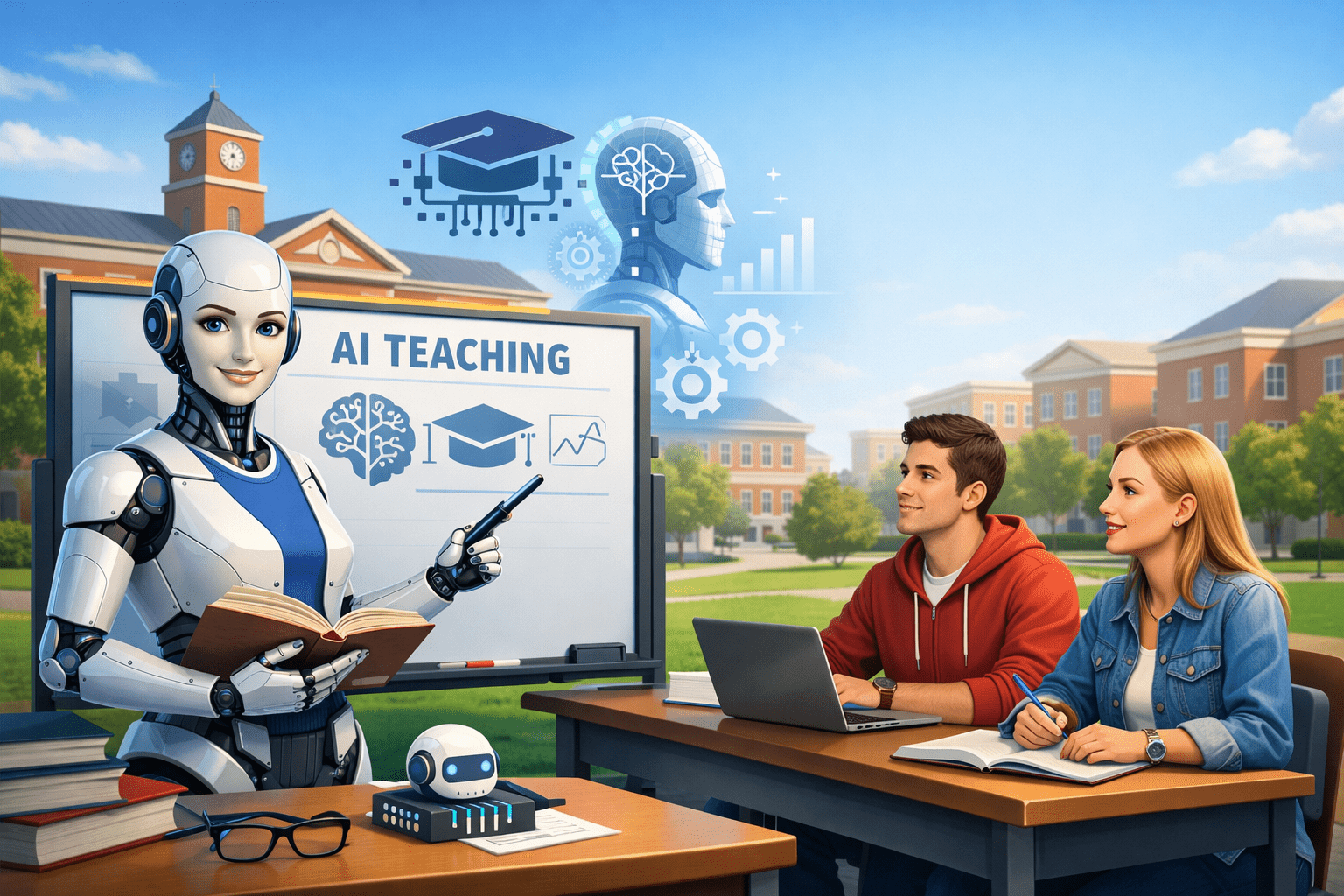
There is not one single federal occupation called “AI teacher.” In real life, AI teaching work usually falls into one of these categories: a high school computer science teacher, a career and technical education teacher, a community-college instructor, a postsecondary computer science professor, or an instructional/curriculum specialist who helps teachers use AI responsibly in class. That is why students should think less about a job title and more about the setting where they want to teach.
This field is growing because AI is moving into classrooms from two directions at once. First, schools are starting to teach students about AI. Second, schools are also training teachers to use AI tools responsibly for planning, feedback, and instruction. Code.org now offers a high-school Artificial Intelligence Foundations course, UNESCO has published an AI Competency Framework for Teachers, and TeachAI provides policy and guidance tools for schools building their own AI rules.
What major should you choose if you want to teach AI?
The strongest college majors for future AI teachers are usually:
-
Artificial Intelligence
-
Computer Science
-
Data Science
-
Statistics
-
Mathematics
-
Computer Engineering
-
Education + Computer Science/AI coursework
That is because real AI degree programs are built on programming, math, statistics, machine learning, and ethics. Carnegie Mellon’s AI bachelor’s program says students study computer science, math, statistics, computational modeling, machine learning, symbolic computation, and social responsibility. Penn’s AI bachelor’s program says students gain mathematical and algorithmic foundations, hands-on programming experience, cognitive science perspective, and concentrations such as machine learning, robotics, vision and language, data and society, and AI plus health systems.
For students who do not have access to a standalone AI major, computer science is still one of the safest and most flexible choices. BLS says data scientists usually enter with degrees in mathematics, statistics, computer science, or related fields, and computer and information research scientists usually need at least a master’s degree in computer science or a related field. That means a strong computer science or data science degree can still lead to AI work and later to AI teaching. This is why many students should view “AI major vs. computer science major” as a practical choice, not a prestige contest.
Which degree level matches which AI teaching path?
1. Certificate or short program
A certificate can help you learn tools or add AI skills, but by itself it is usually not enough for a full-time public-school teaching job or a traditional professor role. Public high school teachers typically need at least a bachelor’s degree and state certification, and postsecondary teachers typically need advanced degrees.
2. Associate degree
An associate degree can be a useful transfer step, especially if you plan to move into a bachelor’s program in computer science, AI, or data science. But for public K-12 teaching, BLS points to the bachelor’s degree as the typical starting point.
3. Bachelor’s degree
A bachelor’s degree is the key entry point for students who want to teach AI in middle school or high school. BLS says high school teachers typically need at least a bachelor’s degree, and public school teachers must have a state-issued certification or license. For many students, this is the most realistic first goal.
4. Master’s degree
A master’s degree becomes much more important if you want to teach AI at the community-college level, move into curriculum leadership, or qualify for more advanced technical roles. BLS says some postsecondary teachers at community colleges may be hired with a master’s degree, while some advanced AI careers also prefer graduate study.
5. Doctorate
A Ph.D. or other doctoral degree is the most common path for students who want to become a university professor teaching AI, machine learning, or advanced computer science. BLS says postsecondary teachers typically need a doctoral degree, especially at four-year colleges and universities.
What do real AI degree programs offer in 2026?
Carnegie Mellon University
Carnegie Mellon’s Bachelor of Science in Artificial Intelligence is one of the clearest examples of a true AI major. The university says the program focuses on turning large amounts of data into actionable decisions and includes computer science, math, statistics, computational modeling, machine learning, symbolic computation, ethics, and social responsibility. For admission to the School of Computer Science, CMU says students should have 4 years of English, 4 years of math, 1 year of physics, 2 years of chemistry/biology/computer science, 2 years of foreign language, and 3 electives, with calculus strongly encouraged. CMU also says the School of Computer Science requires an SAT or ACT for fall 2026.
University of Pennsylvania
Penn Engineering offers a Bachelor of Science in Engineering in Artificial Intelligence. The university says students can choose concentrations including machine learning, vision and language, data and society, robotics, and AI and health systems. Penn Admissions says applicants are evaluated in the context of how their high school academics prepared them for the school or program they choose, and Penn requires the SAT or ACT for the 2025-26 application cycle, with waivers for hardship cases.
UT San Antonio
UTSA offers an undergraduate Artificial Intelligence (Multidisciplinary Studies) pathway and says there are no additional admission requirements to declare this major beyond the university’s general admission requirements. That makes UTSA important for students who want a more accessible public-university route into AI study. UTSA is also expanding AI through its College of AI, Cyber and Computing, which includes undergraduate and graduate programs tied to AI, cybersecurity, computing, and data science.
Florida Polytechnic University
Florida Poly shows how AI is sometimes offered as a concentration inside computer science, rather than as a separate major. Its catalog describes an AI concentration with coursework such as artificial intelligence, applied deep learning, computer vision, and natural language processing. For undergraduate admission, Florida Poly says students should submit a high school transcript and standardized test scores such as the SAT, ACT, or CLT.
So what are the qualification requirements for enrollment?
For the most selective AI and computer science programs, students should expect a very strong high school record in:
-
Math through pre-calculus or calculus
-
Lab science, especially physics
-
Strong English and writing
-
Some computer science exposure if available
-
Standardized testing at some schools
-
Clear essays showing academic fit
CMU’s School of Computer Science explicitly recommends advanced math and calculus-level preparation, while Penn says it reviews whether your high school academics match the school or program you are choosing. At the same time, less selective options such as UTSA show that some AI-related majors may have no extra major-specific barrier beyond general university admission.
In simple terms, the admissions pattern is this: the more technical and selective the AI program, the higher the math expectations. If you are still in high school, the best preparation is not memorizing AI buzzwords. It is building a solid base in algebra, functions, statistics, coding, problem-solving, and writing. That conclusion follows directly from what current AI programs and teacher pathways are asking for.
Salary and job outlook: is AI teaching a smart career move?
If your goal is teaching in a school, salary depends more on the type of institution than on the word “AI” in the title. BLS reports that the median annual wage in May 2024 was $64,580 for high school teachers, $62,910 for career and technical education teachers, and $83,980 for postsecondary teachers overall. BLS also lists computer science teachers, postsecondary at $96,690 in its 2024 education-and-training projections table.
The job-growth picture is mixed. BLS projects high school teachers to decline 2% from 2024 to 2034, and career and technical education teachers to decline 1%, though both still show many annual openings because schools need replacement hires. Postsecondary teachers are projected to grow 7%, much faster than the average for all occupations.
If your goal is AI expertise first and teaching second, the financial numbers look different. BLS projects data scientists to grow 34% from 2024 to 2034 with a median pay of $112,590, and computer and information research scientists to grow 20% with a median pay of $140,910. BLS also says the broader computer and information technology occupation group had a median annual wage of $105,990 in May 2024. The practical lesson is clear: a student who earns a strong AI or computer science degree can keep both industry and teaching options open.
Best path for different students
If you want to teach AI in a public high school
The smartest plan is usually: major in AI, computer science, data science, math, or a related field, then complete teacher licensure requirements. Public-school teachers need a bachelor’s degree and state certification, so your technical major and your teaching credential both matter.
If you want to teach AI at a community college
A master’s degree in AI, computer science, data science, or a related field is often the strongest move. BLS says a master’s may be enough for some postsecondary teaching roles, especially at community colleges.
If you want to become an AI professor or researcher
Plan for the long road: bachelor’s degree, then graduate school, then likely a doctorate. That path matches both BLS expectations for postsecondary teachers and the education level often preferred for advanced AI research careers.
My honest advice for high school seniors
If your dream is “AI teaching,” do not obsess over finding the perfect job title right away. Focus on building a profile that makes you credible in both technology and education. In 2026, the strongest students for this path are the ones who can do real technical work, explain ideas clearly, think ethically about AI, and work well with learners. That matches what colleges, teacher pathways, and AI-in-education frameworks are emphasizing right now.
For most students, the most practical ranking looks like this:
-
Best all-around option: Computer Science
-
Best specialized option: Artificial Intelligence
-
Best teaching-friendly technical option: Data Science or Math
-
Best school-based route: Technical major + teacher licensure
-
Best professor route: Technical bachelor’s + master’s/Ph.D.
Official websites to link in your post
-
NCES CIP 11.0102 Artificial Intelligence for the federal academic classification of AI programs.
-
Carnegie Mellon AI undergraduate admissions and major page for a selective AI bachelor’s example.
-
Penn Engineering AI undergraduate page for concentrations and admissions expectations.
-
UTSA Artificial Intelligence undergraduate program for a public-university option with no added major-specific admission requirement.
-
Florida Poly undergraduate admissions and AI concentration catalog for a CS-plus-AI model.
-
BLS Occupational Outlook Handbook pages for high school teachers, postsecondary teachers, data scientists, and computer and information research scientists.
-
Code.org AI Foundations for K-12 AI classroom examples.
-
UNESCO AI Competency Framework for Teachers for the skills schools increasingly expect educators to understand.
-
TeachAI Toolkit for school AI policy and implementation guidance.
FAQ
Is artificial intelligence a real college major?
Yes. NCES now lists Artificial Intelligence as an official federal instructional-program category, and universities such as Carnegie Mellon and Penn offer AI-focused bachelor’s pathways.
Do I need a Ph.D. to teach AI?
Not always. You usually do not need a Ph.D. to teach AI in K-12 schools, but you usually do need advanced graduate study for university professor roles. A master’s may be enough for some community-college positions.
Is computer science better than an AI major?
For many students, yes—especially if their college does not offer a strong standalone AI degree. Computer science is broader, flexible, and still leads naturally into AI careers and later AI teaching.
What is the minimum degree for teaching AI in a public school?
Usually a bachelor’s degree plus state certification or licensure.
Is AI teaching a good long-term career?
It can be, especially for students who want a mix of technology, communication, and social impact. BLS salary data show that school teaching and AI industry roles have very different pay levels, so the smartest choice is often to build a technical degree that keeps both routes open.