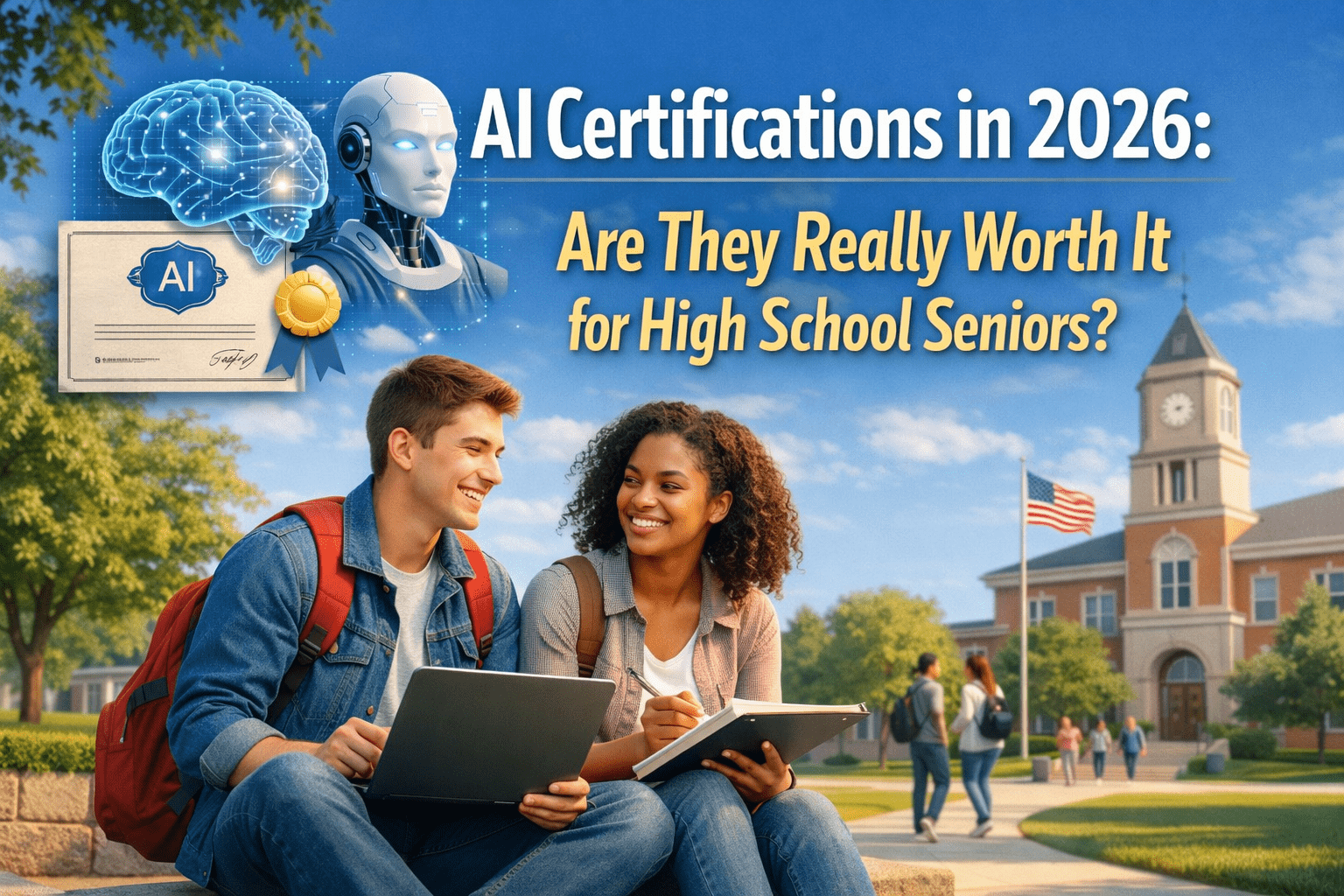
AI Certifications in 2026: Are They Really Worth It for High School Seniors?
What They Offer, Who Can Enroll, and Which Programs Actually Make Sense
Artificial intelligence is no longer a niche topic. The World Economic Forum says AI and big data are the fastest-growing skills in the 2025–2030 period, and the U.S. Bureau of Labor Statistics shows that computer and IT jobs continue to pay far above the national median. In May 2024, the median annual wage for computer and information technology occupations was $105,990, compared with $49,500 for all occupations. BLS also projects strong growth in related fields such as data scientists (34% growth, median pay $112,590), software developers (15% growth, median pay $133,080), and computer and information research scientists (20% growth, median pay $140,910).
That makes the question important for high school seniors: Should you spend time and money on an AI certification now? The most accurate answer is this: yes, sometimes—but only when the certification matches your level, your goals, and your budget. For most seniors, beginner-friendly AI certificates are worthwhile as a way to build AI literacy, prompt-writing skill, and a stronger resume. But they are not a substitute for real academic preparation in math, computer science, statistics, writing, and project work. BLS still shows that many core AI-adjacent careers require at least a bachelor’s degree, and some research-heavy roles require a master’s degree or higher.
What an AI “certification” actually means
Students often use the word certification to describe two different things.
The first type is a course-based certificate of completion, usually offered through platforms such as Coursera or Google Skills. These programs are designed to teach skills and then award a shareable certificate or badge when you finish. Examples include Google AI Essentials, Google AI Professional Certificate, IBM AI Foundations for Everyone, and IBM AI Developer Professional Certificate. These are usually the easiest entry point for high school seniors because many require no prior experience.
The second type is an exam-based industry certification, usually run by a major vendor such as Microsoft, AWS, or Google Cloud. These credentials are typically earned by passing a proctored exam. Examples include Microsoft Azure AI Fundamentals (AI-900), AWS Certified AI Practitioner, and Google Cloud Generative AI Leader. These credentials can carry strong signaling value, but they are usually more useful when you already understand cloud platforms, workplace use cases, or technical concepts.
My verdict for high school seniors
For most seniors, AI certifications are worth it when they are beginner-friendly, low-cost or free to start, and connected to a real output such as a portfolio project, chatbot, workflow demo, coding sample, or research reflection. They are less worth it when they are expensive, highly vendor-specific, or so advanced that you are memorizing exam language without understanding the underlying concepts.
Put differently: a certificate is strongest when it proves one of three things. First, it can show that you understand how AI works at a practical level. Second, it can show initiative and curiosity. Third, it can give you vocabulary and tools for internships, scholarship essays, and college applications. What it usually cannot do by itself is replace strong grades, coding practice, math preparation, or a college degree for technical careers. That conclusion follows directly from BLS education requirements for data scientists, software developers, and computer research scientists.
What AI certifications usually offer
A good AI certification for beginners should offer four things:
1. Practical AI literacy. Students should learn what AI, machine learning, and generative AI actually are, how they differ, and what they can and cannot do. Google AI Essentials, IBM AI Foundations, and Microsoft’s beginner AI materials all do this in some form.
2. Real productivity and prompt skills. Strong beginner programs now focus on writing better prompts, using AI responsibly, brainstorming, summarizing, and improving workflow—not just memorizing definitions. Google AI Essentials explicitly teaches prompting, productivity use cases, and responsible AI. IBM AI Foundations includes prompt engineering and generative AI use cases.
3. Portfolio-building or applied work. This matters most for seniors. IBM’s AI Developer certificate includes building AI-powered chatbots and web applications with Python and Flask. IBM AI Foundations also includes no-code chatbot work. Programs with applied work are usually more valuable than a badge alone.
4. A credential tied to a recognizable company. For a teenager with limited work history, brand recognition can help. Google, Microsoft, AWS, IBM, and Google Cloud are all recognizable names, which can make the credential easier for schools, scholarship committees, and entry-level employers to understand.
Best AI certifications for high school seniors in 2026
1) Google AI Essentials
Best for: absolute beginners, non-technical students, scholarship applicants, future business/communications majors
Google AI Essentials is one of the strongest first-step options for high school seniors. Coursera lists it as a beginner-level, 5-course series with no prior experience required, flexible pacing, and a shareable certificate. Google says it teaches students how to use generative AI tools to develop ideas and content, make decisions, speed up everyday tasks, write clearer prompts, use AI responsibly, and stay current as AI evolves. Google also describes the program as a self-paced way for people across roles and industries to gain AI skills that improve productivity.
What it offers: practical AI literacy, prompt writing, responsible AI, and real-world workflow uses.
Qualification for enrollment: none; no prior experience required.
Why it is worth it: it is short, accessible, and useful even if you are not a coder.
Best use case: add it to a resume, scholarship profile, or summer learning plan, then pair it with one personal project such as AI-assisted research notes, a study workflow, or a mini portfolio.
Official link: Google AI Essentials
2) Google AI Professional Certificate
Best for: students who want a newer, slightly deeper nontechnical credential
Google launched its first AI Professional Certificate in February 2026. Coursera lists it as beginner level, 7 courses, with no prior experience required. The program focuses on using AI for data analysis, research, communication, and even building a custom app through “vibe coding,” while still saying that no coding experience is required. Coursera’s official announcement says the certificate is designed to help learners move beyond the basics and build practical, job-ready AI skills.
What it offers: a broader and more current AI workflow credential than a basic overview course.
Qualification for enrollment: none; no prior experience required.
Why it is worth it: it looks stronger than a one-off intro course and better reflects how AI is used across school and work tasks.
Best use case: ideal for seniors heading toward business, communications, marketing, education, policy, or general college success rather than deep engineering.
Official link: Google AI Professional Certificate
3) IBM AI Foundations for Everyone
Best for: beginners who want more depth than a very short course
IBM’s AI Foundations for Everyone is a strong option for students who want a fuller introduction. Coursera lists it as beginner level, 4 courses, with no prior experience required, and about 4 weeks at 10 hours per week. The program covers AI fundamentals, machine learning, deep learning, neural networks, generative AI, prompt engineering, and even designing a generative AI solution for an organizational problem with ethical considerations included. It also includes a no-code chatbot course.
What it offers: a broader conceptual foundation plus practical generative AI and prompt engineering exposure.
Qualification for enrollment: none; no prior AI background required.
Why it is worth it: it is more substantial than many short AI certificates and gives students a better vocabulary for essays, interviews, and classroom discussion.
Best use case: a strong bridge between general AI curiosity and more technical study later.
Official link: IBM AI Foundations for Everyone
4) Microsoft Certified: Azure AI Fundamentals (AI-900)
Best for: students interested in IT, cloud, computer science, or business tech
AI-900 is one of the best-known exam-based beginner AI credentials. Microsoft describes it as a certification that demonstrates knowledge of machine learning and AI concepts plus related Azure services. Microsoft says it is meant for learners with technical and non-technical backgrounds, that data science and software engineering experience are not required, and that it helps learners describe AI workloads, machine learning, computer vision, natural language processing, and generative AI workloads on Azure. The exam is 45 minutes, is proctored, and Microsoft says students and educators can schedule through Certiport. Microsoft also lists the exam price as $99 USD, depending on region, and notes that AI-900 will retire on June 30, 2026.
What it offers: a recognized vendor certification in cloud AI fundamentals.
Qualification for enrollment: no formal prerequisite, but Microsoft says familiarity with self-paced or instructor-led learning material is expected and basic cloud awareness is helpful.
Why it is worth it: strong signaling value for students targeting cloud, IT, or applied computing.
Main caution: because it retires on June 30, 2026, it is a time-sensitive choice.
Official link: Microsoft Azure AI Fundamentals (AI-900)
5) AWS Certified AI Practitioner
Best for: students who already have some cloud exposure and want a proctored credential
AWS positions this certification as a foundational credential. Its exam guide says it validates foundational AI and ML knowledge for business professionals and is intended for people who want to demonstrate understanding of AI, machine learning, generative AI concepts, and use cases. AWS says the exam has 65 questions, lasts 90 minutes, and costs $100 USD. AWS also says training is recommended but not mandatory, while noting in its FAQ that the best preparation is practical experience and recommending six months to two years of hands-on AWS experience. Importantly for younger students, AWS states that candidates must be 13 or older, and ages 13–17 may test with parent or legal guardian consent.
What it offers: an exam-based credential from a major cloud provider.
Qualification for enrollment: no mandatory training, but practical AWS exposure is strongly recommended.
Why it is worth it: good for advanced high school students who already built cloud labs, did AWS Academy, or have strong IT interest.
Main caution: this is usually not the best first AI credential for a complete beginner.
Official link: AWS Certified AI Practitioner
6) Google Cloud Generative AI Leader
Best for: future business, entrepreneurship, product, and nontechnical tech leadership students
Google Cloud’s Generative AI Leader certification is explicitly positioned as a business-facing credential. Google says the exam lasts 90 minutes, costs $99, includes 50–60 multiple-choice questions, and has no prerequisites. Google also provides an official training path and study guide. The certification is designed around business-level understanding of how generative AI can transform organizations, rather than pure coding skill.
What it offers: a recognized generative AI credential focused on business understanding and responsible adoption.
Qualification for enrollment: none.
Why it is worth it: a surprisingly good option for students who are not future software engineers but still want to show serious AI fluency.
Main caution: because it is leadership- and business-oriented, it is less useful for students seeking deep technical credibility.
Official link: Google Cloud Generative AI Leader
7) IBM AI Developer Professional Certificate
Best for: students who want to build things, not just learn vocabulary
This is one of the best technical pathways for ambitious seniors. Coursera lists it as beginner level, says no prior AI or programming knowledge is required, and estimates about 6 months at 4 hours per week. IBM says the program teaches AI fundamentals, generative AI, chatbot and app building, and web deployment with Python and Flask. IBM also notes that the first part of the certificate does not require programming, while later courses introduce Python and Flask in applied work.
What it offers: actual building experience with AI-powered applications.
Qualification for enrollment: no formal prerequisite, but students should be ready to learn coding as the program progresses.
Why it is worth it: this is one of the few beginner-friendly programs that can produce real portfolio artifacts.
Main caution: it is a bigger time commitment than light AI literacy certificates.
Official link: IBM AI Developer Professional Certificate
Which AI certifications are usually not worth it for most seniors yet
Some certifications are respectable but still not the best fit for a typical high school senior.
Microsoft’s AI Business Professional is beginner level and does not require coding, but Microsoft says candidates should already have experience using Microsoft 365 Copilot, Researcher, and Analyst in business contexts. That makes it more natural for current professionals than for most 17- or 18-year-olds. Microsoft’s AI Transformation Leader is even more clearly aimed at business decision-makers leading AI adoption across teams and organizations.
Likewise, AWS’s Generative AI Developer – Professional is a professional-level exam intended for people with hands-on experience designing and deploying AI solutions on AWS. That is a poor first credential for most seniors.
What are the qualifications for enrollment?
This is the key practical question, and the answer is better than many students expect.
For beginner certificates, the enrollment bar is usually low. Google AI Essentials, Google AI Professional Certificate, IBM AI Foundations for Everyone, and IBM AI Developer all state that no prior experience is required. That means most high school seniors can enroll immediately.
For vendor certifications, the bar is still manageable, but expectations are higher. Microsoft AI-900 says technical and non-technical learners are welcome, though basic cloud understanding is helpful. Google Cloud Generative AI Leader says there are no prerequisites. AWS AI Practitioner does not require mandatory training, but AWS clearly recommends practical experience with AWS as the best preparation.
In plain English: most seniors can enroll in beginner AI programs right now, but not all seniors are equally prepared to benefit from advanced or cloud-heavy certifications.
Do AI certifications replace college preparation?
No. They complement it.
BLS says data scientists typically need at least a bachelor’s degree, software developers typically need a bachelor’s degree, and computer and information research scientists typically need at least a master’s degree, although some federal roles may accept a bachelor’s. That means an AI certification is best understood as a signal of initiative and applied skill, not as a replacement for a college major or deep technical training.
For college admissions, scholarships, and internships, the strongest combination is usually this: certificate + project + reflection + coursework. A student who completes a beginner certificate and then creates a chatbot, AI study assistant, research summary workflow, or basic Python app will usually have a stronger story than a student who only lists a badge. That is also why project-based certificates such as IBM AI Developer often have more long-term value than surface-level credentials.
Best strategy for a high school senior in 2026
A smart path looks like this:
Start with a beginner, low-risk certificate such as Google AI Essentials or IBM AI Foundations. Then build one simple proof-of-work project. After that, decide whether you want the nontechnical/business path or the technical/cloud path. Students leaning toward business, communications, policy, or entrepreneurship may benefit most from Google AI Professional Certificate or Google Cloud Generative AI Leader. Students leaning toward computer science, IT, or data may get more value from IBM AI Developer or Microsoft AI-900 once they have basic coding or cloud exposure. AWS AI Practitioner makes the most sense after real hands-on AWS practice.
Final answer
AI certifications are worth it for high school seniors when they are beginner-friendly, practical, and tied to real work. They are especially useful for building AI literacy, improving resumes, strengthening scholarship and internship profiles, and showing initiative before college. They are not worth treating as a shortcut to an AI career by themselves, because the labor market still rewards deep preparation in computing, math, statistics, writing, and formal education.
For most seniors, the best first picks are Google AI Essentials, Google AI Professional Certificate, or IBM AI Foundations for Everyone. For stronger technical students, Microsoft AI-900 and IBM AI Developer are smart next moves. AWS AI Practitioner is worthwhile only when you already have real AWS exposure, and Google Cloud Generative AI Leader is best for business-minded students who want strategic AI fluency rather than heavy coding.