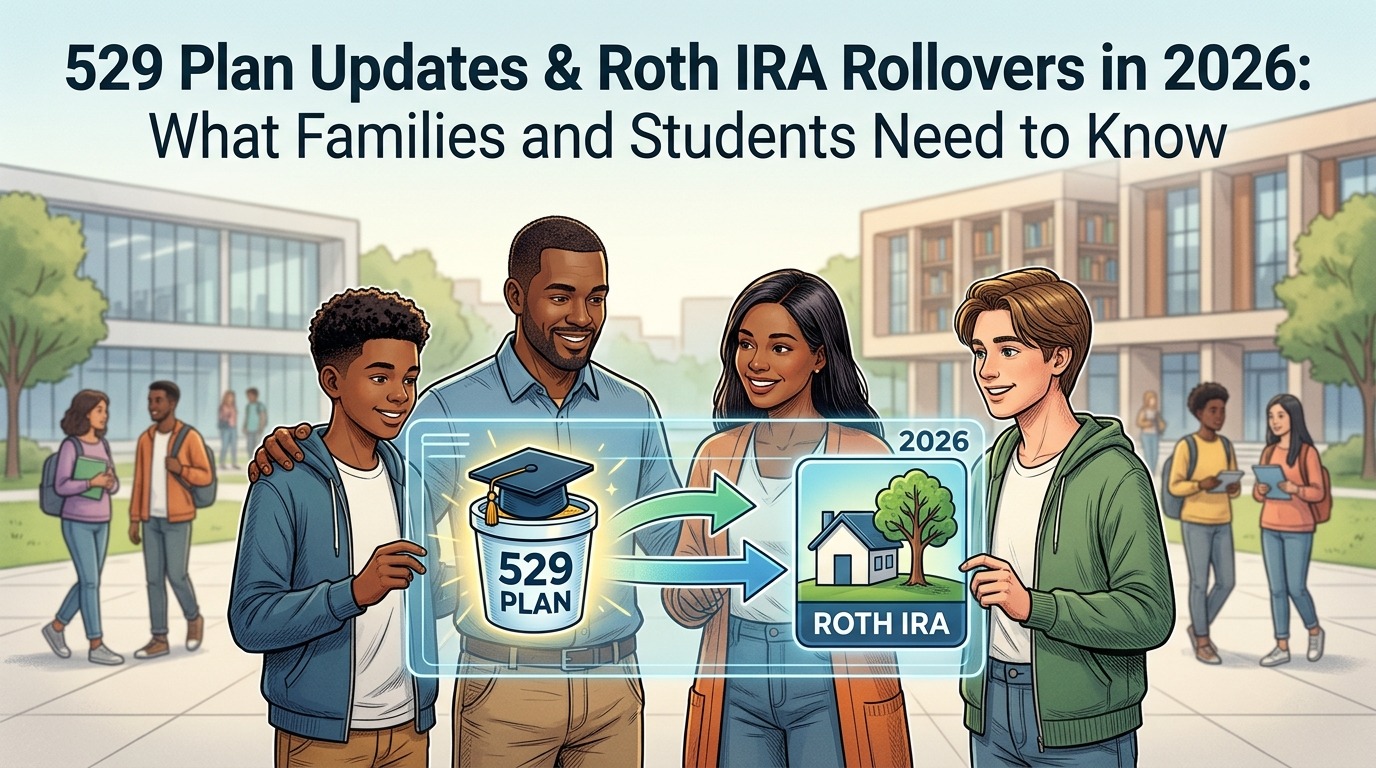
529 Plan Updates & Roth IRA Rollovers in 2026: What Families and Students Need to Know
A 529 plan used to be viewed as a college-only savings tool. In 2026, that is no longer the best way to think about it. A 529 plan is still mainly an education savings account, but federal law now gives families more flexibility than they had a few years ago. The biggest headline is that unused 529 funds may be moved, within strict limits, into a Roth IRA for the same beneficiary. At the same time, newer 2026 rules expanded some other qualified 529 uses, which means the account is broader than many parents and students realize.
For high school seniors, this matters for two reasons. First, a parent or grandparent may already have money saved in a 529 plan and be worried about overfunding it. Second, students who win scholarships, choose a lower-cost college, commute from home, attend a certificate program, or delay college may end up with leftover 529 dollars. In 2026, the smartest move is no longer automatically “spend it now or take a penalty.” The real answer depends on the current federal rules, the student’s earned income for the year, the age of the 529 account, and whether the family still expects future education expenses.
What a 529 plan is, and why families still use it
A 529 plan, legally called a qualified tuition program, is a tax-advantaged savings arrangement sponsored by a state, state agency, or educational institution. The SEC explains that there are two main types: education savings plans and prepaid tuition plans. The IRS also stresses a point families often miss: contributions are not deductible on a federal return, but the investment earnings can grow free from federal tax and stay tax-free when used for qualified education expenses. Many states also offer their own tax benefits, although those state rules vary and may depend on whether you use your home state’s plan.
That tax treatment is why 529 plans remain popular. The account owner, not the student, generally controls the money until it is withdrawn. The beneficiary can usually be changed to another family member without federal income tax consequences, which is one reason 529 plans are more flexible than people think. If one child does not need all the money, families often can redirect the account to a sibling or another eligible relative instead of taking a taxable nonqualified withdrawal.
What changed in 2026
The most important pure rollover update for 2026 is simple: the annual IRA contribution limit increased to $7,500 in 2026, up from $7,000 in 2025. That matters because a 529-to-Roth rollover is tied to the annual Roth IRA contribution cap. In practice, that means a student with eligible rollover room can usually move a little more in 2026 than in 2025. For people age 50 and older, the IRS lists a 2026 IRA limit of $8,600, but that catch-up figure is usually not relevant for traditional college-age beneficiaries.
There were also broader 529 changes taking effect in 2026 under newer federal law. IRS 2026 materials explain that the maximum 529 amount that may be used for elementary or secondary school enrollment rises to $20,000 per student per year beginning in 2026, and the definition of qualified education expenses now also includes certain qualified postsecondary credentialing expenses. IRS materials also note that more guidance is expected, which is important because families should expect some agency pages to update over time as the newer law is folded into older 529 guidance.
That means the 2026 conversation is not only about Roth rollovers. It is also about recognizing that 529 plans now cover a wider range of education pathways than the old “four-year college only” model. For students considering apprenticeship training, nontraditional credentials, or other postsecondary programs, a 529 may still have education uses before a Roth rollover is even considered.
How the 529-to-Roth rollover really works
Congress created the rollover rule in SECURE 2.0, and it applies to distributions made after December 31, 2023. The core idea sounds simple: unused 529 money may be rolled into a Roth IRA for the same beneficiary. But the law and IRS publications place several strict conditions on that transfer. Families should treat this as a narrow tax-favored exception, not a free-form transfer.
Here are the rules that matter most.
- The Roth IRA must belong to the same beneficiary as the 529 plan. The IRS describes the rollover as a transfer from a 529 account to “a Roth IRA for the benefit of the same beneficiary.” That means parents cannot simply pull leftover 529 money into the parent’s own Roth IRA unless the parent is also the beneficiary of that 529 account.
- The transfer must be direct. IRS Publication 590-A says the rollover must be paid through a direct trustee-to-trustee transfer. This is not the place for casual do-it-yourself movement of funds. Families should work through the 529 administrator and the Roth IRA custodian so the transfer is coded correctly.
- The 529 account must have been open for more than 15 years. The IRS and the statute both make the age of the account central. If the account is newer than that, the rollover does not qualify for this special tax-free treatment.
- Recent contributions are blocked. The law excludes amounts contributed during the 5-year period ending on the date of distribution, along with earnings attributable to those recent contributions. In plain English, new money cannot be rushed into a 529 and immediately flipped into a Roth IRA.
- The rollover is capped each year by the annual Roth IRA limit. For 2026, that general IRA limit is $7,500. If the beneficiary already made other IRA contributions for the year, those contributions reduce how much 529 money can still be rolled in that year. The statute explicitly says the annual amount is reduced by the beneficiary’s aggregate IRA contributions for that taxable year.
- There is a lifetime cap of $35,000 per beneficiary. The IRS and the statute both state that total qualifying 529-to-Roth rollovers for the beneficiary cannot exceed $35,000 across all years. This is a lifetime ceiling, not a yearly ceiling.
Does the student need earned income?
This is where families need to slow down and read carefully. IRS Publication 590-A explains that, generally, a person contributes to a Roth IRA only if the person has taxable compensation, and the publication defines compensation as money earned from working, such as wages, salaries, commissions, self-employment income, and certain taxable fellowship or stipend amounts. The statute ties the annual rollover rule to the Roth IRA annual contribution framework, so the safest reading for families is that the beneficiary should have enough taxable compensation for the year before attempting the rollover.
For a high school senior, that usually means a summer job, part-time work during school, or other taxable earned income matters. A student who earned $3,500 from a part-time job should not assume they can automatically move the full $7,500 annual cap in 2026. The safer working assumption is that their usable room may be limited by the amount of their taxable compensation for the year. By contrast, a student who earned $9,000 in wages and made no other IRA contributions may have room to roll $7,500 in 2026, assuming all the 529-specific rollover conditions are met.
What about the normal Roth IRA income limits?
This is one of the biggest points of confusion online. Normal Roth IRA contributions are typically subject to modified AGI phaseout rules. For 2026, the IRS lists Roth IRA phaseout ranges of $153,000 to $168,000 for single filers and $242,000 to $252,000 for married couples filing jointly. But SECURE 2.0 created a special statutory rule for qualified 529-to-Roth rollovers that functions as an exception to the ordinary Roth IRA income limitation rules. That is one reason families should not assume this special rollover works exactly like a standard Roth contribution.
A few practical 2026 examples
Assume a student has a 529 account opened 16 years ago, has more than $20,000 left in it, and the funds being moved are all old enough to satisfy the 5-year restriction. If that student earns $8,200 from work in 2026 and has not made any other IRA contribution, the family may be able to roll $7,500 into the student’s Roth IRA in 2026. They still cannot exceed the $35,000 lifetime rollover cap, so the remaining balance would need to stay in the 529, be used for education, be shifted to another family beneficiary, or be rolled in future years if eligibility continues.
Now assume the same student already contributed $2,000 to a Roth IRA in 2026 from summer-job earnings. The statute says other IRA contributions reduce the amount available for the 529 rollover that year. So the remaining 529-to-Roth space would generally be $5,500, not $7,500. Families who forget this rule can accidentally overstate their available rollover room.
There is also a timing rule that matters right now. IRS Publication 590-A says that a distribution made after December 31, 2025 and before April 15, 2026, if rolled to a Roth IRA by April 15, 2026 and designated for 2025, is treated as a 2025 Roth IRA contribution. Because the 2025 IRA limit was $7,000, families deciding in early April 2026 need to know which tax year they are using. That can affect the maximum amount available.
When a rollover is smart, and when it is not
A 529-to-Roth rollover is usually strongest when the beneficiary has finished or nearly finished education, has leftover 529 funds, has taxable compensation for the year, and is unlikely to need the money for more schooling soon. It can also make sense when a student received scholarships, attended a lower-cost college than expected, or chose a work-and-certification path instead of a traditional four-year residential program. Those situations often create exactly the leftover balance this rule was designed to address.
But a rollover is not automatically the best first move. If the student may attend graduate school, transfer schools, pursue a registered apprenticeship, or pursue a qualified postsecondary credential, the 529 may still have direct education uses. Likewise, if there is another family member who could use the money, changing the beneficiary can be cleaner than starting a multi-year Roth rollover sequence. The IRS says there are no federal income tax consequences when the designated beneficiary is changed to another qualifying family member.
Other 529 uses families should not forget in 2026
Even if the Roth rollover gets the headlines, it is not the only flexibility tool. Current IRS guidance says qualified 529 expenses include certain apprenticeship costs, qualified education loan repayments in limited amounts, and certain qualified postsecondary credentialing expenses. The SEC’s 2026 bulletin also explains that 529 plans can be used more broadly than many savers assume, including K–12 uses and registered apprenticeship costs, subject to the governing federal and plan rules.
For student loan repayment, the IRS says a 529 can be used for principal or interest on a designated beneficiary’s or sibling’s student loan, but only up to $10,000 lifetime per individual. That is not a rollover rule. It is a separate 529 use. Families comparing options should keep those rules distinct. A student loan payment from a 529 does not become Roth IRA money, and a 529-to-Roth rollover does not count as a student loan payment.
The tax traps families should avoid
The first trap is “double dipping.” IRS Publication 970 says you must reduce qualified education expenses by tax-free educational assistance such as scholarships, Pell Grants, veterans’ educational assistance, and other tax-free help. It also says you cannot use the same expenses both for a tax-free 529 distribution and for education credits such as the American Opportunity Credit or Lifetime Learning Credit. In other words, one dollar of expense cannot power multiple tax benefits at the same time.
The second trap is assuming every leftover withdrawal will be harmless. The IRS says that if you receive a taxable 529 distribution, you generally owe ordinary income tax on the earnings portion and a 10% additional tax on the amount included in income. There are important exceptions, including when the distribution is taxable only because the student received a tax-free scholarship or other listed educational assistance, but the exception does not magically convert that withdrawal into a tax-free event. It only removes the extra 10% tax up to the qualifying amount.
The third trap is ignoring state rules. The SEC notes that state tax benefits for 529 contributions vary by state and by plan, and may come with their own restrictions or requirements. That means a federally valid Roth rollover does not guarantee identical state tax treatment or preservation of every prior state tax benefit. Families should check the specific disclosure booklet or offering circular for their state plan before moving money.
A student-friendly bottom line
For most high school seniors, the smartest way to think about a 529 plan in 2026 is this: it is still an education account first, but it is no longer a financial dead end if education plans change. If the account is old enough, the funds are seasoned enough, the student has earned income, and the family follows the direct-transfer rules, up to $35,000 can eventually be shifted into the student’s Roth IRA over multiple years. In 2026, the usual annual ceiling most students should focus on is $7,500, reduced by any other IRA contributions they make that year.
That does not mean every family should rush to do it. The best move is usually to rank the options in this order: first, use the 529 for still-qualifying education expenses if those are likely; second, consider whether another family member should become the beneficiary; third, if the money is truly leftover, use the Roth rollover rules carefully and deliberately. Families who do that preserve the tax advantages of the 529 while avoiding unnecessary penalties or reporting mistakes.
FAQs
Can a parent move 529 money into the parent’s own Roth IRA?
Not under the standard student-beneficiary setup. The IRS says the rollover must go to a Roth IRA maintained for the benefit of the same beneficiary as the 529 account.
Can a family roll over the full $35,000 in one year?
Usually no. The rollover is limited by the annual Roth IRA contribution framework, and for 2026 that general IRA cap is $7,500. Other IRA contributions for that same year reduce the amount available for the special 529 rollover.
Does the 529 account have to be old?
Yes. The IRS and the statute require the account to have been open for more than 15 years.
Can recent contributions be rolled over?
No. Amounts contributed during the 5-year period ending on the date of distribution, plus earnings tied to those contributions, do not qualify for this special rollover.
Does the student need a job?
Families should assume the student needs taxable compensation for the year, because IRS Publication 590-A ties Roth IRA funding to compensation and the 529 rollover uses the annual Roth IRA contribution structure.
What if my student got a full scholarship?
A scholarship does not automatically force a penalty. The family may keep the 529 for future education, change the beneficiary to another family member, or in some cases take a distribution that avoids the extra 10% tax up to the scholarship amount, though the earnings portion may still be taxable. A Roth rollover may also be possible over time if the student meets the rollover rules.
Official resources for readers
- IRS Topic No. 313: Qualified Tuition Programs for the IRS overview of 529 rules.
- IRS Publication 970: Tax Benefits for Education for 529 distribution, rollover, education-credit, and penalty rules.
- IRS Publication 590-A for Roth IRA contribution rules and the special 529-to-Roth rollover language.
- IRS IRA Contribution Limits for current annual IRA limits.
- IRS News Release on 2026 Retirement Limits for the 2026 IRA limit and Roth phaseout ranges.
- Investor.gov Bulletin: An Introduction to 529 Plans for a plain-English overview of 529 structure, fees, state tax issues, and broader uses.