2-Year vs 4-Year Colleges
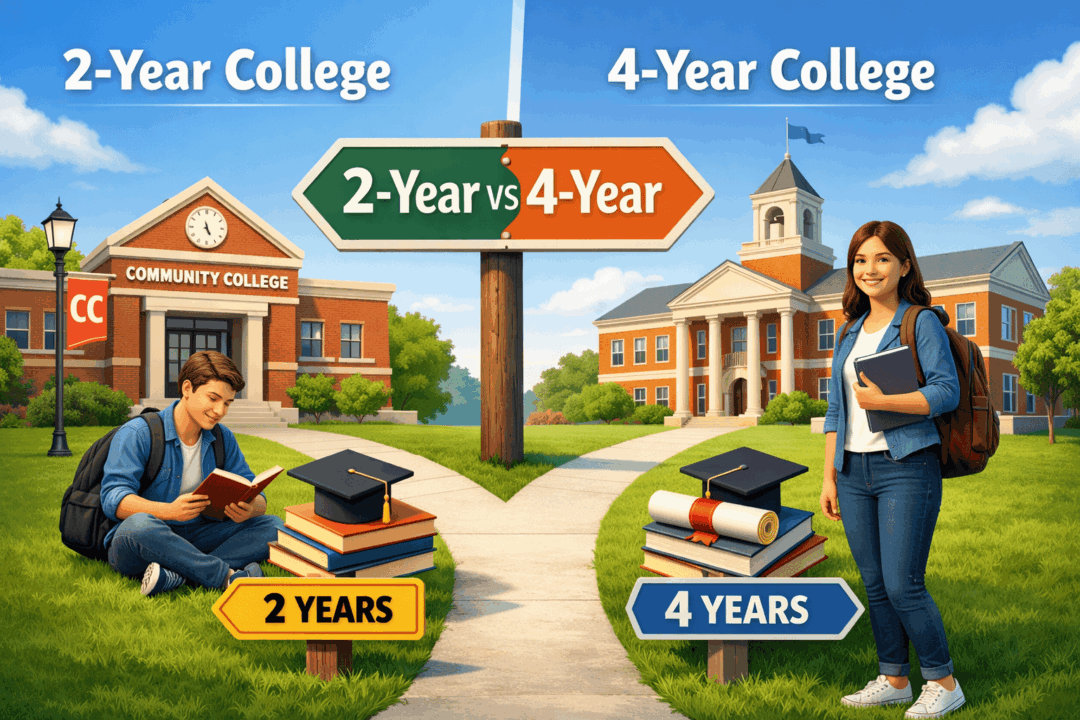
2-year (associate’s) and 4-year (bachelor’s) colleges serve different student needs and yield different outcomes. In fall 2021 about 10.8 million undergraduates were at 4-year colleges (70%) and 4.7 million at 2-year colleges (30%). Between 2010 and 2021, 2-year enrollment fell ~39% (from 7.7M to 4.7M) while 4-year grew ~4%. Costs differ sharply: in 2022–23 average tuition and fees were about $4,000 per year at public 2-year schools vs $9,800 at public 4-year schools, and living expenses (room/board) make up much of the rest. Thanks to grants, many community college students pay little net tuition. Completion rates are lower at 2-year colleges: roughly 30–35% of first-time community college students finish an associate in 3 years, whereas about 64% of full-time 4-year students complete a bachelor’s in 6 years. Many 2-year students transfer into 4-year programs (roughly 15% transfer out within 3 years), but only a minority later earn a bachelor’s.
Labor-market outcomes favor the bachelor’s degree. Among 25–34 year-olds (2022), median full-time annual earnings were ~$66,600 for bachelor’s holders vs ~$49,500 for associate’s holders; median weekly wages were $1,543 vs $1,099. Unemployment rates are slightly lower for bachelor’s (2.5%) than associate’s (2.8%). These gaps reflect higher skills and credentials; they also mean bachelor’s graduates tend to recoup their higher costs over time, though ROI depends on major and debt. Equity note: community colleges enroll proportionally more Hispanic, Black, low-income, and first-generation students than 4-year schools. Federal and state aid (like Pell Grants and state “promise” programs) often fully cover 2-year tuition; institutional grants and scholarships can further reduce costs.
This report reviews definitions, current trends, costs (tuition, net price, debt), completion rates, transfers, time-to-degree, outcomes, ROI, and equity. It cites NCES, IPEDS, BLS, Census data and peer-reviewed research to give high-school seniors clear, actionable comparisons. Tables and charts compare key metrics.
Definitions: 2-Year vs 4-Year Colleges
“2-year colleges” typically grant associate’s degrees (AA/AS) or certificates and include community and technical colleges, tribal colleges, and private 2-year schools. “4-year colleges” grant bachelor’s degrees (BA/BS) and often graduate degrees; they include public universities, private colleges, and state colleges. Both levels may offer workforce certificates or transfer programs, but 4-year institutions generally have broader majors and research. Students at 2-year schools often attend part-time, live at home, and work while studying; 4-year students are more likely full-time and on-campus.
Enrollment Trends
Total U.S. undergraduate enrollment has varied: 18.1M in fall 2010 declined to 15.4M in 2021, with a modest recovery projected (to ~16.8M by 2031). In fall 2021, 70% of undergrads were at 4-year colleges and 30% at 2-year. Between 2010 and 2021, 2-year college enrollment fell sharply (–39%), while 4-year was nearly flat (+4%). Early COVID years saw dips too, but by spring 2025 enrollment is again rising (approx +3% since spring 2024).
Recent trends show strong growth in online learning (61% of undergrads took ≥1 distance course in fall 2021), which is common at 2-year colleges (28% exclusively online) and for-profits. Summary: far more students enter 4-year schools, but millions start at 2-year colleges each year (often for cost or flexibility).
Costs: Tuition, Fees, Living, Net Price, Debt
Published costs: The sticker price of college varies by sector. For 2022–23 the average published tuition+fees at public institutions was about $4,000 for 2-year (community college) in-district students and $9,800 for 4-year in-state students. Private nonprofit colleges charge much more (roughly $40.7K per year at 4-year, $19.5K at 2-year). Living expenses (room, board, etc.) drive up the total cost: a 4-year on-campus student budget averages ~$27,100 (public) to ~$58,600 (private) per year, whereas a 2-year on-campus student’s budget is lower (e.g. ~$16,600 at public 2-year). Many 2-year students live off-campus with family: their total budgets can be ~$10–21K (public 2-year).
Net price (after grants): First-time full-time students at public 2-year colleges have very low net tuition. In 2021–22 the average net price (after grants/scholarships) was only $8,300 at public 2-year schools, vs $15,200 at public 4-year schools. (Private non-profit college net prices were $21–29K.) In fact, College Board notes that since 2009–10, grants typically cover full tuition at public community colleges. Most of these grants are federal Pell or state aid. For example, the Pell Grant maximum is about $7,000/year (2024), which often nearly covers public 2-year tuition. By contrast, after grants public 4-year students still often pay $3–5K net per year (though highly dependent on income).
Student debt: Community college students borrow less on average. Only about 36% of associate’s degree completers in 2020 had any debt, with average borrowings around $17K (in academic year dollars). In contrast, among bachelor’s degree completers, roughly 66% graduate with debt averaging ~$25–30K (recent NCES/BPS data). (Median debts are somewhat lower than means.) Thus 2-year graduates often take fewer loans in total, though those who then transfer to 4-year schools may accrue additional debt. [Note: precise 2021 data by degree are sparse; studies suggest associate borrowers owe much less than bachelor’s borrowers.]
Completion and Graduation Rates
4-year graduation: According to NCES (IPEDS), about 64% of first-time bachelor’s students at 4-year colleges graduate in 6 years (150% of the normal 4-year time). Women graduate at higher rates (~67%) than men (~60%). Retention (first-year persistence) is also higher: in Fall 2021 roughly 81% of first-year full-time bachelor’s students re-enrolled for year 2, versus 61% at 2-year colleges.
2-year (associate) completion: By contrast, only a minority of community college students complete an associate degree. National data for first-time full-time community college cohorts show 3-year completion rates of about 30–35% (150% of 2 years). Completion rates have risen in recent cohorts (from 22.0% in 2010 to 34.8% in 2020). Many others partially complete or transfer: including transfers, about 50–60% eventually “succeed” (graduate, transfer, or still enrolled after 3 years). Transfer-out rates (students leaving a 2-year school for another) are ~15% within 3 years. However, only a fraction of those transfers end in a 4-year degree (see below).
Table: Graduation rates and retention (first-time full-time students)
| Metric | 2-Year (Assoc) | 4-Year (Bachelor) | Source |
|---|---|---|---|
| 1-year retention (Fall 2021) | 61% | 81% | NCES Condition of Education |
| Completion in 150% of normal time | ~34% (3 years for AA) | 64% (6 years for BA) | NCES, IPEDS |
Transfer Pathways
Many students use the 2-year system as a stepping-stone. Formal transfer programs exist in many states (articulation agreements, “2+2” plans, guaranteed admissions). About 15–17% of first-time full-time community college students transfer out to another institution within 3 years (mostly to 4-year schools). Among bachelor’s degree recipients, a substantial share (over 40% nationally) attended a community college at some point. However, earning a bachelor’s after starting at a 2-year college is not guaranteed: only ~30% of those who enter community college eventually complete any degree (associate or higher) and only a portion of those get a bachelor’s within 6–8 years. (National Student Clearinghouse reports suggest ~13% of CC starters earn a bachelor’s within 8 years.)
Despite challenges, transfer can save money: if students complete transferable credits at a lower-cost 2-year college, their 4-year tuition and debt can shrink. Many colleges offer scholarships or tuition credits for transfer students (see “Scholarships” below). Decision note: Students aiming for a bachelor’s degree may start at a 2-year college to reduce costs or until personal/timing factors change. It’s critical to use approved transfer paths to avoid losing credits.
Time-to-Degree
Nominally, associate’s programs are 2 years and bachelor’s 4 years, but actual times vary. Because many CC students attend part-time or stop out, average time to an associate can be 3–4 years or more. Bachelor’s degrees often take longer than 4 calendar years: nationwide, only ~40% of students finish in 4 years; the 6-year graduation measure (~64%) reflects that delays and part-time enrollment are common. Dual enrollment or AP credits can shorten time. Delays add to total cost and affect ROI, so consider how work and personal commitments will impact pace.
Labor-Market Outcomes (Earnings & Employment)
Education level strongly correlates with pay and unemployment. Earnings: BLS data (2024) show 25+ year-old full-time median weekly wages of $1,543 for bachelor’s degree holders vs $1,099 for associate’s. Equivalently, annual full-time medians for 25–34 year-olds are about $66,600 (BA) vs $49,500 (AA). (High school grads in this age group earned ~$41,800.) The bachelor’s advantage (~34% higher median pay than an associate, or ~$17K/year) reflects both higher skills and full-time employment likelihood. Even within majors, BA in a given field generally pays more than an AA in that field.
Unemployment: In 2024 unemployment rates were low overall, but slightly higher for associate’s: ~2.8% vs 2.5% for bachelor’s. BLS and Census data also show higher full-time, year-round employment rates among bachelor’s holders (around 80%) than associate’s holders (about 76%). Over a lifetime, bachelor’s degree holders earn substantially more on average than associate’s holders or high school grads, though debt and field of study are key factors.
Return on Investment (ROI): Quantifying ROI depends on costs and career earnings. On one hand, bachelor’s students pay more (tuition, living, and typically longer time before earning full wages), but on the other hand they command higher wages. Studies find most fields yield positive ROI for a bachelor’s over high school. For example, working 40 years, the extra ~$17K/year (median) for a BA vs AA adds ~$680K before taxes. Community college can offer fast payback for vocational programs (e.g. nursing, IT certifications) where an associate suffices for a good job. Ultimately, ROI varies by major, earnings trajectory, and how much debt is taken on.
Demographic & Equity Differences
Community colleges are an access gateway for many underrepresented and nontraditional students. They enroll more low-income, first-generation, minority, and part-time adult students than 4-year colleges. For example, Hispanics are 22% of community college students nationally (vs 16% of all undergrads), and about 36–43% of first-time community college entrants are Black or Hispanic. Nearly three-quarters of Black college students begin at a 2-year institution. Pell Grant recipients are also disproportionately found at community colleges. Women slightly outnumber men at both levels, but especially in health/education majors, while men dominate some technical fields. Adult learners (age >24) and part-timers are far more common at 2-year colleges, which offer flexible schedules.
These differences have equity implications: on average, community college students have lower family incomes and higher unmet need, but receive grants that often cover their costs. For students from underserved backgrounds, a 2-year college can be an affordable start (with support programs like TRIO, first-generation scholarships, and in-state waivers). However, gaps persist: graduation and transfer rates are lower for underrepresented groups, reflecting systemic challenges (preparation, finances, work/family demands). Programs like targeted tutoring, advising, and promise grants aim to improve equity.
Scholarships and Financial Aid
Federal aid: Both 2-year and 4-year students are eligible for federal aid (FAFSA). The largest source is the Pell Grant (max ~$7,000/year in 2024–25), which is need-based. Since 2009, Pell and other grants have typically covered full public community college tuition. Title IV student loans and work-study are also available at both levels (over 80% of community colleges and virtually all 4-year schools participate in federal aid programs).
State and institutional aid: Many states offer grants or “promise” scholarships for residents. Often these programs fully fund tuition at public 2-year colleges for eligible students. Public 4-year schools also offer state and merit aid, but net prices remain higher. Colleges themselves award grants: average institutional grants per student are larger at 4-year colleges (often merit or need-based). Community colleges may offer fee waivers, textbooks grants, and local scholarships (e.g. to civic groups or PTK honor society members).
Scholarship strategies: According to scholarshipsandgrants.us, the overall grant aid picture is large: in 2024–25 U.S. students received ~$173.7B in grants, mostly from federal ($53.7B) and institutional ($85.1B) sources. Private scholarships play a smaller role but can target specific student groups. Importantly, the “net price” students face at public two-year colleges is often zero or minimal after aid. Seniors should maximize FAFSA early and apply to relevant state and campus aid programs. Also see ScholarshipsandGrants.us guides on college scholarships, community college scholarships, and transfer aid for detailed listings.
Decision Framework for Students
Choosing 2-year vs 4-year depends on goals, finances, and circumstances:
- Career goals: Many jobs (especially in STEM, business, professional fields) require a bachelor’s degree. If your intended career requires a BA/BS (or higher), planning for 4 years is advised. For technical careers (e.g. nursing RN, IT, trade skills) an associate’s or certificate may suffice.
- Academic preparation: If you are well-prepared and ready for college-level work, a 4-year college may be a good fit. Otherwise, starting at a community college can strengthen fundamentals and keep costs low.
- Cost and debt: 2-year colleges are much cheaper per year. If affordability or minimizing loans is critical, begin at a 2-year institution and consider transferring later. If you have scholarships or family support, a 4-year school may be manageable.
- Time & flexibility: 2-year programs are shorter and often offer part-time or evening classes, suiting working students or caretakers. A 4-year college usually requires full-time study for timely graduation.
- Campus experience: For students seeking a traditional on-campus experience, 4-year colleges generally have more campus life, housing, and extracurriculars. 2-year colleges tend to have commuting students and may lack dorms or sports teams.
- Transfer plans: If you intend to transfer from a community college, use formal articulation agreements and maintain high grades. Many states have guaranteed admission programs for AA holders. Seek counseling early to align courses with your ultimate major.
Common Myths and Clarifications
- Myth: “All community college degrees are easy and low-quality.”
Fact: Community colleges offer rigorous programs (often mirroring 4-year general education courses) and many faculty are the same ones teaching at universities. A CC degree or credit will be respected if accredited and relevant. In fact, 2-year colleges often excel at career training and remediation, serving diverse learners. - Myth: “A bachelor’s degree is always better, even for trades.”
Fact: If a career (e.g. electrician, dental hygiene, computer support) requires only an associate’s or technical certificate, a 4-year degree can be unnecessary. Many trades pay well with shorter training. Conversely, some bachelor’s fields (like liberal arts) may not pay enough premium to justify the extra cost for every student. - Myth: “You can transfer any credits to a 4-year later.”
Fact: Only courses in transferable subjects (usually math, science, general ed) will count toward a bachelor’s. CTE or vocational credits often don’t transfer. Plan ahead: get advising and transfer agreements so your 2-year credits apply to your intended 4-year degree. - Myth: “Employers think a community college degree isn’t ‘real’.”
Fact: Employers care more about skills and credentials than where you got them. Many companies recruit from community colleges, especially for technical and nursing roles. More education (of any type) generally enhances job prospects. Certificates from prestigious community colleges can be as valued as bachelor’s in some fields. - Myth: “You should avoid student loans, so only attend community college.”
Fact: It’s true CC costs are lower, but sometimes even after aid a 4-year BA is worth borrowing for, given the earnings gap. Federal loans have income-driven repayment options and forgiveness for public service. The key is minimizing (not necessarily eliminating) debt. Shop around: some 4-year schools offer strong scholarships or allow part-time work to keep debt manageable.
Use reliable information (like this report or school data) rather than rumors. Each student’s path is individual – what works for one (e.g. starting at CC, working full-time) may not suit another (who might jump right into a university program).
Data Tables Comparing 2-Year vs 4-Year Metrics
| Metric | 2-Year College (Associate’s) | 4-Year College (Bachelor’s) | Notes/Sources |
|---|---|---|---|
| Fall 2021 enrollment | 4.7 million (30% of undergrads) | 10.8 million (70%) | NCES IPEDS fall enrollment |
| 10-year enrollment trend (2010–21) | –39% (7.7M ➔ 4.7M) | +4% (10.4M ➔ 10.8M) | NCES projections |
| In-state tuition & fees (2022–23) | ~$4,000 (public) | ~$9,800 (public) | IPEDS data (2022–23) |
| Average total COA (on-campus, 2022–23) | $16,600 (public) | $27,100 (public) | Includes tuition+room+board, etc. |
| Average net price (2021–22) | $8,300 (public) | $15,200 (public) | After grants (FTFT undergrads) |
| 6-yr graduation rate | n/a (use 3-yr assoc) ~34% | 64% | Assoc uses 3-year; BA uses 6-year, first-time FT cohorts |
| 150% graduation rate | 33% (3-year) | 64% (6-year) | NCES Condition of Ed |
| Median earnings (age 25–34, 2022) | $49,500 | $66,600 | CPS 2022 full-time, year-round; 25–34 |
| Unemployment rate (2024) | 2.8% | 2.5% | BLS CPS 2024, age 25+ |
| Typical debt at graduation | ~$17K (assoc completers, if borrowed) | ~$25–30K (BA completers, if borrowed) | See NCES/College Board, varies by year |
| Median time to degree (full-time) | ~3–4 years (for associate) | 5.5 years (for bachelor) | Many 2Y students part-time; NCES medians (IPEDS OM) |
Short Web Copy (Headings + Summaries)
- “Degree Types & Costs” – Compare what degrees 2-year vs 4-year schools grant (associate vs bachelor’s) and see the typical tuition and expenses for each.
- “Campus & Experience” – Briefly contrast campus life and flexibility: 4-year colleges often have more on-campus housing and activities, whereas 2-year colleges offer evening classes and commuter options.
- “Completion & Transfer” – Highlight that roughly 60–65% of 4-year starters finish in 6 years, while only ~30–35% of community college starters finish an associate in 3 years. Also note the availability of transfer pathways to 4-year schools.
- “Earnings & Outcomes” – Summarize labor-market payoffs: bachelor’s grads earn substantially more on average (about $66K/year vs $50K for associate’s, age 25–34) and have slightly lower unemployment.
- “Financial Aid & Aid” – Note that many community college students pay little or no tuition after grants, while bachelor’s students often rely on more loans. Suggest checking Pell, state aid, and scholarships (link to scholarshipsandgrants.us).
Prioritized Sources
- NCES/Condition of Education (2022–24) – Official data on enrollment, costs, graduation, earnings.
- BLS (2024) – Unemployment and earnings by education level.
- Census Bureau CPS – Supplemental to NCES for median incomes.
- AACC Research & College Board Reports – Insights on community college completion and demographics.
- ScholarshipsandGrants.us Guides – Summarized cost and aid landscape for 2025–26.