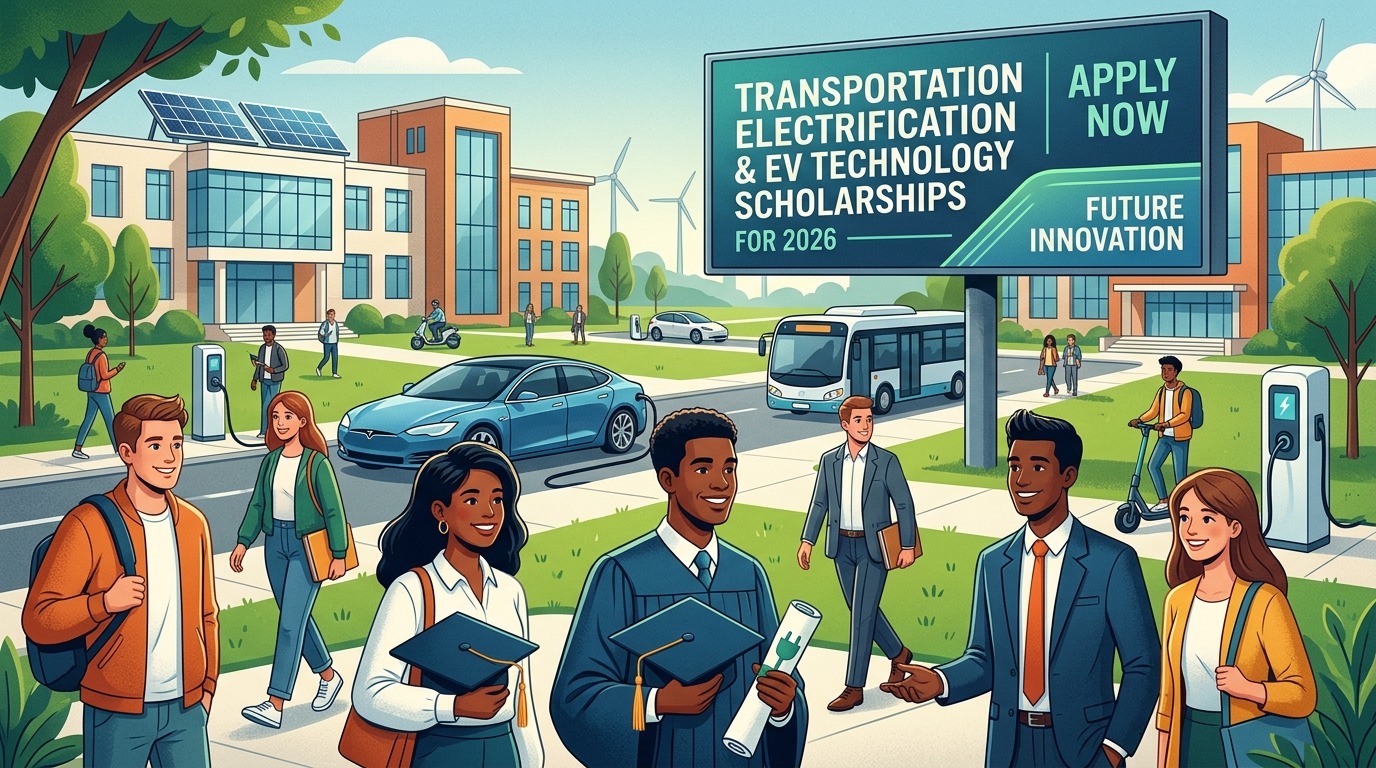
Transportation Electrification & EV Technology Scholarships for 2026
January
1) ECS Summer Fellowships
Why It Slaps: This is one of the strongest EV-adjacent awards on the board because serious transportation electrification runs straight through electrochemistry, battery materials, and energy-storage research. If your work touches lithium-ion systems, solid-state batteries, recycling, fuel cells, advanced materials, or electrochemical modeling, this is a real fit instead of a forced one. It is also unusually clean from a research standpoint: the page clearly states the award size, the deadline, and the academic profile it wants. For graduate students building a battery or clean-mobility research path, this is the kind of scholarship/fellowship that belongs high on the list.
Amount: Up to $5,000.
Deadline: January 15.
Apply/info: ECS Summer Fellowships
March
2) ITE University Scholars Program
Why It Slaps: If your transportation electrification path leans more toward planning, traffic systems, smart infrastructure, or transportation engineering than pure battery chemistry, this is a smart target. ITE’s program supports students entering transportation engineering, planning, and related fields, and the support can continue over multiple undergraduate years instead of being just a one-shot award. That makes it especially valuable for students who want to work on EV charging networks, corridor planning, intelligent mobility systems, or future transportation policy. It is also one of the more student-friendly programs here because the current cycle page spells out the deadline and the official ITE page explains the longer-term scholarship structure.
Amount: Up to $4,000 annually, with total support of up to $20,000 over time.
Deadline: March 15, 2026 at 5:00 PM Central Time.
Apply/info: 2026 ITE University Scholars Program
3) Jack E. Leisch Fellowship
Why It Slaps: This is not marketed as an “EV scholarship,” but it absolutely belongs in a serious transportation electrification guide because electrified transport still depends on roadway design, traffic operations, safety, and transportation planning. If your graduate work sits at the intersection of cleaner mobility and transportation systems, this is a strong fit. It is especially useful for students whose EV interests are tied to infrastructure, traffic flow, multimodal planning, highway design, or public-sector transportation work rather than pure hardware. That systems-level angle is where a lot of real EV career growth lives, and this fellowship supports it well.
Amount: Approximately $5,000.
Deadline: March 27, 2026 at 11:59 PM ET.
Apply/info: Jack E. Leisch Fellowship
4) BCI Battery Chemistry and STEM Scholarship
Why It Slaps: This is one of the most direct transportation-electrification fits on the page. The scholarship explicitly supports students studying electrochemistry, STEM, or related technical disciplines that support energy storage applications, which is exactly where EV batteries, charging innovation, and materials development live. It is also nice because the award is simple and clearly defined instead of buried in vague marketing language. If you are writing about battery packs, battery safety, storage materials, recycling, or manufacturing, this one is a natural inclusion.
Amount: $5,000.
Deadline: March 31, 2026.
Apply/info: BCI Foundation
5) BCI Community Scholarship
Why It Slaps: This is the more community-and-industry-connected side of the BCI Foundation’s scholarship effort. It is a smart fit for students already connected to the battery and energy storage world through a BCI-member company, and that makes it more targeted than a lot of broad STEM money. If your household is already tied to battery manufacturing, supply, recycling, or related energy-storage work, this award is one of the cleaner ways to turn that connection into real education support. It also works well in an EV scholarship guide because the battery industry is one of the core talent pipelines behind electrified transportation.
Amount: $5,000.
Deadline: March 31, 2026.
Apply/info: BCI Foundation
6) COMTO National Scholarship Program
Why It Slaps: COMTO is one of the best transportation-sector scholarships here because it is built around the transportation industry itself, not just a random academic major bucket. That matters for EV and electrification students because the future workforce is not only battery engineers. It also includes planners, operators, public-sector transportation professionals, and students from a wide range of backgrounds heading toward transportation careers. The award range is solid, the program is national, and the live application structure is easy to verify.
Amount: $1,600 to $10,000.
Deadline: March 31, 2026 at 11:59 PM.
Apply/info: COMTO National Scholarship Program
7) National Grid Charging our Future Scholarship
Why It Slaps: This is one of the most obviously relevant awards for a transportation electrification page because it combines engineering scholarship money with a paid summer internship tied to the evolving energy system. EV growth depends on grid readiness, charging systems, and power engineering, so this scholarship sits right where transportation and electricity meet. It is especially strong for students pursuing electrical engineering or power-systems coursework, but the current program description leaves room for other engineering majors too. The internship piece gives it extra career value because it turns the scholarship into a workforce pipeline, not just a tuition drop.
Amount: $10,000 per academic year, with renewal up to a maximum of $20,000.
Deadline: March 31, 2026 by 11:59 PM.
Apply/info: 2026 Charging our Future Scholarship
8) National Grid Electric Worker Scholarship
Why It Slaps: Transportation electrification is not just about designing EVs. It is also about building and maintaining the electrical workforce that makes charging networks and electrified infrastructure possible. This scholarship stands out because it funds students in electrical construction maintenance and overhead electric line worker training, which is exactly the kind of skilled labor pipeline the clean-energy transition needs. If your site wants a guide that speaks to both four-year engineering students and skilled-trades students, this is one of the strongest adds.
Amount: Up to $7,000.
Deadline: March 31, 2026.
Apply/info: National Grid 2026 Scholarships
9) Valvoline Scholarships
Why It Slaps: This one is more automotive-career adjacent than battery-science specific, but it still belongs because EV talent does not come only from engineering departments. It also comes from students building hands-on technical careers in modern vehicle service and repair. Valvoline’s current page clearly states multiple $2,500 awards, including extra awards reserved for female students pursuing automotive careers. If you are keeping this guide practical for readers who want an EV pathway through auto tech or shop-based training, this is a credible add.
Amount: $2,500 each. The 2026 page lists twelve standard awards plus four additional $2,500 awards for female students.
Deadline: March 31, 2026.
Apply/info: Valvoline Scholarships
10) Mitchell 1 Automotive Technology Scholarship
Why It Slaps: This is another good “real-world vehicle systems” scholarship for students who are entering the service-and-repair side of transportation technology. EV adoption will keep pushing the industry toward more electrical diagnostics, software familiarity, and advanced repair workflows, so scholarships like this still make sense inside an EV guide. Mitchell 1 also gives the award some extra juice by adding a cash check and conference travel beyond the scholarship itself. For students in automotive technology who want a more technical, career-facing option, this is a solid pick.
Amount: $2,500 scholarship, plus a $500 check and conference travel package.
Deadline: March 31, 2026.
Apply/info: Mitchell 1 Automotive Technology Scholarship
April
11) IBTTA Foundation Scholarship
Why It Slaps: This is one of the better infrastructure-facing scholarships for students whose electrification interests connect to transportation systems, tolling, roadway operations, planning, communications, or transportation management. EV growth is going to keep colliding with questions around corridors, road finance, data systems, freight movement, and transport operations, so a scholarship tied to transportation-related programs has real value here. The live Scholarship America page is also unusually clean: it shows the amount, the deadline, and the current status in one place. That makes it easy to trust and easy for readers to use.
Amount: $5,000. Up to six awards are available.
Deadline: April 20, 2026 at 3:00 PM CT.
Apply/info: IBTTA Foundation Scholarship
No fixed public deadline currently posted on the live page
12) Ford Auto Tech Scholarship 2026
Why It Slaps: This is a practical scholarship for students who want to build a career in vehicle technology through automotive or diesel training. That may sound broader than EV, but the technician pipeline matters a lot as vehicles become more electrified, software-heavy, and diagnostics-driven. The current page clearly states the award size and eligibility basics, including FAFSA-based financial-need screening. For readers who are not heading into a four-year battery or engineering route, this is a very usable option.
Amount: $5,000.
Deadline: The current live page says “Applications Open Now” but does not publish a fixed closing date.
Apply/info: Ford Auto Tech Scholarship 2026
13) Waymo Scholarships
Why It Slaps: This is one of the few scholarships on the list that explicitly names EV technology alongside automotive technology, electrical and industrial tech, robotics, and mechatronics. That alone makes it one of the most on-theme options here. It is also strong because it recognizes that the future transportation workforce includes more than one degree path: technicians, reskilling adults, robotics learners, and EV-focused students all show up in the eligibility language. If your readers want a direct EV-tech label on the page, this is one of the cleanest examples.
Amount: $2,500.
Deadline: Rolling. The current page says students may apply at any time, are considered starting four months before their start date, and funding is first-come, first-served.
Apply/info: Waymo Scholarships
14) Michigander Scholars Program
Why It Slaps: This is one of the coolest workforce-pipeline programs in the whole guide because it is explicitly built around EV, mobility, semiconductor, and aerospace/defense talent in Michigan. For transportation electrification students, that means this is not just scholarship money floating in the abstract. It is tied to internships and full-time jobs with participating employers in the real EV and mobility ecosystem. If your readers are in Michigan or at participating universities, this is the kind of opportunity that can turn into both cash and a direct industry entry point.
Amount: $5,000 for a qualifying internship/co-op or $10,000 for a qualifying full-time role, depending on pathway.
Deadline: No fixed public deadline is listed on the current U-M page; the program application is live and the page shows ongoing advising/events.
Apply/info: Michigander Scholars Program
15) ITS-NY Academic Excellence Scholarship
Why It Slaps: This is a good fit for high school seniors in New York who want to enter intelligent transportation systems and related fields early. That matters because EV growth is increasingly tied to smart corridors, connected infrastructure, data systems, and transportation technology, not just the vehicle itself. The scholarship page is also useful because it does not pretend ITS is narrow; it clearly frames the field as a future-industry pipeline. For New York high school readers interested in transportation tech, this is one of the cleaner state-level options.
Amount: $1,000. Two awards are listed.
Deadline: The current scholarship page for the Spring 2026–Fall 2026 cycle does not publish a specific due date.
Apply/info: ITS-NY Scholarship Opportunities
16) ITS-NY Future Leadership Scholarship
Why It Slaps: This is one of the best direct-fit entries for undergrads because the eligibility language explicitly includes electric vehicles, automated vehicles, civil engineering, robotics, transportation planning, computer science, and public policy. That is exactly the kind of cross-disciplinary reality transportation electrification students live in. It is also a strong pick for students who are not pure electrical engineers but still want to work in EV-adjacent systems and mobility strategy. For New York undergraduates, this is one of the most on-theme scholarships in the guide.
Amount: $3,500.
Deadline: The current scholarship page for the Spring 2026–Fall 2026 cycle does not publish a specific due date.
Apply/info: ITS-NY Scholarship Opportunities
17) ITS-NY Dotty Drinkwater Scholarship
Why It Slaps: Graduate students often get left out of EV scholarship roundups, so this is a strong inclusion. The page explicitly names electric vehicles, automated vehicles, robotics, transportation planning, civil engineering, and public policy as eligible ITS-related areas, which makes it unusually relevant for advanced students working on electrified mobility problems. It is also friendly to interdisciplinary graduate work, which is a big deal in EV research where policy, systems engineering, data, and infrastructure all collide. For New York grad and PhD students, this is a real fit.
Amount: $3,500.
Deadline: The current scholarship page for the Spring 2026–Fall 2026 cycle does not publish a specific due date.
Apply/info: ITS-NY Scholarship Opportunities
FAQs
Are there many true EV-only scholarships?
Not really. Most strong opportunities are filed under battery science, electrochemistry, power systems, transportation engineering, intelligent transportation systems, mobility, or automotive technology rather than using “EV” in the award title. That is why the best real-fit list usually blends direct EV pages like Waymo with adjacent-but-valid programs in batteries, grid engineering, and transportation systems.
Are trade school and technician students eligible for this niche?
Yes. This page is not just for four-year engineering majors. Ford Auto Tech, Waymo, National Grid’s Electric Worker Scholarship, Valvoline, and Mitchell 1 all create real pathways for students in technician, trade, or auto-tech programs.
Do you need to major in engineering to qualify?
Not always. Some of the strongest awards do want engineering or technical majors, but COMTO, ITS-NY, and IBTTA all leave room for broader transportation-related study, including planning, policy, communications, and other transportation-linked fields.
Which scholarships are best for battery and energy-storage students?
The cleanest battery-and-storage fits on this page are the ECS Summer Fellowships and the BCI Battery Chemistry and STEM Scholarship. They map most directly to electrochemistry, energy storage, and technical disciplines that support battery innovation.
Which scholarships are best for infrastructure and transportation-systems students?
The best bets are ITE University Scholars, the Jack E. Leisch Fellowship, COMTO, IBTTA, and the ITS-NY scholarships. Those awards make the most sense for students focused on planning, mobility systems, traffic operations, charging corridors, and transportation policy or infrastructure.
Which scholarships are best for students who want direct industry access?
National Grid’s Charging our Future Scholarship and the Michigander Scholars Program stand out because they tie funding to internships or job pathways instead of offering only tuition money. Waymo also deserves attention because it is explicitly tied to EV technology and related technical training.