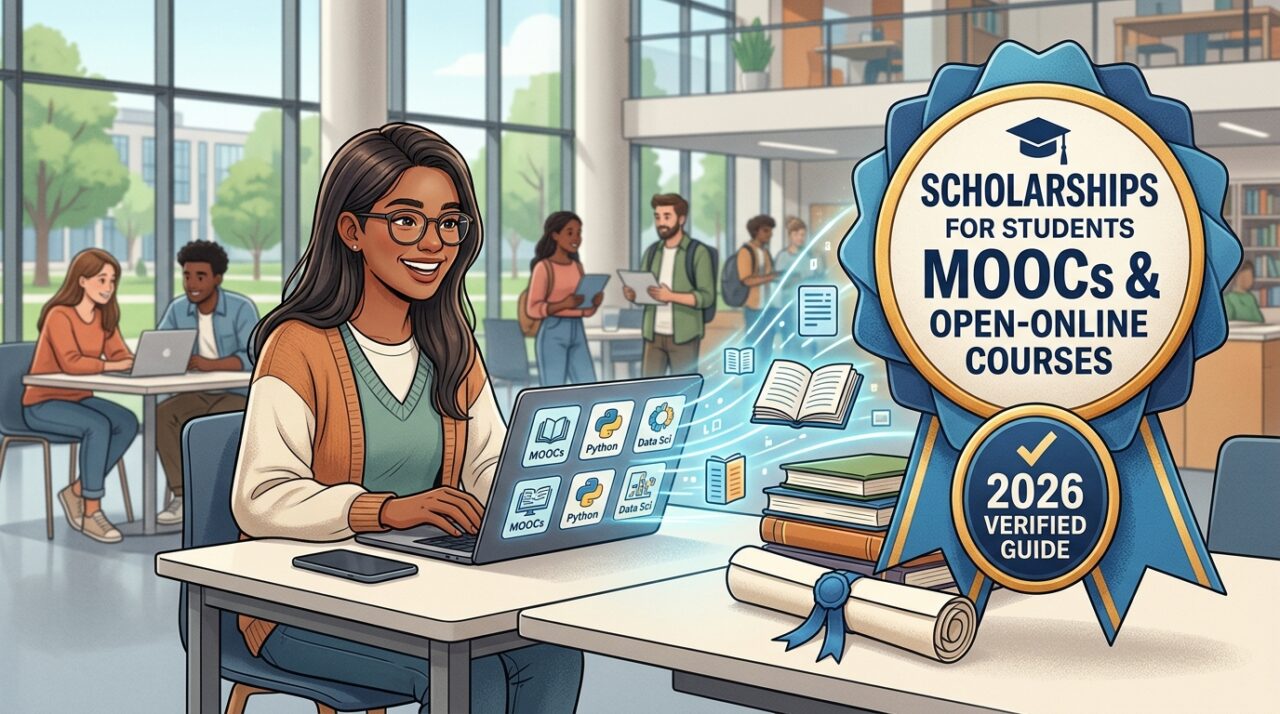
Scholarships for Students Pursuing MOOCs & Open-Online Courses (2026 Verified Guide)
April
1) KMi Annual Summer Scholarship 2026
Why It Slaps: This is one of the strongest true open-learning-adjacent opportunities on the board because it is not just “take a class and good luck.” It blends a non-repayable bursary, mentoring, and a project that can be conducted online, on campus, or in a hybrid setup. For students who are using open-online learning to build a real portfolio in AI and computing, this is the kind of opportunity that can turn curiosity into evidence. It is especially strong because prior programming experience is not required, which makes it much more welcoming than many tech scholarships.
Amount: Up to £2,700
Deadline: April 30, 2026
Apply/info: KMi Annual Summer Scholarship 2026
June
2) The Open University Carers’ Scholarship
Why It Slaps: If you are balancing unpaid care work and trying to study through flexible online learning, this is one of the most relevant scholarships out there. It covers full tuition for eligible Open University undergraduate study, which fits students who need a genuinely flexible open-learning model rather than a rigid campus schedule. For a MOOC learner who wants to move from informal online learning into credit-bearing distance study without losing flexibility, this is a serious step-up option. It also stands out because the scholarship is built around the reality that carers often need open access, home-based study, and a timetable they can actually survive.
Amount: Full tuition for eligible undergraduate study, up to 120 credits per academic year and 360 credits total
Deadline: June 17, 2026
Apply/info: OU Carers’ Scholarship
3) AWS AI & ML Scholars
Why It Slaps: This is one of the best live “learn online first, prove yourself fast” opportunities in 2026. AWS is funding the challenge phase for up to 100,000 learners, and top performers move into a fully funded Udacity Nanodegree track. That makes it unusually strong for MOOC-style learners because you can enter through open online training, build skills on your own schedule, and still earn a respected structured follow-on pathway if you perform well. For students chasing AI, cloud, or career-switch momentum without paying upfront, this is absolutely worth attention.
Amount: Fully funded challenge phase; top 4,500 learners advance to a fully funded Udacity Nanodegree
Deadline: June 24, 2026
Apply/info: AWS AI & ML Scholars
4) Open Futures Scholarship for Black Students
Why It Slaps: This is another strong open-learning scholarship because it directly funds study in a model built for flexibility, home-based learning, and nontraditional progression. For students who are using MOOCs and open courses to test subjects before committing to a full qualification, this scholarship can help convert that experimentation into real credit-bearing progress without tuition cost. It is especially valuable because it is not just a small one-off award. It is a substantial tuition scholarship tied to an actual open university pathway.
Amount: Full tuition for eligible undergraduate study, up to 120 credits per academic year and 360 credits total
Deadline: June 24, 2026
Apply/info: Open Futures Scholarship for Black Students
5) WGU Sage Scholarship
Why It Slaps: This is a bridge pick, not a pure MOOC scholarship, but it deserves inclusion because a lot of learners use MOOCs to test a field before moving into a structured online degree. The Sage Scholarship helps reduce tuition for new WGU students and returning graduates, which can make that jump a lot easier. If you have been using Coursera, edX, or other open platforms to confirm that you really want business, tech, education, or health, this is the kind of next-step funding that matters. It is practical, current, and tied to a fully online university model.
Amount: Up to $3,000
Deadline: June 30, 2026
Apply/info: WGU Sage Scholarship
6) WGU Online Access Scholarship
Why It Slaps: This is another bridge pick, but it solves a very real online-learning problem that many scholarship lists ignore: access itself. If your biggest barrier is not motivation but hardware, internet, or basic equipment needed for reliable online study, this scholarship is unusually relevant. For learners turning open-online courses into a real online degree path, this can remove the tech barrier that quietly kills momentum. It is not flashy cash, but for the right student, a laptop, hotspot, webcam, and access support can be more valuable than a small check.
Amount: Varies; provides technology/access support such as devices and internet-related help
Deadline: June 30, 2026
Apply/info: WGU Online Access Scholarship
July
7) The Open University Care Experienced Scholarship
Why It Slaps: This is a strong fit for students who need an open-access, flexible, online-first study model because life has not followed a neat traditional timeline. The scholarship fully funds eligible undergraduate study and is specifically designed for care-experienced young people who may need home-based, flexible progression rather than a residential college setup. That makes it highly relevant for learners who began with open-online courses and want a softer, more realistic transition into formal higher education. It is one of the few verified opportunities in this niche that pairs real tuition support with a distance-learning structure built for access.
Amount: Full tuition for eligible undergraduate study, up to 120 credits per academic year and 360 credits total
Deadline: July 1, 2026
Apply/info: OU Care Experienced Scholarship
8) The Open University Disabled Veterans’ Scholarships Fund
Why It Slaps: This is one of the clearest examples of a scholarship that pairs funding with the actual structure online learners often need. It funds Open University study and adds careers and disability support, which makes it much stronger than a basic tuition-only award. For disabled veterans who want to build skills through flexible online study and possibly use MOOCs as a low-risk starting point before moving into a fuller qualification, this is a serious, high-value option. It is especially compelling because it funds both undergraduate and postgraduate pathways.
Amount: Tuition waived for eligible study, up to 120 credits per academic year and 360 credits total
Deadline: July 15, 2026
Apply/info: Disabled Veterans’ Scholarships Fund
9) Open Futures Sanctuary Scholarship
Why It Slaps: This scholarship belongs on this list because displaced learners often benefit most from study models that are flexible, home-based, and open. The Open University’s sanctuary scholarship funds a large amount of undergraduate study and fits students who cannot easily pursue a traditional campus path. For someone using MOOCs and open courses as a first re-entry point into education, this can become the bridge to formal, tuition-covered distance learning. It is mission-aligned with access in the deepest sense, not just convenience.
Amount: Full tuition for eligible undergraduate study, up to 360 credits total
Deadline: July 22, 2026
Apply/info: Open Futures Sanctuary Scholarship
Rolling / Ongoing
10) Coursera Financial Aid
Why It Slaps: This is one of the most useful real-world tools for MOOC learners because it targets the exact pain point most people hit: certificate cost. Coursera’s financial-aid option appears on eligible learning-program pages, and approved learners can use it to unlock certificate-track access they otherwise could not afford. This is not a flashy named scholarship, but for students actually taking open-online courses right now, it is often more actionable than waiting around for a tiny outside award. It is especially useful if you are building a stack of job-relevant certificates one course at a time.
Amount: Varies by eligible course or certificate
Deadline: Rolling / course-based
Apply/info: Coursera financial aid help
11) edX Financial Assistance
Why It Slaps: edX remains one of the cleanest direct-funding options for open-online course learners because the assistance is tied to verified certificate fees on eligible courses. The big advantage here is that it lets learners stay in a serious MOOC ecosystem with university and industry-backed content while reducing the cost of the credential layer that employers or transfer pathways may care about most. If you are strategically using open courses to build proof of skill, this is exactly the kind of aid you want to check before paying retail.
Amount: 80% reduction on eligible verified certificate fees
Deadline: Rolling / course-based
Apply/info: edX Financial Assistance
12) Verizon Skill Forward
Why It Slaps: This is one of the best current “skip the paywall and start learning” options for career-minded online learners. Verizon Skill Forward gives learners free access to selected edX certificate pathways in high-growth fields, which makes it much more useful than a generic discount. For students exploring whether MOOCs and online certificates can help them pivot careers or stack skills before committing to a bigger credential, this is a high-value, low-friction entry point. It is especially appealing because it is positioned around job-relevant programs rather than random hobby content.
Amount: No cost to participants
Deadline: Available through the end of the year
Apply/info: Verizon Skill Forward
13) edX MicroMasters Financial Assistance
Why It Slaps: This is a sleeper pick for serious learners who want more than a one-off MOOC. MicroMasters programs can function like a middle ground between open online learning and graduate-level structured study, and edX says financial assistance is available for almost all of them. That makes this a strong option for learners who started with free or low-cost courses, discovered real interest in a field, and now want something more advanced without jumping straight into a full master’s bill. It is especially useful for people who care about academic signal, transfer potential, or deeper subject mastery.
Amount: Typically 80% of cost for almost all MicroMasters programs; the MITx MicroMasters in Finance is the stated exception
Deadline: Rolling / program-based
Apply/info: edX guide to graduate certificates vs. MicroMasters
Related links
Use these as active internal links inside the article or in a “Related guides” block:
Funding Playbook for Distance Learners in the U.S.
Online Colleges With Low Tuition (2026 Guide)
Cheapest Colleges Online (2026 Guide)
2026 Scholarships for Adult Learners (U.S.)
25+ Stackable Scholarships with the Pell Grant (2026)
AI/ML Scholarships 2026
FAQs
Are there many true MOOC-only scholarships?
Not really. The live, reliable pool is much smaller than standard college-scholarship categories, and most real options currently fall into three buckets: platform financial aid, sponsored online-learning cohorts, and open/distance-learning scholarships.
What should students check first before paying for a MOOC certificate?
Check whether the course page or platform offers financial aid first. On Coursera and edX, that can be the fastest way to reduce certificate costs without waiting for an outside scholarship cycle.
Are these all cash scholarships?
No. Many of the best options in this niche are tuition waivers, verified-certificate discounts, funded access programs, or equipment/access support rather than a direct cash award sent to you.
Do I need to be in a formal degree program to use these?
Not always. Coursera financial aid, edX financial assistance, AWS AI & ML Scholars, Verizon Skill Forward, and the KMi scholarship can be used without being in a traditional U.S. college degree program, while several Open University and WGU options are tied to structured institutional study.
What is the smartest strategy for students using MOOCs to save money?
Use MOOCs to test the field cheaply, apply for platform aid on the strongest certificates, and then move into bridge scholarships only after you know the subject is worth deeper investment. That sequence keeps your risk low and your proof-of-skill high.