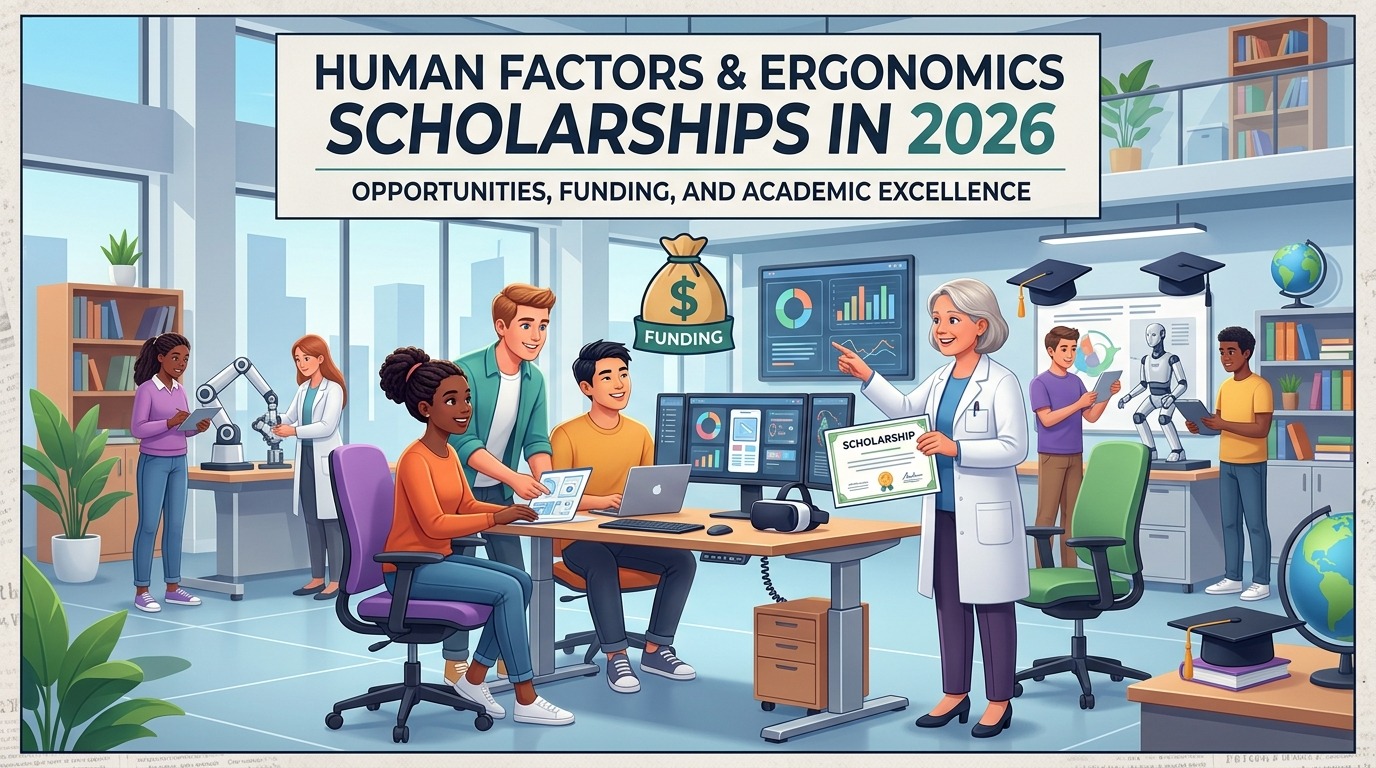
Human Factors & Ergonomics Scholarships in 2026
January Deadlines
1) AsMA Fellows Scholarship
Why It Slaps: This is one of the strongest direct-fit scholarships on the list if your version of ergonomics leans toward human performance, aerospace environments, cognition, fatigue, safety, or mission-critical human systems. What makes it especially good is that AsMA explicitly includes allied fields such as human factors, psychology, ergonomics, and engineering in the eligible training areas. It is also better than a generic engineering award because the scholarship sits inside a community that actually understands applied human performance. For students heading toward aviation human factors, cockpit design, astronaut performance, aerospace psychology, or extreme-environment safety, this is a smart target.
Amount: $2,000 for 1st place and $1,000 for 2nd place.
Deadline: January 31 annually.
Apply/info: Aerospace Medical Association Scholarships
February Deadlines
2) SME Education Foundation Scholarships
Why It Slaps: This is not labeled “ergonomics,” but it is a smart feeder option for students entering industrial engineering, manufacturing systems, human-centered production, workstation design, or safety-minded product/process improvement. The big value here is scale: one application can place students into consideration for multiple scholarships, and the foundation says awards range widely. That makes it useful for high school seniors and current college students who want a broader manufacturing or systems track before specializing in ergonomics later. If your path is “industrial engineering now, ergonomics specialization later,” this is one of the stronger adjacent plays.
Amount: Scholarships range from $2,500 to $20,000.
Deadline: February 1 annually. The 2026–2027 cycle is listed as closed.
Apply/info: SME Education Foundation Scholarships
3) Marvin Mundel Memorial Scholarship
Why It Slaps: This IISE scholarship is one of the better adjacent options because it specifically rewards interest in work measurement and methods engineering, which overlaps naturally with ergonomics, workflow design, task analysis, and human-centered efficiency. That makes it more relevant than a random broad STEM scholarship. Students who like process improvement, labor analysis, operations, and better human-system fit should keep it on their radar. It is especially useful for undergrads building into industrial and systems engineering with ergonomics depth later on.
Amount: Most recently listed at $1,100.
Deadline: February 1 annually.
Apply/info: IISE Scholarships and Fellowships
4) Kenneth E. Case Memorial Scholarship
Why It Slaps: This one is broader than a pure ergonomics scholarship, but it still belongs in the conversation because industrial and systems engineering is one of the main academic homes for ergonomics and human factors. If you are an undergraduate junior building toward usability engineering, human-centered systems, safety engineering, or operations ergonomics, this scholarship can help fund the degree path that gets you there. It also tends to make more sense than chasing random general engineering money, because the discipline alignment is tighter. For students who want a serious undergraduate pipeline award before specializing later, this is a good fit.
Amount: Multiple scholarships of $2,500 each were awarded in 2025.
Deadline: February 1 annually.
Apply/info: IISE Scholarships and Fellowships
5) ASSP Foundation Scholarship, funded by Amazon
Why It Slaps: This is a strong adjacent scholarship for students whose ergonomics interests show up through occupational safety, workplace design, injury prevention, EHS, or safety engineering technology. The ASSP Foundation application is useful because it is built for degrees that support the safety field, and that includes a lot of human factors-adjacent pathways. The Amazon-funded award is attractive because the most recently listed amount is substantial, and recent recipients came from directly relevant programs such as occupational safety and environmental safety management. If your human factors work is more workplace, warehouse, industrial, or safety-systems oriented, this is a real contender.
Amount: Most recently listed at $6,000.
Deadline: February 15 annually through the ASSP Foundation application. The 2026 cycle is listed as closed.
Apply/info: ASSP Foundation Academic Scholarships
6) FabEnCo – LaCook Investment for Excellence (LIFE) in Occupational Safety and Health Scholarship
Why It Slaps: This is one of the better fits for students whose ergonomics work lives inside occupational safety, occupational health, industrial hygiene, or injury prevention. Human factors does not always show up under that exact name on scholarship pages, so opportunities like this matter because they fund the programs where applied ergonomics often lives in practice. The recent recipient profile also shows the scholarship supporting public-health and industrial-hygiene-style study, which makes it useful for students interested in workplace exposure, prevention, and human performance. If your ergonomics angle is more worker-centered than consumer-tech centered, this belongs on your list.
Amount: Most recently listed at $4,000.
Deadline: February 15 annually through the ASSP Foundation application. The 2026 cycle is listed as closed.
Apply/info: ASSP Foundation Academic Scholarships
7) Robert C. Spear Internship Scholarship
Why It Slaps: This is narrow, but it is very worth knowing if you are in the right program. It offers a serious stipend and is tied to occupational safety and health work with community and worker groups, which can connect directly to ergonomics, worker safety design, and applied human factors in real environments. Because it is internship-based, it can also be stronger career fuel than a small generic scholarship. The catch is eligibility: it is for graduate students affiliated with the COEH/NorCal-NIOSH network at UC Davis, UC Berkeley, and UCSF.
Amount: $9,000 stipend.
Deadline: February 23, 2026.
Apply/info: Robert C. Spear Internship Scholarship
March Deadlines
8) Space Medicine Association Undergraduate Scholarship
Why It Slaps: This is a surprisingly strong fit for undergrads interested in human factors research, safety, psychology, biomedical engineering, and space operations. The page explicitly names human factors research among the example interest areas, which is exactly why it made this list. It is also useful because students interested in extreme-environment ergonomics, astronaut performance, cockpit and habitat design, or mission operations do not have many obvious scholarship targets. For undergraduate students with a space-human-performance angle, this is one of the cleanest fits around.
Amount: $1,000.
Deadline: March 1 annually.
Apply/info: Aerospace Medical Association Scholarships
9) Space Medicine Association Medical & Graduate Education Scholarship
Why It Slaps: This is the graduate-school version of the opportunity above, and it is a very good match for students whose work blends human factors, safety, psychology, biomedical engineering, and space medical operations. That matters because many direct human factors scholarships skew graduate-level anyway. If your research touches mission workload, crew systems, fatigue, environment design, or spaceflight human performance, this is the kind of specialized scholarship that actually lines up with your academic story. It is not huge money, but the fit is excellent for the right applicant.
Amount: $1,000.
Deadline: March 1 annually.
Apply/info: Aerospace Medical Association Scholarships
April Deadlines
10) Dr. Guylène Proulx, OC Scholarship
Why It Slaps: This is one of the most direct-fit awards in the entire guide. It specifically supports student research in human factors or human behavior related to fire or emergencies, or research integrating human factors into fire protection engineering. That makes it gold for students working on evacuation behavior, alarm response, emergency wayfinding, crowd movement, risk communication, or human-centered safety design. It is also one of the few awards here that directly names human factors in the eligibility language, which makes it especially valuable.
Amount: $5,000 total, with $1,000 going to the supporting faculty member and the remainder to the student.
Deadline: April 6, 2026.
Apply/info: Dr. Guylène Proulx, OC Scholarship
11) Annual Dieter W. Jahns Student Award
Why It Slaps: This is another direct-hit opportunity for ergonomics students because it is built around an ergonomics project and comes from the Foundation for Professional Ergonomics. It is open to undergraduate and graduate students, plus recent grads within one year of graduation, which widens the pool in a good way. Another nice detail is the extra support for the mentor’s department or lab, which can make faculty more enthusiastic about backing a strong student application. It is not the biggest cash amount, but the discipline alignment is excellent and the professional signaling value is strong.
Amount: $1,000 to the student, $1,000 to the professor’s department/lab, plus first-year BCPE certification fees if the winner chooses to apply.
Deadline: April 15, 2026.
Apply/info: Annual Dieter W. Jahns Student Award
May Deadlines
12) NSC Safety Scholarship
Why It Slaps: This is a practical pick for students whose ergonomics interests live inside occupational health and safety, worker wellbeing, injury prevention, or safety leadership. The National Safety Council says the scholarship supports students pursuing degrees in occupational health and safety, related STEM fields, and other relevant majors, so it is broad enough to catch human-factors-adjacent students without being random. It also adds travel and registration support for the Safety Congress & Expo, which can create networking value on top of tuition help. For students aiming at workplace ergonomics rather than app or interface design, this is a smart target.
Amount: $5,000 tuition award, plus complimentary registration and travel accommodations to the NSC Safety Congress & Expo.
Deadline: May 1, 2026.
Apply/info: National Safety Council Scholarship Program
June Deadlines
13) I/ITSEC Postgraduate Scholarships
Why It Slaps: These are some of the best adjacent scholarships for students in simulation, training, human performance, cognitive systems, and applied human factors. The eligibility list explicitly includes Human Factors (Psychology or Engineering), which is exactly why this belongs in the guide. If your work touches simulation-based training, military or defense usability, human-system integration, XR training, or performance under pressure, this is a highly relevant lane. It is especially strong for graduate students who want a human factors path outside the usual consumer-tech narrative.
Amount: Master’s awards at $5,000 and doctoral awards at $10,000.
Deadline: June 21, 2026.
Apply/info: I/ITSEC Scholarship Awards – How to Apply
July Deadlines
14) International Academy of Aviation and Space Medicine Scholarship
Why It Slaps: This is one of the highest-dollar opportunities anywhere near this niche, though it is also one of the most specialized. It is designed to support training in aviation and space medicine, which can overlap strongly with human performance, cognition, safety, fatigue, environmental stressors, and other applied human factors themes. This is not a casual undergraduate scholarship, but for students or young professionals building into aerospace human performance or aviation medicine, it is a major opportunity. The application process also includes a sponsor recommendation, so it rewards students who already have serious professional momentum.
Amount: Up to US$20,000 annually.
Deadline: July 31, 2026, with both parts of the application due by that date.
Apply/info: IAASM Scholarship Application
October Deadlines
15) Bailey-Shipp Safety Scholarship
Why It Slaps: This is one of the clearest adjacent matches on the board because the eligibility section explicitly includes Ergonomics and Human Factors among relevant fields of study. That alone makes it worth serious attention. It is also open to full-time students at accredited U.S. colleges and universities, which gives it a broader entry point than some of the hyper-specialized awards above. If your degree sits at the intersection of safety, worker protection, design, and human performance, this is a very clean fit.
Amount: $8,000.
Deadline: October 1, 2026.
Apply/info: Bailey-Shipp Safety Scholarship
16) BCSP QAP Scholarships
Why It Slaps: This is a solid late-cycle option for students in approved academic programs connected to environmental, health, and safety education, which is where a lot of applied ergonomics students end up academically or professionally. The funding level is strong, and the number of selected students is unusually generous compared with many niche scholarships. The big catch is that you must be in a BCSP Qualified Academic Program, so this one is highly program-dependent. Still, for juniors, seniors, and master’s students already inside that ecosystem, it is one of the better annual opportunities to track.
Amount: $5,000.
Deadline: Opens August 1 and closes October 3.
Apply/info: BCSP Grants & Scholarships
FAQs
Are there really 30 strong human factors and ergonomics scholarships every year?
No. Not if you are being strict about official sources and real subject fit. Most funding for this field is tucked inside industrial engineering, occupational safety, EHS, aerospace medicine, fire protection, simulation/training, and human performance rather than under a clean “ergonomics scholarship” label. That is why a smaller verified list is better than a padded one.
Is this field mostly for graduate students?
A lot of the most direct-fit awards do lean graduate or research-heavy, but there are still undergraduate options. Good examples include the SME Education Foundation scholarships, the Space Medicine Association Undergraduate Scholarship, the Bailey-Shipp Safety Scholarship, and some IISE and BCSP pathways. The pattern is simple: undergrads often enter through industrial engineering, safety, or related majors, then specialize in human factors later.
What keywords should students search besides “human factors” and “ergonomics”?
Use a wider net. Strong related keywords include industrial and systems engineering, occupational safety, occupational health, EHS, safety engineering, human performance, simulation and training, aerospace medicine, product design with a safety focus, fire protection engineering, and human behavior in emergencies. Many real-fit scholarships sit under those labels instead.
Which scholarships on this list were still open after April 10, 2026?
From this guide, the main still-open options after April 10, 2026 were the Dieter W. Jahns Student Award (April 15), NSC Safety Scholarship (May 1), I/ITSEC Postgraduate Scholarships (June 21), IAASM Scholarship (July 31), Bailey-Shipp Safety Scholarship (October 1), and BCSP QAP Scholarships (open August 1, close October 3).
What if my program is called industrial engineering or safety, not ergonomics?
That is completely normal. In practice, many human factors students come through industrial and systems engineering, occupational safety, public health, industrial hygiene, aerospace medicine, or simulation-focused programs. You should apply based on the real work you want to do, not just the exact wording of your degree title.