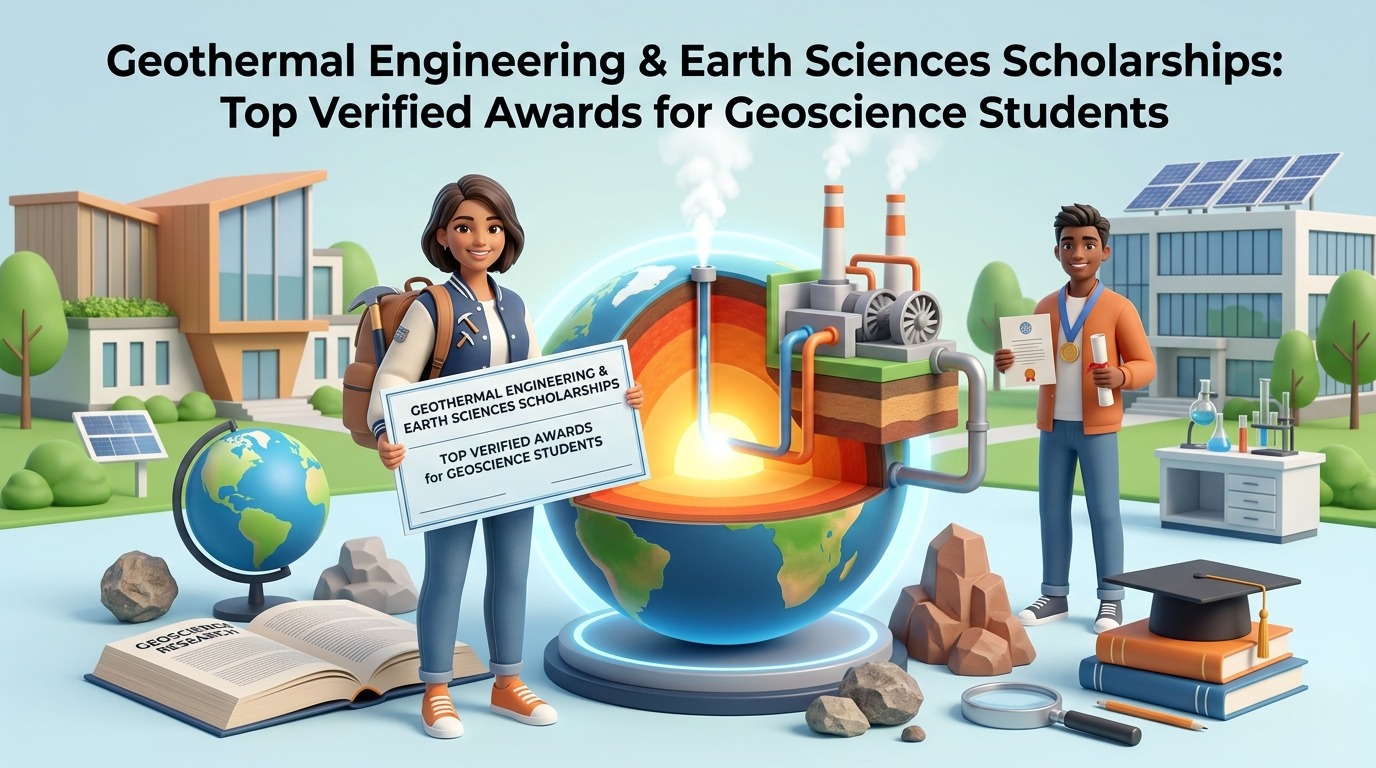
Top 18 Geothermal Engineering & Earth Sciences Scholarships
January Deadlines
1) AEG Foundation Scholarships & Grants
Why It Slaps: This is one of the better fits for students whose geothermal interests overlap with engineering geology, environmental geology, hydrogeology, slope stability, subsurface characterization, and applied site investigation. That matters because a lot of geothermal work lives at the intersection of rock, groundwater, drilling conditions, faulting, and geotechnical judgment. Another big plus is that AEG offers multiple scholarships and grants instead of a single winner-take-all award, which can improve your odds if your work sits in applied geoscience rather than pure academic geology.
Amount: $500 to $5,000
Deadline: January 15
Apply/info: AEG Foundation Scholarships & Grants
2) NOAA Ernest F. Hollings Undergraduate Scholarship
Why It Slaps: This is a strong option for undergrads in earth system science, environmental science, geology, geophysics, GIS, oceanic and atmospheric science, and related fields that can connect to geothermal resource mapping, climate resilience, and environmental monitoring. It stands out because it combines academic support with a paid summer internship, which is huge if you want applied federal experience instead of just resume filler. For students interested in the science-policy-government side of energy and earth systems, this one can open serious doors.
Amount: Up to $9,500 per academic year for 2 years, plus a paid 10-week summer internship at $700 per week
Deadline: January 31
Apply/info: NOAA Hollings Scholarship
3) NOAA EPP/MSI Undergraduate Scholarship
Why It Slaps: Students at Minority Serving Institutions should pay attention to this one because the funding package is much stronger than many small one-off awards. It is especially relevant for students in geoscience, environmental science, atmospheric science, earth systems, and adjacent STEM fields who want paid internships and a more structured pathway into NOAA-related careers. If your geothermal interests connect to climate, subsurface data, resource assessment, water systems, or environmental modeling, this is a very smart target.
Amount: Up to $45,000 total support, including academic funding and paid summer internships
Deadline: January 31
Apply/info: NOAA EPP/MSI Undergraduate Scholarship
4) Barry Goldwater Scholarship
Why It Slaps: This is one of the most prestigious awards on the page for research-focused students, and geosciences are explicitly included. It is best for sophomores and juniors who are already building a real research profile in geology, geophysics, geochemistry, volcanology, hydrology, or earth-energy systems. For geothermal engineering students aiming at graduate school, national labs, or high-level research careers, Goldwater is the kind of award that changes how people read your resume.
Amount: Up to $7,500 per year
Deadline: Late January nationally, but campus nomination deadlines often hit earlier
Apply/info: Barry Goldwater Scholarship
February Deadlines
5) AIPG National Undergraduate Scholarship Program
Why It Slaps: This one is a clean, profession-aligned pick for undergraduates in geology, geoscience, hydrogeology, environmental geology, and applied earth science. It works especially well for students who are not chasing flashy brand-name awards but want funding from a professional organization that actually understands geoscience career paths. That makes it a strong fit for geothermal students building toward fieldwork, consulting, subsurface investigation, or licensure-minded careers.
Amount: $1,000 to $3,000
Deadline: February 1
Apply/info: AIPG National Undergraduate Scholarship
6) Foundation of AIPG William J. Siok Graduate Scholarship Program
Why It Slaps: Graduate students in geothermal systems, structural geology, hydrogeology, geomechanics, environmental geology, or resource characterization should have this on their list. It is one of the more directly relevant grad-level awards for applied geoscience students who want funding from a profession-centered organization rather than a broad generic graduate database. That matters because applied earth science work often gets overlooked by mainstream scholarship roundups, while AIPG clearly values practical geoscience training.
Amount: $5,000
Deadline: February 1
Apply/info: William J. Siok Graduate Scholarship
7) GSA Graduate Student Research Grants
Why It Slaps: This is not traditional tuition money, but for a lot of earth science grad students, research support is the real bottleneck. If your geothermal or earth science project needs field sampling, lab analysis, travel, data acquisition, or specialized research expenses, this can matter more than a small generic scholarship. It is especially valuable for thesis and dissertation students who need funding tied to actual research progress, not just a GPA line.
Amount: Varies
Deadline: February 18
Apply/info: GSA Graduate Student Research Grants
March Deadlines
8) SEG Scholarships
Why It Slaps: This is one of the best matches for students working in geophysics, seismic interpretation, subsurface imaging, and reservoir characterization. That makes it especially relevant for geothermal exploration students because geothermal development depends heavily on understanding the subsurface, not just surface geology. Another plus is that the award range is wide, so this program can work for students at different levels, from newer undergrads to more advanced graduate researchers.
Amount: $500 to $10,000
Deadline: March 1
Apply/info: SEG Scholarships
9) AGU David S. Miller Young Scientist Scholarship
Why It Slaps: Students doing geo-environmental science or engineering work should not overlook this one. It is a good fit for projects involving groundwater, heat transport, environmental systems, earth processes, and the kind of interdisciplinary work that often overlaps with geothermal energy and subsurface sustainability. It also has strong signaling value because AGU recognition can help early-career researchers stand out in a crowded academic field.
Amount: $2,000
Deadline: March 13
Apply/info: AGU David S. Miller Young Scientist Scholarship
10) GeoScienceWorld Graduate Studies Award
Why It Slaps: This is a strong graduate-level earth science award with a broad enough scope to include students in geothermal systems, geochemistry, hydrogeology, volcanology, tectonics, and related research-heavy programs. It is especially nice because it is not boxed into one tiny subfield, so students whose work sits between energy, earth science, and environmental systems can still make a strong case. For grad applicants trying to stack credible national awards, this is a serious one to bookmark.
Amount: $5,000
Deadline: March 27
Apply/info: GeoScienceWorld Graduate Studies Award
April Deadlines
11) GSA Undergraduate Student Research Grants
Why It Slaps: This is a smart play for undergrads who already have a faculty mentor and a real project, even if the project is small. Geothermal and earth science students can use this kind of support for mapping, fieldwork, sample prep, lab costs, poster research, or early capstone-style work. It is one of those awards that can help you move from “interested student” to “student with real research experience,” which is a huge jump in this field.
Amount: Varies by GSA section
Deadline: April 10
Apply/info: GSA Undergraduate Student Research Grants
12) GSA J. David Lowell Field Camp Scholarships
Why It Slaps: Field camp is still a major checkpoint in many geology and earth science pathways, and it can be expensive. This award is especially valuable because geothermal engineering and earth science students often need strong mapping, structural interpretation, field observation, and rock-unit reasoning skills to stay competitive. If you want a scholarship that supports one of the most career-defining training experiences in geology, this one absolutely belongs on the list.
Amount: $3,000
Deadline: April 10
Apply/info: GSA J. David Lowell Field Camp Scholarships
May Deadlines
13) AGI Next Horizons First-Generation Student Geoscience Scholarship
Why It Slaps: This is one of the best transition-point awards on the page for first-generation students moving from undergrad into graduate geoscience study. That matters because the jump into grad school is where a lot of talented earth science students lose momentum, especially if they do not have built-in family guidance on how graduate training works. For first-gen geothermal, geology, geochemistry, hydrogeology, or geophysics students, this is a genuinely high-value opportunity.
Amount: $5,000
Deadline: May 1
Apply/info: AGI Next Horizons Scholarship
14) GSA On To the Future (OTF) Scholars Program
Why It Slaps: This is not a plain cash scholarship, but it is still one of the most useful support programs here for students from underrepresented backgrounds in geoscience. The mix of travel support, professional access, meeting registration, mentorship, and community-building can have a bigger long-term payoff than a tiny one-time scholarship check. If you are trying to get into the geoscience room, meet mentors, and start building a professional identity, this is a very strategic application.
Amount: Varies; includes funded support tied to GSA participation
Deadline: May 7
Apply/info: GSA On To the Future Scholars Program
15) Geothermal Rising Marcelo Lippmann Graduate Scholarship Awards
Why It Slaps: This is one of the most on-theme opportunities in the entire article because it is directly tied to geothermal energy. Graduate students researching geothermal reservoirs, subsurface fluids, geochemistry, exploration, drilling, earth heat systems, or related engineering-science work should treat this as a priority application, not an optional extra. In a field where truly geothermal-specific student funding is limited, this award punches above its size.
Amount: Up to $3,000
Deadline: May 31
Apply/info: Geothermal Rising Student Scholarships
16) Geothermal Rising Undergraduate Awards
Why It Slaps: Undergraduates in geothermal-related programs do not get many directly targeted awards, which is exactly why this one matters. It is built for students already moving toward geothermal energy work, and it even includes extra support directed to the recipient’s university department, which makes it more ecosystem-friendly than a typical one-person scholarship. For juniors and seniors trying to prove they are serious about geothermal before grad school or industry, this is a standout.
Amount: Up to $1,000 for the student, plus an additional $1,000 gift to the recipient’s university or department
Deadline: May 31
Apply/info: Geothermal Rising Student Scholarships
June Deadlines
17) Andrew Mozola Memorial Scholarship
Why It Slaps: This one is Michigan-specific, but it is a very solid scholarship for undergraduates in geoscience and worth keeping if your page is trying to serve real students instead of only national audiences. The award amount is strong, the academic fit is tight, and the requirements clearly target serious geoscience students rather than vague STEM branding. Students in geology, environmental geoscience, hydrogeology, and related earth science tracks at Michigan schools should absolutely know this exists.
Amount: $4,000
Deadline: June 1
Apply/info: Andrew Mozola Memorial Scholarship
October Deadlines
18) Ernest K. Lehmann Memorial Scholarship
Why It Slaps: This is a good fit for undergraduates in geology, geological sciences, and earth resources, especially students whose interests touch resource systems, rock materials, subsurface work, or the applied side of earth science. It is not geothermal-specific, but it sits close enough to the same academic ecosystem that relevant students should still consider it. That makes it a strong “broader-fit” award for earth science students who need more than ultra-niche geothermal options.
Amount: Varies
Deadline: Typically mid-October
Apply/info: Ernest K. Lehmann Memorial Scholarship
FAQ: Geothermal Engineering & Earth Sciences Scholarships
Are there many scholarships that are strictly geothermal-specific?
Not really. The cleanest geothermal-specific opportunities in this niche are the Geothermal Rising student awards. Most students in geothermal engineering will also need to apply to broader geology, geophysics, hydrogeology, geochemistry, environmental geoscience, and applied earth science scholarships.
Can geothermal students apply for general geoscience scholarships?
Yes. In practice, many geothermal students are academically housed inside broader geoscience or engineering tracks, so general geoscience scholarships are often the main pool of relevant funding. Awards from groups like GSA, AIPG, SEG, AGI, AGU, and GeoScienceWorld are often a better fit than waiting for a tiny number of purely geothermal listings.
What kinds of majors usually qualify for these awards?
Common qualifying majors include geology, geoscience, geophysics, earth and environmental science, hydrogeology, geochemistry, atmospheric science, environmental engineering, and related applied earth-system fields. Exact wording varies by scholarship, so students should always read the eligibility language on the program page before applying.
Are research grants worth applying for even if they are not classic scholarships?
Yes. In earth science, research grants can be just as valuable as scholarships because fieldwork, sample analysis, travel, mapping, and lab costs add up fast. Programs like the GSA research grants can directly support the actual work that makes a student competitive for grad school, publications, conference presentations, and future funding.
What makes a strong application in this niche?
The strongest applications usually show a clear connection between the student’s coursework, research interests, field experience, and future geoscience goals. For geothermal-focused applicants, it helps to explain how your work connects to the subsurface, fluids, heat flow, structural geology, geophysics, environmental systems, or applied energy problems rather than just saying you like renewable energy.