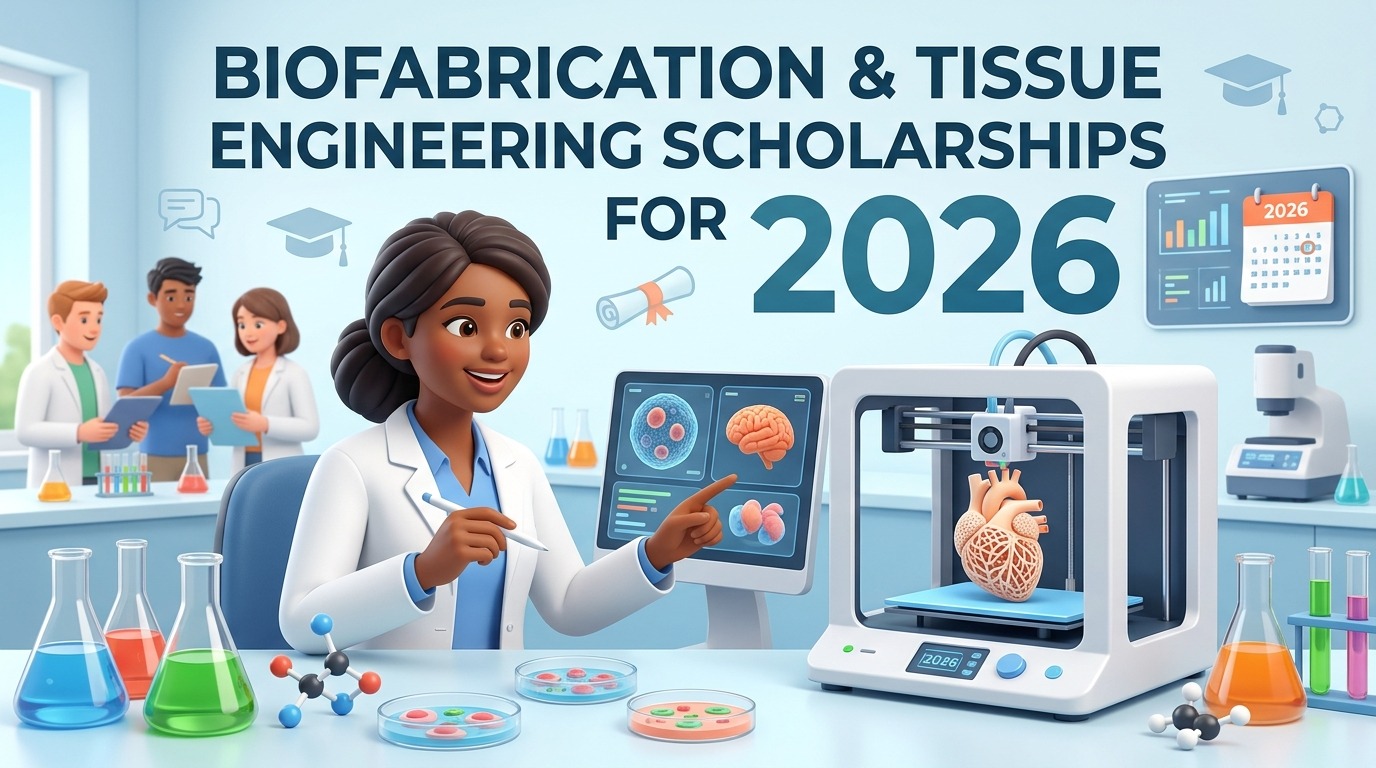
Biofabrication & Tissue Engineering Scholarships
January
1) Barry Goldwater Scholarship
Why It Slaps: This is one of the best long-game awards for students who want to end up in tissue engineering, biofabrication, biomaterials, or regenerative medicine research. It is built for undergraduates headed toward research careers in engineering and the natural sciences, so it fits students who are already building lab experience and thinking seriously about graduate school. The name recognition is also huge if you want future mentors, summer labs, or PhD programs to take your research trajectory seriously.
Amount: Up to $7,500 per academic year
Deadline: Last Friday in January; campus deadlines are earlier.
Apply/info: Official page
2) WFIRM Summer Scholars Program in Regenerative Medicine
Why It Slaps: This is one of the cleanest direct hits on the entire page because the program explicitly includes enabled technologies, biomanufacturing, and biofabrication. If you want actual regenerative-medicine lab time instead of just another essay-only scholarship, this is the kind of experience that can move your resume from “interested in tissue engineering” to “already doing it.” Housing plus a real stipend makes it much more useful than a tiny award with no lab access.
Amount: $6,000 stipend plus housing
Deadline: January 15, 2026, at 5 p.m. EST
Apply/info: Official page
3) Wake Forest Center for Precision Medicine Undergraduate Summer Internship Program
Why It Slaps: This one is broader than pure tissue engineering, but it is still a strong feeder for students who want to work at the biology-engineering interface. Precision medicine, translational biomedical research, and wet-lab experience all connect well to later work in biomaterials, cell therapies, and regenerative medicine. It is especially strong for students who need a credible first or second research experience before aiming higher the next cycle.
Amount: $5,000 stipend
Deadline: January 31, 2026
Apply/info: Official page
4) Wake Forest Biomedical Engineering and Informatics Summer Research Internship
Why It Slaps: This is a very practical best-fit option for students who lean toward device design, imaging, mechanics, injury modeling, medical device prototyping, or biomedical data systems that can support tissue engineering work later. It is not a pure scaffold-and-bioprinting program, but it is very relevant for students entering biomedical engineering through adjacent technical paths. The combination of stipend, housing, and project variety makes it a stronger value play than many small national scholarships.
Amount: Stipend plus on-campus housing
Deadline: January 30, 2026
Apply/info: Official page
5) ON/TERMIS Education Grants 2026
Why It Slaps: TERMIS is one of the most on-topic organizations you can touch in this field. If your work is already drifting into tissue engineering or regenerative medicine, this kind of support can help you get into the room, meet the right researchers, and build serious field-specific momentum. For niche fields, targeted conference funding can be more strategic than a random small scholarship.
Amount: 500 €
Deadline: January 31, 2026
Apply/info: Official page
February
6) Biomedical Engineering Summer Internship Program (BESIP)
Why It Slaps: BESIP is one of the best “paid experience first” options for undergrads trying to break into serious biomedical engineering research. If your future path includes biomaterials, imaging, biofabrication tools, medical devices, or translational engineering, a national NIH-backed internship like this can matter more than a modest one-time scholarship. It also helps students prove they belong in research-heavy bioengineering spaces.
Amount: Stipend through NIH summer internship pay scale; 2026 eligibility page notes BESIP uses NIH SIP pay levels.
Deadline: February 18, 2026; recommendation deadline February 25, 2026.
Apply/info: Official page
7) ScholarSHPE
Why It Slaps: This is not tissue-engineering-specific, but it is a strong umbrella application for Hispanic students in bioengineering, biomedical engineering, chemical engineering, materials, and related STEM tracks. One application can open access to multiple corporate-backed awards, which is efficient if you want to cast a wide but still relevant net. For students in a niche major, efficient scholarship stacking matters.
Amount: Varies by named scholarship
Deadline: February 16, 2026
Apply/info: Official page
8) ON/TERMIS Orthoregeneration Award 2026
Why It Slaps: This is one of the most directly relevant opportunities on the list for students already working in regeneration-focused research. If your project touches biomaterials, tissue repair, bone/cartilage regeneration, or translational scaffold work, this is the kind of field-specific award that says you are not just “interested” in the area, you are already inside it. That positioning can matter a lot for future graduate applications.
Amount: 1,000 €
Deadline: February 28, 2026
Apply/info: Official page
March
9) ACS Catalyst Scholarship
Why It Slaps: Tissue engineering is not only cells and scaffolds; a lot of the real work sits inside chemistry, biomaterials, polymers, interfaces, and surface science. That makes this a strong fit for students entering the field through chemistry, biochemistry, chemical engineering, or materials-heavy pathways. It is especially useful for students who may not find a scholarship labeled “biofabrication” but are clearly building the right scientific base for it.
Amount: $10,000, renewable
Deadline: March 1, 2026
Apply/info: Official page
10) ASBMB Undergraduate Research Award
Why It Slaps: If your version of tissue engineering leans toward cells, extracellular matrix, signaling, protein science, or molecular mechanisms, this is a smart adjacent award. It supports actual summer research, which is exactly what students in this space need to stay competitive. For the right student chapter member, this can punch way above its dollar value because it funds real project momentum.
Amount: $1,200
Deadline: March 20, 2026
Apply/info: Official page
11) NIH Undergraduate Scholarship Program (UGSP)
Why It Slaps: This is one of the biggest and most serious research-oriented funding options on the list for undergraduates with financial need. It supports students committed to biomedical, behavioral, and social science research, and NIH explicitly invites applicants from engineering, chemistry, bioinformatics, and other health-related fields. For a tissue engineering student who wants research depth, this can change the entire trajectory of college and early career planning.
Amount: Up to $20,000 per academic year, renewable up to two years
Deadline: March 31, 2026, at noon ET; references due April 7, 2026.
Apply/info: Official page
April
12) Marion B. Sewer Distinguished Scholarship for Undergraduates
Why It Slaps: This is a strong adjacent option for students whose tissue engineering path runs through biochemistry, molecular biology, or cell biology instead of straight engineering. That makes it especially useful for students interested in stem cells, tissue repair, signaling, biomolecule design, or the biological side of regenerative medicine. It is also a good fit for applicants whose background adds to diversity in science, which gives the award a sharper mission than many broad STEM scholarships.
Amount: $2,000
Deadline: April 30, 2026
Apply/info: Official page
13) OriGen Biomedical STEM Scholarship
Why It Slaps: This one is small, but it is unusually on-brand for this topic because OriGen operates in biomedical and cell-therapy-adjacent spaces. It is best for Austin-area high school seniors who want to tell a regenerative medicine, cryopreservation, cell therapy, or biomedical engineering story early. For a local student with a strong essay, a niche-aligned $500 award is still worth taking.
Amount: $500
Deadline: April 30, 2026
Apply/info: Official page
September / October
14) Society for Biomaterials Student Awards for Outstanding Research
Why It Slaps: This is one of the best pure-fit opportunities for students already doing biomaterials work, which is one of the closest scholarship lanes to tissue engineering and biofabrication. It is built around actual research output, not just a general interest in STEM, so it rewards students who are already generating serious work. In this field, that kind of recognition can be more valuable than a generic scholarship because it signals subject-matter credibility.
Amount: Complimentary registration to the 2026 SFB meeting, travel support up to $500, plus publication consideration
Deadline: Latest posted cycle showed supporting documents due September 17, 2025, and manuscript due October 15, 2025.
Apply/info: Official page
November
15) GEM Fellowship
Why It Slaps: For graduate-bound students in bioengineering, biomaterials, or related science and engineering fields, GEM is a heavyweight option. It combines graduate funding with summer internships, which is a powerful mix for students who want industry plus research exposure in areas that can feed into tissue engineering, medical devices, biomaterials, and translational biotech. It is especially strong for students who want a funded master’s or PhD path rather than patching graduate school together semester by semester.
Amount: Varies by fellowship type; MS and PhD awards can include full tuition and fees plus stipend support, with internships attached in many cases.
Deadline: Second Friday in November; the upcoming cycle is set to commence July 1, 2026.
Apply/info: Official page
16) NSF Graduate Research Fellowship Program (GRFP)
Why It Slaps: This is the gold-standard graduate fellowship for many future tissue engineering researchers. If you are headed toward a research-based master’s or PhD in bioengineering, biomaterials, chemical engineering, materials, or related life-science-heavy paths, this is the kind of award that can change your grad school options completely. It also carries prestige that stays with you far beyond the funding itself.
Amount: $37,000 annual stipend plus $16,000 cost-of-education allowance for each fellowship year of support
Deadline: Latest posted engineering deadline was November 13, 2025; next cycle should be verified once NSF posts the new field deadlines.
Apply/info: Official page
December
17) MTI Bert Krisher & Robert Sinko Memorial Scholarships
Why It Slaps: Biomaterials is one of the closest practical bridges into tissue engineering, and that means materials-focused funding belongs on this page. Students working on polymers, metals, surfaces, processing, or materials behavior that could feed medical-device or biomaterials work should not ignore these opportunities just because the word “tissue” is not in the title. For the right applicant, materials money is tissue-engineering money in disguise.
Amount: Two scholarships at $5,000 each
Deadline: December 15
Apply/info: Official page
18) C. William Hall Undergraduate Travel Scholarship
Why It Slaps: This is a very strong direct-fit award for undergraduates focused on biomaterials, and biomaterials is one of the cleanest feeder disciplines into tissue engineering and biofabrication. Getting all meeting expenses covered for the Society for Biomaterials annual meeting can be a big deal if you need exposure, networking, and field-specific visibility. For a student trying to break into this community, access itself is part of the prize.
Amount: All 2026 Society for Biomaterials Annual Meeting expenses paid, including airfare, hotel, transfers, registration, and meals
Deadline: December 3, 2025, for the latest posted 2026 cycle
Apply/info: Official page
19) Cato T. Laurencin, MD, PhD Undergraduate Travel Fellowship
Why It Slaps: This is another unusually strong direct-fit biomaterials opportunity, especially for underrepresented undergraduate students building toward advanced work in biomaterials or tissue engineering. It does more than cover attendance: it also adds Society membership and mentorship, which can matter a lot when you are still trying to get traction in a specialized field. That makes it one of the better “small-looking but career-shaping” opportunities in this space.
Amount: All 2026 Society for Biomaterials Annual Meeting expenses paid, plus complimentary Society membership
Deadline: December 3, 2025, for the latest posted 2026 cycle
Apply/info: Official page
FAQs
Are there many true biofabrication and tissue engineering scholarships?
Not really. Most of the strongest real-fit money sits inside biomaterials, biomedical engineering, regenerative medicine, chemistry, molecular life sciences, travel awards, and paid research programs rather than awards labeled exactly “biofabrication.” That is why a smart page in this niche has to pull from adjacent but legitimate lanes.
What majors should search beyond the exact phrase “tissue engineering”?
Students should also search biomedical engineering, bioengineering, biomaterials, regenerative medicine, chemical engineering, materials science, biochemistry, molecular biology, and cell biology. Those majors show up again and again across the strongest-fit programs on this list.
Are paid summer research programs worth listing on a scholarship page?
Yes. In this field, funded lab experience can be just as valuable as cash because it helps you build publications, presentations, mentor relationships, and future fellowship credibility. Programs like WFIRM, BESIP, and the Wake Forest summer internships prove that the “money + lab access” combo is very real in this niche.
Are conference travel awards worth applying for?
Yes, especially in a specialized field like biomaterials or regenerative medicine where being in the right scientific room matters. TERMIS and Society for Biomaterials awards can help students present work, meet labs, and become visible in the exact community they want to join.
Should high school seniors use this page?
Yes, but selectively. Many of the strongest options here are undergraduate or graduate research awards, while high school seniors will usually get more traction from local STEM scholarships, biomedical-company scholarships, and broad engineering awards. The OriGen scholarship is one of the clearer high-school-level fits on this list.
How early should students start?
Earlier than they think. Several of the strongest programs require campus coordination, recommendations, research framing, or institutional paperwork, and some of the biggest deadlines hit from January through March. Starting in the fall is the safest move.