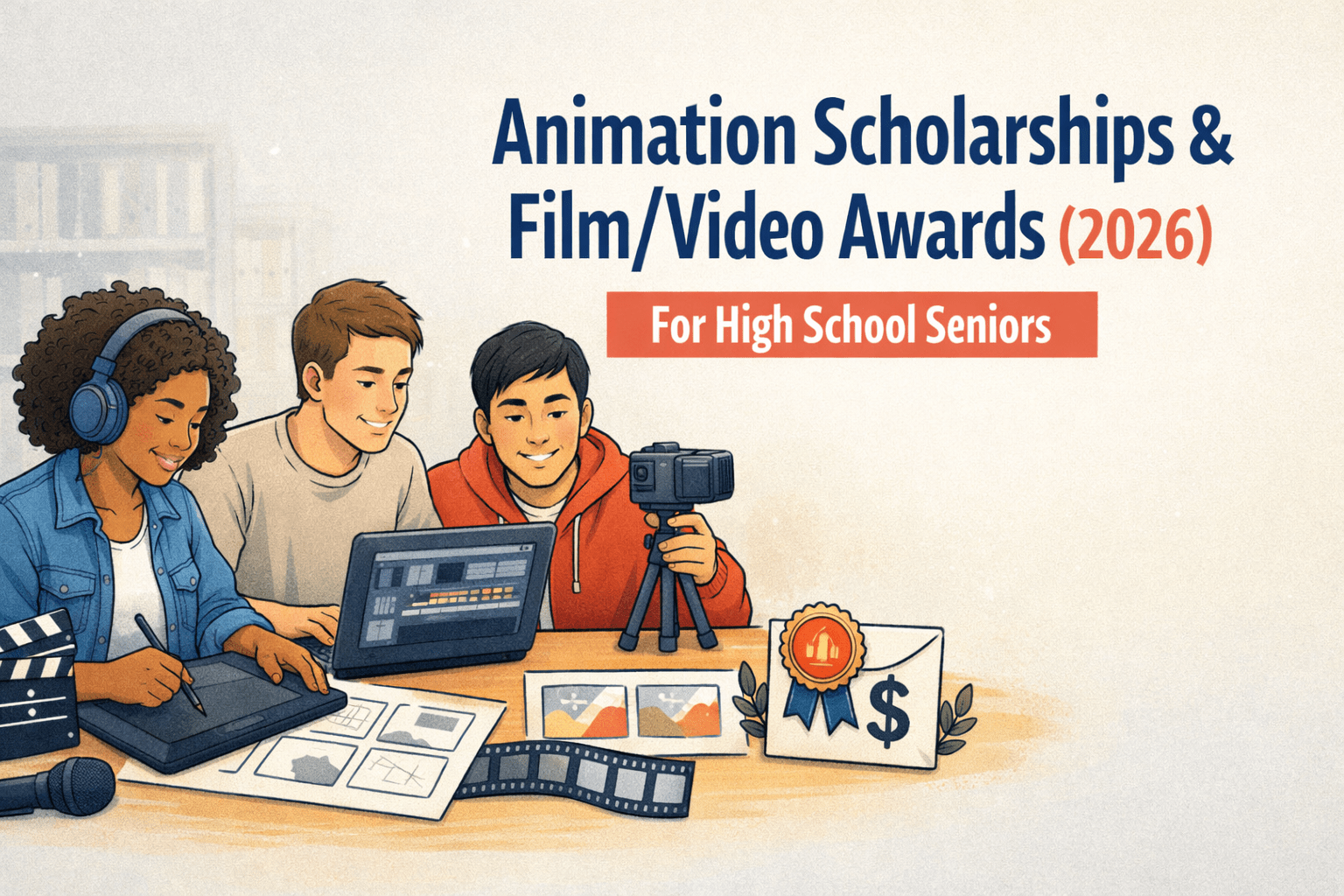
Animation Scholarships for High School Seniors (Class of 2026)
Hand-picked, verified list of animation scholarships, film/video contests, and school-specific portfolio awards for high school seniors (Class of 2026).
Quick Deadline Calendar (Class of 2026)
Oct 2025: ConnectHER Film Festival (10/1), YoungArts – Film (incl. Animation) (10/8), NASA CineSpace (final window closes Sept/Oct)
Dec 2025: Sony Future Filmmaker Awards (12/16)
Jan 2026: Scholastic Art & Writing Awards (region-by-region, Dec–Jan), C-SPAN StudentCam (1/20)
Mar 2026: Directing Change (CA) (3/1), World of 8 Billion (3/4), Project Yellow Light — Animation (3/31)
Apr 2026: Frame My Future (4/15), Create Real Impact — Video/Art (4/18), AIGA Worldstudio (4/21)
May 2026: ScienceSaves Video (5/4), We the Future — Short Film/PSA (5/31)
Jun 2026: National Videogame Museum Scholarships (6/1), Bow Seat Ocean Awareness — Film/Interactive (6/9), One Earth Young Filmmakers (6/25)
Dates verified Sept 4, 2025; always recheck the official page before submitting.
Scholarships & Contests (earliest → latest by deadline month)
Sony Future Filmmaker Awards (Student & Youth categories accepted; animation welcome)
💥 Why It Slaps: Global, free to enter, filmmaking awards with big industry exposure (Columbia Pictures/SONY platform).
💰 Amount: Prestige + industry opportunities; awards package, screenings, and development.
⏰ Deadline: Dec 16, 2025.
🔗 Apply/info: https://www.sonyfuturefilmmakerawards.com/ CineSpace
Scholastic Art & Writing Awards — Film & Animation (grades 7–12)
💥 Why It Slaps: The classic HS pipeline; Gold Portfolios can hit $12,500 and category awards stack.
💰 Amount: Varies; Gold Portfolio up to $12,500; other national awards vary.
⏰ Deadline: Regional deadlines vary (usually Dec–Jan).
🔗 Apply/info: ✅ Link verified 2025-09-04. CineSpace
C-SPAN StudentCam (documentary; animation storytelling allowed)
💥 Why It Slaps: Huge national platform; 150+ prizes; your work airs on C-SPAN.
💰 Amount: Grand prize $5,000; many tiered prizes.
⏰ Deadline: Jan 20, 2026 (11:59 pm PT).
🔗 Apply/info: https://www.studentcam.org/ projectyellowlight.com
YoungArts – Film (includes Animation)
💥 Why It Slaps: Nationally renowned; winners get money, mentorship, and college cred.
💰 Amount: Up to $10,000; masterclasses + National Arts Recognition.
⏰ Deadline: Oct 8, 2025 (for the 2025–26 cycle).
🔗 Apply/info: https://youngarts.org/discipline/film/ World of 8 Billion
ConnectHER Film Festival (formerly Girls Impact the World)
💥 Why It Slaps: Focus on girls’/women’s issues; HS filmmakers eligible; cash awards & exposure.
💰 Amount: Multiple cash awards (varies by category).
⏰ Deadline: Oct 1, 2025.
🔗 Apply/info: https://connectherfilmfest.org/awards/ directingchangeca.org
NASA CineSpace (short film using NASA footage; animation allowed)
💥 Why It Slaps: Make space-inspired shorts with real NASA footage; cash prizes; screens at Houston Cinema Arts Festival.
💰 Amount: Cash prizes (varies annually).
⏰ Deadline: 2025 final window Sept–Oct; 2026 timeline TBA (typically spring–fall).
🔗 Apply/info: https://www.cinespace.org/guidelines-rules
Project Yellow Light — Animation (anti-distracted driving)
💥 Why It Slaps: Dedicated animation category + national PSA impact (Ad Council partners).
💰 Amount: Up to ~$8,000 (varies by year/category).
⏰ Deadline: Mar 31, 2026.
🔗 Apply/info: https://www.projectyellowlight.com/
World of 8 Billion Student Video Contest (HS division)
💥 Why It Slaps: Short, issue-driven videos; clear rubric; many prizes + state/regional honors.
💰 Amount: HS First $1,200; Second $600; two HMs $300; plus state/regional awards.
⏰ Deadline: Mar 4, 2026.
🔗 Apply/info: https://www.worldof8billion.org/video-contest/ directingchangeca.org
Directing Change (California) — includes Animated Short category
💥 Why It Slaps: Mental health/suicide-prevention storytelling; HS eligible; statewide recognition + cash awards.
💰 Amount: Category prizes up to ~$1,000; travel stipends for winners.
⏰ Deadline: Mar 1 (annual CA cycle).
🔗 Apply/info: https://directingchangeca.org/get-started/ directingchangeca.org
Frame My Future Scholarship Contest (video/art accepted)
💥 Why It Slaps: Open prompt—show your future in video or art; simple entry; national brand sponsor.
💰 Amount: One $5,000, two $2,000, one $1,000.
⏰ Deadline: Apr 15, 2026.
🔗 Apply/info: https://www.diplomaframe.com/contests/scholarship Diploma Frame
Create Real Impact (video/art; teen traffic safety)
💥 Why It Slaps: Short, high-impact creative brief; spring cycle aligns with HS calendars.
💰 Amount: Multiple cash scholarships (varies by cycle).
⏰ Deadline: Apr 18, 2026 (Spring 2026 cycle).
🔗 Apply/info: https://www.createrealimpact.com/ Create Real Impact
AIGA Worldstudio Scholarships (visual/communication design; many animation applicants qualify)
💥 Why It Slaps: Prestigious design scholarship emphasizing social impact; animation students often compete via film/animation/illustration.
💰 Amount: Typically ~$2,500–$5,000+.
⏰ Deadline: Apr 21, 2026 (cycle timing historically around April; confirm each year).
🔗 Apply/info: https://www.aiga.org/competitions-initiatives/aiga-worldstudio-dd-scholarships AIGA
CBC Spouses Visual Arts Scholarship (Congressional Black Caucus Foundation)
💥 Why It Slaps: For Black/AA students pursuing visual arts (animation included). HS seniors entering accepted.
💰 Amount: Commonly $2,500–$5,000.
⏰ Deadline: Mar 15 (typical spring window; confirm for 2026).
🔗 Apply/info: https://www.cbcfinc.org/programs/scholarships/ Congressional Black Caucus Foundation
ScienceSaves High School Video Scholarship
💥 Why It Slaps: Quick, focused science-communication video—great portfolio piece for motion designers/animators.
💰 Amount: Up to $10,000 (top prize); multiple awards.
⏰ Deadline: May 4, 2026.
🔗 Apply/info: https://sciencesaves.org/scholarship/ sciencesaves.org
We The Future (Constituting America) — includes Short Film/PSA
💥 Why It Slaps: National civics-themed creative contest; HS PSA/short film options.
💰 Amount: Cash awards; national recognition.
⏰ Deadline: May 31, 2026.
🔗 Apply/info: https://constitutingamerica.org/contest-categories-new/ constitutingamerica.org
National Videogame Museum (Plano, TX) — Scholarships (game/animation adjacent)
💥 Why It Slaps: Great fit for 3D/animation/game-art students; multiple named awards.
💰 Amount: Varies by scholarship.
⏰ Deadline: June 1, 2026.
🔗 Apply/info: https://nvmusa.org/scholarships/ nvmusa.org
Bow Seat Ocean Awareness — Film & Interactive/Multimedia
💥 Why It Slaps: Eco-storytelling through film/animation; global platform with clear rubric.
💰 Amount: Up to ~$1,000 (Gold) + other tiers.
⏰ Deadline: June (check current cycle; historically early June).
🔗 Apply/info: https://bowseat.org/programs/ocean-awareness-contest/contest-overview/ bowseat.org
One Earth Young Filmmakers Contest (short film; animation OK)
💥 Why It Slaps: Sustainability-themed; past winners include HS animated films; prizes + screening.
💰 Amount: Cash awards (varies by category).
⏰ Deadline: June 25, 2026.
🔗 Apply/info: https://www.oneearthfilmfest.org/contest-details One Earth Film Festival+1
All American High School Film Festival (AAHSFF) — Scholarship Partners
💥 Why It Slaps: The biggest HS film fest; real college scholarships offered via partners.
💰 Amount: College partnership scholarships + software/gear awards.
⏰ Deadline: Annual windows open spring; 2026 dates TBA (check site).
🔗 Apply/info: https://www.hsfilmfest.com/how-to-submit/ All American High School Film Festival+1
SkillsUSA — 3D Visualization & Animation / Game Dev (members)
💥 Why It Slaps: Compete in animation/game categories; scholarships & travel awards available to members.
💰 Amount: Org-wide scholarships and specific travel funds; amounts vary (>$400k awarded in recent years).
⏰ Deadline: Varies by state (Jan–Apr); national pre-submissions often due late May.
🔗 Apply/info: https://www.skillsusa.org/recognition/scholarships-and-grants/ SkillsUSA
A Note on WIA/ASIFA/AIAS (college-focused)
Women in Animation (WIA), ASIFA-Hollywood’s Animation Educators Forum, and AIAS Foundation scholarships (Randy Pausch/Mark Beaumont) are excellent but typically require current college enrollment — bookmark for freshman year.
School-Specific (Portfolio-Based) Scholarships & Links (incoming Class of 2026)
Most schools auto-consider you for merit when you apply with a portfolio by the admissions deadline.
-
Ringling College of Art & Design (Computer Animation) — Merit scholarships + portfolio guidance.
🔗 Apply/info: https://www.ringling.edu/admissions/financial-aid-and-tuition/financial-aid-opportunities/scholarships-and-grants/ ringling.edu -
CalArts — Character Animation (BFA) — Portfolio/animation test guidelines.
🔗 Apply/info: https://calarts.edu/apply/bfa-character-animation calarts.edu -
SVA (School of Visual Arts) — BFA Animation — Silas H. Rhodes scholarships for incoming students; portfolio required.
🔗 Apply/info: https://sva.edu/admissions/financial-resources/scholarships School of Visual Arts -
Pratt Institute — Digital Arts/Animation — Merit scholarships; portfolio central to review.
🔗 Apply/info: https://www.pratt.edu/admissions/undergraduate-admissions/finance-your-education/financial-aid-options/scholarships/ Pratt Institute -
LCAD — Animation — Merit scholarships considered with admission + portfolio.
🔗 Apply/info: https://www.lcad.edu/ — Admissions → Financial Aid & Scholarships (menu). ✅ Link verified 2025-09-04. (General site home; financial aid pages vary by year.) lcad.edumy.lcad.edu -
SCAD — School of Animation & Motion — Multiple scholarships (Presidential, Achievement, etc.); submit portfolio; check scholarship matrix + admissions dates.
🔗 Apply/info: https://www.scad.edu/admission/financial-aid-and-scholarships/scholarships SCAD.edu
Judges’ Criteria — Pull-Quotes You Can Aim For
-
C-SPAN StudentCam: documentaries must include C-SPAN clips and explore multiple sides; 5:00–6:00 length. projectyellowlight.com
-
Bow Seat Ocean Awareness: judges consider originality/voice, craftsmanship/technique, accuracy, and fit to theme. bowseat.org
-
Directing Change (CA): “Use of premade templates or AI models is not permitted.” (Disqualification.) directingchangeca.org
Financing the Animation Pipeline: Animation Scholarships for U.S. High School Seniors
Animation is no longer a niche art practice; it is a workforce pipeline spanning film/TV, streaming, advertising, interactive media, and games. Yet the transition from “talented teen creator” to “college-ready animator” is constrained by (1) high educational costs, (2) portfolio-intensive admissions and scholarship screens, and (3) unequal access to tools, mentoring, and paid pre-professional experiences. This paper synthesizes labor-market evidence, postsecondary program data, and scholarship-program design to map the scholarship landscape most relevant to high school seniors pursuing animation. Using U.S. federal statistics, program-level degree field definitions, and representative scholarship models (institutional portfolio awards, juried national competitions, and industry association programs), the analysis quantifies the scale of training pathways, typical cost exposure, and how scholarship criteria implicitly favor certain forms of cultural capital (portfolio coaching, equipment, time). It concludes with practical, evidence-based recommendations for families, counselors, and scholarship publishers: redesigning scholarship discovery around “portfolio-readiness,” deadline timing, and stackable award strategies that reduce both tuition and production-cost barriers.
Keywords: animation scholarships, high school seniors, portfolio admissions, creative labor markets, equity, competitions, cost of attendance
1. Why animation scholarships matter: cost pressure meets a portfolio gate
For high school seniors, animation scholarships operate less like a single funding stream and more like a portfolio-based credentialing system that determines (a) where a student can enroll, (b) what tools they can afford, and (c) how quickly they can accumulate professional signals (festival selections, juried awards, internships, studio mentorship).
Sticker-price pressure is real. National indicators show average published tuition and fees at 4-year institutions in 2022–23 were about $9,800 (public) and $40,700 (private nonprofit). Newer pricing reports also show that “all-in” student budgets (tuition + living) are often far higher than tuition alone; for 2025–26, College Board estimates average budgets ranging from roughly $30,990 (public 4-year in-state) to $65,470 (private nonprofit 4-year).
For animation specifically, non-tuition costs are unusually salient: a competitive portfolio typically requires hardware/software, a reliable production workflow, and time to iterate. Scholarship programs that explicitly allow funds for equipment (not just tuition) are therefore disproportionately valuable, because they reduce a hidden barrier that can otherwise derail a student’s readiness.
2. Labor-market signals: strong pay potential, slower growth, and a freelance-heavy structure
From a labor-economics perspective, animation is a “winner-take-some” creative occupation: the median can look strong while earnings dispersion remains wide, and many workers face project-based employment risk. U.S. Bureau of Labor Statistics (BLS) data report $99,800 median pay (May 2024) for special effects artists and animators, with the bottom decile below $57,220 and the top decile above $174,630—a spread consistent with portfolio-driven career stratification.
Critically, BLS projects 2% growth from 2024–2034 (slower than average), but still about 5,000 openings per year on average due to replacement needs. BLS also flags that AI may automate some routine tasks, potentially damping demand for certain roles even as demand for high-skill creative direction and technical artistry persists.
The employment structure matters for scholarship design: BLS indicates self-employment is a large share of the field (reported as the largest employer category in their industry breakdown). That reality implies high school seniors benefit not only from tuition support but also from scholarships and awards that build portable capital: portfolio pieces, juried recognition, mentorship networks, and early paid experience.
3. Education pipeline: what “animation” includes, who studies it, and where
3.1 Defining the field (CIP 10.0304)
In U.S. education data, many animation programs fall under CIP 10.0304: “Animation, Interactive Technology, Video Graphics and Special Effects.” NCES describes it as preparation to use computer applications and visual/sound imaging techniques to manipulate images and information across film/video/still/digital sources to communicate simulated real-world content. This definition is broader than “character animation” alone; it captures VFX, motion graphics, interactive media, and adjacent production workflows—important because scholarships often use broad “digital media” language.
3.2 Program availability, completions, and demographic signals
Program-level summaries show that this field exists across multiple sectors (including 2-year institutions), and that degree completions are concentrated in certain institution types. For example, compiled profiles indicate public 2-year institutions are common providers of programs, while private nonprofit 4-year institutions account for a large share of completions in recent counts.
Demographic breakdowns of degree awards in this field show near parity by sex in some snapshots (e.g., slightly above 50% female in one profile), alongside racial/ethnic variation in completions. These patterns matter because portfolio access is not evenly distributed; scholarship structures that heavily reward coached portfolios can amplify inequities even when eligibility appears neutral.
3.3 Tuition realities inside the major
Field-specific summaries also report wide tuition variation by sector and residency, with notably higher costs in private settings. While any single aggregation should be interpreted cautiously, the directional message is stable: animation education often sits at the intersection of high institutional cost and high equipment cost, making scholarships (and contests with cash awards) unusually important in determining which students persist.
4. The scholarship ecosystem for high school seniors: four pathways that actually move outcomes
Animation scholarships relevant to high school seniors cluster into four practical pathways. The key is that “eligible as a senior” and “valuable as a senior” are not always the same—some awards become available only after enrollment but should be tracked early because they shape program choice and planning.
Pathway A: Institutional merit scholarships and portfolio competitions (the biggest dollars)
For many seniors, the largest single scholarship outcomes come from college-based merit aid tied to portfolio review, auditions, or competitive challenges. These awards are often bundled into admission decisions and can be renewable.
Example model: SCAD Challenge (portfolio competition). SCAD describes its undergraduate challenge as open to current high school juniors and seniors (for the current academic year), explicitly framing it as a scholarship opportunity based on a submitted creative piece. SCAD also publicly showcases winners by category (including animation/game design), reinforcing that this is both funding and a signaling mechanism.
Example model: Ringling College scholarships (portfolio + GPA). Ringling explains that its scholarships are merit-based and determined using high school GPA, submitted portfolios, and admissions application information. The implication is structural: seniors should treat “scholarship applications” and “portfolio readiness” as the same project, not separate tasks.
Why this pathway dominates: institutional awards can reach multi-year totals that dwarf small external scholarships. However, they often require early timelines, polished submissions, and counseling support—inputs that are unevenly distributed.
Pathway B: National juried competitions that produce scholarships and portfolio signal
Competitions are not just “extra credit.” In portfolio-driven fields, juried recognition functions like third-party validation, strengthening admission and scholarship probability while sometimes providing direct funding.
YoungArts (National Arts Competition). YoungArts states that artists in grades 10–12 (or ages 15–18) may apply, and that applicants can enter film disciplines including animation. Even when cash is not the only outcome, the lifetime network, adjudication, and prestige operate as scholarship multipliers—students who earn recognition often become stronger candidates for institutional merit.
Scholastic Art & Writing Awards (Film & Animation and related categories). Scholastic states that teens in grades 7–12 can apply across many categories and that National Medalists can be eligible for scholarships up to $12,500. Partner organizations (e.g., within specific categories like editorial cartoon/animated film themes) reinforce that animated films can be considered in the ecosystem.
Why this pathway matters to seniors: competitions compress three goals into one submission: scholarship eligibility, a portfolio piece with a hard deadline, and third-party review.
Pathway C: Industry/association scholarships (often not for seniors—still strategically relevant)
Some of the most “animation-native” scholarships are run by industry associations, educator forums, or professional nonprofits. Many target students already in college (sophomore+), but seniors should track them for two reasons: (1) program choice (where you enroll) affects your eligibility later, and (2) the criteria reveal what the industry values.
ASIFA-Hollywood Animation Educators Forum (AEF). Program materials describe awards up to $5,000 and explicitly allow funds for tuition, books, research, and animation equipment (hardware/software). Coverage of 2025–26 recipients reported total scholarship dollars of $26,800. This is a good example of “tool-aware” design: by allowing equipment costs, the scholarship targets a real bottleneck in animation training.
Women in Animation (WIA) Scholarship. WIA’s scholarship program materials emphasize eligibility tied to undergraduate status (commonly sophomore+), and FAQs specify membership requirements. For high school seniors, the funding may not be immediate, but the signal is: membership, community involvement, and persistence in the field are part of the scholarship logic.
Pathway D: Paid work-based opportunities and internships as “income scholarships”
In creative fields, the absence of pay can function as a gatekeeping mechanism. While internships are not scholarships, they can replace borrowing and fund equipment or application fees.
NACE reports the average hourly wage for bachelor’s-level interns at $23.04 (as of its 2025 compensation reporting). Even part-time paid creative work (media clubs, commissioned pieces, local marketing animation) can reduce the need to choose between portfolio development and income—an equity issue often ignored in scholarship lists.
5. A simple quantitative reality check: how far do scholarships go?
A pragmatic way to evaluate scholarship impact is to compare typical award sizes against (a) tuition exposure and (b) production-cost exposure.
-
Tuition exposure: If average tuition/fees at a private nonprofit 4-year are in the ~$40k range (and budgets higher), then a $1,000–$5,000 scholarship is meaningful but rarely transformative alone.
-
Production-cost exposure: In animation, a scholarship that can be spent on equipment can “unlock” portfolio production capacity. ASIFA-AEF explicitly permits hardware/software funding, showing that sophisticated scholarship designs treat tools as educational necessities.
Implication: for seniors, the best strategy is usually stacking: institutional merit + one or two competition-based awards + local/community funds + paid experience (where possible). Scholarship discovery platforms should therefore present awards as stackable bundles, not isolated opportunities.
6. Equity analysis: scholarships often reward “portfolio capital,” not just talent
Scholarships in animation are rarely GPA-only; they are portfolio-, mentorship-, and opportunity-dependent. That creates predictable equity challenges:
-
Equipment gaps (hardware/software, quiet workspace, reliable internet) translate into portfolio quality gaps.
-
Coaching gaps (access to portfolio classes, mentors, art teachers familiar with animation admissions) translate into submission strategy gaps.
-
Time poverty (students balancing jobs/caregiving) reduces iteration time for portfolio refinement.
-
Network effects: competitions and associations create compounding advantages—students who can afford submission fees, travel, or unpaid creative time accumulate stronger signals earlier.
BLS itself notes portfolio centrality in hiring and educational pathways: employers prefer candidates with strong portfolios and technical skills, typically built during degree training, but also honed via self-study. Scholarship programs that explicitly fund tools (or provide mentorship) are therefore not “nice extras”; they are equity interventions.
7. Evidence-based strategy for high school seniors (a scholarship plan that matches how animation is evaluated)
A senior-focused animation scholarship strategy should be built around one core idea: portfolio is the unit of selection. Scholarships, admissions, competitions, and early internships all score the same underlying assets.
7.1 Build a “portfolio-to-scholarship” timeline
-
Spring–Summer (pre-senior year): produce 1–2 cornerstone pieces (a short animated film, a character acting shot, a VFX breakdown, or a motion graphics sequence), plus process materials.
-
Fall (senior year): submit to institutional challenges (e.g., SCAD-style competitions), apply to national competitions with scholarship components (YoungArts / Scholastic where fit), and complete admissions portfolios.
-
Winter–Spring: local scholarships + follow-on awards + departmental audition/portfolio updates.
7.2 Use competitions as “dual-purpose submissions”
A single polished film can be re-versioned to meet different category requirements (runtime limits, file sizes, credits), allowing one production cycle to generate multiple scholarship shots—especially relevant for competitions that explicitly include animation.
7.3 Target scholarships that fund tools, not just tuition
Prioritize awards that allow spending on hardware/software, supplies, or production costs when possible—these often have outsized effects on a student’s ability to keep producing portfolio work (and thus competing for future scholarships).
8. Implications for ScholarshipsAndGrants.us (what to emphasize on the Animation page)
To make an “Animation Scholarships for High School Seniors” hub genuinely decision-useful, the page should reflect how the ecosystem actually works:
-
Segment listings by pathway (Institutional portfolio awards, National competitions with scholarships, External scholarships, Tool/equipment grants, “later-year” industry scholarships worth tracking).
-
Tag scholarships by what they evaluate: portfolio required (Y/N), film submission (Y/N), animation category (Y/N), GPA floor, membership requirement, residency limits. (WIA’s membership and enrollment rules are a good example of why this matters.)
-
Show “stackability”: recommend 2–3 common stacks (e.g., SCAD/Ringling merit + Scholastic/YoungArts recognition + local art council scholarship).
-
Include a “true-cost lens”: present average cost-of-attendance context so students can interpret award size realistically.
-
Add a portfolio-readiness checklist aligned to industry expectations (BLS emphasizes portfolio and technical skills).
Conclusion
Animation scholarships for high school seniors should be understood as a portfolio-capital system embedded in a broader training-to-work pipeline. Labor-market data show strong median pay but slower projected growth and high earnings dispersion—conditions that increase the value of early signaling, networks, and portable skills. Education data define animation broadly (CIP 10.0304), spanning interactive technology and special effects, and program availability stretches across sectors with uneven cost structures. In that environment, the most consequential “scholarships” for seniors are typically institutional merit awards and juried competitions that simultaneously fund education and validate talent (SCAD Challenge, Scholastic, YoungArts), while industry association awards and paid internships shape longer-run persistence and equity.
For a scholarship hub to be truly helpful, it should not merely list opportunities—it should map the ecosystem by pathway, clarify what each award evaluates, and teach seniors how to convert one strong portfolio project into multiple scholarship outcomes.
References (APA-style, web sources)
-
College Board. (2025). Trends in College Pricing and Student Aid 2025 (selected highlights).
-
National Center for Education Statistics. (2002/updated listings). CIP 10.0304 definition and detail pages.
-
National Center for Education Statistics. (2022–23). Condition of Education / tuition indicators (average tuition and fees).
-
National YoungArts Foundation. (2025–26 cycle info). Eligibility and film/animation application requirements.
-
Scholastic Art & Writing Awards. (Current program info). Eligibility, categories, and scholarship amounts.
-
U.S. Bureau of Labor Statistics. (2024–25). Occupational Outlook Handbook: Special Effects Artists and Animators.
-
National Association of Colleges and Employers. (2025). Intern compensation: average hourly wage reporting.
-
Savannah College of Art and Design. (2025–26). SCAD Challenge scholarship competition details and winners.
-
Ringling College of Art and Design. (n.d.). Scholarships and grants overview (portfolio/GPA basis).
-
ASIFA-Hollywood Animation Educators Forum. (2025). Scholarship guide and program details.