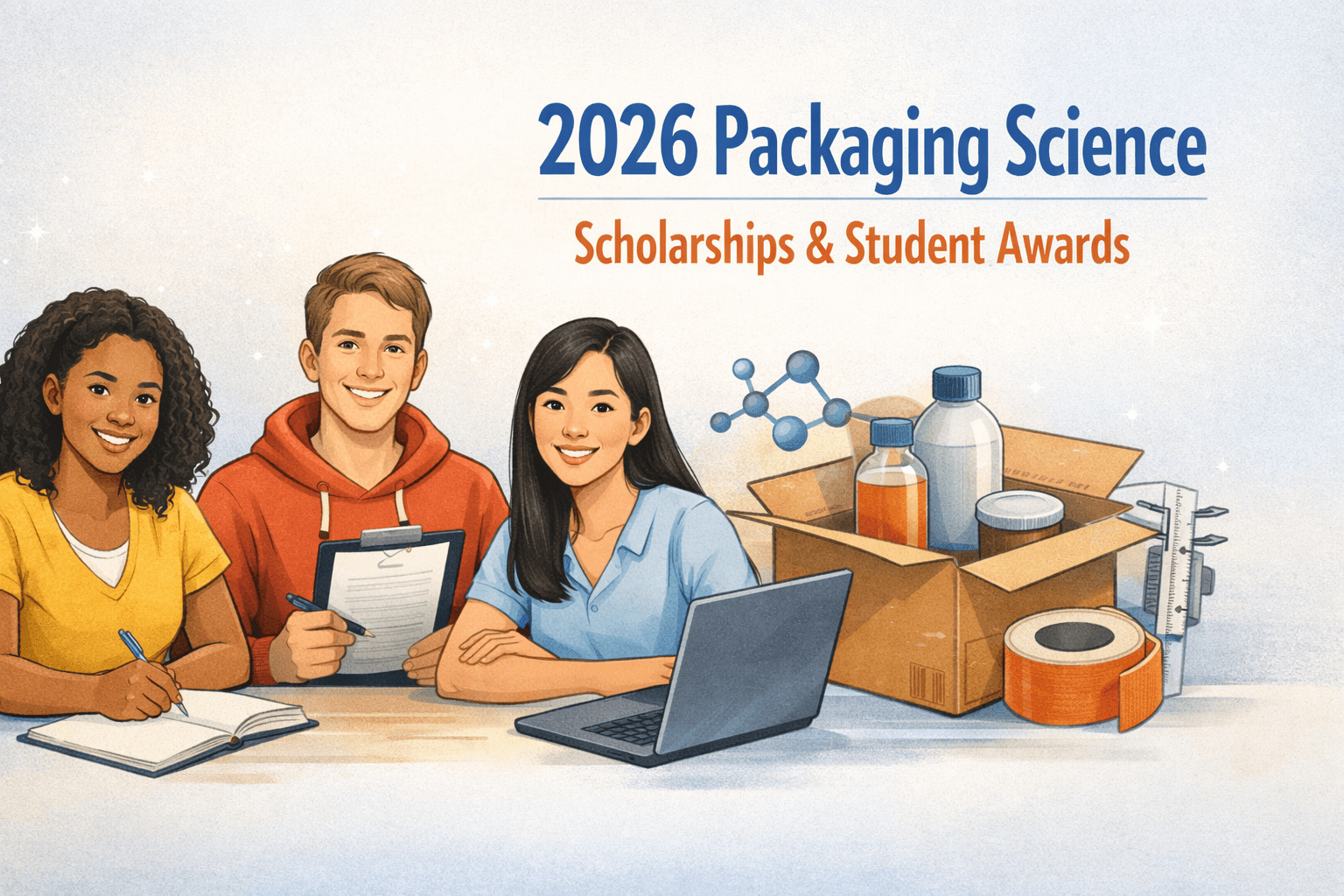
20+ Packaging Science Scholarships & Student Awards (IoPP & PMMI Deadlines Verified)
Fresh, verified list of packaging science scholarships and student awards—including IoPP scholarships, PMMI Foundation awards, and major student design competitions.
TAPPI Technical Division Scholarships (Corrugated Packaging)
💥 Why It Slaps: Multiple awards for students headed into corrugated & packaging—great fit for packaging science majors.
💰 Amount: Five $1,000 awards + two $5,000 memorial awards (corrugated division).
⏰ Deadline: February 15 (annual).
🔗 Apply/info: https://tappiawards.smapply.io/res/p/Scholarships/
IoPP Packaging Education Scholarship Fund (National)
💥 Why It Slaps: Flagship IoPP scholarships backed by industry partners, chapters, and technical committees.
💰 Amount: Varies by sponsor (commonly $1,000–$5,000 total across multiple awards).
⏰ Deadline: February 28 (most recent cycle).
🔗 Apply/info: https://www.iopp.org/i4a/pages/index.cfm?pageid=5021
FFTA (Flexographic Technical Association) Scholarship
💥 Why It Slaps: Flexography = core to consumer packaging; great for students leaning print/packaging production.
💰 Amount: $3,000.
⏰ Deadline: March 31 (recent cycle).
🔗 Apply/info: (FFTA Scholarship info via program listings) https://collegeaidpro.com/top-75-private-scholarship-opportunities-for-march-25-through-april-7-2025/ Flexographic Technical Association
IoPP Student AmeriStar Awards (Competition)
💥 Why It Slaps: The student packaging competition in the U.S.—free to enter, killer portfolio piece; winners showcased by IoPP.
💰 Amount: Recognition/awards (student entries are free).
⏰ Deadline: Typically March 31 (recent cycles).
🔗 Apply/info: https://www.iopp.org/i4a/pages/index.cfm?pageid=4926
FPA Student Flexible Packaging Design Challenge
💥 Why It Slaps: National flexible packaging contest—concept-to-prototype experience directly aligned with industry.
💰 Amount: Cash prizes to top teams + national recognition.
⏰ Deadline: Prototype/video due April 25 (concept outline Mar 7; winners May 9) for 2025 cycle.
🔗 Apply/info: https://www.flexpack.org/student-design-challenge-application
AICC Student Packaging Design Competition
💥 Why It Slaps: Corrugated-focused, two judged tracks (structural & graphics) + travel to AICC Annual Meeting for 1st place.
💰 Amount: $500 (1st), $250 (2nd), $150 (3rd) per category + travel for 1st place team.
⏰ Deadline: June 20 (2025 cycle).
🔗 Apply/info: https://www.aiccbox.org/page/StudentDesign
PMMI PACK EXPO Scholarship (PMMI Foundation)
💥 Why It Slaps: High-visibility $5k scholarship announced at PACK EXPO—open to packaging/processing/mechatronics students.
💰 Amount: $5,000 (six awards).
⏰ Deadline: July 18 (recent cycle).
🔗 Apply/info: https://www.pmmifoundation.org/scholarships
PMMI Scholarship in Memorial of Claude S. Breeden, Glenn Davis & Art Schaefer (2-year programs)
💥 Why It Slaps: Tailored to community/technical college students entering packaging/processing—great entry ramp.
💰 Amount: $4,000 (recent cycles).
⏰ Deadline: July 18 (recent cycle).
🔗 Apply/info: https://www.pmmifoundation.org/scholarships
PMMI Electrical Engineering Scholarship
💥 Why It Slaps: Targets EE students headed into packaging/processing automation controls.
💰 Amount: $5,000 (recent cycles).
⏰ Deadline: Spring window (status now shows “Closed”—watch page for 2026 dates).
🔗 Apply/info: https://www.pmmifoundation.org/scholarships
PMMI Mechanical Engineering Scholarship
💥 Why It Slaps: For MechE students focused on machinery design, machine safety & packaging automation.
💰 Amount: $5,000 (recent cycles).
⏰ Deadline: Spring window (status now “Closed”—watch for 2026).
🔗 Apply/info: https://www.pmmifoundation.org/scholarships
PMMI Processing Scholarship
💥 Why It Slaps: Dedicated to students pursuing processing (upstream of packaging) with direct industry ties.
💰 Amount: $5,000 (recent cycles).
⏰ Deadline: Spring window (status “Closed”—watch for 2026).
🔗 Apply/info: https://www.pmmifoundation.org/scholarships
PMMI Packaging & Processing Women’s Leadership Network (PPWLN) Scholarship
💥 Why It Slaps: $5k scholarship supporting women pursuing packaging/processing careers + leadership exposure.
💰 Amount: $5,000.
⏰ Deadline: Spring window (recent cycles).
🔗 Apply/info: https://www.pmmifoundation.org/scholarships
PMMI Member Family Scholarship
💥 Why It Slaps: For students with a family member at a PMMI member company; packaging/processing strongly preferred.
💰 Amount: $5,000 (recent cycles).
⏰ Deadline: Spring window (status varies; check page for current year).
🔗 Apply/info: https://www.pmmifoundation.org/scholarships
PMMI/ISBT Beverage Scholarship (when offered)
💥 Why It Slaps: Targets students linked to beverage/processing—relevant to packaging lines.
💰 Amount: Two awards of $5,000 (recent cycle reference).
⏰ Deadline: Spring (status “Closed”—watch for reopen).
🔗 Apply/info: https://www.pmmifoundation.org/scholarships
NJPEC (New Jersey Packaging Executives Club) Scholarships
💥 Why It Slaps: Long-running, industry-led packaging scholarship; resume-making club connection.
💰 Amount: Varies (multiple winners annually).
⏰ Deadline: October 3 (2025 cycle).
🔗 Apply/info: https://njpec.com/scholarship
WorldStar Student Awards (World Packaging Organisation)
💥 Why It Slaps: Global packaging award for student designs—top signal for employers; low entry fee.
💰 Amount: Recognition/awards (global showcase).
⏰ Deadline: November 1 (2025 cycle).
🔗 Apply/info: https://www.worldstarstudent.org/site/apply/
IoPP New England Chapter Scholarships
💥 Why It Slaps: Regional IoPP support—good odds if you’re studying packaging in New England.
💰 Amount: Varies.
⏰ Deadline: November 1 (recent notice).
🔗 Apply/info: https://www.ioppne.org/scholarships
ICPF Full Scholarship — The Packaging School Certificate (online)
💥 Why It Slaps: Full-ride for the Packaging School Certificate (CPS), valued training that complements your degree.
💰 Amount: Full tuition (~$7,000 value).
⏰ Deadline: Oct 10 (just announced) or Oct 25 (apply page); follow the apply link for the exact date posted.
🔗 Apply/info: https://packagingschool.com/icpf
ICPF $2,500 Scholarships (two awards)
💥 Why It Slaps: Corrugated-industry foundation awards—ideal for packaging students with corrugated interest.
💰 Amount: $2,500 (two awards).
⏰ Deadline: Oct 10 or Oct 25 per site updates (see page); apply early.
🔗 Apply/info: https://packagingschool.com/icpf
SPE Foundation Scholarships (Plastics & Packaging)
💥 Why It Slaps: Dozens of plastics/packaging-aligned scholarships—great for polymer/packaging tracks.
💰 Amount: Varies (multiple awards, often $1,000–$6,000).
⏰ Deadline: Opens each December; closing date varies by fund (check page when live).
🔗 Apply/info: https://www.4spe.org/i4a/pages/index.cfm?pageid=3313
PPA (Paperboard Packaging Alliance) Student Design Challenge
💥 Why It Slaps: Premier paperboard/package design contest; frequent finalists from Cal Poly, RIT, UW-Stout.
💰 Amount: Cash awards + national exposure.
⏰ Deadline: June 5, 2026 (next announced cycle).
🔗 Apply/info: https://www.paperboardpackaging.org/
Packaging Science Scholarships & Student Awards: Funding Ecosystem, Talent Pipelines, and Opportunity Design (2026)
Packaging science sits at the intersection of materials science, mechanical/industrial engineering, food science, sustainability, and supply-chain systems—so its scholarship ecosystem is similarly cross-sector and fragmented across trade associations, technical societies, corporate partners, and event-based “access” awards. This paper synthesizes an environmental scan of packaging-specific scholarships and student awards (U.S./North America emphasis) and builds a quantitative “funding profile” using publicly stated award amounts, deadlines, and eligibility signals. The analysis finds (1) mid-range awards ($2,500–$5,000) dominate, with a small number of high-value fellowships and program-scholarships as outliers; (2) deadlines cluster tightly in February–March, creating a predictable annual “application season”; (3) many programs explicitly reward industry alignment (internships, chapter participation, demonstrable packaging projects), indicating that scholarships are functioning as targeted workforce pipelines rather than purely philanthropic aid; and (4) a growing share of opportunities fund professional access (conference travel/registration) rather than tuition, reflecting packaging’s relationship-driven hiring markets and the field’s rapidly shifting sustainability and policy requirements. These findings translate directly into a stronger, filterable scholarship list architecture for Packaging Science majors.
1. Why packaging scholarships behave differently than “general” STEM scholarships
Packaging is rarely treated as a standalone academic discipline in national scholarship catalogs; instead it is distributed across (a) manufacturing/processing technology, (b) materials and plastics, (c) paperboard/corrugated and converting, (d) food packaging, and (e) healthcare/medical device packaging. The result is a funding ecosystem anchored by industry associations that have a direct incentive to build the next generation of talent.
Two macro forces amplify this “pipeline logic”:
-
Workforce constraints in packaging & processing. Industry reporting continues to document persistent difficulty hiring skilled workers in packaging/processing roles; PMMI’s workforce research is frequently cited for the breadth of the challenge (e.g., very high shares of firms reporting hiring difficulty).
-
Rising sustainability/policy complexity. Extended Producer Responsibility (EPR) packaging laws have expanded in the U.S. at the state level, increasing demand for packaging professionals who can design for recyclability, compliance labeling, and end-of-life systems.
These two drivers help explain why many packaging scholarships prioritize evidence of industry engagement—internships, projects, association membership, and leadership—because donors are effectively funding a screening and acceleration mechanism for future hires.
2. Methods: environmental scan + program coding
This paper uses a structured scan of packaging-relevant scholarship providers and student awards (trade associations, technical societies, universities, and corporate partners). Programs were coded along five dimensions:
-
Award type: cash scholarship, fellowship, tuition/program scholarship, travel/registration scholarship, competition prize.
-
Field alignment: packaging machinery/processing, corrugated/paper, flexible packaging/plastics, food packaging, medical packaging, sustainability, general packaging.
-
Eligibility signals: major/discipline requirements, GPA thresholds, internship/industry experience, chapter participation, geographic constraints.
-
Timing: stated open/close windows and deadline month.
-
Amount disclosure: fixed vs. variable vs. in-kind.
The scan intentionally blends “scholarship” and “student award” opportunities, because in packaging the latter often functions as a labor-market signal equivalent to funding (portfolio credit, networking, recognition, and recruitment pathways).
3. Landscape overview: where packaging funding comes from
3.1 Packaging & processing technology (machinery + mechatronics): PMMI Foundation
The PMMI Foundation is among the most visible packaging-adjacent scholarship engines because it ties packaging education directly to packaging and processing technology careers. A large share of awards sit in the $1,500–$5,000 range and the Foundation is described as awarding over $200,000 annually across packaging/processing/engineering/mechatronics-related fields.
A 2025 PACK EXPO scholarship announcement illustrates the model: six students received $5,000 each, and PMMI states it has awarded over $6 million to date to strengthen the workforce pipeline.
PMMI’s own scholarship portal also reveals that the Foundation increasingly funds access costs (e.g., travel assistance and certification-related supports) alongside tuition scholarships—another indicator that packaging scholarships are built around employability and mobility, not only tuition gaps.
Implication: Packaging Science students who can show alignment with automation, mechatronics, or packaging line operations often unlock a parallel scholarship universe beyond “packaging design.”
3.2 “Packaging as a profession”: IoPP (Institute of Packaging Professionals)
IoPP functions as a professional identity hub for packaging—certification, chapters, student programming, and recognition. Its student-facing scholarship messaging emphasizes that scholarships are aimed at students embarking on packaging careers.
Because chapter ecosystems vary by region, IoPP scholarships often appear in two ways in practice:
-
National/central scholarships and recognition programs, and
-
Local chapter scholarships tied to specific schools or regions.
A concrete example of the local-chapter pipeline is visible in university recognition (e.g., packaging programs highlighting IoPP chapter support and GPA expectations).
Implication: For a list page, IoPP items should be tagged with “chapter-based / region-based” and “professional membership leverage,” because students can materially improve eligibility by joining student chapters and documenting packaging projects.
3.3 Paperboard/corrugated + converting: TAPPI and corrugated scholarship infrastructure
TAPPI’s scholarship portal is unusually transparent about scholarship structures and amounts. In corrugated packaging alone, TAPPI describes:
-
Up to five $1,000 scholarships and two $5,000 memorial scholarships, plus additional $5,000 memorial awards tied to maintenance/engineering pathways.
Timing matters: TAPPI’s scholarship pages show February deadlines for “Technical Division” scholarships, with additional sub-deadlines for specific awards (the portal presents multiple dates across divisions, reinforcing the need for careful deadline verification).
BigFuture’s listing for a TAPPI corrugated scholarship illustrates how these programs may target both industry employees and full-time students endorsed by faculty, with a visible close date of February 15, 2026 and “win up to $1,000.”
Implication: Corrugated/paper scholarships are an under-recognized funding lane for Packaging Science students, especially those interested in paperboard sustainability, converting, and industrial engineering roles in box plants.
3.4 Flexible packaging, extrusion, and plastics: SPE and TAPPI (dual pipeline)
Flexible packaging talent is funded across both paper/converting networks (TAPPI) and plastics/materials networks (SPE). SPE’s scholarship catalog includes a specific Flexible Packaging Division Scholarship for undergraduates in related science/engineering programs, with preference for juniors/seniors and documented flexible packaging experience.
On the TAPPI side, the portal also includes flexible packaging division scholarship language and positioning toward packaging careers and technical awareness.
Implication: Students should not search “packaging scholarships” narrowly; they should search materials/plastics scholarships with packaging keywords (extrusion, films, barrier materials, recycling/circularity), because flexible packaging is funded as much by polymer societies as by packaging societies.
3.5 Food packaging: IFT scholarships + packaging division awards
Food packaging lives inside the broader food science ecosystem. The IFT scholarship system is a large funding platform (hundreds of thousands distributed across many awards), and its 2026 cycle shows a clearly defined window (applications open mid-January and close in early March).
Food packaging division-specific awards also appear through third-party scholarship catalogs (e.g., $1,000 food packaging graduate scholarship listings), reflecting that packaging specialization is often nested inside a larger discipline rather than standing alone.
Implication: Packaging Science pages should cross-link to Food Science and Chemical Engineering scholarship hubs, because many “packaging” awards are embedded in those ecosystems.
3.6 Medical device & healthcare packaging: AAMI scholarship model
Medical packaging is frequently underrepresented in generic packaging scholarship lists, yet it has its own professional society infrastructure. AAMI’s Michael Scholla Scholarship description demonstrates a hybrid model: a $3,000 scholarship plus conference-access components and a stated February 15, 2026 deadline.
Implication: Medical packaging scholarships should be tagged as “regulated industry” and “professional society pathway,” because candidates often need to articulate quality systems, sterility assurance, validation/testing, and patient safety relevance.
3.7 Sustainability + inclusion access awards: SPC Events Scholarship
A key shift in packaging funding is the rise of scholarships that pay for access, not tuition. The Sustainable Packaging Coalition’s Events Scholarship explicitly covers travel, hotel, registration, and meal per diem and is positioned for students who identify as part of a minority group, with GPA and full-time enrollment criteria.
Implication: Packaging scholarship lists should separate cash scholarships from event-access scholarships, because students often overlook the latter even though they can unlock internships and job offers through networking.
3.8 Program-level and corporate-partner scholarships
Packaging programs often surface scholarships that operate like targeted talent taps for employers or sectors. For instance, PMMI describes multiple named scholarships in its ecosystem (including PACK EXPO and other industry network scholarships).
Similarly, corrugated industry organizations increasingly fund program scholarships (e.g., full-tuition/value coverage for a packaging management certificate program) to build a broader funnel that includes business, supply chain, design, and engineering—not only packaging majors.
Implication: “Packaging science scholarships” should include packaging education/certificate scholarships when they are industry-funded and directly job-aligned.
4. Quantitative findings: award sizes, deadline seasonality, and eligibility signals
4.1 Typical award size: the $2,500–$5,000 center of gravity
Using publicly disclosed amounts from major packaging-adjacent programs (PMMI, TAPPI divisions, SPE division scholarships, AAMI), the ecosystem’s “typical” scholarship amount clusters in the low-thousands. Illustratively:
-
PMMI awards often range $1,500–$5,000.
-
TAPPI corrugated division includes $1,000 awards and $5,000 memorial awards.
-
AAMI’s scholarship is $3,000.
-
SPE’s flexible packaging scholarship exists as a defined program in its portfolio (and is tied to documented experience).
When a small set of high-value fellowships (e.g., large graduate fellowships in adjacent ecosystems) is included, averages rise sharply, but the median remains in the low-thousands—exactly what you would expect from a pipeline-funding model designed to support many students, not only a few.
4.2 Deadline clustering: February–March is “Packaging Scholarship Season”
Across multiple major providers, the application season is consistent:
-
February 15 appears as a key date across TAPPI technical division scholarships and other packaging-adjacent awards.
-
IoPP-linked packaging education scholarship listings show a late-February close (e.g., Feb 28, 2026 in at least one widely used catalog).
-
IFT’s main scholarship application closes in early March (e.g., March 2, 2026).
-
PMMI’s scholarship ecosystem shows late-March deadlines for major scholarships (e.g., March 27–31, 2026, depending on the named award listing).
Interpretation: This seasonality likely reflects coordinated academic calendars and spring recruiting cycles. For your list page, deadline heatmaps should show a strong spike in February and March, with additional summer deadlines for certain PMMI-linked awards.
4.3 Eligibility signals: packaging scholarships behave like “mini-recruiting funnels”
Across programs, repeated selection signals include:
-
Documented packaging experience (courses, research, projects, or jobs) — explicit in division scholarships.
-
Industry involvement and leadership — emphasized by PMMI.
-
Faculty endorsement/recommendation — common in technical society scholarships and event scholarships.
-
GPA thresholds — sometimes modest (e.g., 2.5 for certain access awards), sometimes higher (e.g., 3.0+ signals in multiple programs).
Interpretation: The strongest applicants are those who can prove they are already “in the packaging world,” even if informally. This suggests your Packaging Science list page should foreground “How to become eligible fast” tactics (student chapters, a small packaging project portfolio, one relevant internship/co-op, and a faculty recommender).
5. Student awards: why recognition is funding-adjacent in packaging
Packaging student awards—design competitions, innovation recognitions, and program awards—often do not provide large cash amounts, but they function as high-signal credentials in hiring. In packaging, employers routinely evaluate tangible artifacts: package prototypes, test reports, sustainability LCAs, line-efficiency improvements, and distribution test plans. Awards effectively certify that a student can execute applied work.
This is why professional associations also maintain recognition pathways alongside scholarships (IoPP navigation around Student AmeriStar and related recognition is structurally adjacent to the scholarship section).
Implication for your page: Treat “Student Awards” as a distinct category with tags like portfolio builder, internship magnet, and industry judge feedback.
6. Recommendations for ScholarshipsAndGrants.us: how to make the Packaging Science page outperform
6.1 Build the page around packaging’s six funding lanes
A high-performing Packaging Science scholarship hub should not be one flat list. It should be filterable into:
-
Packaging & Processing Tech (machinery, automation, mechatronics) — PMMI ecosystem.
-
Professional Packaging (general packaging identity + chapter scholarships) — IoPP.
-
Paperboard/Corrugated & Converting — TAPPI corrugated division and related portals.
-
Flexible Packaging/Plastics — SPE divisions + TAPPI flexible packaging tracks.
-
Food Packaging — IFT scholarship windows + division awards.
-
Medical/Healthcare Packaging — AAMI scholarship model.
Add a 7th lane for Sustainability Access Scholarships (conference travel/registration) because these behave differently and students miss them.
6.2 Add two student-facing tools that match the data
-
Deadline heatmap (Feb–Mar spike): Packaging scholarships cluster heavily in February and March, so a visual calendar is genuinely useful.
-
Eligibility “fast-track” checklist: A one-screen checklist that maps common eligibility signals—GPA, coursework, documented packaging experience, and recommendation letters—directly reflects how these awards are structured.
6.3 Write “Why it exists” blurbs that reflect the pipeline reality
For each scholarship, include a 1–2 sentence rationale framed as:
-
“This scholarship is a talent pipeline into [sector]. Judges reward [signal].”
This is especially true for PMMI (workforce investment framing) and TAPPI (industry-professionalization framing).
Conclusion
Packaging Science scholarships are best understood as distributed workforce-development instruments rather than a single, centralized scholarship market. The funding landscape is dominated by industry associations and technical societies, with award sizes typically in the low-thousands and deadlines concentrated in February–March. Selection criteria repeatedly reward industry alignment (projects, internships, leadership, and recommendations), and a growing share of opportunities fund professional access (conference travel/registration) as a pathway to jobs. For ScholarshipsAndGrants.us, the winning strategy is to structure the Packaging Science page around packaging’s sector-based funding lanes, add deadline and eligibility tooling that matches observed seasonality, and treat student awards as “career capital” alongside scholarships.
FAQs: Packaging Science Scholarships, IoPP & PMMI (Editor’s Cut)
What counts as a “packaging science” major for scholarships?
Programs titled Packaging Science, Packaging Engineering, Paper Science, Plastics/Polymer Engineering, Industrial/Product Design with a packaging concentration, and sometimes Mechanical/Electrical Engineering aimed at packaging machinery all typically qualify. Always match your major to the scholarship’s stated eligibility words (e.g., “packaging,” “processing,” “corrugated,” “flexible packaging,” “paperboard,” “automation”).
When is the IoPP scholarship deadline?
IoPP’s education scholarships typically open in winter and close in late winter (often February). Exact dates change each cycle—check the official IoPP scholarship page each December–January and set a reminder two weeks before last year’s close date.
What about PMMI Foundation scholarships—what’s the cadence?
PMMI Foundation awards commonly open in spring and many close mid-summer, with some program-specific (e.g., two-year/memorial, Mechanical/Electrical/Processing, PPWLN). Treat spring as your prep window and aim to submit by early summer; watch for cycle updates around March–April.
Do student design competitions (AmeriStar, PPA, FPA, AICC, WorldStar Student) help with scholarships?
Absolutely. They’re résumé rocket fuel. Several awards include cash prizes; even when they don’t, wins/shortlists can tip scholarship committees. List: problem statement, constraints, your role, metrics (drop-test data, material reduction %), and photos.
I’m a community/technical college student—am I eligible?
Yes—many awards (including some PMMI scholarships) specifically include two-year programs, especially in mechatronics, industrial maintenance, and packaging/processing tech. Read eligibility carefully; highlight hands-on labs and any industry certifications.
What GPA do I need?
Typical minimums range 2.75–3.20. If GPA is borderline, emphasize portfolio/work samples, internships, faculty references, and competition outcomes. Use an optional statement to explain any one-off GPA dips and how you corrected course.
Do I need a portfolio for packaging scholarships?
Not always required—but it can differentiate you. Include 4–8 projects with: brief, constraints, CAD/dielines, prototyping photos, test plans/results (ISTA/ASTM where applicable), sustainability rationale (material down-gauge, recycled content), and a quick reflection on what you’d improve.
Which software skills are most valued?
CAD and packaging-specific tools: SolidWorks, ArtiosCAD, Cape/TOPs Pro or similar palletization tools, Esko (Ai plug-ins), Adobe Illustrator/InDesign, basic Minitab/statistics; for machinery-leaning awards, PLC awareness and basic controls literacy help (ladder logic fundamentals).
How do I show “sustainability” beyond buzzwords?
Quantify: weight reduction (g), recycled content (%), recyclability (SPC How2Recycle category), material substitution impact, cube efficiency & truckload optimization, e-commerce damage-rate changes, LCA snapshots (even simplified). Include trade-offs (barrier vs recyclability).
Can I apply for both IoPP and PMMI in the same year?
Yes—if you meet each program’s criteria. Tailor essays: IoPP → packaging knowledge/impact; PMMI → packaging and processing/machinery/automation exposure. Avoid copy-pasting the same essay; emphasize the distinct focus of each award.
Are international students eligible?
Some are U.S.-only; others allow international students studying at U.S. institutions. A few global competitions (e.g., WorldStar Student) are open internationally. Check citizenship/enrollment requirements line-by-line.
What recommendation letters work best?
One packaging faculty (lab/project mentor) + one industry recommender (internship supervisor, plant engineer, co-op lead). Provide them: your résumé, transcripts, project one-pagers, and the scholarship’s selection criteria. Ask for specifics (metrics, leadership, safety mindset).
What makes a packaging scholarship essay stand out?
A clear problem-solution arc: 1) real constraint (cost, barrier, shelf-life, drop failures), 2) your method (DOE, ISTA-6 e-com tests, CAD iteration, pallet audit), 3) measurable outcome (cost/CO₂/damage reduction), 4) what you’d do next (controls tweak, material trial, Poka-Yoke).
Common mistakes that trigger rejections?
Missing required docs, vague essays (“I love sustainability”), portfolio files that don’t open, unlabeled CAD/dielines, no proof of enrollment/major, late submissions, and not answering the actual prompt (e.g., writing about graphic branding when the award seeks machinery exposure).
I’m more machinery/automation than materials—where should I aim?
Prioritize PMMI Foundation scholarships, PACK EXPO-aligned awards, and campus mechatronics/industrial maintenance funds; also look at controls/automation scholarships from engineering departments and allied industry associations (processing, beverages, corrugated).
How early should I start?
Back-plan 12 months:
- Aug–Sep: audit past deadlines; list requirements; pick 2–3 competitions.
- Oct–Dec: draft portfolio/essay; line up recommenders; begin small lab projects.
- Jan–Mar: submit IoPP + early competitions.
- Apr–Jul: PMMI applications; finalize summer competitions.
- Aug: update résumé with outcomes; prep for next cycle.
How do I find regional chapter scholarships (e.g., IoPP chapters, local exec clubs)?
Search for “IoPP [your state/region] scholarship” and packaging executive clubs (e.g., NJPEC) or corrugated councils in your area. Chapter awards often have smaller applicant pools—great odds for strong applicants.
Do need-based students have a chance in industry-funded awards?
Yes. Many are merit-leaning but appreciate financial need when disclosed (FAFSA EFC, work hours, family context). Pair need with impact (how the award advances your specific packaging goals) rather than leading only with hardship.
What if my school doesn’t have a formal packaging program?
Show a “packaging track” you built: electives (materials, polymers, logistics), independent studies, capstone with packaging sponsor, internships in a plant, competitions, and a portfolio tied to packaging outcomes. Secure a faculty mentor to vouch for the rigor.
How should I format my résumé for packaging roles?
Lead with Projects & Results: “Reduced parcel damage 18% via corrugated redesign (ISTA-6)”; “Improved pallet fill +7% with CAPE analysis”; “Down-gauged film 12% maintaining OTR barrier.” Then Skills (tools/tests), Education, Experience. Keep it one page unless you have extensive co-op experience.
Snappy mini-answers (for readers on mobile)
- IoPP deadline? Usually late winter; monitor Dec–Feb.
- PMMI? Spring opens; many close mid-summer.
- Portfolio? Not required, but it wins decisions.
- Competitions? Count as awards + experience.
- Community college? Yes—several awards welcome 2-year programs.
- Key tools? SolidWorks, ArtiosCAD, TOPS/CAPE, Esko, Adobe, stats; basic PLC awareness helps.