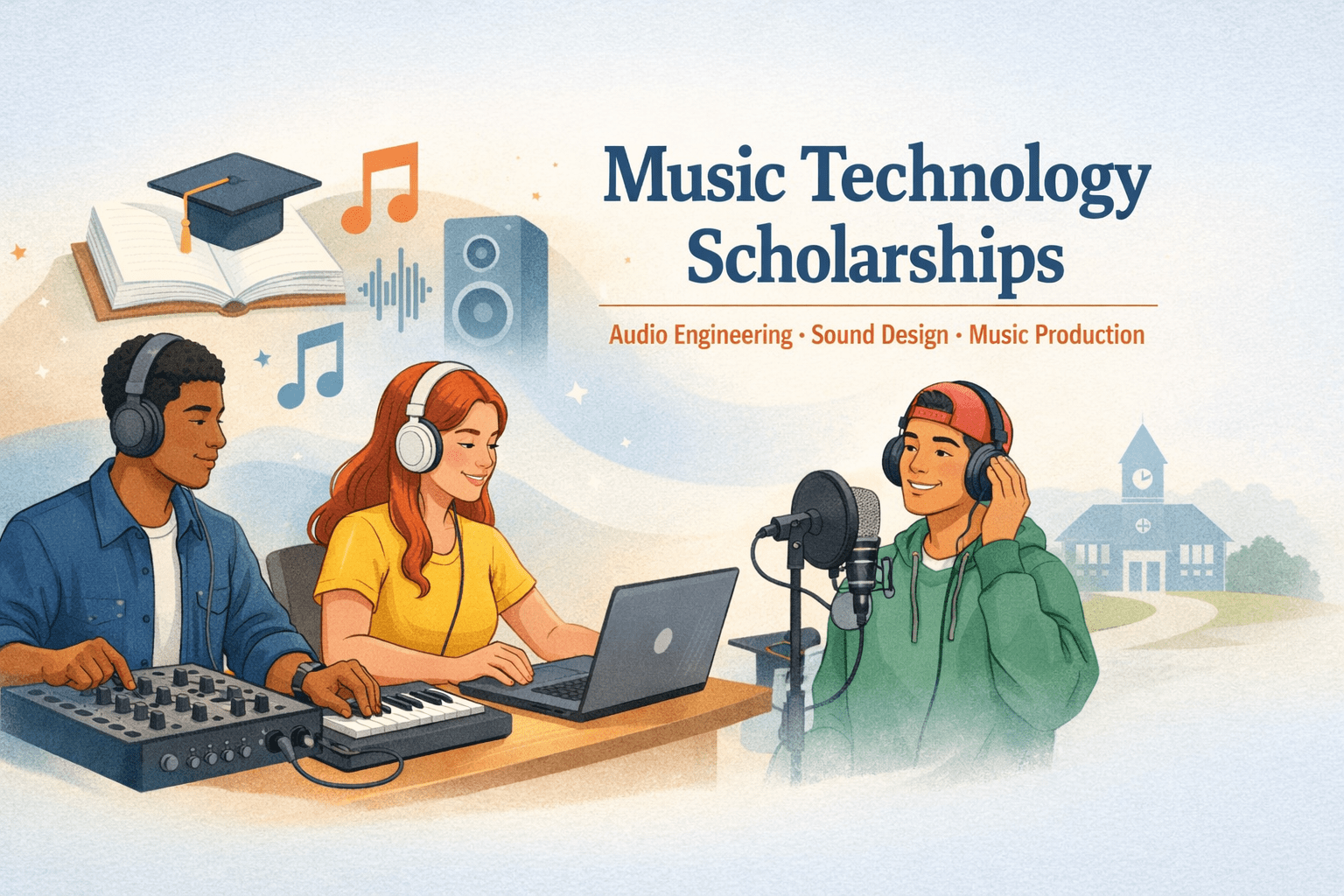
Music Technology Scholarships (sorted by month of typical annual deadline)
January
G.A.N.G. Scholars (Game Audio Network Guild)
💥 Why It Slaps: Industry-backed scholar program that helps aspiring game-audio creators attend major conferences (e.g., GDC) for mentoring, networking, and career break-ins.
💰 Amount: Varies (conference pass + travel support varies by event).
⏰ Deadline: Varies by event (often ~6–10 weeks prior; winter cycles typically land Jan/Feb).
🔗 Apply/info: https://www.audiogang.org/resources/scholars-program/
March
Live Nation Scholarship (Music Forward Foundation)
💥 Why It Slaps: $10K for students pursuing live-music careers (promotion, ticketing, e-commerce, artist mgmt).
💰 Amount: $10,000.
⏰ Deadline: March 31 (annually).
🔗 Apply/info: https://musicforwardfoundation.org/programs/scholarships/
Tiffany Green Operator Scholarship (Music Forward)
💥 Why It Slaps: $10K supporting women pursuing careers in live entertainment (including production & music engineering).
💰 Amount: $10,000.
⏰ Deadline: March 31 (annually).
🔗 Apply/info: https://musicforwardfoundation.org/wp-content/uploads/2023/11/Tiffany-Green-Operator-Guidelines-2024.pdf
Steven J. Finkel Service Excellence Scholarship (Music Forward)
💥 Why It Slaps: $10K for students focused on improving the live-music fan/artist experience.
💰 Amount: $10,000.
⏰ Deadline: March 31 (annually).
🔗 Apply/info: https://musicforwardfoundation.org/scholarships-awards/
David E. Ballard Scholarship (Music Forward)
💥 Why It Slaps: $10K for students who have experienced homelessness and/or foster care.
💰 Amount: $10,000.
⏰ Deadline: March 31 (annually).
🔗 Apply/info: https://musicforwardfoundation.org/scholarships-awards/
Governors Ball Scholarship (Music Forward)
💥 Why It Slaps: $10K for NYC students pursuing live-entertainment careers.
💰 Amount: $10,000.
⏰ Deadline: March 31 (annually).
🔗 Apply/info: https://musicforwardfoundation.org/scholarships-awards/
Affinity Plus Scholarship (Music Forward partner)
💥 Why It Slaps: Dedicated award for MN students pursuing music-industry paths.
💰 Amount: $5,000.
⏰ Deadline: March 31 (annually).
🔗 Apply/info: https://musicforwardfoundation.org/scholarships-awards/
April
Acoustical Society of America — Leo & Gabriella Beranek Scholarship
💥 Why It Slaps: Flagship $30K award for acoustics and studio design.
💰 Amount: $30,000.
⏰ Deadline: Early spring (annually).
🔗 Apply/info: https://acousticalsociety.org/fellowships-and-scholarships/
May
AES Educational Foundation — Graduate Studies Grants
💥 Why It Slaps: The go-to graduate funding for audio engineering and related fields.
💰 Amount: Varies (tuition grants).
⏰ Deadline: May 15 (annually).
🔗 Apply/info: https://www.aeseducationalfoundation.org/grants
AES Educational Foundation — Mary Lea Simpson Memorial Scholarship
💥 Why It Slaps: Tuition help for your final undergrad year in audio engineering.
💰 Amount: Varies.
⏰ Deadline: May 15 (annually).
🔗 Apply/info: https://www.aeseducationalfoundation.org/scholarships
Genelec Dr. Ilpo Martikainen Audio Visionary Scholarship
💥 Why It Slaps: Celebrates innovation in sound research.
💰 Amount: $5,000.
⏰ Deadline: May 15 (annually).
🔗 Apply/info: https://www.aeseducationalfoundation.org/grants
Genelec Mike Chafee Audio Pioneering Scholarship
💥 Why It Slaps: Supports outstanding women in audio graduate study.
💰 Amount: $5,000.
⏰ Deadline: May 15 (annually).
🔗 Apply/info: https://www.aeseducationalfoundation.org/grants
L-Acoustics Dr. Christian Heil “Future of Sound” Scholarship
💥 Why It Slaps: Focused on loudspeaker & live-sound research.
💰 Amount: Varies.
⏰ Deadline: May 15 (annually).
🔗 Apply/info: https://www.aeseducationalfoundation.org/grants
SMPTE — Louis F. Wolf Jr. Memorial Scholarship
💥 Why It Slaps: $5,000 for motion-imaging disciplines (sound for picture included).
💰 Amount: $5,000.
⏰ Deadline: Spring window each year.
🔗 Apply/info: https://www.smpte.org/membership/student/louis-f.-wolf-jr.-memorial-scholarship
SMPTE — Student Scholarship
💥 Why It Slaps: General scholarship for students in motion-imaging programs.
💰 Amount: Varies.
⏰ Deadline: Spring window.
🔗 Apply/info: https://www.smpte.org/membership/student/louis-f.-wolf-jr.-memorial-scholarship
SBE — John H. Battison SBE Founder’s Scholarship
💥 Why It Slaps: Supports students headed into broadcast engineering.
💰 Amount: Up to $2,500.
⏰ Deadline: Opens May 1; closes June 1.
🔗 Apply/info: https://sbe.org/education/ennes-scholarships/
June
(See above) SBE — John H. Battison SBE Founder’s Scholarship
— closes June 1.
July
SBE — Harold Ennes Educational Foundation Trust Scholarships
💥 Why It Slaps: Multiple awards for broadcast-tech students; can cover tuition, books, or training.
💰 Amount: $2,500–$3,000 (recent years).
⏰ Deadline: Often early–mid summer.
🔗 Apply/info: https://sbe.org/education/ennes-scholarships/
August
USITT/LDI — Pat MacKay Diversity in Design Scholarships (Sound Design eligible)
💥 Why It Slaps: Up to $5,000 paid directly to school for undergrad sound-design students.
💰 Amount: Up to $5,000.
⏰ Deadline: Summer (apps open in May).
🔗 Apply/info: https://www.usitt.org/awards-and-grants/pat-mackay-diversity-design-scholarships
October
MPSE — Verna Fields Student Award (Outstanding Sound Editing – Student Film)
💥 Why It Slaps: Winner also receives the Ethel Crutcher Scholarship; major recognition for sound editors.
💰 Amount: Varies annually.
⏰ Deadline: October 31.
🔗 Apply/info: https://www.mpse.org/Current-Awards
AVIXA Foundation — Scholarships (incl. Michael Vergauwen & Mosaic)
💥 Why It Slaps: AV industry scholarships aligned with live sound/AV systems and audio tech.
💰 Amount: $2,500–$5,000 (varies).
⏰ Deadline: Fall (Aug–Oct).
🔗 Apply/info: https://www.avixa.org/about-avixa/who-we-are/avixa-foundation/scholarships
November
Cinema Audio Society — Student Recognition Award (CAS)
💥 Why It Slaps: $5,000 to the winner + gear for finalists; top credential for aspiring mixers.
💰 Amount: $5,000 (winner) + gear.
⏰ Deadline: Fall (varies annually).
🔗 Apply/info: https://cinemaaudiosociety.org/student-recognition-award/
NAMM Foundation — Lamond GenNext Award
💥 Why It Slaps: $750 stipend + NAMM Show access; unparalleled exposure to live sound & music tech industry.
💰 Amount: $750 stipend + badge.
⏰ Deadline: Autumn (apps mid-year; for January NAMM Show).
🔗 Apply/info: https://www.nammfoundation.org/LamondGenNextAward
Rolling / Programmatic
Women’s Audio Mission (WAM) — Course/Training Scholarships
💥 Why It Slaps: Scholarships that cover WAM’s hands-on recording & audio courses.
💰 Amount: Tuition coverage (varies by course).
⏰ Deadline: Rolling by class/session.
🔗 Apply/info: https://womensaudiomission.org/summer-2025-academy-scholarship/
Bonus Awards
SBE — Robert D. Greenberg Scholarship
💥 Why It Slaps: Broadcast tech award often grouped under Ennes Trust.
💰 Amount: ~$2,500.
⏰ Deadline: Summer (varies).
🔗 Apply/info: https://sbe.org/education/ennes-scholarships/
SBE — Youth Scholarship
💥 Why It Slaps: For high school seniors entering broadcast engineering/audio pathways.
💰 Amount: $1,000–$3,000.
⏰ Deadline: Summer (varies).
🔗 Apply/info: https://sbe.org/education/ennes-scholarships/
Music Technology Scholarships in the U.S.: Analysis of Supply, Demand, and Equity
Abstract
Music Technology sits at the intersection of creative practice and applied engineering, preparing students for roles spanning recording, synthesis, scoring for media, audio-visual production, and software-enabled music creation. Yet the field’s training pipeline and funding landscape are uneven: completions are geographically concentrated, awards skew heavily male, and a large share of degrees come from the private for-profit sector—conditions that amplify financial risk and make scholarships unusually consequential. Using national education and labor-market data (IPEDS/CIP definitions, degree completions and diversity profiles, federal wage/outlook statistics, and national college-cost benchmarks), this paper models why Music Technology scholarships matter, which scholarship designs most efficiently reduce student debt and improve persistence, and how applicants can maximize “fit” between portfolio evidence and funder priorities. Evidence indicates that Music Technology produced 1,763 U.S. degrees in 2023 and was labeled as a STEM major in the cited field profile, with male recipients comprising 75% and degrees clustered in a few counties (notably Los Angeles County and Orange County, Florida). In parallel, core technician roles (sound engineering, broadcast, audio/video) pay around the mid–$50k to mid–$60k range at the median, but projected growth is modest—placing a premium on low-debt completion, skills signaling, and early work experience. The paper concludes with scholarship design recommendations (tuition + equipment microgrants, paid-apprenticeship hybrids, and portfolio-anchored evaluation rubrics) and a practical applicant strategy calibrated to the field’s real selection mechanisms.
Keywords: Music Technology; scholarships; audio engineering; recording arts; STEM + arts; equity; IPEDS; BLS; cost of attendance.
1. Defining “Music Technology” and why scholarships are structurally central
The federal instructional program definition (CIP 50.0913) frames Music Technology as a program blending music and technology and preparing students to apply technical skills to composition, recording, synthesis, performance, audio-visual production, film/multimedia scoring, and software/multimedia development. This definitional breadth is not cosmetic—it drives scholarship dynamics in three ways:
-
Multi-market labor alignment: Graduates compete across creative labor markets (music production, composition) and technical labor markets (broadcast, A/V systems, post-production workflows).
-
Capital intensity: Unlike many majors where the primary cost is tuition, Music Technology typically adds hardware/software needs (computing, audio interfaces, microphones/controllers, plug-in ecosystems, storage). Even when campuses provide labs, students still face “production readiness” costs to build independent portfolios.
-
Portfolio-gated selection: In this field, scholarships often behave more like early-career fellowships: funders value demonstrable work (mixes, sound design reels, scores, patches, systems projects) as a proxy for persistence and employability.
In short, Music Technology scholarships do not merely “reduce price.” They can function as credential accelerators by funding the tools, memberships, and project time that produce portfolio outputs.
2. Education pipeline snapshot: who earns Music Technology degrees, where, and in what sector
National degree data show a relatively small but growing pipeline. In 2023, 1,763 Music Technology degrees were awarded, growing 5.38% year-over-year in the referenced profile. The geographic distribution is highly concentrated, with the highest concentrations of degree recipients in Los Angeles, CA; Murfreesboro, TN; and Cedar City, UT, and top degree-producing counties including Los Angeles County, CA (369) and Orange County, FL (338).
Table 1. Music Technology pipeline indicators (U.S., 2023)
| Indicator | Value |
|---|---|
| Total degrees awarded | 1,763 |
| YOY growth (degrees) | +5.38% |
| Sex distribution (common institutions) | Male 75% |
| Race/ethnicity counts (all degrees) | White 861; Black 313; Hispanic 236 |
| Largest single sector by completions | Private for-profit, 4-year+ (718 completions) |
| Median tuition (field profile) | In-state public $6,930; out-of-state private $39,400 |
Two implications follow:
First, sector risk is unusually salient. The largest single share of completions occurs in the private for-profit 4-year+ sector (718 of 1,763; ~41%), meaning scholarship counseling must include program-level due diligence (accreditation, outcomes transparency, net price, placement support) and not only “how to apply.”
Second, gender imbalance suggests a targeted scholarship rationale. A 75% male share at common institutions indicates that scholarships earmarked for women and gender minorities are not merely symbolic; they are plausibly corrective interventions aligned with measured pipeline imbalance.
3. Cost structure: tuition is only the baseline
A core mistake in scholarship advising is treating tuition as the full cost of becoming employable. In reality, Music Technology students face a layered cost stack: tuition/fees + living costs + materials + the “portfolio production layer.”
At the national level, College Board estimates that in 2024–25, average total budgets for full-time undergraduates ranged from $20,570 (public 2-year in-district) to $62,990 (private nonprofit 4-year), with public 4-year budgets averaging $29,910 (in-state) and $49,080 (out-of-state). These totals matter because scholarship awards must be interpreted against full budget, not sticker tuition.
College Board also reports average published tuition and fees for 2024–25 of $4,050 (public 2-year in-district), $11,610 (public 4-year in-state), and $43,350 (private nonprofit 4-year). The field-specific profile adds another dimension: median tuition for Music Technology programs is listed as $6,930 (median in-state public) and $39,400 (median out-of-state private), underscoring how quickly price escalates across institution types.
Scholarship adequacy gap. Nationally, families who receive scholarships report average scholarship funding around $8,004 (among scholarship users). That amount is meaningful, but it rarely closes the full budget gap—especially in high-cost metros where Music Technology programs cluster (e.g., Los Angeles). Therefore, effective scholarship strategies in this major are almost always stacking strategies (multiple awards + institutional aid + paid work + low-cost tool access).
4. Labor-market reality: stable demand, modest growth, and strong pay dispersion
Music Technology pathways map to several occupational clusters. The most directly aligned federal occupation group is “Broadcast, Sound, and Video Technicians,” where the median annual wage was $56,600 (May 2024). Within that group, median pay varies by role: sound engineering technicians $66,430; audio and video technicians $54,830; broadcast technicians $53,920; lighting technicians $60,560.
However, the same federal outlook projects 1% employment growth (2024–2034) for broadcast/sound/video technicians overall, with about 11,100 openings per year largely from replacement needs. This “low-growth/high-churn” pattern has a direct scholarship implication: scholarships that reduce debt and fund employability signals (portfolio + internships + certifications) can be more impactful than scholarships that only reward test scores. When job growth is modest, competition intensifies around signaling and networks.
For students oriented toward composition/scoring, the related occupation “Music Directors and Composers” shows a median annual wage of $63,670 (May 2024), but with extremely wide dispersion at the top end. Scholarships that underwrite time for scoring reels, collaborations, and mentorship can be decisive in helping students cross the experience threshold required to access higher-paying segments of media work.
Table 2. Selected earnings/outlook benchmarks (U.S.)
| Pathway cluster | Key metric |
|---|---|
| Broadcast, sound, video technicians (overall) | Median pay $56,600 (May 2024); projected growth 1% (2024–34); ~11,100 openings/year |
| Sound engineering technicians (sub-role) | Median pay $66,430 (May 2024) |
| Music directors & composers | Median pay $63,670 (May 2024) |
5. Scholarship ecology in Music Technology: who funds, what they reward, and why
Music Technology scholarship funding typically comes from five overlapping ecosystems:
5.1 Professional societies and technical associations
These awards frequently require membership, align to industry standards, and prioritize demonstrable skill.
-
Audio Engineering Society (AES) Educational Foundation: offers scholarships/grants, including awards tied to audio engineering and recording arts training.
-
SMPTE (motion imaging): student opportunities include scholarships tied to engineering/technology emphases in motion-imaging sound and workflows (e.g., a memorial scholarship noted as $5,000 in the student opportunities listing).
Selection logic: Funders want evidence you can contribute to the field’s technical craft. Winning applications often resemble mini professional dossiers: project logs, mixes with annotations, system diagrams, or research statements.
5.2 Mission-driven nonprofits and inclusion initiatives
These awards address measured pipeline gaps—especially gender imbalance and access barriers.
-
Women’s Audio Mission (WAM) scholarship (program listing).
-
We Are Moving The Needle scholarships and grants to support creators attending audio programs.
Selection logic: Applicants must connect identity- or access-based rationale to credible skill trajectories. Strong submissions tie scholarship support to specific production milestones (EP mixing, live-sound practicum, certification exams, capstone scoring project).
5.3 Industry-affiliated programs and music-industry workforce pipelines
These often blend scholarship dollars with internships, mentorship, or equipment support.
-
Recording Academy-linked programs (e.g., Black Music Collective “Your Future Is Now,” with reported $10,000 scholarships for selected HBCU students in a cited press release).
Selection logic: Leadership potential + professional readiness. These programs value communication, teamwork, and industry awareness alongside creative/technical output.
5.4 Adjacent A/V and systems industries
Music Technology is increasingly entangled with integrated A/V, live events, and immersive media.
-
AVIXA Foundation scholarship opportunities (example listing emphasizes women and leadership in the AV profession).
Selection logic: Clear linkage between coursework and applied A/V practice: signal flow competence, systems thinking, and safety/protocol fluency.
5.5 Institutional scholarships (often the largest dollars)
Although this paper emphasizes external scholarships, institutions remain the dominant source of large awards. This is why “stacking” matters: external scholarships can improve net price, reduce work hours, and fund portfolio buildout even when institutional aid covers tuition.
6. Equity, access, and what the degree-demographics imply for scholarship design
The field profile shows a gender imbalance (male 75%) and notable race/ethnicity distributions (e.g., White 861; Black 313; Hispanic 236 among 2023 degree awards). These patterns suggest three evidence-based design principles for scholarship makers (and three targeting lenses for applicants):
-
Pipeline-corrective targeting: Awards explicitly supporting women and gender minorities directly align with measured imbalance.
-
Geography-aware access: Concentration in major counties implies that rural and smaller-market students may face fewer local program options; scholarships that support relocation, online/hybrid study, or summer intensives can increase entry.
-
Debt-risk mitigation in high-cost sectors: Because a substantial share of completions occurs in the for-profit sector, scholarship design should incentivize transparency (completion rates, placement support) and help students avoid high-debt outcomes through last-dollar tuition, transfer pathways, and paid work placements.
7. An evidence-informed applicant strategy for Music Technology scholarships
Music Technology scholarship decisions are rarely “grades-only.” They are typically portfolio + trajectory + fit decisions. A high-yield approach:
7.1 Build a portfolio that matches funder rubrics
Create 2–3 “anchor artifacts” and document them like a professional:
- Recording/mix/master: before/after, session screenshots, mic chain notes, loudness targets, and reflection on tradeoffs.
- Sound design reel: 60–90 seconds of curated clips with short captions (tools, technique, intent).
- Scoring or interactive audio: a cue sheet, mock brief, and implementation notes (especially for SMPTE-adjacent scholarships).
7.2 Treat scholarship applications as employability practice
Given modest job-growth projections in technician roles, scholarship applications double as rehearsal for the hiring market: your statement should read like a project pitch plus a professional development plan.
7.3 Stack strategically using realistic benchmarks
If average scholarship support among recipients is roughly $8,004, plan to stack multiple awards or pair scholarships with paid work experiences (campus studios, event crews, broadcasting, A/V labs).
7.4 Align “need narrative” to cost-of-attendance reality
Use national budget benchmarks to frame need credibly (total costs often far exceed tuition). Scholarship committees respond to specificity: show how funds translate to reduced work hours, increased studio time, or a certification milestone—especially when total annual budgets can range from roughly $20.6k to $63.0k depending on sector.
8. Recommendations for scholarship providers and institutions (what “works” given the data)
8.1 Bundle tuition aid with “production capacity” microgrants
For Music Technology, a $1,000–$3,000 equipment/software microgrant can be disproportionately impactful because it increases portfolio output per semester. This complements tuition aid rather than duplicating it.
8.2 Use portfolio-anchored scoring rubrics
Scholarship rubrics should explicitly score: (a) technical competence, (b) creative intent, (c) documentation quality, (d) collaboration evidence, and (e) learning velocity. This reduces bias toward students with privileged access to expensive studios by rewarding process and problem-solving.
8.3 Tie awards to paid experiential learning
Because projected growth is modest in technician roles, scholarships should be linked to apprenticeships (campus A/V teams, partner venues, public media stations) that produce references and hours logged—directly improving placement odds.
8.4 Require outcome transparency in high-cost programs
Given the sizable for-profit footprint in completions, funders can protect students by requiring basic transparency (completion, placement support, typical borrowing) as a condition of eligibility for institutional partnership awards.
Conclusion
Music Technology scholarships operate in a context where (1) degree production is growing but still small and geographically concentrated, (2) the training pipeline shows pronounced gender imbalance, (3) a large share of degrees are awarded in the private for-profit sector, and (4) labor-market outcomes offer solid median wages but modest growth—making employability signals and low-debt completion especially valuable. The most effective scholarship strategies for students are portfolio-led and stacking-oriented, while the most effective scholarship designs for providers combine tuition relief with equipment microgrants and paid experiential pathways. Done well, Music Technology scholarships do more than pay bills: they accelerate portfolio production, reduce time-to-signal, and improve the probability that creative talent converts into sustainable, technical careers.
References (selected)
- U.S. Department of Education, NCES IPEDS. CIP 50.0913 definition (Music Technology).
- Data USA. Music Technology (CIP) profile: degrees, demographics, sector, tuition indicators.
- U.S. Bureau of Labor Statistics (BLS). Occupational Outlook Handbook: Broadcast, Sound, and Video Technicians (pay/outlook; role medians).
- U.S. Bureau of Labor Statistics (BLS). Occupational Outlook Handbook: Music Directors and Composers (median pay).
- College Board. Published tuition and cost/budget benchmarks (2024–25).
- Sallie Mae. How America Pays for College 2025 (scholarship usage and average amounts).
- AES Educational Foundation. Scholarships and grants overview and submissions information.
- SMPTE. Opportunities for students (scholarship information).
- Women’s Audio Mission; We Are Moving The Needle; AVIXA Foundation. Scholarship program pages.
FAQs — Music Technology Scholarships (Updated September 21, 2025)
1) What counts as a “music technology” major?
Audio engineering, recording arts, music production, sound design (for film/TV/games), live sound, broadcast audio, acoustics/electroacoustics, audio software/DSP, music tech–focused AV systems, and some music business programs with strong tech/production tracks.
2) I’m a performance major who also produces/mixes. Am I eligible?
Often yes—if your coursework, portfolio, or declared concentration clearly centers on audio tech/production/sound design. Many awards accept performance majors pursuing a tech emphasis or dual-path.
3) Do I need an audition or a portfolio?
Most tech-centric awards prefer a portfolio/reel (stems, mixes, post sessions, game audio scenes, live-sound system files). Some also request a short “session breakdown” explaining your role, tools, and creative/technical choices.
4) What should go in a strong portfolio?
3–5 polished pieces showing range (music mix, sound-for-picture, game audio, live capture). Include a one-page cue sheet per piece: goals, chain/signal flow, before/after snippets, metering/loudness notes, and what you’d improve next time.
5) GPA vs. skills—what matters more?
Many programs weigh demonstrated skills, initiative, and impact more heavily than a perfect GPA. That said, minimum GPA thresholds (e.g., 3.0) are common—read each eligibility line carefully.
6) Are community college, certificate, or online programs eligible?
Frequently, yes. Some scholarships require degree-seeking status at accredited institutions; others fund certificates or short courses. Check whether “degree-seeking,” “credit-bearing,” or “accredited” is specified.
7) Grad students: are there options beyond undergrad awards?
Absolutely—acoustics, advanced audio research, spatial audio, and postgrad recording arts/engineering funding exists. Many foundation grants specifically target graduate research or thesis work.
8) Can I stack multiple scholarships?
Usually—but your financial aid office may adjust institutional aid (“stacking” rules). Ask two questions up front: (a) does the donor restrict stacking, and (b) how will my school repackage aid if I win?
9) Are awards need-based, merit-based, or both?
All three exist: merit-only (portfolio/essay), need-only (FAFSA or CSS Profile required), and hybrid. Prepare both a compelling portfolio and basic financial docs so you’re covered either way.
10) Typical application timeline by month?
- Jan–Mar: Many national music-industry awards open; several close by late March.
- Apr–Jun: Prominent audio/acoustics and motion-imaging tech awards; late spring deadlines are common.
- Jul–Aug: Broadcast-tech and AV/production scholarships often close over summer.
- Oct–Nov: Student sound-editing/mixing recognitions and show-access stipends commonly close in the fall.
Always confirm the current cycle—deadlines shift year to year.
11) Do I need industry memberships (AES, SBE, SMPTE, USITT)?
Not always required, but they help. Some awards require or strongly prefer student membership and/or involvement (chapter leadership, conference volunteering, paper/poster presentations).
12) What if I’m an international or DACA/undocumented student?
Some awards are open internationally; others require U.S. citizenship/permanent residency. Many private foundations set their own rules. Look for “open to all nationalities,” “U.S. only,” or “residents of X” in eligibility.
13) Do I need letters of recommendation?
Common. Choose recommenders who can speak to technical rigor (gain staging, editing, routing, restoration, system design) and collaboration under deadline. Provide them your reel links, cue sheets, and prompt answers two weeks ahead.
14) What software/format expectations are typical?
Programs don’t mandate a DAW, but clarity matters. Provide WAV/AIFF for audio; if sharing DAW sessions, bounce consolidated stems and a short PDF with sample rate/bit depth, plug-in list, and bus/routing diagram.
15) Gear vs. tuition—what can scholarship funds cover?
Varies. Tuition/fees/books are common. Some awards allow equipment (interfaces, mics, headphones) or travel to industry events; others don’t. Read the “allowable expenses” line and keep receipts.
16) Will a scholarship affect my taxes or financial aid package?
Funds applied to qualified education expenses may be tax-advantaged; equipment or stipends may be treated differently. Schools can also re-balance your aid. Always check with your financial aid office (and a tax professional if needed).
17) How do I stand out in essays?
Tell a problem → approach → result story: a specific sonic challenge, your methodology (signal chain, room treatment, metering targets), what you learned, and measurable impact (before/after LUFS, intelligibility, reduced feedback, client outcomes).
18) Any common deal-breakers?
Missing the format specs (file types, word counts), unlabeled roles on team projects, unclear authorship, and late submissions. Use a pre-flight checklist before you hit submit.
19) Accessibility & inclusion—does it matter?
Yes. Many awards value projects that improve access (captioning/mix translation, immersive audio accessibility, hearing-safe stage practices). If you’ve done work here, highlight it.
20) I’m focused on game audio or post sound—are these “music tech”?
Yes. Sound design, implementation (middleware), dialogue/VO editing, Foley, and mix for picture or interactive media squarely fit the music-tech umbrella.
21) What if my school doesn’t offer a “music tech” major?
Major adjacent (CS/audio DSP, ECE with acoustics, media arts, theatre sound, broadcast engineering) and demonstrate applied audio projects—scholarships often accept these with a strong portfolio.
22) Can high school seniors apply?
Some awards allow HS seniors entering eligible programs; others require current enrollment. Look for “incoming freshman” language and be ready with proof of admission.