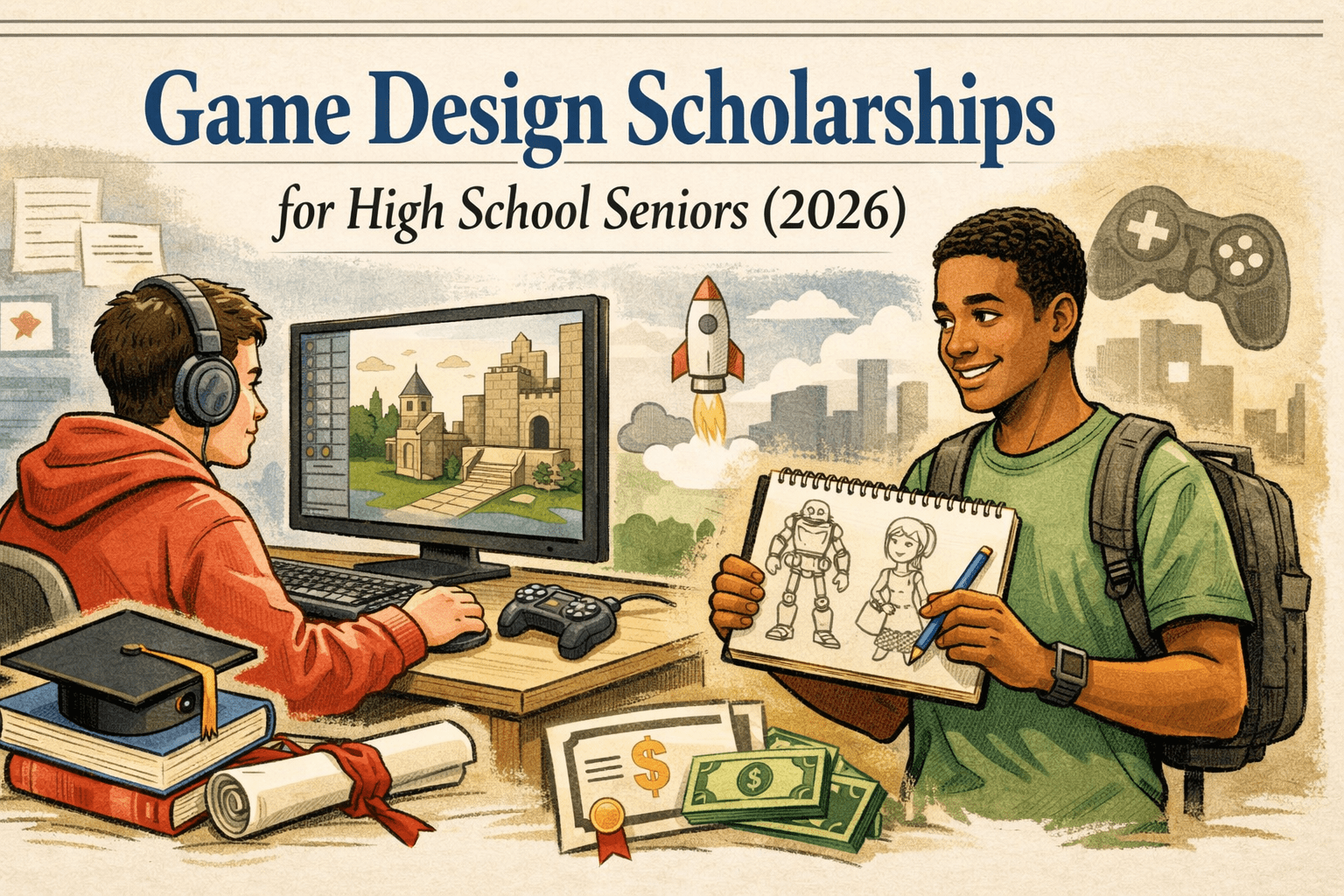
Game Design Scholarships for High School Seniors (Class of 2026)
October
NCWIT Aspirations in Computing — High School Award (national + regional)
💥 Why It Slaps: Recognition + cash/prizes + a powerful tech community for women, genderqueer, and non-binary students interested in computing (great for future game devs).
💰 Amount: Varies (cash awards + perks; amounts differ by region/tier).
⏰ Deadline: Oct 28, 2025 (2025–26 cycle).
🔗 Apply/info: https://www.aspirations.org/award-programs/aic-high-school-award
November–December
(Most programs in this space either open late fall or set January deadlines. Keep an eye on the “Opens Fall” programs below.)
January
Amazon Future Engineer Scholarship (CS-related majors welcome, including game-dev tracks)
💥 Why It Slaps: Up to $40k over four years plus a paid Amazon summer internship after freshman year.
💰 Amount: Up to $40,000 total (up to $10,000/year; need-based) + internship offer.
⏰ Deadline: Applications open Fall 2025; deadline posted on program page when live.
🔗 Apply/info: https://www.amazonfutureengineer.com/scholarships
Blacks at Microsoft (BAM) Scholarship
💥 Why It Slaps: For Black/African-descent HS seniors pursuing tech—stackable with other aid.
💰 Amount: Mix of $5,000 renewable (up to 3 years) and $2,500 one-time awards.
⏰ Deadline: Typically Jan–Mar (2026 window to be posted on official page).
🔗 Apply/info: https://www.microsoft.com/en-us/diversity/programs/bam-scholarship
February
ESA Foundation — Computer & Video Game Arts and Sciences Scholarship (women & under-represented students)
💥 Why It Slaps: One of the most “on-brand” tuition scholarships in games—HS seniors are eligible if they’ll enroll full-time in the fall.
💰 Amount: Varies (tuition support + mentoring/networking).
⏰ Deadline: Opens Feb 2026 (for 2026–27); deadline posted when the cycle launches.
🔗 Apply/info: https://www.theesa.com/foundation/computer-and-video-game-arts-and-sciences-scholarship/
March
Microsoft Disability Scholarship
💥 Why It Slaps: For HS seniors with a disability pursuing a tech/CS field (game design fits); run by Microsoft ERGs.
💰 Amount: Varies (historically renewable awards).
⏰ Deadline: Typically Jan–Mar; watch the official Microsoft ERG pages for the 2026 window.
🔗 Apply/info: https://www.microsoft.com/en-us/diversity/programs/microsoftdisabilityscholarship
Women In Technology Scholarship (WITS) — by Visionary Integration Professionals
💥 Why It Slaps: Long-running scholarship for women heading into tech degrees; great fit for game-design-adjacent CS/HCI/UX tracks.
💰 Amount: Varies (multiple awards annually).
⏰ Deadline: Historically late winter/early spring; see current cycle details.
🔗 Apply/info: https://www.trustvip.com/wits/
June
National Videogame Museum (NVM) Scholarships (TX + national awards for women)
💥 Why It Slaps: Scholarships targeted at aspiring game developers/tech students; includes TX-resident awards and Amie Dansby Women in Technology awards (open nationally).
💰 Amount: Varies (multiple scholarships each cycle).
⏰ Deadline: Most recently June 1 (check the current cycle page).
🔗 Apply/info: https://nvmusa.org/scholarships/
Rolling / Program-Based (College-Specific but HS-Senior Friendly)
These are direct scholarships from top game schools; most are automatic/portfolio-based or tied to campus events. They can stack with federal/state aid. Check each page for amounts and “when you apply/visit” fine print.
Champlain College — First-Year Merit Scholarships (Game Design BS)
💥 Why It Slaps: Game-design-top-10 program; strong four-year merit.
💰 Amount: $13,000–$32,000 per year (renewable).
⏰ Deadline: Awarded with admission (apply by college deadlines).
🔗 Apply/info: https://www.champlain.edu/financial-aid/types-of-aid/scholarships/
Champlain College — Visit Scholarship (stackable)
💥 Why It Slaps: Literally get $$ for visiting—great add-on for Game Design admits.
💰 Amount: $4,000 total ($1,000/yr x4).
⏰ Deadline: Make an official campus visit; auto-awarded to admitted students.
🔗 Apply/info: https://www.champlain.edu/admissions/visits-tours/
Full Sail University — Momentum Scholarship (Game Design, Game Dev, etc.)
💥 Why It Slaps: Big merit for tech/creative degrees; can cover a huge chunk.
💰 Amount: Up to $30,000 (degree-specific).
⏰ Deadline: Varies by program start (apply early).
🔗 Apply/info: https://www.fullsail.edu/admissions/scholarships
Full Sail — Creative Minds (Game Jam/Competition) Scholarships
💥 Why It Slaps: Compete (often via game jam/creative challenge) for tuition awards; super on-brand for portfolios.
💰 Amount: Up to $25,000 (degree-specific competitions).
⏰ Deadline: Event-based; multiple intakes annually.
🔗 Apply/info: https://www.fullsail.edu/scholarships/creative-minds-scholarship
Full Sail — Emerging Technology Scholarship
💥 Why It Slaps: Highly competitive full-tuition opportunities for select tech degrees.
💰 Amount: Full tuition (select programs).
⏰ Deadline: Rolling by start date; limited awards.
🔗 Apply/info: https://www.fullsail.edu/scholarships/emerging-technology-scholarship
DigiPen Institute of Technology — Undergraduate Scholarships
💥 Why It Slaps: One of the OG game schools; multiple institutional scholarships for incoming freshmen.
💰 Amount: Varies (merit/need-based; multiple programs).
⏰ Deadline: With admission/FA process.
🔗 Apply/info: https://www.digipen.edu/admissions/financial-aid/types-of-financial-aid/scholarships
RIT (School of Interactive Games & Media) — Merit Scholarships
💥 Why It Slaps: Strong IGM + co-ops; merit is awarded at admission and stacks with aid.
💰 Amount: Varies (RIT merit is substantial; awarded on admission).
⏰ Deadline: Apply by RIT’s first-year deadlines.
🔗 Apply/info: https://www.rit.edu/financialaid/first-year-undergraduate
DePaul CDM (Game Design/Dev, Animation) — College & Department Scholarships
💥 Why It Slaps: Dedicated CDM awards in addition to university merit.
💰 Amount: Varies (multiple CDM-specific awards).
⏰ Deadline: Department calendars; typically late winter/early spring.
🔗 Apply/info: https://www.cdm.depaul.edu/Student-Resources/Pages/scholarships.aspx
USC (School of Cinematic Arts / USC Games) — University Merit + SCA aid
💥 Why It Slaps: Top-tier USC Games; large university merit (Trustee/Presidential) + SCA funds.
💰 Amount: Up to $25,000/yr (university merit) + program awards.
⏰ Deadline: Apply by USC merit deadlines (typically Dec 1 for scholarship consideration).
🔗 Apply/info: https://cinema.usc.edu/scholarships/
SCAD — First-Year/Competition Scholarships (Game Dev, Interactive Design)
💥 Why It Slaps: Portfolio-driven awards + SCAD Challenge competitions; strong game/interactive programs.
💰 Amount: Varies (multiple awards; some substantial).
⏰ Deadline: With admission and competition calendars.
🔗 Apply/info: https://www.scad.edu/admission/financial-aid-and-scholarships/scholarships
Ringling College — PreCollege Scholarship (stackable toward BFA, inc. Game Art)
💥 Why It Slaps: PreCollege performance can unlock $5,000 scholarships applicable toward degree—great pathway into Ringling’s Game Art.
💰 Amount: $5,000 (stackable; details on Ringling page).
⏰ Deadline: PreCollege application deadlines (winter/spring).
🔗 Apply/info: https://www.ringling.edu/admissions/financial-aid-and-tuition/financial-aid-opportunities/scholarships-and-grants/
Academy of Interactive Entertainment (AIE) — New Student Scholarships (Seattle & Lafayette)
💥 Why It Slaps: Purpose-built game school; entry awards for incoming students in Game Art, Design, & Programming.
💰 Amount: Varies.
⏰ Deadline: Aligned to start dates; rolling until filled.
🔗 Apply/info: https://aie.edu/student-information/scholarships/
Game/Interactive-Adjacent External Scholarships (Great for Game Design Majors)
Girls Make Games — College Scholarship Fund
💥 Why It Slaps: Tuition assistance for women & non-binary students in game-related majors; HS seniors accepted to a program are eligible.
💰 Amount: Varies (tuition assistance).
⏰ Deadline: Opens each year; rolling until funds are allocated.
🔗 Apply/info: https://www.gmgsf.org/
Gay Gaming Professionals (GGP) Scholarship
💥 Why It Slaps: Supports LGBTQ+ students working toward careers in games (design, art, audio, production, etc.).
💰 Amount: Varies (multiple awards).
⏰ Deadline: Annual; see current cycle.
🔗 Apply/info: https://gaygamingpros.org/
AIAS Foundation — Student Scholarships (Randy Pausch, WomenIn, etc.)
💥 Why It Slaps: Flagship industry foundation awards + mentorship; superb for early portfolio builders.
💰 Amount: Varies (tuition assistance + GDC/mentoring opportunities).
⏰ Deadline: Annual; typically opens in spring/summer; see current cycle.
🔗 Apply/info: https://www.interactive.org/foundation/scholarships.asp
Autodesk — Design & Make Student Award (media/design fields welcome)
💥 Why It Slaps: Project-based national recognition; recent cycles have awarded $10,000 per winner.
💰 Amount: Up to $10,000 (recent winners).
⏰ Deadline: Annual; see current cycle page for dates.
🔗 Apply/info: https://www.autodesk.com/campaigns/design-make-awards
SMART Scholarship-for-Service (DoD) — CS/Engineering (incl. graphics/real-time)
💥 Why It Slaps: Full tuition + stipend + summer internships + post-grad DoD job—great route for engine/graphics-focused game devs.
💰 Amount: Full tuition + stipend (multi-year).
⏰ Deadline: Annual; see current cycle dates (opens late summer/fall typically).
🔗 Apply/info: https://www.smartscholarship.org/smart/en
Region / Audience-Specific (Nice Adds for Game-Bound Seniors)
National Videogame Museum — Texas Resident/Frisco/Title I + Women in Tech (nationwide)
💥 Why It Slaps: Directly focused on gaming & tech pathways; multiple categories.
💰 Amount: Varies.
⏰ Deadline: Most recently June 1; check current cycle.
🔗 Apply/info: https://nvmusa.org/scholarships/
(Already listed above, repeated here so Texas students don’t miss it.)
Esports/Project Funding You Can Use (if you build games)
Epic MegaGrants (Unreal Engine projects)
💥 Why It Slaps: Funding for student creators using Unreal—great for capstones, prototypes, or vertical slices.
💰 Amount: Varies (project grants).
⏰ Deadline: Rolling.
🔗 Apply/info: https://gameplan.com/news/a-comprehensive-guide-to-grants-and-funds-for-esports-programs
Game Design Scholarships in the United States: Access, Workforce Demand, and Funding Design (2026)
Game design is simultaneously an arts discipline and a software-driven engineering practice, and the scholarship ecosystem that supports aspiring game designers has evolved accordingly: tuition awards are frequently paired with mentorship, conference access, and network-building programs that function as “career capital” subsidies. This research paper synthesizes (1) U.S. labor-market indicators for adjacent occupations that absorb game design talent, (2) cost drivers of game-design training and portfolio production, and (3) the structure and scale of prominent national scholarship and access programs that explicitly target interactive entertainment. The evidence suggests a mismatch between the size of the pipeline the industry needs and the limited number of high-dollar scholarships; however, the field compensates through a dense “access layer” of conference scholarships and professional development cohorts that can materially improve placement outcomes. Key program-design findings include: (a) tuition-only awards cover a shrinking share of total attendance costs, especially at private institutions; (b) combining modest cash awards with high-touch mentorship and conference access may yield outsized returns; and (c) diversity-focused funding is a rational response to measurable representation gaps inside the industry workforce. The paper concludes with actionable recommendations for students, universities, and sponsors to improve scholarship targeting, transparency, and outcome measurement.
1. Introduction: Why Game Design Scholarships Matter
The modern game industry is large enough to exert macroeconomic and labor-market gravity, while still maintaining “creative industry” characteristics: portfolio-based hiring, project cycles, and a strong premium on networks and demonstrated work. In the U.S., the Entertainment Software Association (ESA) reports consumer spending of $58.7 billion in 2024, and its economic-impact research estimates $101 billion in total economic output and 350,000+ jobs supported by the video game industry. These scale indicators imply that game design is not a niche pastime; it is part of a labor ecosystem spanning software development, interactive art and animation, audio, product management, narrative design, and community operations.
Scholarships in game design matter for two reasons. First, the direct cost of degree programs (and the indirect costs of tools, hardware, and portfolio time) can be prohibitive. Second, hiring in games is heavily mediated by proof-of-skill artifacts (playable prototypes, art reels, shipped mods) and access to professional communities. Scholarships that include conference passes, mentorship, and curated cohorts therefore function not only as financial aid, but also as structured labor-market access.
2. Labor-Market Demand: Mapping Game Design to Observable Occupations
“Game designer” is not neatly captured as a single Bureau of Labor Statistics (BLS) occupation, so a data-driven approach treats game design as a talent cluster that feeds into measurable roles. Two adjacent anchors are particularly informative:
2.1 Software development as an employment magnet for game design talent
BLS reports a median annual wage of $133,080 (May 2024) for software developers, and projects 15% overall employment growth from 2024–2034 for software developers, quality assurance analysts, and testers, with about 129,200 openings per year on average.
For many game design students, this category represents both (a) direct game programming pathways (engine, gameplay, tools, backend) and (b) adjacent “plan B” pathways (general software roles) that reduce the perceived risk of investing in the major.
2.2 Special effects, animation, and interactive art roles
BLS reports a median annual wage of $99,800 (May 2024) for special effects artists and animators, and projects 2% growth from 2024–2034 with approximately 5,000 openings per year. BLS also notes the occupation held about 57,100 jobs in 2024 and emphasizes portfolio development and bachelor’s-level preparation.
This slower growth relative to software development helps explain why many game design scholarships emphasize hybrid skill sets (design + programming, design + production, or art + technical pipelines) and why programs often prioritize employability signals beyond a transcript.
2.3 Industry size and participation as demand context
ESA’s “Essential Facts” materials indicate gaming is mass-market (e.g., 205.1 million Americans play video games), which supports sustained demand for new content and the services surrounding it. While player counts are not job counts, they contextualize why scholarships and foundations frame game design as a legitimate workforce pipeline rather than a hobbyist track.
3. The Cost Structure of Becoming a Game Designer
3.1 Tuition and fees: the baseline cost floor
College Board’s Trends in College Pricing reports average published 2025–26 tuition and fees of $11,610 for in-state students at public four-year institutions, $31,330 for out-of-state students at public four-year institutions, and $43,350 at private nonprofit four-year institutions.
Game design programs are offered across all sectors, including high-cost private institutions. Therefore, scholarships that appear meaningful in absolute dollars can have very different purchasing power depending on the institution.
3.2 Portfolio costs: “shadow tuition”
Game design education carries “shadow tuition” costs—expenses not always captured in tuition bills but required for competitive portfolio output:
- Hardware capable of 3D modeling, real-time rendering, or engine development
- Software subscriptions and asset tools (even if student licensing discounts exist)
- External learning resources (specialized courses, plug-ins, marketplace assets)
- Time costs for unpaid portfolio projects and game jams
Because portfolio artifacts are hiring currency, the opportunity cost of time is a real constraint, especially for students who must work many hours while enrolled.
3.3 Access costs: the network premium
Professional conferences often function as labor-market clearinghouses. GDC Festival of Gaming 2026 states a simplified pass structure “starting at $649” (advanced rate) and frames the new structure as 45% more affordable than the former all-access pass. Even at reduced prices, travel, lodging, and time remain major barriers—hence the proliferation of conference scholarship programs.
4. Scholarship Ecosystem Typology in Game Design
Game design scholarships in the U.S. tend to fall into four overlapping categories:
- Tuition-focused industry foundation scholarships (cash awards for degree completion)
- Mentorship-and-network scholarships (cash + structured industry mentorship + travel)
- Conference access scholarships (passes + travel stipends + cohort programming)
- Identity- and equity-targeted programs (aimed at underrepresented groups, often integrated into categories 1–3)
A distinctive feature of this field is the degree to which scholarships are designed as pipeline infrastructure, not merely financial aid.
5. Empirical Snapshot: Prominent National-Scale Programs (2025–2026)
Table 1 summarizes several programs with publicly stated award features and timelines. (These are exemplars, not an exhaustive list.)
Table 1. Selected game design–relevant scholarships and access programs (U.S.-focused)
| Program | What it Provides | Applicant Focus | Notable Timing / Scale |
|---|---|---|---|
| ESA Foundation Scholarships (Computer & Video Games Arts and Sciences; Esports) | Scholarships; career development and networking opportunities | Underrepresented students and future creators (program framing); includes high school seniors & undergraduates in application cycle described | Applications for 2026–27 open February 2026; prior cycle closed April 30, 2025. A 2025 cohort: 28 students, awards $5,000–$10,000. |
| AIAS Foundation Scholarships (AIAS / WomenIn / Girls for Gaming) | $2,500 tuition reimbursement for student scholars; $2,000 travel stipend for early professionals; mentorship; D.I.C.E. Summit access | Students and early professionals pursuing careers in game development or the business of interactive entertainment; WomenIn supports women in technical game roles | Award amounts and bundled mentorship/event benefits publicly stated; scholarship program describes extensive mentor network and alumni outcomes (e.g., “over 90%…working in the games industry”). |
| GDC Festival of Gaming – Scholarship Partner Network | Complimentary passes via partner organizations | Marginalized communities and a broad ecosystem of partner-led eligibility criteria | GDC lists dozens of scholarship partners and states partners enable qualified candidates to apply for complimentary passes. |
| Game Devs of Color Scholarship @ GDC 2026 | GDC Festival Passes + travel arrangements + cohort activities | “Anyone trying to advance their careers” with explicit emphasis on access for marginalized developers (via org mission and alumni feedback) | Applications open Dec 1–22; GDC dates listed as March 9–13, 2026; includes a meetup March 10, 2026. |
| G.A.N.G. Scholars Program (GDC 2026) | Free GDC pass + $500 travel stipend + mentor pairing (for selected scholars) | Full-time music/sound design/audio programming students | Applications close Dec 5, 2025; selecting five scholars; travel stipend explicitly stated. |
| Xsolla Scholarship Program (GDC Festival of Gaming 2026) | Support for 45 developers to attend the 2026 GDC Festival of Gaming (scholarship framing) | Developers (program announcement) | Program size publicly stated as 45 developers. |
| Global Game Jam (GGJ) Scholarship for GDC 2026 | Scholarship pathway to attend GDC Festival of Gaming 2026 (program framing) | GGJ community / applicants | GGJ publicly promotes an application pathway to attend GDC 2026 via scholarship. |
5.1 Scholarship purchasing power: a simple coverage model
Using College Board’s average published tuition and fees, the purchasing power of common scholarship amounts varies sharply by institution type:
- A $10,000 scholarship covers ~86% of average in-state public tuition/fees ($11,610) but only ~23% of average private nonprofit tuition/fees ($43,350).
- A $2,500 scholarship (AIAS student award) covers ~22% of in-state public tuition/fees and ~6% of private nonprofit tuition/fees, before accounting for room, board, and other costs.
This arithmetic supports a key interpretation: in game design, scholarships often need to be paired with non-cash advantages (mentorship, conference access, internships) to meaningfully shift career outcomes.
6. Equity Rationale: Scholarships as a Response to Measured Representation Gaps
Scholarships in game design are frequently explicit about broadening participation. Industry workforce data supports why.
The IGDA Developer Satisfaction Survey (DSS) 2023 Summary Report describes a workforce sample where respondents are highly educated (e.g., 80% reporting a degree or diploma, plus 10% with some college), and it reports gender identification patterns including 63% men, 31% women, and 8% identifying as non-binary/genderqueer categories, with discussion that women are underrepresented relative to broader labor-force benchmarks.
The same report’s ethnicity/ancestry snapshot indicates 79% of respondents identifying as White/Caucasian/European (with alternative framing that drops to 72% when isolating “only White” selections) and notes underrepresentation of Black and Hispanic/Latino respondents relative to U.S. population estimates.
Given these gaps, scholarships targeted at underrepresented creators are not merely symbolic; they are interventions designed to address pipeline inequities. ESA Foundation explicitly frames scholarships as pipeline-building and documents a long-running scholarship track record and fundraising scale in its public communications.
7. Why Conference Scholarships Are So Common in Games
In many majors, scholarships are primarily tuition instruments. In games, they are also network instruments. Several dynamics explain the pattern:
- Hiring is portfolio- and referral-sensitive.
- Professional identity forms early through community participation (game jams, mod scenes, Discord communities, student showcase festivals).
- Conferences concentrate opportunity (recruiting, publishing, tool partnerships).
GDC’s scholarship partner program is revealing: rather than a single monolithic scholarship, GDC maintains a partner network spanning diversity organizations, regional collectives, and professional groups, explicitly aimed at “amplifying the work of marginalized communities” and providing complimentary passes through partner-led eligibility rules.
Programs like Game Devs of Color and G.A.N.G. demonstrate a common design logic: (a) access passes, (b) a cohort experience, (c) mentorship, and (d) modest travel support.
8. Student Strategy: Evidence-Based Scholarship Positioning in Game Design
Based on the observable selection criteria across major programs (portfolio emphasis, mentorship fit, GPA thresholds in some programs, and career intent alignment), applicants can increase scholarship competitiveness through five tactics:
8.1 Treat your portfolio as a research artifact, not a gallery
Curate 2–4 projects that demonstrate iterative design reasoning: problem definition, player feedback loops, and measurable outcomes. For technical design, include instrumentation, balancing spreadsheets, or A/B logic. For narrative or level design, include “intent vs. observed behavior” notes.
8.2 Translate creativity into employability signals
BLS emphasizes that employers value portfolios and technical skills for adjacent creative-tech roles.
Applicants should show at least one project demonstrating cross-functional literacy (e.g., designer who can script; programmer who can tune systems; artist who understands performance budgets).
8.3 Use essays to prove pipeline logic
Many programs are explicitly pipeline-oriented (e.g., scholarships linked to industry networking and professional events). Applicants should explain:
- What role they are targeting (systems designer, UX designer, tools engineer, producer)
- Why they have credible evidence they can do it (projects, collaborations, shipped mods)
- How the scholarship’s specific benefits (conference pass, mentorship, cohort) will be used
8.4 Secure “industry-relevant” recommendation letters
Programs like AIAS specify recommendation expectations and discourage non-supervisory letters.
The strongest letters come from professors or supervisors who can describe how the applicant performs in production-like constraints: deadlines, revision cycles, teamwork, and feedback response.
8.5 Apply to both “cash” and “access” scholarships
A rational application portfolio includes:
- Tuition scholarships (ESA Foundation, AIAS student awards)
- Conference cohort scholarships (GDoC, G.A.N.G., GGJ, Xsolla)
Because access scholarships can catalyze internships and referrals, their expected career ROI may rival or exceed modest tuition awards.
9. Recommendations for Sponsors, Universities, and Policymakers
9.1 Design scholarships around total cost and portfolio needs
Tuition-only awards are increasingly insufficient relative to full costs. Sponsors should consider micro-grants for portfolio production (hardware/software support) and structured time allowances (paid internships, stipended capstones).
9.2 Bundle mentorship and professional exposure as standard practice
AIAS’ model is illustrative: modest tuition support paired with mentorship and event access, with explicit program infrastructure and a defined alumni network.
9.3 Improve transparency and outcome measurement
Many scholarships state aspirational goals (diversity, pipeline building) but publish limited outcome metrics. Programs should track and report (with privacy safeguards):
- Completion rates
- Internship placement rates
- First job role and time-to-placement
- Alumni retention in the industry after 2–5 years
9.4 Reduce information asymmetry for first-generation applicants
Application cycles, portfolio expectations, and conference scholarship ecosystems can be opaque. Universities should institutionalize “scholarship studios” that teach application writing, portfolio packaging, and professional conduct—especially for students without family networks in tech/creative fields.
10. Conclusion
The scholarship landscape for game design in the United States reflects the hybrid nature of the discipline. Labor-market indicators show strong opportunity in software-adjacent pathways (high median wages and robust projected growth) alongside more modest growth in some creative-visual occupational categories—making versatility and cross-disciplinary competence a rational educational strategy.
At the same time, the economic scale of gaming and its workforce footprint justify targeted investments in talent pipelines, particularly when industry surveys and workforce snapshots indicate persistent representation gaps.
The strongest inference from the data is that the most effective “game design scholarships” are rarely just tuition checks. Instead, they operate as integrated access systems—pairing money with mentorship, conference entry, and social capital. For students, the optimal strategy is to pursue both tuition awards and access scholarships that materially expand professional networks. For sponsors and institutions, the next frontier is to measure outcomes and redesign awards around the actual production economics of becoming employable in games.
References (selected)
- U.S. Bureau of Labor Statistics, Occupational Outlook Handbook: Software Developers, Quality Assurance Analysts, and Testers (median wage; projections; education).
- U.S. Bureau of Labor Statistics, Occupational Outlook Handbook: Special Effects Artists and Animators (median wage; projections; portfolio and education; employment).
- College Board, Trends in College Pricing 2025 (published tuition and fees averages).
- Entertainment Software Association (ESA), consumer spending and industry positioning statement (2024 spending).
- ESA / TEConomy Partners, 2024 Economic Impact Report (economic output; jobs supported).
- ESA, Essential Facts (U.S. player participation figure).
- ESA Foundation, scholarship program pages and press releases (deadlines; awards; cohort size; award range; pipeline framing).
- AIAS Foundation, scholarship FAQ and scholarship program pages (award amounts; mentorship; program features).
- GDC Festival of Gaming, Scholarship Partner Program and 2026 festival information (partner network; pass pricing).
- Game Devs of Color Expo, GDC 2026 scholarship page (application window; benefits; event dates).
- Game Audio Network Guild (G.A.N.G.), Scholars Program page (application deadline; number of scholars; travel stipend).
- IGDA, Developer Satisfaction Survey 2023 – Summary Report (education, gender, ethnicity snapshots and interpretation).
- Xsolla (Business Wire), scholarship program announcement (support for 45 developers).
- Global Game Jam, GGJ scholarship announcement for GDC 2026 (application pathway framing).
Tips to Boost Your Odds (Game-Design Edition)
- Build a small, polished game (2–6 weeks scope). Include a design doc, playable build, and 1-page postmortem.
- Show discipline alignment: Design = systems/levels; Game Art = models/textures; Tech/Programming = tools, shaders, engine scripting.
- Use competitions wisely: Full Sail Creative Minds, local/global game jams, and school portfolio days often connect directly to scholarships.
- Track “visit/automatic” awards at target schools (e.g., Champlain Visit Scholarship); these stack and are easy wins. Champlain College
FAQs — Game Design Scholarships for High School Seniors
1) What counts as a “game design” major for scholarship purposes?
Programs typically include Game Design, Game Development, Game Art, Game Programming/Engineering, Interactive Media, XR/AR/VR, Technical Art, and some Animation or HCI/UX tracks if your coursework focuses on interactive experiences. When in doubt, align your essay/portfolio to how your degree leads to making games (systems, levels, mechanics, art pipelines, tools).
2) Do I need a portfolio as a high school senior?
Usually yes (or strongly recommended). Aim for 1–3 small, finished pieces over a half-done epic: a tiny polished game, a level pack, a modular art set, or a shader/toy tool. Include a 1-page design brief and a short postmortem explaining decisions, iteration, and what you’d improve.
3) What if my school doesn’t offer game design classes?
Totally fine. Use free engines/tools (Unreal, Unity, Godot, Twine), build small projects, join a local/online game jam, and document your process. Reviewers look for initiative, follow-through, and reflection—not just formal coursework.
4) Are “no-essay” scholarships worth my time?
They’re quick, but very competitive since everyone can enter. Use them as bonus entries, not your core plan. Put most effort into portfolio-based or major-specific awards where your work can stand out.
5) My projects were team-based. How do I show my individual impact?
Add a credit block per project: role, responsibilities, your specific contributions (e.g., “level graybox + encounter scripting,” “enemy AI behavior tree,” “stylized materials”). Include before/after gifs or captions highlighting what you personally shipped.
6) What GPA and test scores do I need?
Many programs are test-optional; GPA expectations vary. Competitive merit awards often see 3.3–3.8+ unweighted ranges, but portfolio strength can offset stats for creative programs. Always meet minimums listed by the school/program.
7) Can I apply if I haven’t declared “game design” yet?
Yes—if the award allows related majors (CS, Interactive Media, Digital Art). Use essays to connect your intended track to game creation. For undecided students, emphasize exploration plan (e.g., CS + game scripting, art + tech art).
8) Will esports scholarships help if I want to design games, not compete?
Esports awards fund competitive play/teams and don’t replace game-creation scholarships. They can stack with merit or major awards, but make sure you also apply to portfolio-based opportunities aligned to design/dev/art.
9) Can international or DACA students apply?
Some awards are U.S. citizen/PR only, others welcome international/DACA. Check each eligibility line carefully. If you’re ineligible for federal need-based aid, lean harder on institutional merit, department awards, and private foundations that allow your status.
10) Are community-college pathways supported?
Yes. Many institutional and private awards allow starting at community college and transferring. Keep transcripts strong, maintain a portfolio cadence, and watch for transfer-specific scholarships at your target four-year program.
11) How do I make my application essay stand out?
Lead with a moment of proof (a mechanic you solved, a UX pain you fixed), show iteration (v1 → v2 → v3), quantify impact (playtest feedback, frame-time gains), and tie it to your next steps in college. Avoid generic passion statements without evidence of shipping.
12) What’s the ideal portfolio scope for seniors?
- 1 “hero” project (2–6 weeks) that’s fully playable or viewable
- 1 supporting piece (e.g., level blockout with encounters, prop set with materials, or a small tools script)
- Process artifacts: a short design doc, annotated screenshots/gifs, and a postmortem
Quality > quantity. Finished > sprawling.
13) Can I use mods or templates in my portfolio?
Yes—credit the base and highlight your additions (systems, encounters, art kits, shaders). Reviewers care about what you built/changed and why, not just the final look.
14) What file formats/hosting should I use?
Provide a simple web page or portfolio hub (clean index page). For builds: a web build or a single .zip with readme + controls. For art: short reels (≤90s), stills with asset sheets, and wireframe/UV/material breakdowns. Avoid huge downloads or unclear navigation.
15) How do deadlines usually break down through the year?
Many major-specific or institutional awards align with admissions (late fall to early spring), while industry foundations may open in spring/summer. Use our list’s month sort and set calendar reminders 2–3 weeks ahead of each cutoff.
16) Can scholarships be stacked?
Often yes, with limits. Typical order: federal/state aid → institutional merit/need → department/college awards → private scholarships. Some schools reduce institutional aid when externals come in; ask financial aid about stacking policies and cost-of-attendance caps.
17) Are scholarships taxable?
Tuition, required fees, and required books/supplies are generally non-taxable when you’re degree-seeking. Amounts used for room/board or stipends may be taxable. Keep award letters and receipts and consult a tax professional for your situation.
18) Do recommendation letters matter for game scholarships?
Yes—especially from mentors who’ve seen you build (teachers, club advisors, jam organizers, internship supervisors). Coach them to cite specific examples of your problem-solving, collaboration, and iteration.
19) What’s the fastest way to improve my odds in 30 days?
Pick one small project and finish it. Add 1 page of design notes, a 30–60s capture, and a clean itch.io or page link. Ask two peers for feedback and fix the top three issues. Update your resume/portfolio and submit to 2–3 targeted awards.
20) I’m stronger in art than code (or vice versa). Is that OK?
Absolutely. Many programs want T-shaped talent: deep in one area (art, design, or programming) and conversant across others. Show collaboration and your plan to round out gaps via coursework, clubs, and jams.
21) What mistakes get applications rejected?
- Missing eligibility details (residency, status, major)
- Late or incomplete submissions
- Portfolios with no context (what did you do?)
- Unplayable builds or broken links
- Essays that tell passion but show no shipped work
22) How should I plan my senior-year timeline?
- Sept–Oct: shortlist 10–15 awards; pick 1–2 portfolio projects
- Nov–Dec: finish “hero” piece; request letters; draft essays
- Jan–Mar: submit major school/industry awards; keep iterating
- Apr–Jun: apply to late-cycle and summer awards; refine for orientation/bridge programs
Quick Portfolio Checklist (copy/paste ✓ list)
- ☐ 1 polished project (playable or viewable start → finish)
- ☐ 1 supporting piece (level set, prop kit, shader/tool, UI flow)
- ☐ 1-page design brief + short postmortem
- ☐ Clear crediting on team work
- ☐ Simple download or web build + controls/readme
- ☐ Contact info and updated resume/links