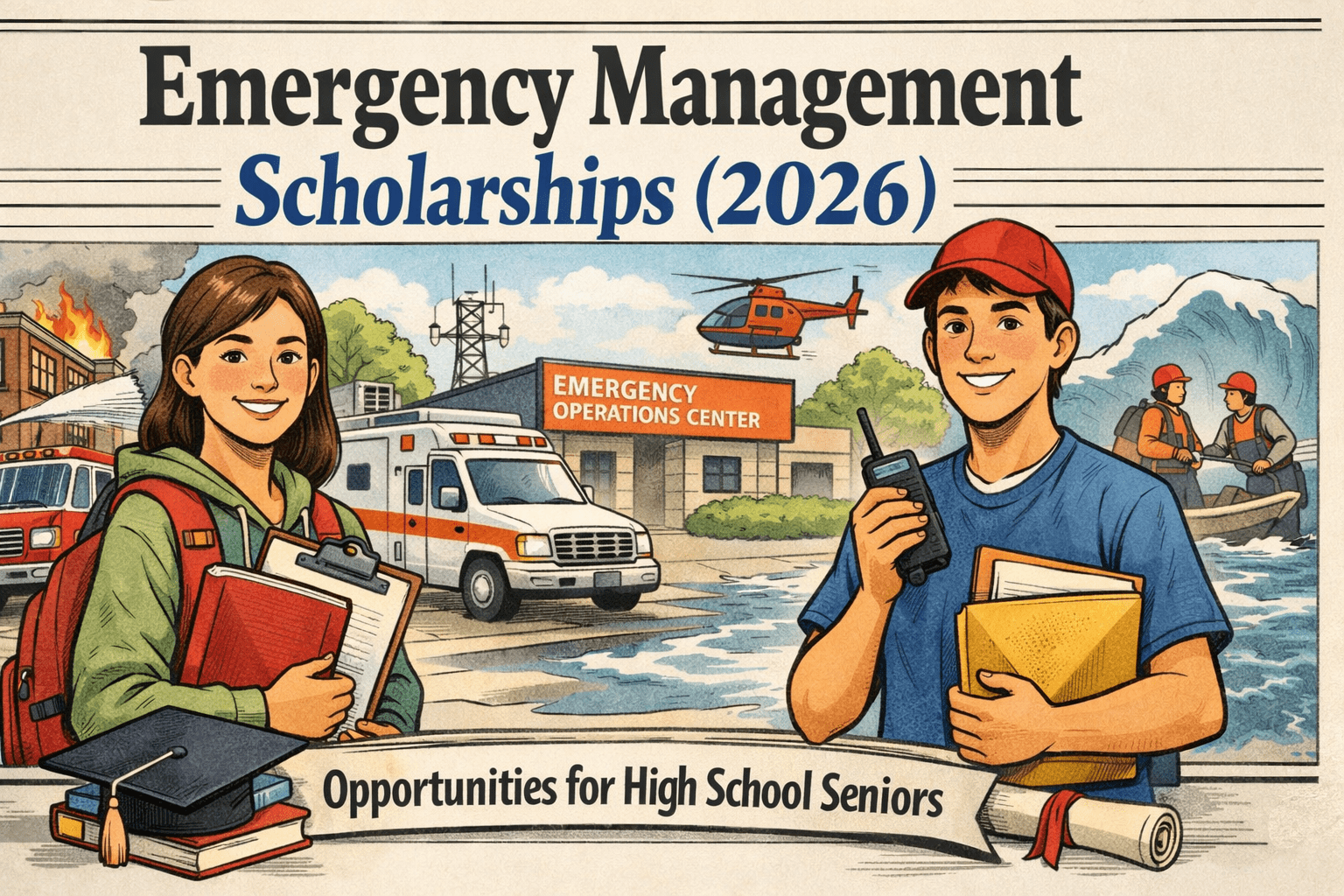
Emergency Management Scholarships (2026) — 20+ Verified Awards, Deadlines, and Links
Hand-checked scholarships for Emergency Management, Disaster Science, and Homeland Security majors.
February
ASFPM Foundation Future Leaders Scholarship (Floodplain Management)
💥 Why It Slaps: One of the largest EM-adjacent awards—two-year support + mentoring for future flood risk leaders.
💰 Amount: Up to $20,000 per year for 2 years (max $40,000).
⏰ Deadline: February 1, 2025.
🔗 Apply/info: https://www.asfpmfoundation.org/scholarships/future-leaders-scholarship
VEMA Addison E. Slayton Memorial Scholarship (Virginia)
💥 Why It Slaps: Supports VA students entering EM careers; part of a trio of VEMA student awards.
💰 Amount: Varies.
⏰ Deadline: February 15, 2025 (applications accepted Jan 1–Feb 15).
🔗 Apply/info: https://www.vemaweb.org/slaytonscholarship
VEMA Eugene W. Breeding Sr. Scholarship (Virginia)
💥 Why It Slaps: Honors a long-time EM leader; open to students with demonstrated EM interest.
💰 Amount: Varies.
⏰ Deadline: February 15, 2025.
🔗 Apply/info: https://www.vemaweb.org/scholarships
VEMA Cynthia Conlin Scholarship (Virginia)
💥 Why It Slaps: Recognizes academic promise + service orientation in EM.
💰 Amount: Varies.
⏰ Deadline: February 15, 2025.
🔗 Apply/info: vemaweb.org/Scholarships
NCEMA Tim Miller Scholarship (North Carolina)
💥 Why It Slaps: Straightforward student aid from North Carolina’s state EM association.
💰 Amount: $500.
⏰ Deadline: February 28, 2025.
🔗 Apply/info: https://www.ncema.net/scholarship/
March
NDSU Emergency Management & Disaster Science Department Scholarship
💥 Why It Slaps: Program-specific support for EM/Disaster Science majors (and HS minor option).
💰 Amount: Varies.
⏰ Deadline: March 1, 2025.
🔗 Apply/info: https://ndsu.academicworks.com/
UNT Michael A. Penaluna Endowed Scholarship in Emergency Administration & Planning (EADP)
💥 Why It Slaps: Named award within a top EM program; preference for IAEM-SC involvement.
💰 Amount: $1,000.
⏰ Deadline: March 15, 2025.
🔗 Apply/info: unt.academicworks.com/opportunities/13644
UNT Alyssa Carrier Emergency Management Scholarship (EADP)
💥 Why It Slaps: Need-aware aid dedicated to EADP majors.
💰 Amount: Varies.
⏰ Deadline: March 15, 2025.
🔗 Apply/info: unt.academicworks.com/opportunities/14688
UNT Tom Joslin Memorial Scholarship (EADP)
💥 Why It Slaps: Long-standing departmental award for committed EM students.
💰 Amount: Varies.
⏰ Deadline: March 15, 2025.
🔗 Apply/info: https://unt.academicworks.com/opportunities/13892
May
IAEM Scholarship Program (Undergrad/Grad — Worldwide)
💥 Why It Slaps: Flagship EM scholarship—multiple awards for students in EM or closely related fields.
💰 Amount: Varies (multiple awards each cycle).
⏰ Deadline: May 30, 2025 (application window opened Mar 31, 2025).
🔗 Apply/info: iaem.org/2025-scholarship-application
IAEM E. L. Quarantelli Scholarship (via IAEM application)
💥 Why It Slaps: Premier $10,000 award honoring a legend of disaster research.
💰 Amount: $10,000.
⏰ Deadline: May 30, 2025 (apply through IAEM Scholarship portal).
🔗 Apply/info: iaem.org/2025-scholarship-application
IAEM Robert C. Bohlmann, CEM®, Scholarship (via IAEM application)
💥 Why It Slaps: Recognizes leadership potential and service to the EM field.
💰 Amount: Varies.
⏰ Deadline: May 30, 2025 (apply through IAEM Scholarship portal).
🔗 Apply/info: iaem.org/2025-scholarship-application
August
WSEMA Student Scholarship (Washington)
💥 Why It Slaps: State association support with a clean, student-friendly app process.
💰 Amount: Varies.
⏰ Deadline: August 1 (postmark by Aug 1).
🔗 Apply/info: wsema.org/scholarship
KEMA Student Scholarship (Kansas)
💥 Why It Slaps: Annual $1,000 boost for students pursuing EM/public safety in Kansas.
💰 Amount: $1,000.
⏰ Deadline: August 15, 2025.
🔗 Apply/info: kema.org/scholarships
December
Mary Fran Myers Scholarship (Natural Hazards Workshop)
💥 Why It Slaps: Funds travel/registration for hazards practitioners & students—A-list networking and exposure.
💰 Amount: Covers part/all of travel, lodging, meals, and registration (varies).
⏰ Deadline: December 1, 2025 (for 2026 competition; 2025 call specifies eligibility details).
🔗 Apply/info: hazards.colorado.edu/awards/myers-scholarship
Rolling / TBA (Check back monthly; we verify links & dates)
Jacksonville State University (JSU) First Responders Scholarship (EM Undergrad & MS)
💥 Why It Slaps: 20% tuition scholarship for first responders enrolled in JSU EM programs.
💰 Amount: 20% tuition.
⏰ Deadline: Rolling (see program page).
🔗 Apply/info: jsu.edu/emergency-management/emergency-management-scholarships.html
JSU Royce B. Woodruff Scholarship (D.Sc. in EM)
💥 Why It Slaps: Research support for dissertation data collection in JSU’s D.Sc. program.
💰 Amount: Varies (research support).
⏰ Deadline: Rolling (department submission).
🔗 Apply/info: https://www.jsu.edu/emergency-management/emergency-management-scholarships.html
Millersville University — CDRE Student Scholarship (UGI-supported)
💥 Why It Slaps: Targeted for juniors/seniors in EM; preference for service and local ties.
💰 Amount: Varies.
⏰ Deadline: Varies (departmental cycle).
🔗 Apply/info: millersville.edu/cdre/student-opportunities
NJEPA Memorial Scholarships (New Jersey)
💥 Why It Slaps: State EM community funding for NJ students in EM-related study.
💰 Amount: Varies.
⏰ Deadline: TBA (recent cycle listed March 10 for 2024–25—watch for 2026 date).
🔗 Apply/info: njepa.org/scholarships
I-DIEM Lt. Gen. Julius Becton Jr. Scholarship
💥 Why It Slaps: Equity-focused award for minority students in EM/HS and related fields—up to $5K.
💰 Amount: Up to $5,000.
⏰ Deadline: TBA (last cycle closed Aug 23, 2024; monitor for 2025–26).
🔗 Apply/info: https://i-diem.org/julius-becton/
UNT EADP/EMDS — Additional Departmental Scholarships
💥 Why It Slaps: UNT EMDS consistently runs multiple endowed awards each March.
💰 Amount: Varies.
⏰ Deadline: Typically mid-March (check current postings).
🔗 Apply/info: https://hps.unt.edu/emds/give-emds.html
NDSU DREM — Scholarship Hub (additional internal awards)
💥 Why It Slaps: Central portal listing internal/EM-adjacent opportunities by cycle.
💰 Amount: Varies.
⏰ Deadline: Varies (most open Nov 1; see each listing).
🔗 Apply/info: ndsu.academicworks.com
IAEM Scholarship Program — General Info & FAQs
💥 Why It Slaps: Confirms eligibility (associate through doctoral; worldwide).
💰 Amount: Varies.
⏰ Deadline: See current cycle (May 30, 2025 for 2025 window).
🔗 Apply/info: iaem.org/Resources/Scholarships & iaem.org/scholarship-application-FAQs
Millersville BS in Emergency Management — Scholarship Note
💥 Why It Slaps: Program page flags NJEPA scholarship pathway + other departmental support.
💰 Amount: Varies.
⏰ Deadline: Varies (per award).
🔗 Apply/info: https://www.millersville.edu/cdre/student-opportunities/
UNT EMDS — Current Students (Scholarship hub landing)
💥 Why It Slaps: One stop for EMDS scholarship links + timelines.
💰 Amount: Varies.
⏰ Deadline: Varies (most due in March).
🔗 Apply/info: hps.unt.edu/emds/current-students.html
Emergency Management Scholarships as Strategic Human-Capital Investments in an Era of Escalating Disaster Losses
Emergency management (EM) has shifted from a niche public-sector specialty to a cross-sector “resilience” profession spanning government, healthcare, higher education, insurance, utilities, and global NGOs. This shift is driven by the compounding costs of disasters and the operational complexity of modern crises (multi-hazard events, cascading infrastructure failures, cyber-physical disruptions, and prolonged recovery). In the United States alone, NOAA’s tally of billion-dollar disasters from 1980–2024 reaches 403 events with total costs near $2.915 trillion (CPI-adjusted), and 2024 alone recorded 27 billion-dollar disasters costing $182.7 billion. Global catastrophe losses also remain high; Munich Re estimates $224 billion in overall natural-disaster losses and $108 billion insured losses for 2025.
Against this backdrop, scholarships function as targeted human-capital instruments: they shape who enters EM, what skills they acquire (planning, mitigation, logistics, public information, crisis informatics), and which subfields expand (hazmat, public health preparedness, business continuity, climate adaptation). Using publicly available labor-market data, catastrophe-loss baselines, federal preparedness-grant allocations, and scholarship program documentation, this paper maps the EM scholarship ecosystem and evaluates it as a capacity-building strategy. Key finding: while disaster losses are measured in tens to hundreds of billions annually, major field-specific scholarships often operate at the thousands-of-dollars per award scale—implying that the social return hinges on leverage (competency gains, practicum pipelines, and retention), not raw dollar volume.
1. Introduction: Why EM Scholarships Matter More Than Ever
Emergency management is inherently “systems work.” It coordinates preparedness, response, recovery, and mitigation across actors who do not share a single chain of command: local jurisdictions, voluntary organizations active in disaster (VOAD), critical-infrastructure owners, hospitals, schools, and state/federal agencies. The profession’s public value is difficult to price ex ante because its success is frequently invisible: disasters that do not escalate, supply chains that do not fail, and recoveries that stabilize communities before secondary harms (housing displacement, mental-health crises, business closures) cascade.
Yet the macroeconomic signal is unmistakable. NOAA’s billion-dollar disaster accounting indicates a persistent, high-frequency “new normal,” with cumulative damages in the trillions and annual totals that can rival the GDP of mid-size economies. Meanwhile, global reinsurance estimates underline that this is not only a U.S. phenomenon; catastrophe losses remain structurally elevated, reflecting both hazard and exposure growth.
In this environment, EM education becomes infrastructure. Scholarships are the financing mechanism most directly tied to who gets trained and which competencies are rewarded. They can (1) widen access to EM degrees, (2) steer talent toward under-served geographies (rural counties, small tribal nations), and (3) accelerate specialization where the workforce is thin (hazmat regulation, crisis informatics, disability inclusion, disaster finance, public-private continuity planning).
2. Data and Method
This analysis is desk-based and triangulates four “signal” domains:
-
Risk and loss environment: NOAA billion-dollar disasters; global catastrophe-loss reporting.
-
Labor-market baseline: BLS occupational profile for Emergency Management Directors (employment, pay, outlook).
-
Public investment context: federal preparedness grant opportunity allocations used to support EM capability building (e.g., EMPG, HSGP).
-
Scholarship ecosystem documentation: major EM-adjacent scholarship programs and representative university pipelines (IAEM; disaster recovery/business continuity; EM university scholarships; state EM talent pipelines).
Rather than claiming a complete census of all EM scholarships (which would require a maintained database and continuous link-verification), the goal is to build a defensible typology and quantify “orders of magnitude” in awards, demand pressures, and institutional incentives.
3. Demand-Side Pressures: Disasters, Budgets, and the EM Workforce
3.1 Disaster losses create continuous workforce demand
NOAA’s accounting reports 403 U.S. billion-dollar disasters from 1980–2024 totaling $2.915T, and 27 such events in 2024 costing $182.7B. The operational consequence is that many EM agencies no longer experience discrete “event cycles” (quiet → disaster → recovery → quiet). Instead, they operate in overlapping phases: recovery staff are writing project worksheets and managing public assistance while planners update hazard mitigation plans and responders run exercises for the next season.
Global catastrophe-loss estimates reinforce the broader macro-trend: Munich Re’s 2025 estimates place overall natural-disaster losses at $224B with $108B insured. Even when insured losses are a subset, the operational workload (damage assessment, housing, debris, public messaging, grant management) accrues to EM systems regardless of insurance penetration.
3.2 Labor-market baseline: pay and professionalization
BLS reports a median pay around $86,130 for Emergency Management Directors (May 2024) and estimates 13,200 jobs in the occupation, with projected growth of ~3% over the next decade. While these figures are modest compared to very large occupations, they understate total resilience workforce demand because EM work is distributed across roles not titled “Emergency Management Director” (continuity managers, risk analysts, public health preparedness coordinators, safety officers, crisis-communications specialists). In other words, the EM degree increasingly functions as a platform credential for multiple career tracks.
3.3 Public investment sets the “capability floor”
Preparedness grants are not scholarships, but they are a major funding stream that shapes training demand and can indirectly finance education (tuition support, specialized courses, conference participation, internships) depending on allowable costs at the state/local level.
-
Emergency Management Performance Grant (EMPG), FY2025: listed program funding $319,500,000.
-
Homeland Security Grant Program (HSGP), FY2025: listed program funding $1,008,000,000.
Together, these figures indicate that public funding for preparedness is measured in the hundreds of millions to billions, even before considering disaster response/assistance spending. Scholarships, by contrast, operate as precision tools: they are small relative to system budgets, but they can be decisive for individual entry into the field.
4. The EM Scholarship Ecosystem: A Typology With Quantitative Anchors
4.1 Professional-association scholarships: IAEM as the flagship model
The International Association of Emergency Managers (IAEM) scholarship program is one of the clearest field-specific pipelines. IAEM frames its scholarships as supporting students worldwide pursuing EM, disaster management, or closely related degrees, and it operates with an explicit endowment logic: a long-run goal of $1 million to sustain awards. IAEM’s FAQ adds a practical finance heuristic: each principal amount of about $30,000 can generate about a $2,000 scholarship (via interest/earnings), clarifying that this is an endowment-based capacity strategy rather than one-off fundraising.
Award scale and competitiveness. In the 2025–2026 cycle, IAEM reports over 130 applications and awards scholarships to eight students, plus a special one-time $10,000 doctoral research award (Dr. E.L. Quarantelli Scholarship) for the program’s 25th anniversary. The 2025 application page also documents the $10,000 Quarantelli special award and the application window (March 31–May 30, 2025).
Observed award amounts over time. IAEM’s past recipient chart shows awards commonly in the $1,000–$5,000 range, with some smaller part-time graduate awards historically as low as $750, and several examples of $4,000–$5,000 awards in recent years. This creates a data-driven “expectation band” for applicants: IAEM scholarships are meaningful but rarely full-tuition; their greatest value is often (a) credential signaling, (b) professional network access, and (c) conference/visibility benefits, which IAEM explicitly notes (e.g., conference registration as a recipient benefit).
Strategic interpretation. IAEM’s model is best understood as professionalization finance: it uses scholarship selection to reward applicants demonstrating field-relevant praxis (work in EM/response roles, applied research, community preparedness initiatives) and to reproduce a pipeline into leadership and specialized research. The Quarantelli doctoral award is especially illustrative: it ties scholarship dollars to scholarly output, explicitly positioning doctoral research as a field asset.
4.2 University-based scholarships: localized pipeline building (example cases)
Many EM degrees are housed in public administration, homeland security, public health, or interdisciplinary resilience programs. Scholarships here often mix need and merit criteria, and they are frequently tied to donor identities or departmental goals (e.g., supporting a student chapter, honoring an alumnus).
-
University of North Texas (Emergency Administration & Planning): the department lists multiple scholarships with specific award amounts, including examples like $1,000 awards (e.g., Tom Joslin Scholarship) alongside other named funds.
-
Florida International University (Emergency Preparedness & Disaster Management): FIU highlights scholarship and fellowship opportunities for students in its EPD program, illustrating how programs package financial support as part of a professional pipeline (often combined with assistantships, practicum placements, and agency partnerships).
Strategic interpretation. University scholarships are typically smaller per award than federal aid, but they can be “stackable” and targeted. Their greatest value is often in reducing friction—covering fees, books, a certification course, or travel to a conference/interview—costs that can otherwise exclude lower-income students from resume-building experiences.
4.3 Sector-adjacent scholarships: business continuity, disaster recovery, and risk
Emergency management increasingly overlaps with private-sector continuity and recovery, especially as critical infrastructure and supply chains face complex disruptions.
-
DRI Foundation Scholarship Award: offers $5,000 scholarships (including distinct opportunities such as for high school seniors and for undergraduates), explicitly linking disaster-recovery education to future professional practice.
Strategic interpretation. These scholarships can be attractive to EM majors because they map to private-sector roles that often pay more than entry-level public roles. They also widen the labor-market ROI story for EM degrees: EM is not only “public safety,” it is also operational resilience in corporate, healthcare, and nonprofit systems.
4.4 State and experiential “scholarship substitutes”: paid pipelines and career entry
Not all support is structured as tuition dollars. Some agencies create internship/apprenticeship pathways that function like scholarships by converting time into employable experience.
-
Florida Division of Emergency Management – Student Investment Program: structured student engagement that builds readiness and professional exposure, effectively converting agency capacity needs into a workforce pipeline.
Strategic interpretation. For EM students, paid placements and structured pipelines can outperform small scholarships in net value because they generate both income and career capital (references, incident experience, specialized training). Scholarship ecosystems that ignore experiential funding risk reproducing inequities: students who cannot afford unpaid practicums are systematically disadvantaged.
4.5 Training infrastructure: federal education as the “floor” of access
FEMA’s National Disaster & Emergency Management University (NDEMU) frames its mission as building a “future-ready” disaster workforce and notes ongoing transformation to meet evolving hazards and community expectations. While not a scholarship, this training infrastructure reduces marginal training costs for students and early-career professionals—effectively increasing the real value of scholarships by lowering complementary expenses.
5. Scholarship ROI: Why Small Awards Can Have Outsized Social Returns
A central puzzle emerges from the data: U.S. disaster losses can be $182.7B in a single year (2024), yet marquee EM scholarships may be $3,000–$5,000 per award, with special doctoral awards at $10,000. How can such small awards matter?
5.1 The leverage mechanism is competency, not coverage
Scholarships rarely “buy” an EM degree outright. They buy capabilities at the margin: a student stays enrolled; a working responder can afford a graduate certificate; a doctoral student finishes a dissertation tied to real hazard problems (e.g., ammonium nitrate risk factors, crisis informatics, equity-focused coastal resilience research). IAEM’s 2025–2026 recipient descriptions show scholarship selection explicitly rewarding applied research and program building (youth preparedness initiatives, STEM outreach, agency training roles).
5.2 Endowment logic: stable, compounding capacity
IAEM’s finance framing (e.g., ~$30,000 principal → ~$2,000 scholarship) is a rare explicit articulation of why scholarship programs pursue endowments rather than one-time gifts: stability makes the pipeline predictable, which encourages educational institutions to align curricula and advising around recurring opportunities. Predictability also matters for students making enrollment decisions.
5.3 A practical ROI thought experiment
If a $4,000 scholarship helps a student persist into a role where they improve hazard mitigation planning, reduce response time through better logistics, or avoid a compliance failure in grant management, the avoided cost can dwarf the award. Given NOAA’s annual loss scale, even extremely small fractional improvements in preparedness and recovery effectiveness can have large expected value.
6. Implications and Recommendations
6.1 For scholarship seekers (content that converts on an “Emergency Management Scholarships” page)
A data-driven strategy is to treat EM scholarships as a stack, not a single win:
-
Anchor with field-specific awards: IAEM is a primary target due to visibility, recurring cycles, and professional signaling.
-
Stack university departmental funds: small awards can cover the hidden costs of practicums and certifications (fees, travel, software).
-
Add sector-adjacent scholarships: disaster recovery/business continuity awards diversify career options and may align with higher-wage private roles.
-
Pursue experiential pipelines: agency student programs can substitute for cash scholarships through paid experience and hiring pathways.
6.2 For scholarship designers and donors: redesign for leverage
Scholarship programs maximize public value when they explicitly fund one or more of the following:
-
Practica tied to community outcomes (e.g., local preparedness program builds, inclusive evacuation planning updates).
-
Research-to-practice outputs (toolkits, exercises, hazard communication products).
-
Retention mechanisms (multi-year awards, cohort mentoring, conference travel support).
-
Equity in access (funding for unpaid practicum replacement wages; childcare support; rural/tribal travel).
The funding context suggests feasibility: preparedness grants show large public investment streams in capability building (EMPG $319.5M; HSGP $1.008B for FY2025), indicating policy space for scholarship-like workforce development, if allowable costs and partnerships are structured effectively.
Conclusion
Emergency management scholarships should be understood less as “college discounts” and more as resilience infrastructure: small, targeted investments that influence workforce composition, professional norms, and specialized skill development in a high-loss environment. NOAA’s data show disaster costs measured in trillions over recent decades and in the hundreds of billions annually, while leading EM scholarships often fall in the low-thousands per award, with occasional flagship awards at $10,000. The mismatch in scale is not a failure—it is an argument for leverage: scholarships must be tightly coupled to competencies, practicums, and career entry. As disasters become more frequent and complex, scholarship programs that align funding with applied capability (and remove barriers to experience-building) will produce the highest social return, strengthening the workforce that protects lives, property, and community continuity.
FAQs — Emergency Management Scholarships (Read This Before You Apply)
1) What majors count as “Emergency Management” for eligibility?
Programs titled Emergency Management (EM), Emergency Administration & Planning, Disaster Science/Studies, Homeland Security, Crisis/Continuity/Resilience, Floodplain Management, Public Safety, and sometimes Public Health or Environmental Hazards often qualify. Always match your degree plan to the award’s wording (e.g., “EM or closely related field”).
2) I’m in “Homeland Security” or “Disaster Science.” Do I still qualify?
Usually yes—most EM awards accept closely related programs. In your application, map your coursework (mitigation, preparedness, response, recovery, risk analysis) to the scholarship’s mission.
3) Are online or part-time students eligible?
Frequently, yes. Many EM practitioners study while working shifts. Check for phrases like “enrolled in an accredited program” rather than “full-time only.” If full-time is required, some committees still allow 9+ credits—read carefully.
4) Do associate degrees and certificates count?
Some awards are bachelor’s/grad-only, but EM-community and state-association scholarships often include A.A.S./A.S. paths and professional certificates (ICS/NIMS, continuity, HAZMAT). When in doubt, email the contact listed on the application.
5) What GPA do I need?
Common floors are 2.5–3.0. EM associations may prioritize service and leadership over a razor-high GPA; strong resumes with drills, CERT/Red Cross, or EOC work can offset a merely “good” GPA.
6) I’m a first responder (EMT/Fire/LE). Are there targeted awards?
Yes. Some programs offer tuition discounts or dedicated funds for active first responders and dispatchers. Others give preference to applicants with verifiable field experience (incident reports, ICS roles, exercise participation).
7) Can international or DACA/undocumented students apply?
It depends on the sponsor. University-based awards may accept international students; some community/association funds require U.S. residency/citizenship. If status is not specified, ask—several EM nonprofits are mission-driven and flexible.
8) Can I stack scholarships with Pell Grants, GI Bill®, or employer tuition aid?
Often yes. List every source in your application and financial aid portal. Some awards reduce the amount to avoid over-awarding; others stack fully. Employer tuition and union/association stipends can usually be combined.
9) What actually wins these scholarships?
Evidence that you’re already doing EM: incident exercises, ICS/NIMS course transcripts, CERT or Red Cross deployments, EOC shifts, hazard-mitigation or continuity projects, floodplain or damage-assessment volunteering, after-action writeups, and letters from EM supervisors.
10) Do FEMA Independent Study (IS) courses help?
Absolutely. Upload the IS-100/200/700/800 certificates and any advanced coursework. Tie each course to a concrete moment (e.g., “how IS-700 guided our MACS comms during the tabletop”).
11) Does working toward CEM®/AEM® or CBCP/continuity credentials matter?
Yes—mention progress toward professional certifications (CEM®/AEM®, business continuity, floodplain manager, HAZMAT). It signals commitment and career trajectory.
12) What’s the typical application calendar for EM awards?
Many open December–January and close January–March (university & association cycles), with notable national awards due in late spring and several state association awards in mid-to-late summer. A few travel/participation awards post late fall for the next year’s hazards conferences. (We sort the list by month for you.)
13) Can grad students get research or travel funding?
Yes—look for awards that cover fieldwork, conference travel (e.g., hazards workshops), or data collection. Frame your research around community benefit (mitigation outcomes, inclusive planning, risk communication for vulnerable populations).
14) Any essay tips specific to EM?
Use the whole EM cycle (mitigation-preparedness-response-recovery) to structure your narrative. Show measurable impact (exercise metrics, shelter throughput, damage-assessment turnaround). Translate acronyms for lay reviewers, but keep the professional tone.
15) What should my recommenders emphasize?
Operational reliability (shift work, call-outs), teamwork under stress, ICS role performance, situational awareness, after-action learning, and ethics/community trust. Provide your recommenders a bullet list + resume two weeks ahead.
16) How can I prove community involvement without paid EM experience?
Document CERT, Red Cross sheltering, VOAD membership, Skywarn spotter reports, campus safety committees, CERT train-the-trainer hours, or continuity tabletop facilitation. Logs, certificates, and letters matter.
17) I study Business Continuity/Resilience—do EM scholarships still fit?
Often yes, especially when the prompt mentions resilience, continuity of operations (COOP), or risk. Show how your continuity work supports emergency operations and whole-community recovery.
18) Are there hidden eligibility filters I might miss?
Watch for state residency, program accreditation, minimum credits in-major, service commitments, or conference attendance requirements. These sit in the fine print; missing one can disqualify you.
19) Can I reuse the same essay for multiple EM scholarships?
Reuse the core story, but retarget: if the sponsor focuses on mitigation or flood risk, emphasize those pieces; if it’s a state association, localize your hazards (e.g., wildfire interface, coastal surge, rail/HAZMAT corridors).
20) How do I vet if a scholarship page is legit?
Prefer .edu / .gov / established .org domains. Avoid aggregator “apply” buttons that don’t belong to the sponsor. The page should list a real program contact, eligibility, amount, and a first-party application or portal. (On our list, we only link official pages and note “✅ Link verified [date]”.)