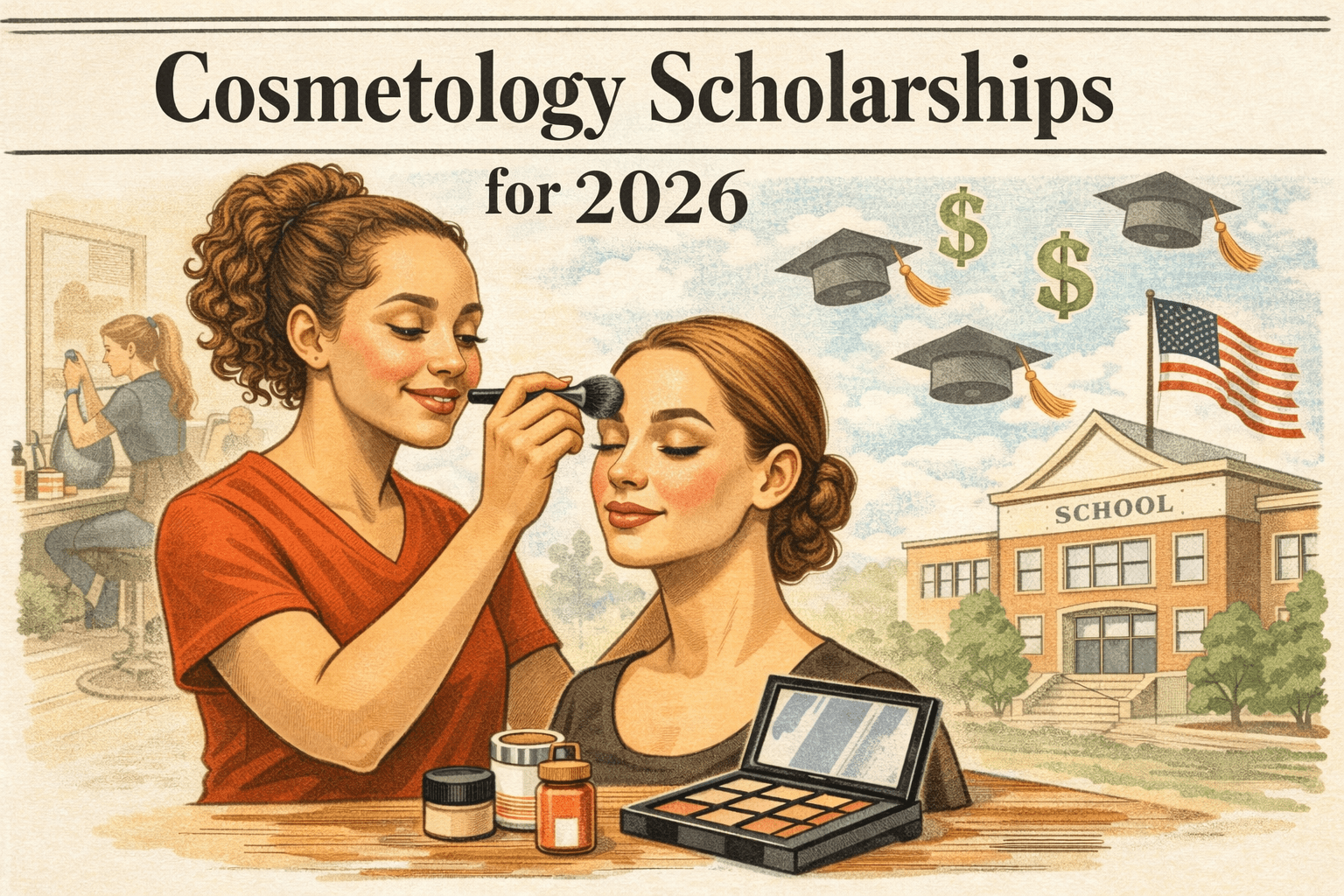
30 Best Cosmetology Scholarships for 2026 (Verified Links & Deadlines)
Hand-curated list of 30 cosmetology scholarships for 2026. Includes BCL, PBA, Joe Francis, Great Clips, and more.
February
Oregon Barber & Hairdresser Grant (Oregon Student Aid)
💥 Why It Slaps: A true, state-backed grant for Oregonians in licensed barbering, hair design, cosmetology, or manicure programs. No essay contest fluff—funds are awarded by participating Oregon schools based on need, and the money goes straight toward your costs. If you’re training in Oregon and finances are tight, this is one of the most reliable ways to reduce tuition out-of-pocket.
💰 Amount: Varies by year and funding.
⏰ Deadline: Information must be received by your school no later than February 1 of the award year.
🔗 Apply/info: https://oregonstudentaid.gov/grants/oregon-barber-and-hairdresser-grant-program/
March
BeautySchoolsDirectory “Beauty & Wellness Professionals” Scholarship
💥 Why It Slaps: Runs twice a year and is open to current or prospective students in cosmetology and related beauty programs, including part-time students and DACA recipients. Funds are sent to your school and can cover tuition, books, or supplies—super flexible for real costs students face. Clear, simple application hosted on the provider’s own site.
💰 Amount: $2,500 (awarded twice per year).
⏰ Deadline: March 2, 2026 (next cycle typically in early September—check page).
🔗 Apply/info: https://www.beautyschoolsdirectory.com/cosmetology-school-scholarships
April
VFW × Sport Clips “Help A Hero” Scholarship (post-secondary, incl. trades)
💥 Why It Slaps: If you’re a service member or veteran training for a civilian career (including licensed trades/certificate programs), this program pays up to $5,000 per semester toward tuition and fees. Application windows are predictable and the VFW administers the funds—one of the largest veteran-focused private scholarship initiatives.
💰 Amount: Up to $5,000 per semester.
⏰ Deadline: April 30 for fall-semester funding (window opens Jan 1); Nov 15 for spring-semester funding (window opens Aug 1).
🔗 Apply/info: https://vfwnc.com/uploads/HelpAHeroScholarshipBrochure.pdf
June
Joe Francis Haircare Scholarship
💥 Why It Slaps: A long-running, industry-loved scholarship dedicated only to cosmetology/barber students (not esthetics/nails). Awards are multiple and no award is under $3,000, with a clear online portal and a known January–June application season. Money is paid directly to your school—clean and legit.
💰 Amount: Varies, but never under $3,000 per recipient.
⏰ Deadline: June 1 annually (application window typically Jan 1 – Jun 1).
🔗 Apply/info: https://www.joefrancis.com/apply/
October
Rosy Salon Software — Rosy Rewards Scholarship (PBA-managed)
💥 Why It Slaps: A simple, portfolio-friendly scholarship for currently enrolled cosmetology, barber, or esthetics students in the U.S. or Canada. Emphasizes inclusion—half of awards go to traditionally underrepresented students. Funds go to your school, and the deadline is easy to plan for each year.
💰 Amount: Two awards of $250.
⏰ Deadline: October 1 (annual).
🔗 Apply/info: https://rosysalonsoftware.com/rosy-scholarship-program/
Beauty Changes Lives — “The Power of ONE” Candy Shaw Cosmetology Education Scholarship
💥 Why It Slaps: Premium, brand-backed scholarship aimed squarely at aspiring hairstylists—great for students who can show passion and purpose. BCL is the most active clearinghouse for beauty scholarships in North America, and Candy Shaw’s fund is a marquee tuition award.
💰 Amount: Up to $5,000.
⏰ Deadline: Fall cycle closes Oct 31 (see page for 2026 cycle).
🔗 Apply/info: https://beautychangeslives.org/offer/the-power-of-one-candy-shaw-cosmetology-education-scholarship/
Beauty Changes Lives — Jerry Alexander Gorman Foundation “The Passion to Succeed” (Cosmetology)
💥 Why It Slaps: A generous cosmetology-only award honoring the late Jerry Alexander Gorman. If you’re driven and can tell your story, this is a high-impact, tuition-first scholarship with national visibility—great for your portfolio and your budget.
💰 Amount: Up to $6,500.
⏰ Deadline: Oct 31 (fall cycle; see page for future cycles).
🔗 Apply/info: https://beautychangeslives.org/jag-foundation-esti-nails/
Beauty Changes Lives — European Wax Center “Experts in Wax” (Cosmetology/Esthetics)
💥 Why It Slaps: National brand support plus a focus on hair removal and skin—perfect if you’re leaning toward waxing and beauty services inside or alongside hair. A resume-boosting award from a household-name employer in the sector.
💰 Amount: Up to $2,500.
⏰ Deadline: Oct 31 (fall cycle).
🔗 Apply/info: https://beautychangeslives.org/europeanwaxcenter-experts-in-wax/
Beauty Changes Lives — Sugarlash PRO Lash Mastery Scholarship
💥 Why It Slaps: Ideal if you’re expanding into lash artistry while in cosmetology school. Includes tuition support and can feature partner-school bonuses—smart way to cross-skill and future-proof your service menu.
💰 Amount: $1,500 (plus potential $1,000 partner school bonus).
⏰ Deadline: Oct 31 (fall cycle).
🔗 Apply/info: https://beautychangeslives.org/offer/sugarlash-pro-cosmetology-esthetics-student-scholarship-partner-school-bonus/
Beauty Changes Lives — Dermalogica BIPOC Cosmetology Student Scholarship
💥 Why It Slaps: Purpose-built to reduce barriers for BIPOC students pursuing cosmetology. Backed by Dermalogica’s education ecosystem and BCL’s national platform, it’s both funding and a brand-networking opportunity.
💰 Amount: Up to $5,000.
⏰ Deadline: Oct 31 (fall cycle).
🔗 Apply/info: https://beautychangeslives.org/scholarships-opportunities/
Beauty Changes Lives — Kristin Ess Hair “Female Hairstylist” Cosmetology Scholarship
💥 Why It Slaps: Designed to elevate emerging female hairstylists, this award pairs money with brand credibility. A great fit if your work and goals align with editorial/IG-forward hairstyling.
💰 Amount: Up to $5,000.
⏰ Deadline: Oct 31 (fall cycle).
🔗 Apply/info: https://beautychangeslives.org/offer/kristin-ess-hair-female-hairstylist-cosmetology-scholarship/
Beauty Changes Lives — L’Oréal Professionnel “Jeff DeShazer Memorial” Cosmetology Student Scholarship
💥 Why It Slaps: Flagship award from L’Oréal Professionnel honoring education and artistry—exactly the kind of brand alignment employers notice. Strong fit for students who want to level up with advanced techniques and classic French-inspired foundations.
💰 Amount: Up to $5,000.
⏰ Deadline: Oct 31 (fall cycle).
🔗 Apply/info: https://beautychangeslives.org/offer/loreal-pro-jeff-shafer-memorial-cosmetology-student/
Beauty Changes Lives — Redken “Learn Better, Earn Better, Live Best” (Cosmetology Students)
💥 Why It Slaps: Redken’s education-driven philosophy comes with serious resources; winning here boosts your training and your salon marketability. Great add to a beginner portfolio with a color-centric vibe.
💰 Amount: Up to $5,000.
⏰ Deadline: Oct 31 (fall cycle).
🔗 Apply/info: https://beautychangeslives.org/offer/redken-cosmetology-student/
Beauty Changes Lives — Matrix “Think. Believe. Dream. Dare.” (Cosmetology Students)
💥 Why It Slaps: If your aesthetic leans bold, Matrix’s platform and creative community can help you stand out. Strong for students building a cutting/color portfolio with social-first ambitions.
💰 Amount: Up to $5,000.
⏰ Deadline: Oct 31 (fall cycle).
🔗 Apply/info: https://beautychangeslives.org/scholarships/
Beauty Changes Lives — PCA SKIN “Diversity in Esthetics” (Beauty-adjacent)
💥 Why It Slaps: For cosmetology students cross-training into skin, PCA’s award can underwrite key esthetics hours and pro product exposure. A sensible pathway if you want dual licensing.
💰 Amount: Up to $5,000.
⏰ Deadline: Oct 31 (fall cycle).
🔗 Apply/info: https://beautychangeslives.org/pca-skin/
(That’s 12 BCL fall-cycle awards listed individually.)
November
Milady RISE Scholarship (PBA-admin)
💥 Why It Slaps: Ten $500 awards every cycle, split between enrolled students and licensed pros, and it’s tied to the Milady RISE certification (client well-being & safety). The credential itself looks great to schools and salons, and the application is fast once you’re certified.
💰 Amount: $500 (10 awards per cycle).
⏰ Deadline: Nov 15, 2025 (fall cycle; future 2026 dates post on the page when live).
🔗 Apply/info: https://www.miladytraining.com/pages/milady-rise-scholarship
“All-Year / Rolling / School-Specific” (check pages for 2026 windows)
Great Clips® — Great Scholarship Program
💥 Why It Slaps: One of the largest salon brands in North America funds over $100,000 in cosmetology/barber student scholarships annually. Awards are typically up to $5,000, with school partners across the U.S. and Canada—fantastic odds if your school participates.
💰 Amount: Up to $5,000 (>$100k total each year).
⏰ Deadline: Varies by partner/school; cycles run throughout the year.
🔗 Apply/info: https://jobs.greatclips.com/schools
PBA — Lifetime Member Scholarship (for PBA members/families)
💥 Why It Slaps: Administered by the Professional Beauty Association with funds from the Joseph L. Weir Trust—credible, industry-rooted support for education. Especially relevant if you or your family has an established PBA connection.
💰 Amount: Varies.
⏰ Deadline: Varies (see PBA scholarships page).
🔗 Apply/info: https://www.probeauty.org/wp-content/uploads/2023/08/PBA-Lifetime-Member-Scholarship-Terms-2024.pdf
Buy-Rite Beauty Annual Cosmetology Scholarship
💥 Why It Slaps: Straightforward application from a well-known equipment supplier; funds can help with tuition or gear when your kit is getting pricey. They’ve maintained this award for years—dependable.
💰 Amount: $1,000.
⏰ Deadline: Typically offered annually (see page for current cycle).
🔗 Apply/info: https://www.buyritebeauty.com/annual-cosmetology-scholarship/
Keller International Cosmetology Scholarship
💥 Why It Slaps: Another equipment-brand award aimed at easing tuition for one outstanding cosmetology or barbering student each year. Clear criteria, and brand visibility with schools/salons that use Keller.
💰 Amount: $1,000 (one recipient annually).
⏰ Deadline: Annual; check current cycle dates on the page.
🔗 Apply/info: https://keller4salon.com/pages/scholarship
Aveda Institutes — Scholarships (school network)
💥 Why It Slaps: Many Aveda campuses run recurring scholarships and partner with BCL on national awards. If you’re Aveda-bound, these can stack with federal aid and often include creative submissions that showcase your aesthetic.
💰 Amount: Varies by campus/program.
⏰ Deadline: Rolling/varies by campus; see central page to find your location.
🔗 Apply/info: https://avedaarts.edu/financial-aid/scholarships/
Paul Mitchell Schools — Scholarships (school network)
💥 Why It Slaps: The network is massive, and many campuses post recurring entry scholarships tied to admissions events, creative submissions, or partner funds. Good odds if you apply early with a strong portfolio.
💰 Amount: Varies (often multiple awards per campus).
⏰ Deadline: Rolling/varies by campus.
🔗 Apply/info: https://paulmitchell.edu/nyc/financial-aid/scholarships
Empire Beauty School — Scholarships (school network)
💥 Why It Slaps: Empire regularly offers campus-based awards and participates in brand scholarships; easy to pair with FAFSA aid. Great if you’re already considering an Empire campus.
💰 Amount: Varies by campus/term.
⏰ Deadline: Rolling/varies by campus.
🔗 Apply/info: https://www.empire.edu/financial-aid/scholarships
Ogle School — Scholarships (school network)
💥 Why It Slaps: Texas-based network with multiple scholarship options (merit, need, and partner-backed). Strong pick if you’re in TX/DFW/Austin/Houston metros.
💰 Amount: Varies by program/cycle.
⏰ Deadline: Rolling/varies.
🔗 Apply/info: https://www.ogleschool.edu/financial-aid/scholarship/
MUD — Makeup Designory Scholarship (beauty-adjacent)
💥 Why It Slaps: If your cosmetology path includes makeup, MUD’s school-hosted scholarship can offset tuition and plugs you into a pro-makeup network. Great way to deepen skills outside the standard hair curriculum.
💰 Amount: Varies by campus/cycle.
⏰ Deadline: Campus-specific; see current application cycle.
🔗 Apply/info: https://beautychangeslives.org/makeup/
Pivot Point × Beauty Changes Lives — Leo Passage “Dare to Lead” (Cosmetology/Barber Students)
💥 Why It Slaps: Honors Pivot Point’s founder and emphasizes leadership + craft—stellar for students who see themselves as future educators or salon leaders. Application runs through BCL’s Submittable, which is streamlined.
💰 Amount: Varies (student award available; educator award also exists).
⏰ Deadline: Spring/fall cycles (check current Submittable listing).
🔗 Apply/info: https://beautychangeslives.org/scholarships-opportunities/
Cécred × BeyGOOD Fund — Education & Career-Building Scholarships (beauty-adjacent)
💥 Why It Slaps: Beyoncé’s philanthropic fund supporting haircare, education, and entrepreneurship—schools announce campus-specific awards using these funds. If your institute participates, this can be a major boost with global-brand shine.
💰 Amount: Varies by institution/partner initiative.
⏰ Deadline: Set by participating schools (check your campus).
🔗 Apply/info: https://www.beygood.org/cecred/
Esthetics/Nails (beauty-adjacent awards many cosmetology students cross-train into)
Beauty Changes Lives — JAG Foundation “Esthetics & Nail Technician” Scholarship
💥 Why It Slaps: For cosmetology students adding a second license, this helps cover esthetics or nail training and signals commitment to a broader service menu. Dual-licensing = more ways to earn as a new grad.
💰 Amount: Up to $3,500.
⏰ Deadline: Oct 31 (fall cycle).
🔗 Apply/info: https://beautychangeslives.org/scholarships/
Beauty Changes Lives — European Wax Center “Experts in Wax” (Esthetics Track)
💥 Why It Slaps: If your cosmetology curriculum includes waxing/skin, this is a direct brand pipeline into services that are booming in salons and studios. Good way to offset the esthetics portion of your costs.
💰 Amount: Up to $2,500.
⏰ Deadline: Oct 31 (fall cycle).
🔗 Apply/info: https://beautychangeslives.org/scholarships/
Dermalogica — Professional Education Scholarships (Esthetics; via Dermalogica)
💥 Why It Slaps: Structured education awards tied to Dermalogica’s Expert Program. Even if your primary license is cosmetology, this helps you level up in skin services that complement your chair.
💰 Amount: Education package (6-month Expert Program; $1,400+ value).
⏰ Deadline: Listed on Dermalogica’s page; cycles open periodically.
🔗 Apply/info: https://pro.dermalogica.com
Massage-Therapy (beauty-adjacent; for students pursuing both licenses)
Massage Envy — National Scholarship Sweepstakes (for Massage Therapists)
💥 Why It Slaps: One of the largest national tuition-support programs for massage students—multiple $2,500 winners each month during active cycles, with funds usable at the massage school of your choice. Great if your campus offers combined beauty/wellness pathways.
💰 Amount: $2,500 (many winners; recurring drawings across the program period).
⏰ Deadline: Recurring monthly drawings during program windows (see page/newsroom).
🔗 Apply/info: https://massageenvyscholarshipsweepstakes.com/
Cosmetology Scholarships in the United States: Financing Licensure-Based Career Pathways in a Regulated Service Economy
Abstract
Cosmetology education sits at an unusual intersection of postsecondary finance and occupational licensing: programs are typically short, nondegree, and workforce-oriented, yet they often carry tuition levels comparable to (or higher than) many community-college certificates. At the same time, earnings in early career can be volatile, frequently tip-dependent, and often partially realized through self-employment. This combination—high upfront costs, constrained liquidity, and uncertain short-run earnings—creates a financing problem that scholarships are uniquely positioned to solve. Using recent federal labor-market data, policy documents on postsecondary program accountability, and sector research on beauty-school pricing and debt, this paper analyzes (1) the structural drivers of cosmetology training costs, (2) how scholarships operate as both financial transfers and quality signals, and (3) evidence-based design principles to improve completion, reduce debt-to-earnings risk, and expand equitable access to the beauty workforce.
1. Introduction
Cosmetology is often described as a “faster” route into a career, but the economics are more complex than the common narrative suggests. Entry into licensed beauty work typically requires completing a state-approved training program and passing an exam. In practice, this means students face a front-loaded bundle of expenses (tuition, fees, kits/supplies, and licensing costs) before they can legally earn as a professional. Unlike many degree programs where costs are spread over semesters and supported by campus-based aid infrastructure, cosmetology programs frequently operate in clock-hour formats, include extensive in-person requirements, and enroll large shares of working adults—students who are especially sensitive to cash-flow shocks, childcare needs, transportation constraints, and the opportunity cost of time.
Scholarships matter here not simply as “free money,” but as targeted risk reduction. In a field where many graduates will be self-employed or will lease chairs/booths early in their careers, limiting educational debt and smoothing entry costs can materially change the feasibility of completing training and persisting through the fragile first 6–18 months of building clientele.
2. Data and methods
This paper synthesizes five evidence streams:
-
Labor-market structure and earnings: U.S. Bureau of Labor Statistics (BLS) Occupational Outlook Handbook (OOH) and related wage/employment tables for barbers, hairstylists, and cosmetologists; plus related specialty tracks (skincare, nails).
-
Training cost, debt, and program structure: A recent New America sector report on cosmetology education and consumer outcomes; and industry-side reporting on tuition/debt and completion/placement.
-
Occupational licensing and required hours: Cross-state comparisons emphasizing how mandated instructional hours shape tuition and time-to-credential.
-
Policy accountability context: Federal rules and commentary on Financial Value Transparency/Gainful Employment (FVT/GE) and how debt-to-earnings metrics interact with certificate programs including cosmetology.
-
Scholarship supply and design patterns: Documentation from major beauty-industry scholarship platforms and philanthropic funds supporting cosmetology students.
3. Labor-market demand and earnings: a “high-churn, high-entrepreneurship” occupation
BLS frames cosmetology (within “hairdressers, hairstylists, and cosmetologists”) as a large occupation with steady replacement needs. In 2024, the category held about 575,200 jobs, with total “barbers, hairstylists, and cosmetologists” at 651,200 jobs, and projected growth over 2024–2034 of about 5% overall (with tens of thousands of net new positions plus substantial annual openings).
Earnings are modest at the median but have wide dispersion. For hairdressers/hairstylists/cosmetologists, BLS reports a median hourly wage of $16.95 (May 2024); importantly, BLS notes tips are included in the wage estimates. The pay distribution is broad (with a low 10th percentile and a much higher 90th percentile), reflecting differences in geography, clientele, specialty services, and—critically—business model (employee vs. chair/booth rental vs. independent operator).
The structure of work also matters for scholarship design. BLS estimates that 48% of hairdressers/hairstylists/cosmetologists are self-employed, a strikingly high share compared with many occupations. This implies that “earnings” are often business revenue net of expenses, not simply wages, and that early-career liquidity constraints can be severe (tools, product inventory, continuing education, marketing, rent, insurance). Scholarships that reduce educational debt can free post-graduation cash flow for business formation and stabilization.
Finally, cosmetology is not a single earnings track. BLS data on adjacent specialties illustrate skill-stacking pathways: skincare specialists show a higher median hourly wage ($19.98, May 2024) than hair services, and nails remain closer to the hair-services median ($16.66). This wage gradient supports scholarship strategies that fund specialty add-ons (advanced skincare, lash, corrective color, textured hair specialization, salon management) as productivity upgrades rather than purely tuition relief.
4. Training and licensing: seat-time requirements as a cost driver
A defining feature of cosmetology education is that it is licensure-gated. BLS emphasizes that states require licensure and that candidates typically must graduate from a state-approved program and pass an exam.
The “hours requirement” functions like a policy-driven minimum duration of schooling. Cross-state licensing data highlight large variation in required cosmetology training hours—commonly clustered around 1,500 hours, but ranging widely by jurisdiction (and sometimes exceeding 2,000 hours historically). This matters because, in many beauty schools, tuition is closely coupled to time: more required hours generally mean more weeks of attendance, higher total tuition/fees, and higher opportunity costs (foregone wages and family time).
From a doctoral-level policy lens, mandated seat-time can be analyzed as a quantity regulation (hours) intended to ensure quality and public safety, but which also restricts supply and raises entry costs. Sector research has questioned whether additional hours beyond basic competency thresholds improve consumer outcomes, while clearly increasing tuition exposure and delaying labor-market entry.
This has direct implications for scholarships: if public policy structurally inflates training time, scholarships become a compensatory mechanism—especially for low-income students—rather than a purely merit-based reward.
5. Cost, debt, and the “total cost of entry”
Recent sector analyses converge on a central figure: cosmetology programs often cost around the mid–five figures in tuition alone. New America summarizes cosmetology school tuition as averaging around $15,000 and notes typical borrower debt in the several-thousand-dollar range (with variation by program and borrower). Industry-side reporting similarly places average tuition around $15,953 and average student debt around $8,936 (citing program-level and Scorecard-based summaries).
But tuition understates the financing problem. A realistic cosmetology “cost of entry” also includes:
-
Kit/supplies (often required up front or in the first term)
-
Testing and licensure fees
-
Transportation and childcare costs during intensive in-person training
-
Opportunity cost of restricted work hours while completing required clock hours
Because many cosmetology students are working adults, the binding constraint is often not only “can I pay tuition,” but “can I survive the training period without missing hours.” This is why scholarships targeted to non-tuition costs (kits, exam fees, transit, childcare stipends) can have outsized effects on persistence and completion—an insight well established in the broader completion literature, and particularly relevant for clock-hour programs.
Table 1. Key indicators shaping cosmetology scholarship need (U.S.)
| Indicator | Recent benchmark | Why it matters for scholarships |
|---|---|---|
| Jobs (hairdressers/hairstylists/cosmetologists) | 575,200 (2024) | Large, stable labor market with ongoing openings |
| Self-employment share | 48% | Cash-flow volatility; debt burdens hit harder |
| Median hourly pay (hair services) | $16.95 (May 2024) | Debt-to-earnings sensitivity in early career |
| Typical tuition level (sector reports) | ≈ $15k | High upfront cost for nondegree program |
| Common licensure hours | often ~1,500 hours | Seat-time drives time + cost |
(See cited sources for underlying figures.)
6. Scholarship ecosystem: who pays, and what they incentivize
Cosmetology scholarships come from a different funding ecology than traditional four-year academic scholarships. The most common sources include: (a) industry nonprofits and foundations, (b) brand-sponsored philanthropy, (c) school-based aid, (d) local community foundations and professional associations, and (e) workforce and veterans’ training funds.
6.1 Industry nonprofit platforms
Beauty Changes Lives (BCL) presents one of the most visible centralized scholarship marketplaces in the beauty sector, reporting over $500,000 in scholarships awarded each year and substantial cumulative fundraising since its founding. In spring 2025 alone, BCL reported awarding over $90,000 to 21 students—illustrating both the scale and the competitive nature of awards.
From a research standpoint, these platforms do more than distribute funds: they standardize application processes, increase visibility of opportunities, and often bundle scholarships with mentorship—an important “non-cash” input linked to completion and early-career earnings.
6.2 Brand philanthropy and celebrity-linked funds
Brand-backed initiatives increasingly treat cosmetology scholarships as part of “workforce investment + community impact.” For example, the Cécred x BeyGOOD Fund describes a $500,000 commitment that includes scholarships for cosmetology students (alongside salon business support). This matters because brand programs may prioritize specific geographies, partner schools, or equity criteria—features that can expand access for some students while leaving others outside targeted regions.
6.3 Workforce and veterans’ training supports (often overlooked)
While not “scholarships” in the philanthropic sense, workforce programs can function like scholarships by covering training costs. CareerOneStop highlights funding routes such as WIOA training funds. Separately, the VA explicitly notes that GI Bill benefits can be used for non-college degree programs, including barber or cosmetology school, subject to program approval and benefit rules.
For students, this is a practical implication: the cosmetology “aid stack” may involve scholarships + workforce vouchers + veterans benefits, reducing reliance on high-cost borrowing.
7. Equity and access: scholarships as barrier-reduction, not just merit
Cosmetology is a major entry point into postsecondary training for women and for many students navigating work, family responsibilities, and sometimes immigration or language barriers. Industry reporting emphasizes that many beauty-school students are women and disproportionately women of color. Independent sector research similarly frames cosmetology as a common pathway for students seeking faster labor-market entry but facing high program prices.
A key doctoral-level insight is that “merit-only” scholarship logic can be misaligned with cosmetology’s risk structure. The most common failure mode in clock-hour programs is not low academic ability; it is attendance disruption caused by life shocks and liquidity constraints. Therefore, scholarship designs that act like “persistence insurance” may generate greater returns than single, upfront awards.
Examples of high-impact barrier-reduction scholarship components include:
-
Tool/kit grants (reducing upfront lump-sum spending)
-
Testing/licensure fee vouchers (ensuring students can convert training into a credential)
-
Emergency micro-grants (preventing attendance gaps that jeopardize hour completion)
-
Childcare/transport stipends tied to attendance milestones
These mechanisms align with the real bottlenecks of licensure-based education: required hours, continuous participation, and timely exam passage.
8. Accountability and consumer information: why policy affects scholarships
Cosmetology programs appear frequently in debates about postsecondary program value because they are expensive relative to credential level and operate in a labor market where income can be undermeasured. Federal accountability rules—commonly discussed under “gainful employment”—evaluate programs using debt and earnings metrics and are designed to reduce federal aid flowing to programs that consistently produce poor financial outcomes. Major reporting on the rule notes that certificate programs in low-paying fields (including cosmetology) can be especially exposed to debt-to-earnings tests, and that measurement issues (like underreported tips) are a disputed concern.
Why does this matter for a cosmetology scholarships page?
-
Scholarships can improve measured outcomes by reducing borrowing (lower debt) and supporting completion (credential attainment).
-
Transparency pressures can shift school behavior, pushing schools to demonstrate placement, licensure success, and responsible pricing.
-
Students need “consumer information literacy”—how to compare programs by completion, placement, licensure pass rates, net price, and borrowing.
In short, scholarships are part of an emerging accountability ecosystem: they are not just aid; they can be levers for program quality and student protection.
9. Evidence-based scholarship design principles for cosmetology
Drawing from the cost structure, licensing constraints, and labor-market volatility, effective cosmetology scholarships tend to share five design traits:
Principle 1: Target the largest friction points, not only tuition
Tuition-only awards help, but cosmetology students often fail at predictable choke points: kits, transportation, missed hours, and exam fees. Designing awards that explicitly cover these costs can be more completion-effective per dollar.
Principle 2: Use milestone-based disbursement to support persistence
Rather than a single lump sum, split awards across milestones (enrollment, 50% hours completed, exam registration, licensure achieved). This reduces dropout risk and ensures funds translate into a credential.
Principle 3: Pair money with mentorship and business supports
Given the high self-employment share, scholarships bundled with mentorship (client-building, pricing, social media marketing, bookkeeping, tax compliance) may raise earnings trajectories more than cash alone.
Principle 4: Recognize specialization and “stackable skills”
BLS wage differences across specialties suggest that scholarships funding advanced skincare, corrective color, or other high-demand services can function like productivity investments.
Principle 5: Build equity criteria around constraints (hours, caregiving, work)
Cosmetology is often a second-chance or nontraditional pathway. Scholarship criteria that value persistence, community service, caregiving responsibilities, and career goals (not just GPA) better match the population’s realities.
10. Recommendations for students, schools, donors, and policymakers
For students (practical scholarship strategy)
-
Treat your funding plan as an aid stack: scholarships + workforce training funds + veterans benefits where eligible.
-
Prioritize scholarships that pay for kits and exam fees; these are common “last-mile” barriers.
-
Compare programs using outcomes transparency where available (completion, placement, licensure pass rates) and avoid over-borrowing relative to early-career earnings expectations.
For schools and scholarship sponsors
-
Shift from “one-time award” thinking to persistence engineering: milestone disbursements, emergency micro-grants, and exam vouchers.
-
Publish clear net-price estimates that include tools, fees, and expected timeline; transparency improves trust and reduces attrition driven by surprise costs.
-
Embed entrepreneurship curricula (pricing, client retention, digital marketing, compliance), reflecting the self-employed reality.
For policymakers and workforce systems
-
Treat cosmetology as a legitimate workforce pathway deserving of the same consumer protections and performance measurement as other short-term credentials.
-
When licensing hours are reconsidered, evaluate reforms on student outcomes (completion, debt, exam pass rates) rather than seat-time alone; the goal is public safety and economic mobility.
Conclusion
Cosmetology scholarships are not a peripheral “nice-to-have” in the education finance landscape; they are a central tool for making licensure-based career entry feasible and equitable. In a labor market with high self-employment, variable early earnings, and heavy reliance on continuous training hours, scholarships function as liquidity support, risk reduction, and—when well designed—completion and quality drivers. The data imply a clear north star: scholarships that reduce borrowing, fund non-tuition barriers, and support the transition from student to working professional will outperform generic merit awards in both equity and economic impact.
References (selected)
- U.S. Bureau of Labor Statistics (OOH): Barbers, Hairstylists, and Cosmetologists.
- U.S. Bureau of Labor Statistics (OOH): Skincare Specialists; Manicurists and Pedicurists.
- New America: research on cosmetology education costs and outcomes.
- American Association of Cosmetology Schools (AACS): sector statistics on tuition, debt, and completion/placement (industry perspective).
- Institute for Justice: occupational licensing requirements and training-hour comparisons.
- Beauty Changes Lives: scholarship scale and recent award reporting.
- Cécred x BeyGOOD Fund: scholarship-focused philanthropic commitment.
- Policy context on gainful employment/accountability (overview reporting + federal documentation).
- CareerOneStop (WIOA funding overview) and VA (GI Bill non-college degree programs).